Prime Minister Mark Carney’s once-impressive reputation as a global climate leader has fallen fast. A United Nations Envoyé spécial on Climate Action and Finance as recently as January 2025, Carney was just named by Newsweek as number two on its list of the top 50 climate heretics, ahead of climate change denier U.S. President Donald Trump.
One cohort, however, must be very pleased with Carney’s performance. The Alliance des sables bitumineux and its members have lobbied the federal government 588 times since Carney came into office, according to a DeSmog analysis.
The Oil Sands Alliance (OSA) has been steadily increasing its lobbying over time, reaching an average of 6.7 times per week under Mark Carney’s government.
The OSA (formerly known as the Pathways Alliance) was formed in 2022 by Canada’s largest bitumen companies including Canadian Natural Resources, Suncor, Imperial Oil, Cenovus and ConocoPhillips, representing 95 percent of oil sands production. The individual companies have been lobbying the federal government individually for decades, and now have another avenue to do so through OSA. Its original stated goal was to bring oil sands emissions to net zero by 2050, a high profile talking point conspicuously abandoned after changes to the federal Loi sur la concurrence en 2024
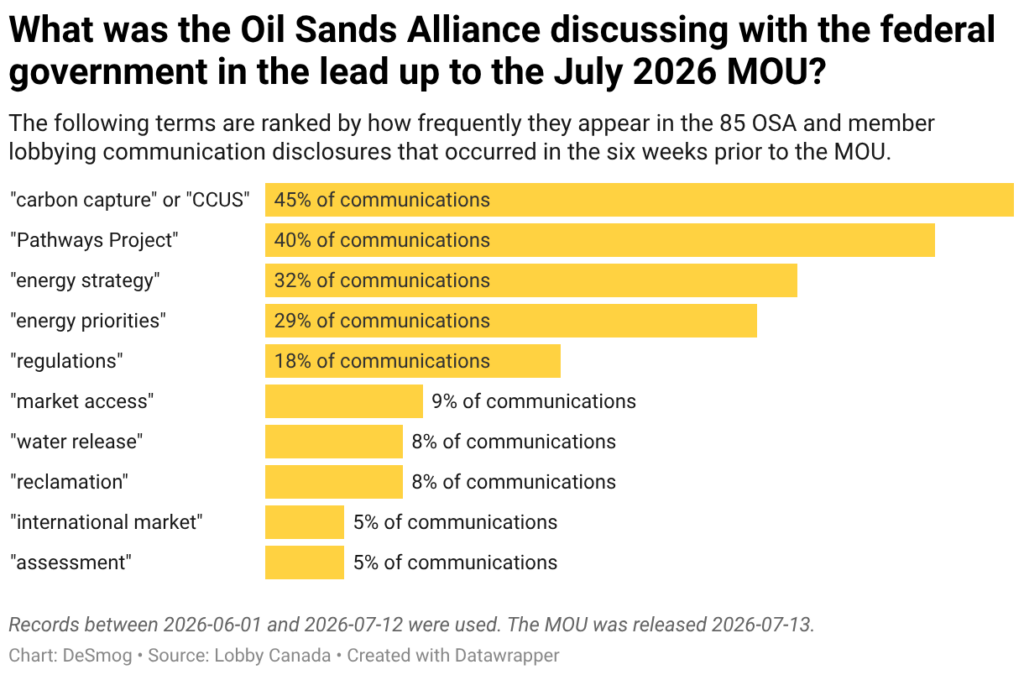
The latest flurry of oil patch lobbying reached a crescendo with 85 meetings in the six weeks before Carney finalized a July 2026 deal with Alberta and British Columbia to fast track a new bitumen pipeline to the west coast and to advance the Pathways carbon capture project. Media reports at the time documented how bitumen producers were backing away from funding their highly-hyped megaproject intended to clean up their production emissions.
“A group of oil sands companies pitched the Pathways project years ago, but has since soured on it, mainly because of the cost,” reported the Globe and Mail on June 26th. “One of the officials said Ottawa is open to further backstopping the multibillion-dollar project with pre-existing funds.” The July agreement included a commitment to extending more investment tax credits for carbon capture and storage, and to creating new tax credits for enhanced oil recovery. The federal government also designated the proposed pipeline to the west coast a project of national interest, and British Columbia was offered billions in taxpayer-funded infrastructure inducements in exchange for not opposing another bitumen pipeline and related risky tanker traffic.
This additional capitulation from the federal government for “further backstopping” of the long delayed and increasingly discredited Pathways project happened directly after the enormous lobbying effort launched by the OSA. Lobbying communication disclosures from the lead up to the government’s agreement with Alberta and BC show OSA and its members largely discussed the Pathways project, Canada’s “energy strategy,” and “energy priorities.”
Among the many meetings OSA members have booked with the Carney government, 80 encounters took place with Kelsen Vallee, Ottawa’s Major Project Office’s chief investment officer. The OSA also met 39 times with Jeff Labonté, the associate deputy minister of Natural Resources Canada.
While ordinary Canadians struggle with a cost of living crisis and diesel prices north of $2.50 per litre, Big Oil is being feted at the taxpayers’ expense by its friends within the highest levels of the federal government. Adding insult to injury around the unfolding Pathways boondoggle is the steadily declining utility of what was loudly billed by the fossil fuel sector as the largest carbon capture and storage projet dans le monde.
Pathways was originally hyped to reduce 68 million tonnes (MT) of bitumen production emissions a year, or three-quarters of the oil sands’ entire output. That dubious goal has since been quietly rolled back to 16 MT by 2050, a decline of 76 pour cent.
The first phase of the Pathways project was supposed to be completed by 2030 to store 22 MT per year, now revised down to 6 MT sometime after 2032. DeSmog attended the Carbon Capture Canada conference in Edmonton where Kendall Dilling, President of the Oil Sands Alliance, bravely characterized these massive decreases in emissions reduction promises as “slightly smaller.”
But why worry about actual results when you can pay for political influence? Environmental Defence documented over 1,300 lobbying meetings between the fossil fuel sector and the Carney government from May 2025 to April of this year. “Since becoming Prime Minister, Mark Carney has taken a wrecking ball to the country’s climate progress,” said Julia Levin, associate director of national climate at the environmental non-profit. “And it’s no wonder, given that fossil fuel lobbyists have been given unprecedented access to his government.”
Carney’s handpicked Minister of Natural Resources, Tim Hodgson, served on the board of MEG Energy from 2016 to 2019. MEG was a major bitumen producer and founding member of OSA before being bought out by Cenovus Energy in 2025. According to Environmental Defence, Hodgson was lobbied by the industry he formerly represented at least 83 times in the Carney government’s first year.
While the oil industry enjoys unprecedented access to elected power, its leadership basks in obscene war-related windfalls. DeSmog previously documented how Murray Edwards, the founder and executive chairman of Canadian Natural Resources Limited (CNRL) banked over $1 billion in additional personal wealth over an eight-month period from increases in CNLR stock value due the disastrous war with Iran.
Cash-strapped Canadians subsidize the fossil fuel industry at unprecedented levels as the climate crisis accelerates, and Big Oil enjoys a backstage pass to our political process.