
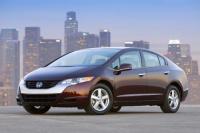
Honda Motor of Japan has launched the world’s first hydrogen-powered fuel-cell vehicle intended for mass production.
Although it will make just 200 of its FCX Clarity vehicles over the next three years, Honda plans eventually to increase production, especially as hydrogen filling stations become more common.
And even the small initial run represents progress toward a clean-burning technology many have rejected as too exotic and too expensive to gain wide acceptance.
“This is a must-have technology for the future of the earth,” said Honda president Takeo Fukui. “Honda will work hard to mainstream fuel-cell cars.”
Fuel cells have an advantage over electric cars, whose batteries take hours to recharge and use electricity, which, in the case of the United States, China and many other countries, is often produced by coal-burning power plants.
Honda says its version can be filled easily at a pump, can drive 280 miles on a tank and gets the equivalent of 74 miles per gallon of gas.
David Sanborn Scott, a Canadian engineer and scientist, told DeSmogBlog earlier this year that hydrogen, the simplest element in the universe, contains more energy per unit mass than any other chemical fuel – almost three times as much as gasoline.
In Scott’s view, hydrogen is key to breaking the addiction to fossil fuels. It can fly airplanes and propel cars, and its only waste product is water.
Said Scott: “Hydrogen is the colossal missing link between non-fossil power sources and big transportation.”
Kazuaki Umezu, head of Honda’s Automobile New Model Center, said the company can already mass produce the new vehicles: “We are waiting for the infrastructure to catch up.”