In my last post, I discussed how the increasing risk of devastating heat waves—unlike the worsening of tornadoes—is definitely a phenomenon we can link to global warming. And now, as summer plods on, it’s time to begin paying attention to another one: the continuing decline of Arctic sea ice.
The extent of ice covering the Arctic has been declining for decades, and reached a record low in September of 2007, nearly 40 percent below its long term average. This wasn’t solely the product of global warming—weather patterns also have a lot to do with ice extent, and they contributed to the 2007 record.
Nevertheless, much like the worsening of heat waves, Arctic ice decline is one of the most obvious impacts of global warming—and this year, it’s possible that Arctic ice extent might reach a minimum even lower than it did in 2007.
The annual Arctic sea ice minimum occurs sometime in September—that’s when the ice cover has received the most summer heat and shrunken accordingly, before beginning to build again as winter sets in. There’s a natural cycle of melt and freeze, but global warming is perturbing that cycle.
As I reported in New Scientist last year, the ice doesn’t simply rebound, during winter, back to where it was before. Rather, total ice volume has been declining, and most ice is now “first year” ice, rather than “multi-year” ice. In other words, it melts entirely in the summer, rather than surviving a full cycle and adding to its girth over years.
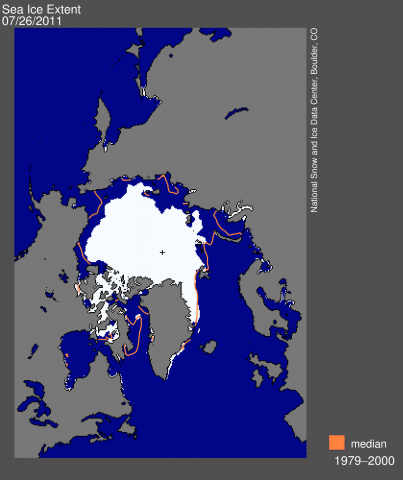
Which brings us to 2011: The National Snow and Ice Data Center, at the University of Colorado, is reporting that as of now, ice extent is even lower than where it was at this time of year in 2007, the record-breaker. The melt got an early start this year in many parts of the region, and has been going gangbusters ever since.
That doesn’t ensure there will be a record shattering: Weather patterns, the alignment of winds, and many other factors ultimately determine what happens with the ice and whether a record will be broken. But overall, you can bet Arctic ice extent will keep trending downward, breaking records regularly. The ice will also be losing volume steadily, and becoming “younger”: less and less of it will even be a year old.
Oh…and you can bet that deniers will have some way of explaining all of this. This year, they may have to start the rationalizations in just over a month.
Subscribe to our newsletter
Stay up to date with DeSmog news and alerts