
For those of us who care about global warming, 2006 and 2007 felt like pretty good years. Al Gore won the Nobel Peace Prize for An Inconvenient Truth, sharing it with the Intergovernmental Panel on Climate Change. Media attention to the issue soared, and it was positive attention. Given all the buzz, I—and many others—figured the problem was all but solved.
The next steps appeared deceptively simple. Elect Barack Obama, pass cap-and-trade, go to Copenhagen in the snowy winter of 2009 and take it global—or so I advised in Scientific American. I didn’t expect “ClimateGate,” or the dramatic consequences that an overseas non-scandal (for so I perceived it to be) could have for U.S. climate policy.
Nor did I imagine that virtually the entire Republican Party, rather than just some part of it, would come to reject climate science on this flimsy basis. I expected out-and-out climate change deniers like Oklahoma Senator James Inhofe to be further marginalized, not mainstreamed.
Needless to say, I now look back on all this and shake my head. Clearly, I–and many other people who felt the same way–was missing something rather big. We were far too optimistic in thinking that our governmental and media institutions were up for dealing with this type of problem.
Recently, a new book has helped bring the nature of their failure–and particularly the media’s failure–into sharp focus.
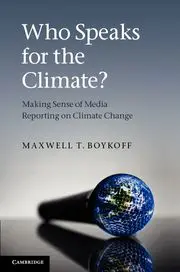
It’s University of Colorado media scholar Max Boykoff’s Who Speaks for the Climate: Making Sense of Media Reporting on Climate Change, and it points to a disturbing paradox. In an interview for this post, Boykoff summarized it to me like this: “The crux of the book is that while media coverage has increased on the issue of climate change, rather than greater clarity and consensus on what to do, there has been more confusion than ever.”
Indeed, Boykoff’s book presents data showing that 2009, not 2006-2007, represented the overall global peak of media attention to climate change. Much of that attention, however, was due to “ClimateGate.” And insofar as much of the media coverage out there is “balanced” or focused on doubt-mongering (particularly in the U.S. and the UK), there’s every reason to think it is doing more harm than good.
For a striking example of how media attention to climate change can actually hurt, just open Boykoff’s book to page 104:
….during the coverage of COP15 popular Fox News programme ‘The O’Reilly Factor’ pitted the comments of former US Vice-President Al Gore against those of former Alaska Governor Sarah Palin, with the segment title ‘The Climate Feud.’ Sarah Palin’s authority to speak on the climate derived from an opinion piece she wrote in the Washington Post the day before. In that piece, she confused and conflated weather and climate among other issues, where she opined, “While we recognize the occurrence of these natural, cyclical environmental trends, we can’t say with assurance that man’s activities cause weather changes. We can say, however, that any potential benefits of proposed emissions reduction policies are far outweighed by their economic costs.” These error-laden claims apparently passed editorial correction by the weight of her importance and personality-driven arguments.
In our interview, I asked Boykoff to discuss the role of Fox in particular. We have, after all, every reason to suspect that the station’s coverage of climate change actively causes its audience to be misinformed about the issue, rather than more engaged or better conversant with the science.
Here’s how Boykoff put it:
Fox is a sign of what’s to come. General assignment reporters commenting as experts on complex issues like climate science and climate policy. And opinion journalism taking the place of what had formerly been considered straight journalism.
Fox has, under the banner of fair and balanced journalism, infused these spaces with opinion…as viewership increases with Fox, and atrophies with other places like CNN, then this opinion journalism, and general assignment reporter stories will continue and perhaps flourish. That’s detrimental to gaining public attention and more accurate and effective public engagement with the public on this issue.
But Fox is just the most glaring example of the problem. The deepest issue, Boykoff explained, is that we’re using a “20th century media apparatus”—one whose journalists are focused on conflict, on chasing after the “new,” on “balance”—to tackle a “21st century problem”—climate change. The medium just isn’t adequate for conveying the appropriate message.
Why? Climate change isn’t an issue that we have the luxury to endlessly debate about, to hear “both sides” on, or to selectively attend to when it’s convenient. It is the issue of the century, if not the millennium.
But at the same time, you really won’t know that unless you are A) insulated from Fox-style misinformation; B) have enough perspective, scientific and otherwise, to see this issue in the context of the global human energy system, and ultimately, the planetary energy balance itself.
Needless to say, human beings who can tick off both box A and also box B are still far too scarce. And our media, overall, do little or nothing to create them. Indeed, our media are full of people who themselves are either misinformed, missing the broader perspective, or both.
Who, then, speaks for the climate? If you ask me, it’s too often journalists who not only don’t know what they’re talking about, but don’t feel that it’s part of their job description to do better. And that, really, is the essence of our problem.
To order Boykoff’s book, you can click here.