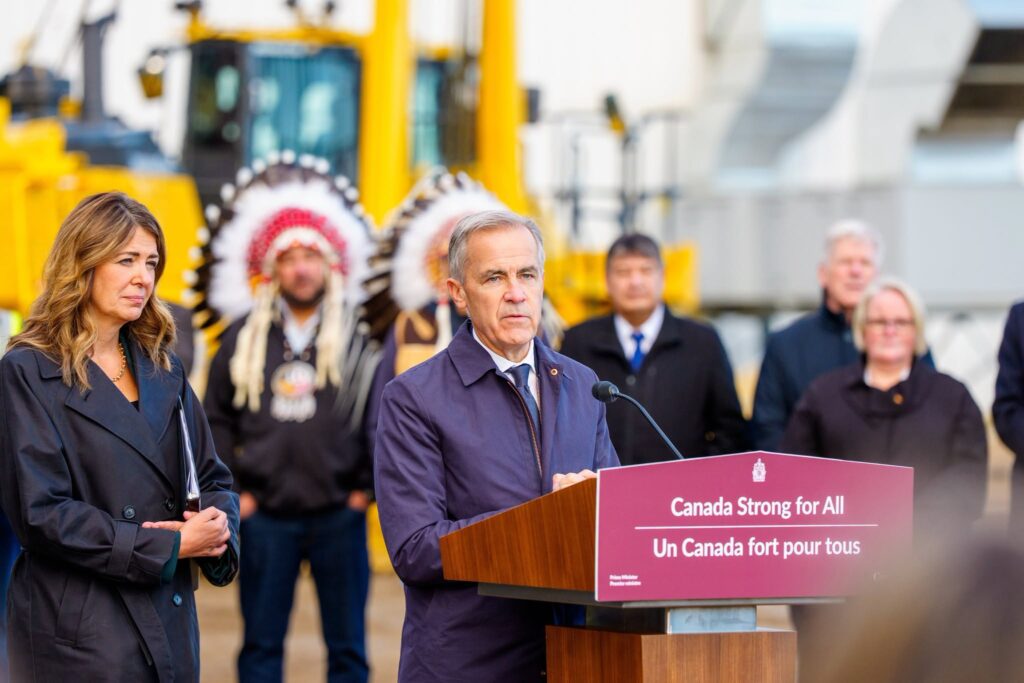

In mid-April, Indigenous leaders from British Columbia traveled to Ottawa to protest against the federal government’s aggressive support for fossil fuel expansion.
Mark Carney’s Liberal government is fast-tracking multiple LNG projects in British Columbia, including the recent approval of Enbridge’s $4 billion natural gas pipeline expansion.
Securing Indigenous support for fossil fuel projects has been a cornerstone strategy of Canada’s oil and gas sector in recent years, with companies promising considerable benefits on the one hand while highlighting Indigenous involvement as an aspect of corporate responsibility on the other.
Not everyone is on board however, and Indigenous communities have been some of the most vocal opponents of major Canadian energy projects, including Union of BC Indian Chiefs representative Kitisha Paul, who argued at the Ottawa protest that fossil fuel expansion is causing the “deterioration of our land, our water.”
Kai Nagata, an energy campaigner with the B.C.-based environmental non-profit Dogwood, has spent years working with Indigenous communities on the front-lines of opposition to new oil and gas infrastructure, a role that’s included deep research into the benefit agreements offered by industry as well as the foreign investors set to cash-in from new gas pipelines and export terminals. In an extensive Q&A with DeSmog, Nagata illuminates some of the tensions around promises of Indigenous participation in new fossil fuel projects, and the ways in which these supposedly “nation building” projects are tied to the U.S. and the MAGA movement.
This interview has been edited for length and clarity.
To what extent are Indigenous communities participating in the development of new fossil fuel infrastructure in British Columbia?
Coastal GasLink, a gas pipeline built across Northern BC, has zero percent Indigenous equity ownership. Sixty-five percent of the pipeline is owned by KKR, which is a New York private equity firm, and 35 percent remains with TC Energy Corporation.
The LNG Canada terminal in Kitimat has zero percent Indigenous ownership, as it’s owned by Royal Dutch Shell and a consortium of Asian oil companies, some of which are state-owned.
The financing for these projects came from U.S., Canadian, Japanese and some Chinese banks. So the investors, the shareholders, the owners, and indeed many of the senior project staff and people involved in engineering and building the thing are not even Canadian, let alone Indigenous.
The only LNG project that has Indigenous ownership right now in BC is Cedar LNG. So the Haisla Nation has a 50 percent stake in the terminal, but they’re buying the gas from Coastal GasLink, which is owned by KKR. And KKR also has a midstream infrastructure partnership with Pembina Pipelines, which is the Haisla’s partner on Cedar LNG. So they’re not outside the orbit of KKR by any means.
With Prince Rupert Gas Transmission pipeline (PRGT) or the Ksi Lisims project, which are being advanced by this Texas company [Western LNG] with Wall Street investors, they’ve really been at pains to make it seem like this is an Indigenous-owned project. That’s how it’s been pitched by the provincial government. And that’s just not true.
(Author’s note: filings with the BC Environmental assessment office show Western LNG is the primary owner and operator of the Ksi Lisims project).
Companies are riding this wave of concern over the poor treatment of Indigenous people historically in Canada and the need to make that up to them.They’re calling this ‘economic reconciliation’: here’s an opportunity for a small number of your governing elite to cash in, with hopefully some long-term benefits for the broader population on your reserve or in your nation.
Can you speak more to the kinds of agreements companies have signed with Indigenous communities?
Every deal is different, and they’re all secret. So that’s the first sign they might not stand up to scrutiny.
During the initial negotiations around the PRGT, which was back in 2014, you had band councils and hereditary chiefs signing impact benefit agreements. That was the same era as Coastal GasLink. Prior to that era of projects, the older model involved people from industry coming into Indigenous communities and saying “you people need to get out of the way now, the bulldozers are coming.”
Recognizing that that approach carried material risk for projects, the energy companies started crafting impact benefit agreements. They follow a similar template, basically an Indigenous community gets some limited financial benefits upfront. They get a promise of ongoing financial benefits, often very modest, but in return, they have clauses that are pretty draconian, like you have to prevent any of the members of your Indigenous group from speaking out against this industry or this project, and that can include on social media.
How do you get people to agree to that?
If your chief and council signs a closed-door deal with a pipeline company, it may contain clauses like your band members can’t shit talk this project on Facebook. That came out of a leaked benefit agreement that was signed with Coastal GasLink.
The chief and council weren’t sure if it was a good idea. So they put it out to a plebiscite and the community voted against it. Then they said there were ‘problems with the process’, so they took it to an in-camera vote. The council was split down the middle, so the chief himself passed the tie-breaking vote.
It actually came down to one guy—the band chief—after a democratic majority of band members rejected the deal. And the deal contained disparagement clauses. If community members disparaged the industry, the community could be held financially liable. I would characterize that as coercive. That’s not a deal anyone should sign. But when you have no leverage and when you’ve been dealing with the effects of poverty for 150 years, there’s a lot of immediate needs that these projects promise to fulfill.
Like what?
Kitselas First Nation recently signed an impact benefit agreement with Western LNG, the company developing the PRGT pipeline. They’re going to find some spaces for child care on the reserve, so that more people can go to work.
But childcare is a provincial responsibility. Except for First Nations. So you have a situation where they’re being deprived of services the non-Indigenous population receive from the provincial government, and are then forced to sign very one-sided deals with industrial projects to fund those basic social services.
You create a situation where it feels like a pretty good deal if the pipeline goes through and you get a little revenue and maybe some childcare too. Obviously you’re gonna take the deal where you get something instead of nothing.
What are the risks of pursuing these projects for Indigenous partners?
There’s some really big risks around LNG right now, like what’s happening in global markets in Asia and Europe. Who carries those risks? Which investors are first in line to be paid? Which creditors are first to line if things go wrong? You might be the last in line to recoup your investment depending on the structure of the deal.
The trend is that the lawyers and the industry consultants—the people who jump from project to project around the world and arrange these big financing deals—they get paid right away. They don’t stick around to build the project. And I’m concerned by the fact that this current crop of LNG projects are all backed by Wall Street, because Wall Street doesn’t know anything about building pipelines or operating energy infrastructure.
But they do know how to ride a bubble.
They know to make money into other money, and they know how ruthlessly exploit a dying industry. Don’t forget, what we call ‘private equity’ today used to be called ‘leveraged buyouts’. And that may sound high-minded and complicated financial stuff, but really it’s just the same core business it was 40 years ago: either you turn around a troubled asset, or you fire all the workers and sell off the parts.
Vulture capitalism is a key component of private equity.
What happens when Indigenous communities resist projects, like in the case of Wet’suwet’en Hereditary chiefs and land defenders opposing the Coastal GasLink project
Pipelines in particular come with a whole playbook and a set of actors which are very practiced in operating in conflict zones and sites of recent political or environmental upheaval.
The companies that are building PRGT include Bechtel, which is a major U.S. military contractor, and one of the biggest privately-owned companies in the world. They manufacture weapons, build defense installations, and they do oil and gas work in shall we say the ‘imperial borderlands’, contested spaces. They’re deeply integrated with the U.S. security state and with U.S. foreign policy. And they have a playbook for dealing with the ‘restive local tribes’ or any other local community that might give the Americans a hard time over their globe-spanning infrastructure.
We saw an example of this with the Wetʼsuwetʼen when they contested Coastal GasLink. The company that bought the pipeline, KKR, has its own internal intelligence division, which is run by David Petraeus, who’s the former CIA director and was prior to that a top-ranking general who literally wrote the U.S. Armed Forces manual on counterinsurgency warfare.
And if you read his book, you see there’s a lot of familiar tactics that we saw adapted to Northern BC. We saw veterans of the War on Terror step in and take control of a physical space in a way that was new to people covering Canadian resource extraction projects.
You had American, British, Belgian, South African mercenaries essentially working as private security for the pipeline who were really directing the actions and collecting intelligence and evidence for the police who just got called in to do the hands-on stuff and make the arrests.
I would characterize what we witnessed there as a corporate counter-insurgency.
Do you view Indigenous participation in new fossil fuel projects part of the marketing scheme or a guarantee against another Wetʼsuwetʼen crisis?
Both the federal and provincial levels of government are doing all they can to de-risk these projects and entice these very small communities with limited fiscal capacity to invest in these multi-billion dollar projects which include loan guarantees and other kind of bespoke deals around transmission line access and that kind of thing.
They’re bending over backwards to make these projects work because they know that [between the] combination of Indigenous ownership and the green branding around electrified LNG terminals, most people in Vancouver who see one news article will think “oh, a First Nation has decided to build a gas terminal in a place I’ve never visited. Sounds like they’re trying to protect the environment and it’s good to see native people get a stake in these projects after being on the sidelines for so long, good for them.”
In the case of the Haisla nation that has ownership over Cedar LNG, It’s up to them to determine whether these projects benefit their community, but we do need to consider how much information—and the quality of the information—the public, Indigenous or otherwise, has when making these decisions. In the small towns of Northern BC, there’s really no media scrutiny to speak of. The energy companies send their press releases to the local newspaper, the focus of which is how many jobs will be created, but there’s really no scrutiny of what the impact will be. And many of these decisions are happening behind closed doors anyways. We only find out the terms if they leak.
What was the calculus for investors in wanting to develop these projects?
Apollo Global Management invested in Western LNG and the development of the Ksi Lisims terminal back in 2018. They got in on the ground floor at a time when there were low LNG prices worldwide. There was a down cycle starting in about 2015, 2016, where we saw a huge wave of these projects get canceled because the markets weren’t there yet. The prices didn’t take off until Russia invaded Ukraine in 2022, and that’s what kicked off the current gold rush.
Some of these people had the idea of using an emerging technology—modular floating LNG terminals—as a way to both lower the risk and lower the cost. The floating terminals are basically converted LNG bulk carriers, which can be moved around the world and hooked up wherever they’re needed. Instead of building a massive onshore terminal, the floating terminals are built in Korea and they can be hooked up in series to expand capacity.
Apollo saw the potential in that, not just the export terminals, but there are equivalent facilities that are built on ships for the import of LNG, which Apollo also invested in, in the same year. They really saw the opportunity for vertical integration in emerging markets where people need access to reliable electricity. And this is the cheap modular way to do it.
Leon Black is the former CEO who made that call and who got Apollo Global Management to be the first major Wall Street backer of the Ksi Lisims project, and it’s the only project that Western LNG has ever developed. The company was incorporated in Delaware and headquartered in Texas, but it’s only ever existed to develop this project in BC.
You have talked about how the backers of the Ksi Lisims project are tied to the MAGA movement, can you tell me more about this?
Steve Schwartzman, who runs Blackstone, (the other major investor in this project) is a top-10 donor to Trump. He’s bankrolling the MAGA movement. He’s a major advisor and donor to Trump, who is steering and financing what I would characterize as like an authoritarian political movement that is taking over institutions in the U.S. and openly wants to annex Canada for its resources.
It puts the question of Indigenous ownership in perspective, given the players. I really don’t think that they have the best interests of local people in their minds as they’re structuring these deals. They’re not here on a charitable project. The reason why they would empower the companies that they’re invested in to strike these deals with local First Nations is to give them the kind of political cover they need to get permits and authorizations and the loans.