

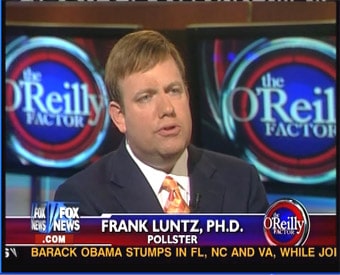
Frank Luntz, an expert cherished equally by Fox News and the Republican Party, has just released a new poll showing bipartisan support for climate legislation that would promote energy independence and protect the environment.
The poll is important in its own right: it confirms that Americans are thoughtful and concerned about energy security, climate and the environment, and that the Republican Party’s ideologically driven opposition to climate legislation is out of step.
But the subtext is even more fascinating: here you have a poll, sponsored by the Environmental Defence Fund and executed by an ideological darling of the American right – someone who has been incredibly effective at coaching Republican politicians to mislead, distract or dissemble on environmental issues. It is an unlikely professional relationship – and therefore a surprisingly credible one.
It’s been clear from some of Luntz’s more recent comments that he was trying to rehabilitate his reputation as someone who understood climate science and cared about accuracy. He has been quoted saying that doubt was still a reality in the American conversation in 2002, but that it is no longer defensible today.
Still, given the choices that EDF would have had in choosing a firm experienced in climate change polling, it was an interesting decision to engage Luntz. If they made that call because Luntz’s work is more immediately credible to the Republican demographic, it was sgtrategically clever. And if Luntz himself is forced to further moderate his position – on the strength of research results that he gathered himself – all the better.
Finally, anything that bleeds the partisanship out of the climate conversation is a good thing. If the environmental movement also discovers a route to more effective communications – by taking note, for example, that many Americans are more responsive to a discussion about security than they are about a distant climate threat, well, that’s good, too.As long as the end result is better policy, the justification for that policy can come from any point on the political spectrum and any number of compelling and ultimately relevant factors.