In mid December, you may recall, Media Matters exposed an email from Fox News editor Bill Sammon instructing his reporters to “refrain from asserting that the planet has warmed (or cooled) in any given period without IMMEDIATELY pointing out that such theories are based upon data that critics have called into question.” It was no surprise that Fox was guilty of misrepresenting the science on climate change—anyone who has watched the channel cover the subject has seen this—but it was nevertheless appalling to find the goal so blatantly stated.
But there’s been less discussion of a finding that closely accompanied this revelation. In a survey late last year, Stanford political psychologist Jon Krosnick found that more frequent Fox viewers were significantly less likely to trust climate science and climate scientists than those who don’t watch the channel, or who watch it less.
We don’t know, based solely on this reported association, what kind of causal chain we’re dealing with here, or if there even is one. It’s possible that watching Fox makes people doubt, but it’s also possible that those who doubt anyway gravitate to Fox, an ideologically congenial news outlet for them.
However, it strikes me as pretty likely that at least in part, the coverage is driving the skepticism. Indeed, still more research by Krosnick backs up this idea.
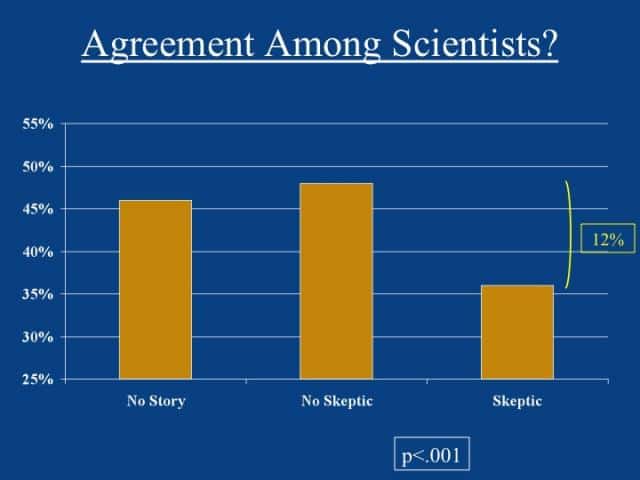
In a 2009 experiment, Krosnick showed study subjects a series of videos about climate change– two in which a mainstream scientist discusses global warming’s existence and two in which a mainstream scientist discusses its effects. Then, in the case of one video but not the other for each pair, an interview with a climate skeptic was included at the end. Very simple study design, and results unequivocal: Those who saw the skeptic were less likely to think scientists agree about global warming, less likely to want the problem addressed, etc. (See the figure accompanying this post for one of the results.)
Need I add that Fox features a lot of skeptics?
Going back half a decade or more, I’ve been criticizing media “balance” on scientific topics where there is a strong consensus within the scientific world itself. And I’m hardly the only one: It was the concerns of scientists that made me want to write about this problem in the first place in Columbia Journalism Review.
Ever since then, I’ve taken it for granted that misleadingly “balanced” media coverage of climate change leads viewers to be less accepting of the mainstream scientific consensus. And that was certainly a reasonable assumption–but it’s fair to say that based on the research discussed above, it’s more reasonable than ever.
Sad to say, when it comes to the misinformation environment out there, our longstanding fears seem more than justified.