
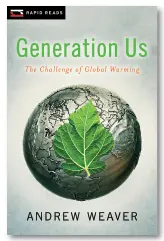
Canadian readers should keep an eye out for Generation Us, a tiny climate change primer by University of Victoria Professor Andrew Weaver, the Canada Research Chair in Climate Modelling and Analysis.
Subtitled The Challenge of Global Warming, Generation Us is like a climate change CliffNotes. Published by Raven Books as part of a “Rapid Reads” series, this is a short, succinct, clear and readable rendering of the science – followed by a passionate appeal for us all to move from “Generation Me” (which really seems to have outlasted its stylishness) to Generation Us, in which we start taking seriously the opportunity we have to mitigate the climate damage that we have already inflicted on future generations.
Actually, if you’re looking for an informed tour through the science, I might recommend Weaver’s earlier book even more highly. In Keeping Our Cool, Weaver drilled down into the topic a bit more thoroughly, even explaining precisely how scientists such as Lonnie Thompson torture 650,000-year-old oxygen isotopes to get them to admit what the temperature was on the year they were frozen into the Antarctic plains.
But for someone coming to this topic without any science background, GenUs is a perfect introduction – and as such is an important addition to the climate library.