
The fossil fuel industry continues to use a long list of deceptive tactics to conceal environmental destruction that harms Black, Indigenous, and People of Color (BIPOC) and low-income communities.
That’s the top finding of a newly released NAACP report titled “Fossil Fuel Foolery.” The report identifies 10 tactics that polluters, industry lobbyists, and politicians often deploy to deflect accountability for the impacts of fossil fuel production and pollution on the environment and human health.
This report updates material on fossil fuel industry influence tactics that the NAACP published in 2019.
Many of the industry’s tactics are familiar, such as obscuring or denying the true effects of pollution. In one glaring instance, a firm named Mobile Gas did not report a 2008 Alabama spill of tert-butyl mercaptan, a chemical that is mixed with natural gas to give it an odor that can help with detecting leaks. The spill probably contributed to respiratory ailments and other health problems affecting nearby residents of a mostly Black and working-class community. Years later, Mobile Gas maintained that the amount spilled was “safe.”
Another top-ten industry tactic identified by the NAACP is to “co-opt community leaders and organizations and misrepresent the interests and opinions of communities,” sometimes with financial support, to “neutralize or weaken public opposition.”
Utilities have lavished donations on churches, nonprofits, and advocacy organizations to obtain local community buy-in on pollution-generating projects, or to stifle the push towards renewable energy. In a situation that directly affected the NAACP itself, the utility Florida Power & Light donated roughly $225,000 to the group’s Florida state chapter between 2013 and 2017. The donations alarmed the national organization when the Florida chapter began repeating industry talking points against the growth of solar energy in the state, and helped spur the NAACP’s initial 2019 report.
Fossil fuel companies and their allies also try to shift blame onto the very communities affected by pollution to distract from the impact of industry operations, the NAACP found.
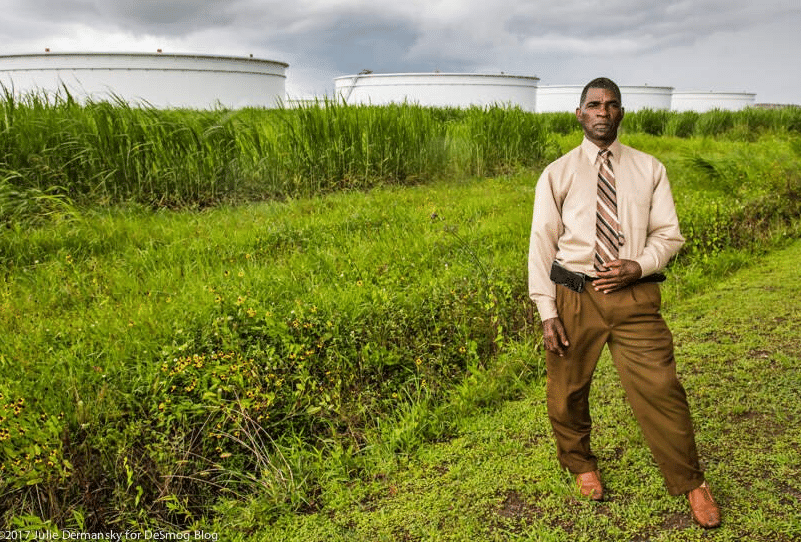
In February, when President Joe Biden brought attention to Louisiana’s “Cancer Alley,” a stretch of petrochemical facilities between Baton Rouge and New Orleans that dump enormous volumes of toxic pollution onto predominantly Black communities, Louisiana Sen. Bill Cassidy (R) criticized the comment as a “slam.”
After United Nations human rights officials issued a statement in March calling ”the development of petrochemical complexes” in the region “a form of environmental racism,” Cassidy — who received roughly $600,000 in campaign contributions from the oil and gas industry during the 2020 election cycle — pointed to cigarette smoking and obesity among the local population as possible causes of cancer, rather than the region’s rampant industrial pollution.
Other tactics documented by the NAACP involve much broader assaults on civil rights and democracy. Many oil, gas, and coal companies have funded conservative lobby groups such as the American Legislative Exchange Council (ALEC), which promotes corporate interests in state legislature. ALEC-backed bills identifying fossil fuel facilities as “critical infrastructure” have proliferated in recent years, imposing harsh fines and prison sentences on environmental protesters. ALEC has also pushed anti-voting-rights legislation at state capitols around the country.
The NAACP’s report also suggests 10 strategies to help communities counter deceptive tactics deployed by the oil and gas industry. These range from local political organizing to taking legal action and pushing for campaign finance reform. The group also recommends speeding up the nation’s shift from oil, gas, and coal to clean energy.
“I have read the report and believe it is a must-read for any group or organization engaged in environmental/climate work, especially in or around black, brown and indigenous communities,” Heather McTeer Toney, an Obama-era southeast regional administrator for the U.S. Environmental Protection Agency, told DeSmog in an email. Toney now directs national political organizing for the activist group Moms Clean Air Force.
Communities of color suffer disproportionately from the pollution wrought by fossil fuel and petrochemical production and use, as DeSmog has reported, and are also on the frontline of the impacts of climate change. There is also a long history of white supremacy within the oil and gas industry.
“We have tried various fossil fuel pathways and have met a ‘dead end.’ We have no choice but to try another approach,” the NAACP states in its report. “As a result, transitioning to a new energy economy is the only real solution to provide purposeful, actionable change to revive communities for thriving, sustainable futures.”