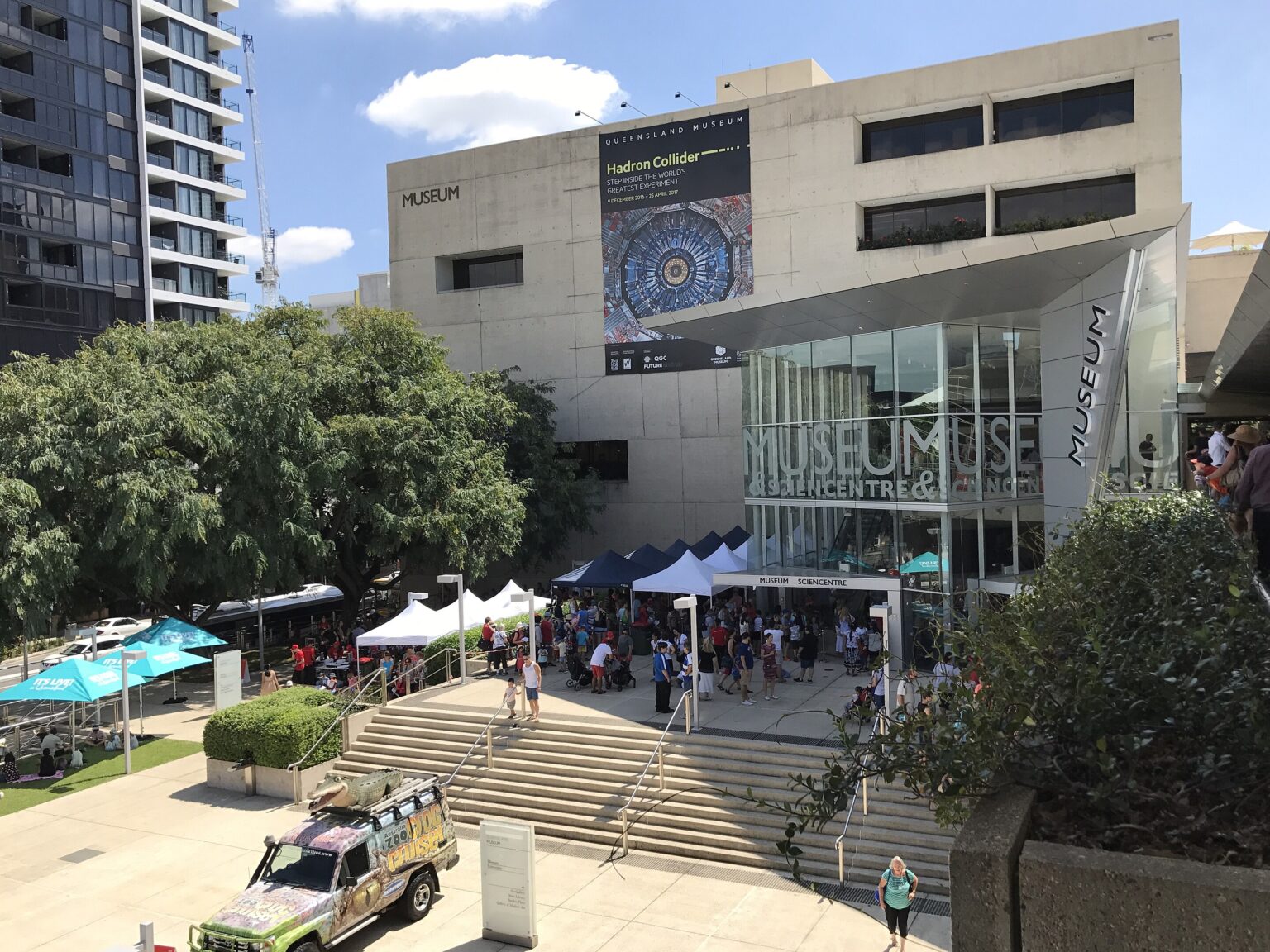
Shell QGC, one of Australia’s largest gas and coal companies, has paid the Queensland Museum in Brisbane 10.25 million Australian dollars (US$6.94 million) since 2015 to fund educational programmes — aimed at school children as young as nine years old — that fail to clearly identify fossil fuels as the primary cause of climate change.
Materials created for the programme, which include lesson plans, learning activities, and design challenges “give a one-sided view of the energy future by downplaying the role of fossil fuels in driving climate change,” said Belinda Noble, founder of Comms Declare, an Australian climate advocacy group.
Comms Declare has released a new analysis highlighting dozens of instances where the materials are misleading, such as promoting “false climate solutions such as carbon capture,” Noble said. “They also falsely position gas companies as part of the solution to climate change and tell kids that fossil fuels are compatible with a safe climate, which is simply untrue.”
The materials have been downloaded more than 400,000 times over the past decade according to the museum.
The partnership may breach the Queensland Museum Act, which requires the museum to provide “leadership and excellence” in communicating the state’s natural heritage, according to a legal analysis commissioned by Comms Declare from Environmental Defenders Office, Australia’s largest environmental legal centre.
The extent of the funding came to light in correspondence between Queensland Museum and Comms Declare and seen by DeSmog.
Michael Berkman, Green MP for Maiwar in the state of Queensland, said the partnership amounts to marketing for a polluter.
“The Queensland Museum is basically running a marketing campaign for a fossil fuel company whose operations are directly responsible for wrecking the Great Barrier Reef and destroying cultural heritage in the Torres Strait,” said Berkman.
In response to the legal analysis, released in September by Comms Declare, the Greens have called call on Queensland Arts Minister John-Paul Langbroek to intervene and end the Queensland Museum’s partnership with Shell QGC.
During questioning at a September session of Parliament, Langbroek told Berkman he hadn’t read the Environmental Defenders Office’s legal advice, despite confirmation from his office that it had been received. Langbroek called the link between Shell QGC’s emissions and the partnership’s legality “a specious line”.
Queensland Museum and Arts Minister Langbroek did not respond to requests for comment. Shell QGC declined to comment.
‘Learning Resource’
According to the Environmental Defenders Office the partnership may have put the Queensland Museum in direct contravention of its guiding principle under the state’s 1970 Museums Act, which states that “leadership and excellence should be provided in the preservation, research and communication of Queensland’s cultural and natural heritage.”
The group told Comms Declare that the partnership is “inconsistent with the objectives of the Queensland Museum” because greenhouse gas emissions from Shell QGC’s operations “are having direct impacts on Queensland’s natural heritage” through climate change, and on Torres Strait Islander cultural heritage due to sea level rise.
Some of Shell QGC’s funding has gone to a “Future Makers” programme that aims to “increase students’ uptake of and performance in STEM-related subjects and careers, and inspire teachers with curriculum-aligned learning resources and strategies to increase confidence delivering STEM activities in the classroom”, according to the museum’s website.
The programme’s offerings have ranged from science festivals and other events for children, to professional development for teachers.
Shell QGC sponsors the World Science Festival Queensland, an annual event for local students between 10 and 16 years old. The festival features mini-exhibitions of childrens’ inventions, which are submitted via the Future Makers STEM Inventor Challenge, also sponsored by Shell QGC.
The “Future Makers” programme offers free professional development workshops for teachers as well as self-taught online courses, and provides Shell QGC-branded teaching materials based on the museum’s collections and linking back to the curriculum taught in Australian schools.
These materials, which are targeted at educators as well as parents and carers, according to the museum’s website, are available for download from the “Learning Resource” section of the museum’s website. Shell QGC’s logo appears on the front page of every resource, alongside the Queensland Museum and Queensland Government logos, with a description of the partnership repeated throughout: “Future Makers is an innovative partnership between Queensland Museum Network and Shell’s QGC project aiming to increase awareness and understanding of the value of science, technology, engineering and maths (STEM) education and skills in Queensland.”
Young Minds
Comms Declare found that the branded materials present a biased and incomplete picture of climate science.
In one learning module called “Changing Climates, Changing Waters,” rising seas and extreme temperatures are presented as something to adapt to, with no mention of transitioning away from fossil fuels.
Another module “Introduction to Ocean Acidification,” aimed at 14 to 16-year-olds, teaches students about the chemistry of CO2 absorption in the ocean and the impacts of ocean acidification on marine life. Although the materials never explain the role of fossil fuels in ocean acidification, children are tasked with designing carbon capture and storage devices.
In the “States of Matter: Our Warming World,” module pamphlet for children aged eight to 13, the sole mention of fossil fuels is buried in a teacher’s note: “It is recommended that you conclude this activity with a discussion about how individuals, the local community, Australia and the international community are reducing their reliance on fossil fuels and combatting climate change. This can demonstrate that we are working together to address climate change, thus mitigating future warming.”
Queensland Museum CEO Jim Thompson defended the sponsorship in an October letter to Comms Declare.
“[The programmes] are designed to foster critical thinking, evidence-based learning, and engagement with Queensland’s natural history,” Thompson wrote. “Partnerships are structured to support these objectives without influencing scientific content, priorities, or public messaging.”
Thompson told Comms Declare that the museum receives 70 per cent of its approximately AUD 62 million annual budget from the Queensland Government — more than AUD 43 million per year, according to the museum’s most recent annual report — and that it needs corporate sponsorship to “supplement this funding.” He said the museum’s board did “comprehensive due diligence and risk assessment” before approving the Shell QGC partnership, and concluded that “the benefits significantly outweigh any risks.”
Thompson highlighted that the Shell QGC-sponsored learning materials have been downloaded over 400,000 times, while 1,700 teachers have received professional development, and 10,000 students have participated in events through partnership.
Shaping Opinion
The Queensland Museum’s partnership with Shell QGC fits a documented pattern of fossil fuel companies using cultural and educational sponsorships to influence public perception while lobbying against climate policies.
Internal documents subpoenaed by a 2024 U.S. Congressional investigation into climate disinformation from Shell, BP, Chevron, and the American Petroleum Institute revealed how oil giants have used sponsorships to cultivate “nontraditional local allies,” ward off climate regulations, and build networks of “third-party advocates,” DeSmog reported in May this year.
Green MP Berkman is concerned that political donations from fossil fuel companies could be influencing government decision-making on fossil fuel funding and donations to public institutions. “The Queensland Museums Act should ensure that this kind of partnership with fossil fuel companies doesn’t happen, and it’s incumbent on any government — LNP or Labor — to make sure the Act is followed,” he said. “Yet with the LNP and Labor both taking millions of dollars in fossil fuel donations, it’s no surprise that the Queensland Government is unwilling to act.”
Noble placed the the Queensland Museum-Shell QGC partnership within a broader pattern of fossil fuel influence in Queensland.
“Queensland’s media and politics are largely awash in fossil fuel influence,” she said. “We were outraged that a trusted government and educational institution was also subject to influence from polluting companies.”
Tobacco-style Ban?
In 2023, The Guardian Australia identified 535 similar deals between fossil fuel companies and Australian cultural institutions.
Australian oil giant Woodside alone had 56 sponsorships, ranging from the Western Australia Symphony Orchestra and Western Australia Ballet, to the Surf Life Saving WA “Nippers” programme, where children as young as five years old sport the company logo on their T-shirts.
Australian oil and gas company Santos sponsored a school science roadshow, while the oil giant Chevron held naming rights for the Perth City to Surf fun run.
A growing number of Australian organisations are rejecting fossil fuel money. In 2023, Australian Cricket ended its partnership with the gas company Alinta Energy. In 2022, Australian Tennis ended its partnership with Santos, and in the same year the Darwin Festival and Perth Festival dropped their partnerships with Santos and Chevron respectively.
Polling from the Australia Institute found 53 percent of Australians support a ban on fossil fuel sponsorships of national sporting teams, while 60 per cent liken such sponsorships to tobacco advertising.