


The Alberta electricity company Capital Power, which is developing a large new AI data centre in the province powered by natural gas, lobbied the federal Mark Carney government dozens of times last year to eliminate clean energy regulations, DeSmog has learned.
These regulations were subsequently dropped from a fossil fuel accord that the prime minister signed with the government of Alberta last November, allowing large new data centres fuelled by gas turbines to proceed.
“We’ve got a new paradigm that allows us to look at growth capital” for Canadian gas-powered AI projects, Capital Power CEO Avik Dey said in reaction to the Carney government announcing it would suspend the regulations.
The Edmonton-based power company communicated with the government of Canadian Prime Minister Mark Carney close to 40 times between the time Carney was elected in April 2025, and the signing of the Canada-Alberta Memorandum of Understanding (MOU), in November 2025, according to federal lobbying records analyzed by DeSmog.
The MOU is an agreement between Canada’s federal government and that of the Province of Alberta wherein the federal government agreed in principle to support a new oil pipeline to the Pacific Coast, as well as special treatment for the province on a range of federal government climate policies.
The MOU lists increasing oil production in Alberta as its first objective, while also suspending Alberta’s Clean Electricity Regulations and eliminating the Oil and Gas Emissions Cap. The same agreement also proposed the development of AI data centres in Alberta, a potential new use for the province’s considerable gas resources.
That agreement has been widely criticized by environmentalists and Indigenous communities.
The term ‘data centre’ appears at least 25 times in notes from Capital Power’s interactions with the federal government, while the term ‘emissions’ appears 17 times, and ‘clean energy regulations’ and ‘net zero’ appear each at least 14 times.
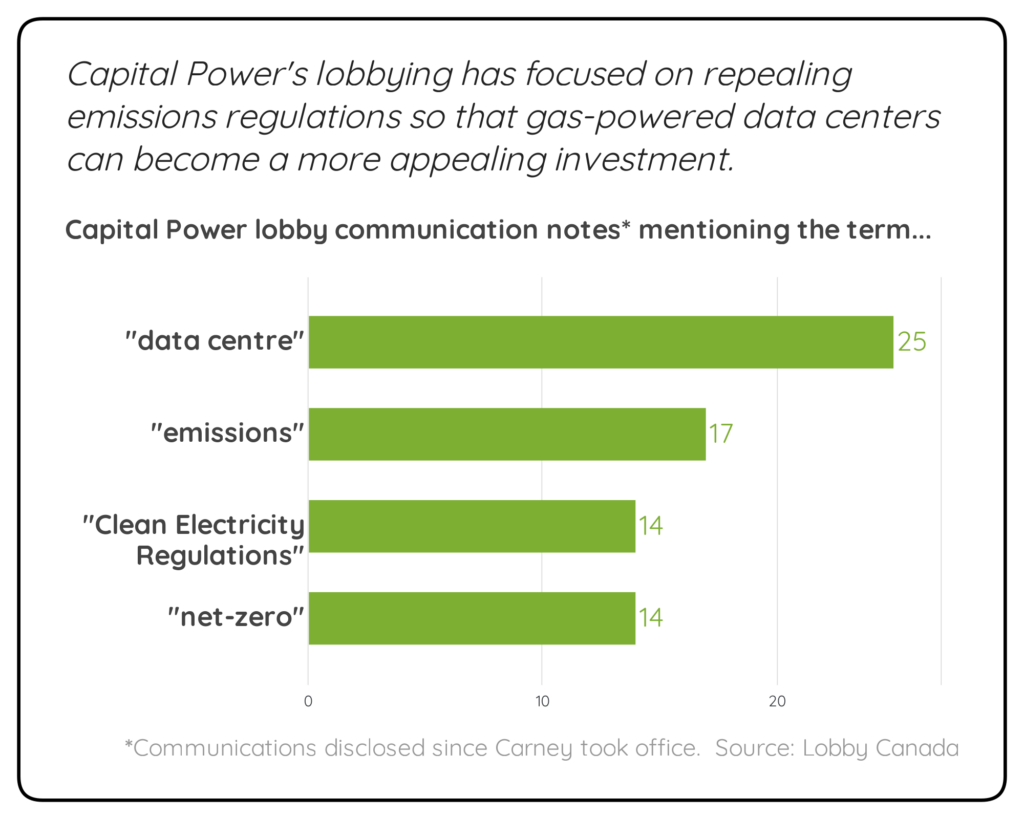
Records show the company has advocated specifically for the development of gas-fired power plants, policies and programs related to the development of AI data centres, and “the energy source(s) required for those data centres to be successful.”
Environment and Climate Change Canada press secretary Keean Nembhard wrote in an emailed statement to DeSmog that the government’s clean energy regulations continue “to apply in all provinces and territories and will require electricity-generating units to achieve net-zero emissions by 2050.”
However, Nembhard added, “data centres with their own power generation, not connected to the commercial grid, would not be covered by the [regulation].”
Capital Power didn’t respond to a request for comment.
Capital Power’s Effective Lobbying
Federal clean energy regulations, which aimed to kickstart the energy transition by mandating a reduction in greenhouse gas emissions from fossil fuel power generation by 2035, were developed under the previous Liberal government of Justin Trudeau. Nembhard confirmed that Capital Power Corporation, one of Alberta’s largest energy generators, was included in that process.
“Over a two-year period from 2022-2024, our government undertook extensive engagement with provincial and territorial governments, industry, such as Capital Power, utilities and others,” Nembhard explained.
But Capital Power wasn’t necessarily happy with the regulations. In November 2023, the company blamed the Trudeau government’s environmental regulations for why it wasn’t pursuing any new gas-fired power plants. At the time, Capital Power’s CEO said Trudeau’s then-proposed clean electricity regulations had made investments in gas plants “unviable”. As a result, Dey later explained, Capital Power turned its attention towards expansion in the United States.
Lobbying records show that Capital Power communicated twelve times on record with the federal government in the last year of former Prime Minister Justin Trudeau’s term in office.
But after Carney took office, the company’s lobbying seemed to accelerate. In total, Capital Power communicated with the Carney government 37 times from when Carney took office until the time the MOU was announced.
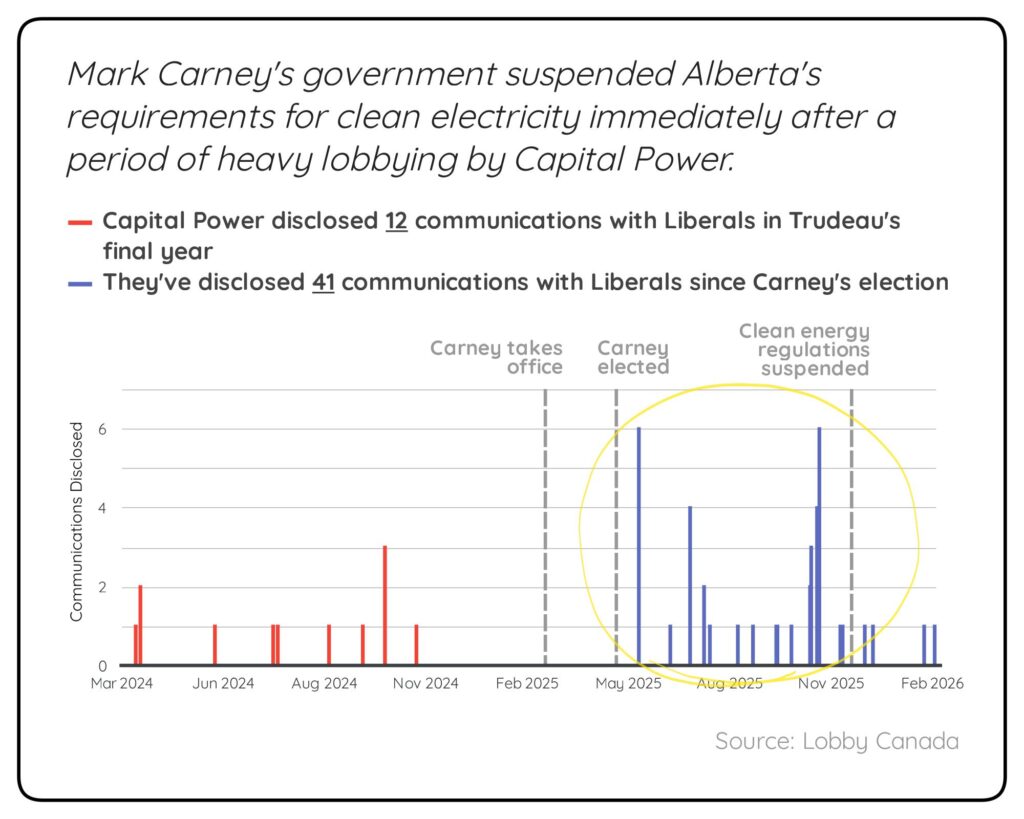
Duff Conacher, director of Democracy Watch, a Canadian corporate responsibility watchdog group, notes that because of Canada’s lax lobbying laws, it’s possible the actual number of times Capital Power lobbied the Carney government was much higher.
“Many lobbyists are not required to disclose their lobbying,” said Conacher in a statement to DeSmog. “At the federal level, disclosure is not required if a company is lobbying about the enforcement of a law or regulation, or if the lobbyist is working as an employee for a business and lobbying less than 20 percent of their work time, or if the lobbyist is not paid for the lobbying.
“Other loopholes in the requirements mean that letters, emails, texts and other communications are not required to be disclosed,” he added.
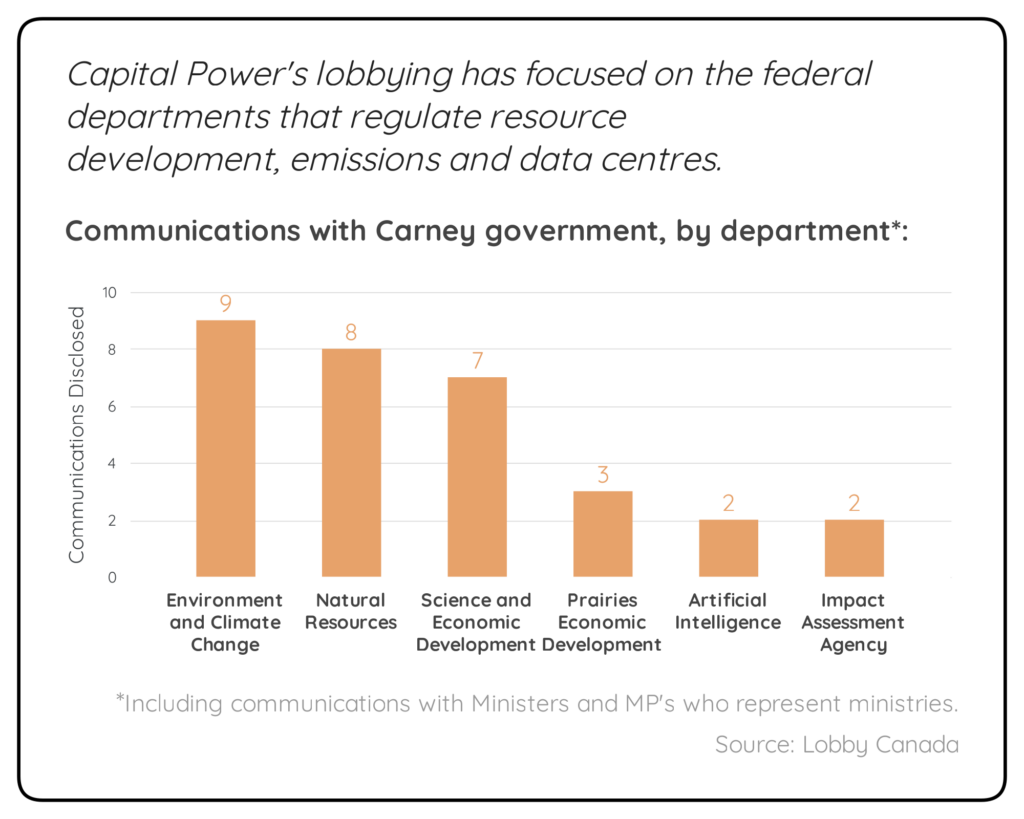
The company’s lobbying of the Carney government, including multiple instances of communication between Dey and Environment Minister Julie Dabrusin, focused on developing new gas-fired power plants, federal climate policies, the Clean Electricity Regulations, and the development of large data centres in Canada. In addition, Capital Power’s lobbying effort focused on the federal ministries that regulate resource development, data centres, and emissions. Environment and Climate Change Canada was lobbied nine times while Natural Resources Canada was lobbied eight times.
Twelve days after Carney signed the MOU, Dey was interviewed by Bloomberg saying that because Carney relaxed environmental regulations, it was now possible to build new gas-fired power plants to support AI data centres.
The next day — December 10, 2025 — the Globe and Mail reported Capital Power had signed its own binding memorandum of understanding to supply an unnamed AI data centre developer with 250 megawatts of electricity. The Canada-Alberta MOU “paved the way” to lock in long-term contracts for AI- data centre related gas-generation, the paper reported.
Cashing In On An AI Gas Boom
Prior to his appointment as chief executive of Capital Power, Dey worked for the Canada Pension Plan Investment Board (CPPIB), where he served as Managing Director, Head of Energy & Resources. As previously reported by DeSmog, the CPPIB is heavily invested in the development of fossil fuels in the United States, particularly as new power sources to power new AI infrastructure.
The AI boom is itself driving a massive development of gas power generation: over 1,000 gigawatts worldwide, a quarter of which is in the United States. Though AI data centres can be powered by any form of electricity, the gas industry has marketed gas power as cheap, efficient, and reliable.
The environmental and public health consequences of the gas-powered AI data centre build-out are enormous, however. A recent Cornell University study reveals that, at the current rate of growth, AI will add 24 to 44 million metric tons of carbon dioxide into the atmosphere, the equivalent of adding between 5 and 10 million cars to U.S. roadways.
Experts have been warning for some time that the AI build-out — supported by U.S. President Donald Trump as much as Carney and Alberta Premier Danielle Smith — will severely compromise climate change goals and entrench fossil fuel use for another generation.
Yet Nembhard insisted that the Carney government is still committed to achieving “a net-zero electricity grid by 2050” in Alberta and across the country. Federal policymakers will only suspend the application of clean energy regulations in Alberta
“Upon completion of a new carbon pricing agreement and factoring all other measures to the satisfaction of both parties, including on net zero electricity and pursuant to an equivalency agreement.”
Yet this isn’t the first time that the Carney government has taken policy cues from the fossil fuel and AI sectors. Last October, the prime minister directly referenced in a speech the organization Build Canada, which is led by and associated with tech and oil and gas billionaires.
“It’s great to see ideas shared by the Build Canada community get taken up by government,” a spokesperson explained to DeSmog at the time.