


This piece is co-published by DeSmogand ExxonKnews. ExxonKnews is a reporting project of the Center for Climate Integrity.
Major oil and gas lobby groups are leveraging energy shortages during the U.S. and Israel’s war on Iran to call on the European Union to pause its regulations on methane, a powerful climate pollutant. If successful, the delay could help pave the way for a marked expansion of fossil fuel infrastructure across the United States.
Two industry groups, the International Association of Oil and Gas Producers (IOGP) and Fuels Europe, urged policymakers earlier this month to stop the next phases of the law’s implementation until “targeted adjustments” could be made. The groups cited a Wood Mackenzie study commissioned by IOGP that found up to 43% of U.S. gas imports could fail to meet the law’s standards.
“The EU cannot afford a self-made regulatory supply shock, even more so in the current geopolitical context,” said François-Régis Mouton de Lostalot, managing director of IOGP Europe, whose member companies include Chevron, Exxon, Shell, and BP, in a statement.
The U.S. is the world’s largest exporter of liquid natural gas (LNG), and oil and gas companies and their trade groups have spent years lobbying to weaken the EU’s methane law in the name of energy security concerns. Now, attacks on gas infrastructure in the Middle East and spiking energy shortages in Europe add urgency to the industry’s push.
As U.S. gas companies are poised to reap windfall profits from the war, communities around the world are caught in the fray. Many proposed LNG projects in the U.S. — from Louisiana to Texas to Pennsylvania — are waiting on final investment decisions, and increased demand from the EU could be a deciding factor. While new capacity might not come online in time to solve Europe’s new energy shortages, environmental advocates say the potential boost in LNG projects in the U.S. will have a lasting impact on the health of nearby residents, pocketbooks, and the global climate.
As it stands, the EU’s law imposes new requirements on imported gas beginning in 2027, making it more difficult to sell highly polluting U.S. gas projects.
The oil and gas industry “loves crises from an economic standpoint, but also to force policy changes,” said Justin Mikulka, an energy industry analyst and communications director at the environmental watchdog group, Oilfield Witness. The global economics of the LNG market do not support investing in more U.S. gas exports, “so this is an emergency situation for them.”
U.S. Advocates Appeal to the EU
Scientists say reining in methane emissions from gas operations is essential to avoid the most disastrous consequences of climate change. Despite the industry’s attempts to sell LNG as “green” and climate-friendly, its greenhouse gas footprint is 33 percent greater than coal in the short-term, according to a peer-reviewed study by Robert Howarth, an environmental scientist at Cornell University.
“Politicians and the industry talk about it as if the gas magically moves from the U.S. to Europe or to Bangladesh or wherever it’s going,” said Howarth, who documented the emissions associated with the process of transporting, producing, liquefying, and shipping U.S. gas.
Europe’s methane law requires imported gas to comply with its measurement, reporting, and verification requirements, as well as with requirements to mitigate emissions from leaks and flares. But U.S. LNG exports are so energy-intensive and polluting that experts think they are unlikely to ever meet the EU’s requirements.
“It’s kind of hard to wrap your head around how much [methane] is escaping at these LNG terminals,” Sharon Wilson of Oilfield Witness, who tracks emissions from oil and gas facilities in Texas and across the country, told DeSmog and ExxonKnews. Venting and flaring methane are routine at every stage of gas production in the U.S., and methane emissions are drastically underreported by the industry’s own accounts. Wilson said she hoped European policymakers would come see the process through her optical gas imaging camera for themselves.
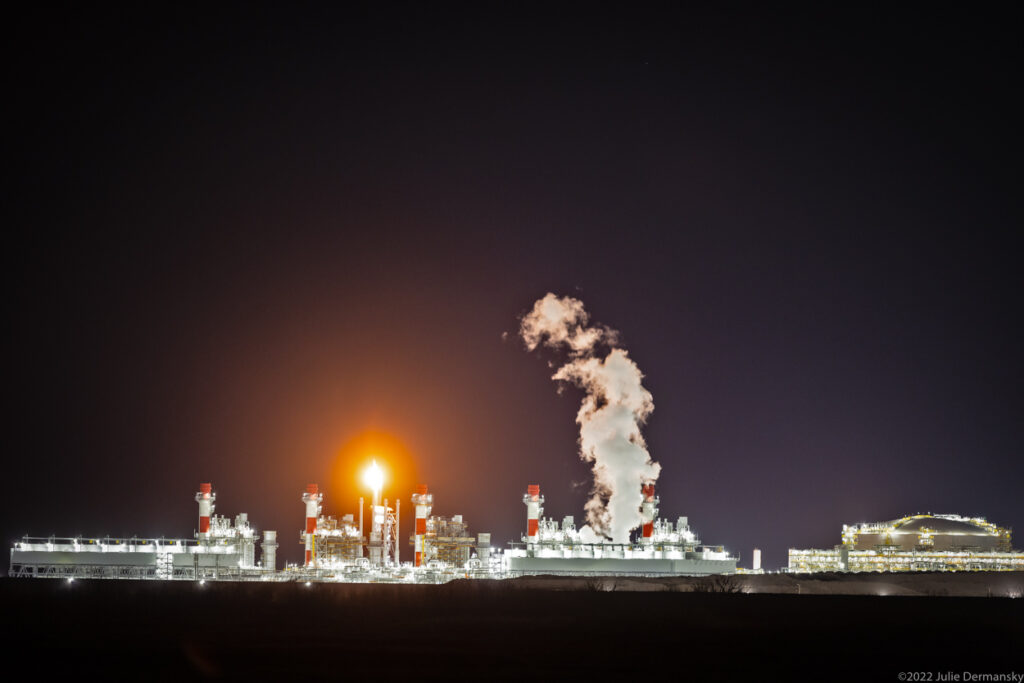
As the Trump administration works to unravel greenhouse gas regulation entirely, communities have been left vulnerable to intensifying climate disasters and the local health impacts of expanding fossil fuel infrastructure.
In Pennsylvania, gas extraction has been linked to more severe asthma reactions and elevated rates of rare childhood cancer in nearby communities. Fracking operations have sometimes led to the prolific dumping of toxic and often radioactive waste in local waterways, said Chris DiGiulio, an environmental chemist with Physicians for Social Responsibility. She says her family was sickened by pollution from the 350 mile-long Mariner East pipeline, which runs through Pennsylvania and exports natural gas liquids for plastic production in Europe.
DiGiulio saw Europe’s methane regulations as a barrier against new gas export projects, like the $7 billion LNG facility proposed in the working-class communities of Chester and Eddystone Borough in Pennsylvania. She said she felt a pit in her stomach when she read that the gas industry’s lobbyists were asking Europe to put the law on hold.
The EU’s import requirements were “where our comfort was,” DiGiulio said. “There’s no way we could ever meet their emission standards. I wish [our politicians] were saying, ‘Fracking is bad for people’s health in Pennsylvania,’ but they don’t give a crap.”
Every operational LNG export terminal in the U.S. has violated pollution permits at least once in recent years, according to an analysis last year by the nonprofit watchdog group the Environmental Integrity Project.
On Louisiana’s Gulf Coast, the expanding terminals are adding to a growing landscape of polluting infrastructure that is harming the fishing industry while driving up natural gas prices across the country. The infrastructure is also prone to explosions, like the one that erupted at the Delfin LNG pipeline in Cameron Parish last month.
“Our state and this federal government are captured by oil and gas,” said James Hiatt, a former oil and gas worker who now battles against LNG terminals in Louisiana through his local advocacy group, For a Better Bayou. “We’re out of control, but Europe still seems to have their head on their shoulders and could push back and stop these harms that are happening here.”

More Leverage to Secure a Buildout
The war in Iran gives the gas industry a better chance to lock in long-term projects. Just last week, U.S. LNG company Venture Global secured $8.6 billion in project financing for an expansion of its LNG export facility in southwestern Louisiana, which the company called “a strategically important project to global energy supply and security.”
At the CERAWeek energy industry conference in Houston this week, companies continue to argue that LNG expansion will combat wartime energy shortages. “We’ve been making this case for years that American LNG is the most reliable form of energy in the world, one, because it’s being produced and supplied in a part of the country that is safe, and number two, it’s backed by the world’s strongest military,” said Toby Rice, CEO of energy company EQT, one of the U.S.’s largest LNG producers, in an interview with Bloomberg on Monday.
“There are a number of projects that are still pending, and the opportunities for further expansion are still there to try to lock in either long-term contracts or speed financing,” said Ethan Buckner, energy program director at nonprofit advocacy group Earthworks. The longer the war and LNG shutoffs in the Middle East go on, he said, “the more leverage that LNG exporters will have.” It takes three to five years to build an LNG export terminal in the U.S., according to Global Energy Monitor, which may not be fast enough to supply short-term energy needs.
U.S. oil and gas companies and their trade groups, including the American Petroleum Institute (API) and the U.S. Chamber of Commerce, have long cited energy security concerns in their lobbying to weaken the EU’s methane requirements and expand the LNG buildout, according to reports from the nonprofit research group InfluenceMap.
During his presidential campaign, Trump met at Mar-a-Lago with the CEOs of many of the gas companies now benefiting from the Iran war, promising them favors in exchange for campaign donations. Last year, his administration demanded that the EU entirely exempt U.S. gas from its methane regulations.

In a January policy agenda, API said it would ensure climate laws, including the EU’s methane law, “do not disadvantage U.S. producers.” The trade group also planned to “[p]romote U.S. LNG through coordinated action by the Department of Energy and State Department, using proactive energy diplomacy to support allies, strengthen global energy security, and reinforce U.S. economic leadership.”
Days before the U.S. attack on Iran, EU officials told U.S. gas industry executives that European countries would continue to buy large amounts of U.S. LNG, E&E reported.
A similar pattern played out after Russia’s invasion of Ukraine in 2022, when industry lobby groups and companies worked to exploit fears over energy security to promote more investment in gas infrastructure, according to a 2023 DeSmog review of social media posts and a report by Greenpeace. Industry lobbyists and officials also used the Ukraine invasion to attack climate policies, and to portray looser regulations as essential to energy independence, InfluenceMap found.
The lobbying today is “part of a broader strategy to secure long-term dependence on U.S. LNG,” said Eszter Matyas, a regional gas campaigner for Greenpeace Central and Eastern Europe. During the war in Ukraine, she said, the industry has “argued for expanded LNG imports and new infrastructure while diverting attention from renewable alternatives.”
At a gas industry conference in April 2025, Alex Whittington, an executive at LNG company Cheniere Energy, explained why the U.S. could influence European lawmakers on the rules.
“When the Europ[ean] methane regulation was designed many years ago, I think the Commission saw a world in 2030 that was awash in gas, in LNG, where they could turn off suppliers if the supplier wasn’t clean to their standards,” he said in a recording shared with ExxonKnews and DeSmog. “That is not the world in which they find themselves in 2025, it is not a world they will find themselves in 2030.”
Cheniere Energy did not respond to a request for comment by press time.
During the current war in Iran, European countries most reliant on gas have seen the greatest price spikes, while Spain, France, and Portugal were shielded by their increased reliance on renewables. If the EU wants to avoid those skyrocketing prices and further reliance on an increasingly unstable U.S. government, advocates said, perhaps it won’t take the industry’s bait.


.jpg“)