“Viktor Orbán is the strongest leader in Europe and the EU’s biggest nightmare.”
These were the words posted on Twitter by Reform UK leader Nigel Farage about the prime minister of Hungary in April 2018.
Since returning to power in 2010, Orbán has used a network of state-backed think tanks, media outlets, and conferences to promote his brand of “illiberal democracy” across Europe, including in the UK.
Ahead of Hungary’s parliamentary elections on 12 April, and elections in the UK on 7 May, DeSmog has mapped Orbán’s influence network in British politics, which is concentrated around Farage.
It documents how senior Reform figures have held positions at Orbán-funded organisations, appeared on Orbán-backed political and media platforms, and have repeatedly praised the Hungarian leader’s autocratic rule.
The elections come at a crucial time for climate policy, as the U.S.-Israeli war in Iran has spiked oil and gas prices, prompting calls from Reform for new North Sea drilling.
Orbán, whose re-election is supported by U.S. President Donald Trump, relies on Russia for oil and gas. A leaked transcript from a call in October shows that Orbán privately told Vladimir Putin: “I am at your service”.
In his 16-year rule, Orbán has used the state to attack press freedom, LGBT and abortion rights, fair elections, and asylum seekers, while opposing EU sanctions on Russia for its invasion of Ukraine. Hungary has been ranked as the most corrupt country in the EU, with high levels of poverty.
Yet Farage and his allies have singled out Orbán’s Hungary for praise, and held it up as a model for the UK and Europe.
In a February 2019 interview with Hungarian outlet Válasz, Farage said: “Do I see Orbán as a little authoritarian monster? No I do not. He represents much more the future of Europe.”
Farage went on: “He [Orbán] actually believes in things. He does not sheepishly, slavishly go along with the European project… he firmly believes in the concept of the nation-state.”
Speaking at a political festival in Hungary in August 2025, Reform’s current head of policy James Orr described Orban’s regime as a “counterexample to the ideology in my own country that rejects national pride and heritage.”
Meanwhile, Reform politician and GB News presenter Matthew Goodwin has joined Farage and Orr in their praise of the Hungarian autocrat.
In an interview last month with Hungary Today during a visit to the country, Goodwin said: “One of the reasons I have come to Hungary, and why I am a supporter of the country, is that I see a nation-state fully invested in the defense of its national sovereignty, democracy, and people, which in today’s world is a very rare thing.”
However, campaigners have slammed Farage and his troops for supporting a regime renowned for its repressive policies, particularly towards minority groups and democratic institutions.
“It’s deeply shocking that Reform has developed such close ties with Orbán’s regime, an authoritarian government with an appalling record of rolling back democracy and civic rights in Hungary”, said Olivier Hoedeman of the pro-transparency group Corporate Europe Observatory.
“Reform’s deep connections with Orbán’s pro-Kremlin regime reveals the stunning hypocrisy of the party’s claims to defend sovereignty and democracy.”
A Green Party spokesperson told DeSmog: “To know what a Nigel Farage government would be like, look at what his mate Viktor Orbán has done in Hungary.
“Orbán opposed EU sanctions on Russia over its invasion of Ukraine, has undermined press freedom, fair elections and protections for asylum seekers.”
They added: “Reform is a party working for billionaires and fossil fuel interests, backing authoritarian rulers and intent on undermining the rights and freedoms of ordinary people.”
Reform was approached for comment.
MCC
Reform’s ties to Orbán go beyond warm words.
Orbán’s government has funded a network of think tanks and foundations to promote its interests abroad. At the centre of this network is Mathias Corvinus Collegium (MCC), a think tank and private education institution chaired by Orbán’s political director, Balasz Orbán (no relation).
Balasz has said: “It is our goal for Hungary to become an intellectual powerhouse, in which MCC plays a key role.”
The group has vast resources. In 2020, MCC was gifted more than $1.3 billion in Hungarian state funding, including a 10 percent stake in the country’s national oil company, MOL, which derives much of its income from selling Russian fossil fuels.
Using this wealth, MCC convenes regular conferences and events featuring high-profile politicians from across Europe and America – including figures associated with Reform.
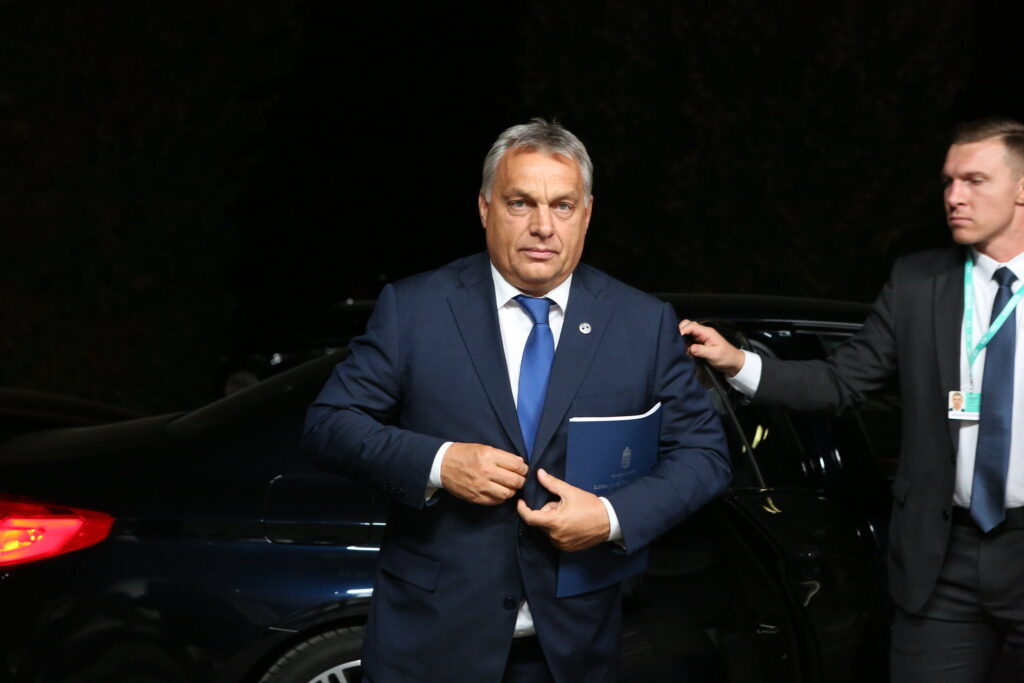
Credit:
Credit: Annika Haas (EU2017EE) / Flickr (CC BY 2.0)
Goodwin, who unsuccessfully stood for Parliament in February, has spoken at the last two summer festivals organised by MCC.
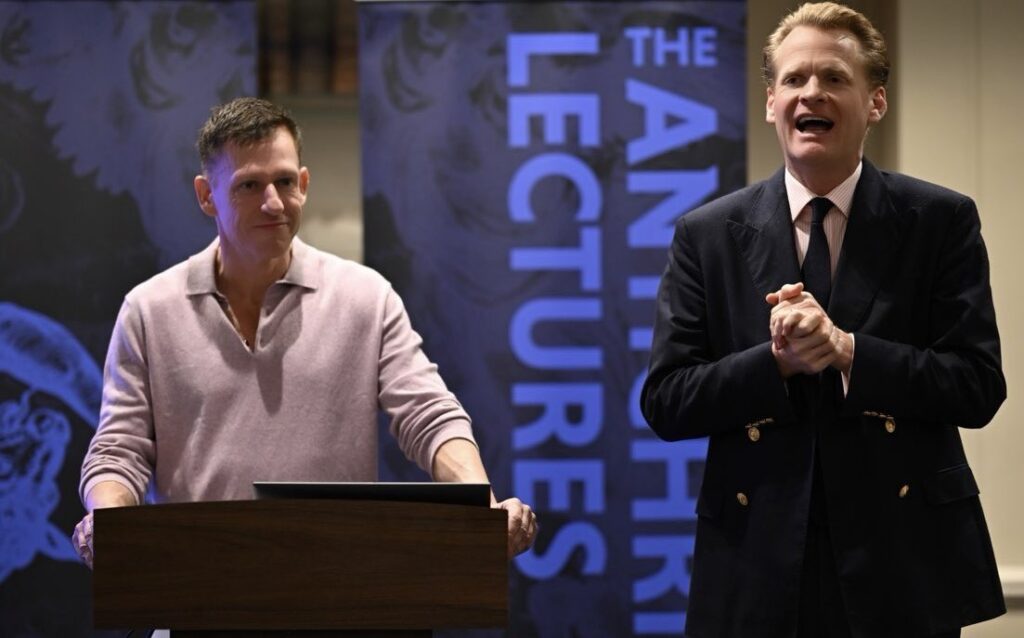
At the 2025 event – which also featured Orr, techno-authoritarian entrepreneur Peter Thiel, and former Conservative advisor Dominic Cummings – Goodwin praised the Hungarian government as a “counterexample” to what he called the ideology of “national self-loathing” in Britain.
Goodwin even formerly served as an MCC visiting fellow, teaching at “classes across Hungary” and giving “public lectures and educational events” – a role that reportedly pays between €5,000 and €10,000 a month (although Reform denies that Goodwin was paid this much).
Goodwin has also appeared at other Orbán-backed events, including the Roger Scruton Symposium at the Hungarian Embassy in London last October, and a Budapest Global Dialogue event in June featuring Viktor Orbán and Balázs Orbán, co-hosted by the Hungarian Institute of International Affairs, a government-funded group.
The Reform-Orbán Alliance
MCC is a leading sponsor of the pro-Orbán network across Europe, but it’s not alone.
In April 2024, Farage spoke in Brussels at the National Conservatism conference, a gathering of right-wing politicians and public figures headlined by Viktor Orbán.
The event was sponsored and coordinated by MCC’s Brussels arm and run by the Edmund Burke Foundation, a Washington DC-based think tank that employs Reform’s James Orr as its UK chairman.
Orr spoke at the event, as did Suella Braverman, the former Conservative minister who has since defected to Farage’s party.
The Edmund Burke Foundation received $200,000 in 2024 from the Heritage Foundation, the group that drafted the authoritarian Project 2025 blueprint for Trump’s second term. U.S. Vice President JD Vance has today (7 April) visited Hungary to lend his support to Orbán.
The Heritage Foundation also has an official “cooperation agreement” with the Danube Institute, another think tank funded via the Hungarian government.
As DeSmog has reported, Orr spoke last month at CPAC Hungary, a Trump-inspired event in Budapest.
The conference featured speeches by Viktor Orbán, Argentinian president Javier Milei, Dutch far-right leader Geert Wilders, and video messages from Israeli prime minister Benjamin Netanyahu, and Donald Trump. The event attempted to corral international support for Orbán. According to the latest polls, his party Fidesz is trailing its rival Tisza ahead of parliamentary elections this weekend.
Orr spoke at the event alongside a far-right Estonian politician and claimed a Reform government in the UK would seek to “reverse” immigration.
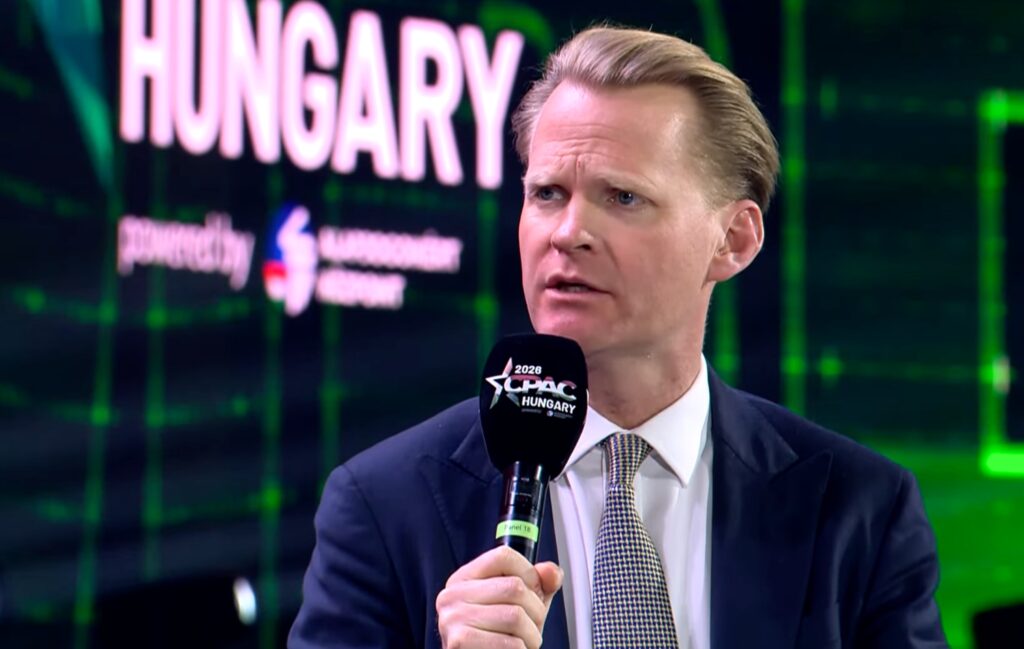
Credit: The European Conservative / YouTube
MCC also funds the Roger Scruton Legacy Foundation (RSLF), a charity named after the late British conservative philosopher. RSLF has received more than £500,000 from MCC since 2023, over 90 percent of its funding, according to the Good Law Project. The foundation’s board of directors includes Reform’s James Orr and Spectator editor (and former Tory minister) Michael Gove.
MCC Brussels, lobbies aggressively against EU climate policies, is led by Frank Furedi, a Hungarian-born sociologist and former professor at the University of Kent. Furedi is part of a group of Marxists who converted to libertarianism and founded the UK website Spiked, an anti-climate publication.
Another member of this group is Mick Hume, the editor-in-chief of the European Conservative, a pro-Orbán magazine which is reportedly funded by Batthyány Lajos Foundation (BLF), a group which receives its money from the government.
Hume was employed by Reform as a communications consultant during the 2024 UK general election campaign.
The Reform-Orbán alliance appears to be based on a mixture of common interests and ideologies. This includes hostility to liberal politics, immigration, climate action, and unenthusiastic support for Ukraine in its war against Russia.
In an infamous 2022 speech, Orbán warned of “race-mixing” in Europe, while Farage – who used fear of immigration to campaign for Brexit – is calling for mass deportations of up to 600,000 people if elected.
Orbán has been an aggressive opponent of EU sanctions on Russia, and has portrayed Ukrainian President Volodymyr Zelenskyy as a villain in this year’s election propaganda.
Although Reform doesn’t have the same allegiance with Putin’s Russia, its senior figures have frequently echoed talking points that are helpful to his regime.
In August 2025, James Orr called Russia’s invasion of Ukraine a “regional Slavic conflict” that he doesn’t “care very much about”.
Meanwhile, Farage has long repeated Putin’s line on the war – claiming that the EU and NATO provoked Russia’s invasion – and in 2014 said that Putin was the world leader he most admired.
In their own words: Reform UK’s praise for Viktor Orbán
“Viktor Orbán is the strongest leader in Europe and the EU’s biggest nightmare.” — Nigel Farage, April 2018, X.com
“Do I see Orbán as a little authoritarian monster? No I do not. He represents much more the future of Europe. […]
“He actually believes in things. He does not sheepishly, slavishly go along with the European project as he firmly believes in the concept of the nation-state. He clearly is a strong defender of, as he sees, the Hungarian culture and he is not afraid to say and do these things despite huge criticism from the European Union.
“[…] With the [George] Soros thing I agree with completely of course. His influence is all across the Western democracies.” — Nigel Farage, February 2019, Válasz Online
Orban’s Hungary is a “counterexample to the ideology in my own country that rejects national pride and heritage.” — James Orr, August 2025, MCC Festival
“One of the reasons I have come to Hungary, and why I am a supporter of the country, is that I see a nation-state fully invested in the defense of its national sovereignty, democracy, and people, which in today’s world is a very rare thing. […]
“I also believe there are a lot of things that Britain can learn from countries like Hungary: how to preserve national borders, oppose mass immigration, invest in pro-family policies, and stand up to distant supranational institutions — like the European Union.” — Matthew Goodwin, March 2026, Hungary Today.
“The British elite often portrays Hungary as a country in violation of EU laws, regulations and standards. But I think their country is just resisting the pressure to impose a liberal agenda represented by a narrow minority of Western countries.” — Matthew Goodwin, August 2024, Mandiner
“I just spent 4 days in Hungary, a conservative country criticised by elites across the West. I saw no crime. No homeless people. No riots. No unrest. No drugs. No mass immigration. No broken borders. No self-loathing. No chaos. And now I’ve just landed back in the UK.” — Matthew Goodwin, August 2024, X.com