

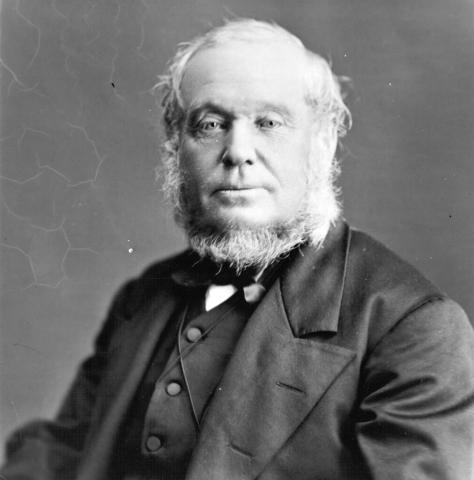
This is a guest post by Andrew McLaren
With all the present glorification of the 1812-15 conflict being promoted by Canada’s Federal Government, another important bicentennial is being pointedly overlooked: the birth of Dr. Charles Smallwood (1812-1873), a Canadian physician and scientist who can be credited for the earliest extended research into Meteorology and Astronomy in our emergent Country. His early work included studies into snowflake formation (can any Canadian not relate to this?), many years of observations and research in atmospheric Ozone levels, later founding the Montréal Observatory at McGill University. He even established the National Astronomical Time Standard still used for over a half-century after his death!
Smallwood’s research in Ozone, particularly as relating to atmospheric humidity, was published in Montréal in 1857. It is sad to note over a century and a half since, present-day Ozone monitoring in the Canadian North has been subjected to terminal funding cuts, even with the shocking discovery of a Polar Ozone Hole for the first time in recorded history (2011). This bears an unfortunate testimony to our current Federal Government’s politically motivated attacks on Science and scientists, particularly those studying the environment. In spite of this “War of 2012” against climate, water, and other environmental scientists, we should commemorate the life and work of Charles Smallwood, and celebrate his massive contribution to science here in Canada and internationally on the occasion of his 200th Birthday.
Born in Birmingham, England, Smallwood obtained his MD from University College, London before immigrating to Lower Canada at age 21 in 1833, becoming licensed to practice in Lower Canada the following year. By 1841 he had established a residence at Saint-Martin (Isle-Jésus, now Laval), near Montréal. Here he began the first long-term record of local weather conditions in Canada, monitoring his instruments and improvised recording devices—these even using photographic technology—three times daily. An eighty-foot mast hosted an electrometer for measuring atmospheric electricity, and his 7 inch telescope was in constant use on clear evenings. The observatory was connected via the Montréal telegraph early on, to major cities in the US, linking him to American astronomers and meteorologists, with whom he corresponded extensively.
Smallwood’s Ozone measurement technique gauged the bleaching properties of O3 upon paper strips treated with starch and Potassium iodide, which would turn deeper shades of blue with increasing oxidation. He noted the importance of locating his (nearly 6000, over eight years) observations at a 3-mile distance from the river, to avoid the higher incidence of O3 in localized mists, fog, and vapour. Analyzing these with his meteorological records, he established that high Ozone levels correlate well with days of high humidity and precipitation, rather than prevailing atmospheric electricity (and even the aurora borealis) as proposed by earlier researchers. Concern with the toxicity of Ozone (for both plants and animals) is also evident in his 1857 paper.
His celebrated studies of the formation of snowflakes were illustrated by sketches from the microscope and photography, and his essay accompanied a popular American publication, Cloud Crystals, a snow flake album, edited/illustrated by Frances E. Chickering (1864). “On some of the forms of snow crystals and the different electrical states of the atmosphere during their formation” earlier appeared in the Annual Report of the Montréal Natural History Society for 1855-56, the first of many papers published (later in the first issues of Canadian Naturalist, and Canadian Journal) up to 1872.
The Bibliotecha Canadensis (1867) lists several foreign Science Institutes to which Smallwood belonged: La Société Météorologique de France, the Observatoire Physique Central (St. Petersburg), Académie Royale des Sciences des Lettres des Beaux-Arts (Belgium), the National Institute of the United States, and the Academy of Natural Sciences (Philadelphia), while also noting his articles contributed to the British Meteorological Society.
As the word ‘Science’ was only then supplanting the older term ‘Natural Philosophy’ as an academic category, Dr. Smallwood’s works earned him an LLD from McGill in 1856, and a further DCL from the University of Bishop’s College in 1864. Around that time he moved his observatory from Saint-Martin to the McGill campus, where a purpose-built stone building was inaugurated as the Montréal Observatory. It took several years of canvassing for support, but full operational funding was secured in 1871, jointly underwritten by the Signal Office of the US War Department, and the Canadian Ministry of Marine and Fisheries. Along with studies in the magnetic field, and astronomical timekeeping, weather reports were telegraphed to Toronto for use in determining National forecasts. This year, 2012, also marks the 50th anniversary of that building’s eventual demolition in 1962 (though McGill’s MacDonald Physics Building continues to house an observatory).
Dr. Smallwood died of a short illness only two years after the Montréal Observatory was fully operational, on December 22, 1873. Despite his relatively ealy demise, Charles Smallwood’s legacy represents the beginning of what is now known as Environment Canada. His groundwork provided the basis for the National Astronomical Time Standard in use up to the 1926 establishment of the Dominion Observatory in Ottawa. Active internationally, Smallwood also exemplifies an early Canadian working at the cutting edge of his contemporaries in science, and whose situation here in Canada added immensely to the world’s greater knowledge-base.
As powerful interests seek to suppress Canadian scientists from publicly discussing their work two centuries later, it is time that we Canadians reclaim the legacy of arguably, our foremost mid-19th century scientist, born in 1812: a builder of knowledge, a man who believed such knowledge must be shared far and wide, and on whose academic foundations, one of Canada’s great Universities has served generations of Science graduates. It is lamentable that Canada’s leading ‘legacy’ agenda now dominating the bully pulpit in Ottawa effectively seeks to accomplish the opposite.
Charles Smallwood represents a far greater, and more constructive vision of what can be accomplished in Canada, than the false prophets of neo-conservatism who attack his scientific descendants. If Dr. Smallwood was able to build his place in the history of Canadian Science from the ground up, so too must we Canadians resolve to eventually re-build a strengthened commitment to Environmental Science in our Federal Governments of the future.
Sources:
Dictionary of Canadian Biography Online (University of Toronto/Université Laval, 2000)
Henry J. Morgan, Bibliotecha Canadensis. (G.E. Desbarats, Ottawa, 1867)
Charles Smallwood, On Ozone, and on the Meteorology of the vicinity of Montreal. (John Lovell, Montréal, 1857)
Author note: Andrew McLaren is a visual/media artist and writer living in Halifax, NS.
Image credit: Dr. Charles Smallwood in 1872 William Notman /McGill University Archives PR010565
Subscribe to our newsletter
Stay up to date with DeSmog news and alerts