


The only ice factory in Bubaque is out of service. Local fishermen, like Pedro Luis Pereira, are forced to source ice from factories on the mainland in Guinea-Bissau, West Africa, some 70 kilometres away – a six-hour round trip by boat.
“The machines have been broken for months,” Pereira explains, as he pulls in his nets on the shore of the island inside the protected Bijagós Archipelago. “We’ve alerted the Ministry of Fisheries, but so far, no one has come to fix them.”
Wooden canoes are the only fishing boats allowed among the cluster of 88 islands that make up the Bijagós archipelago. Its shallow waters are a rich breeding ground for silver flat sardinella, which Pereira, racing the tropical heat, sells fresh for 250 CFA francs (£0.33) a kilo at the market in Bissau, the capital of this tiny west African republic.
The tides dictate when fishermen can navigate the shallow waters of the archipelago. Its sandbars are a nursery for countless species, including endangered turtles and manatees, leading marine biologists to describe it as “the Galapagos of West Africa”.
Like Pereira, many of these creatures rely on sardinella, a small oily fish. It’s a vital food source for migratory birds like terns that winter in Bijagós in their tens of thousands, as well as for barracudas and jacks, and whales and dolphins further out to sea.
But the shoals of this pelagic fish draw another, more voracious predator: industrial boats, which fish the boundary of the protected zone, where, in theory they cannot enter.
Among the vessels circulating here in 2025 was the Hua Xin 17. At 125 metres, it’s longer than a football field. Listed as a cargo ship in maritime databases, a new investigation by The Guardian and DeSmog can reveal that the Chinese-owned boat is in fact a floating factory that turns fresh sardinella into fishmeal and oil by the tonne.
Eye witness accounts, exclusive video footage and satellite records show that a group of Turkish boats that supply the Hua Xin 17 appear to have routinely fished sardinella illegally inside Bijagós.
The factory is one of two ships anchored in the open sea that have illicitly processed thousands of tonnes of freshly caught sardinella into fishmeal and oil.
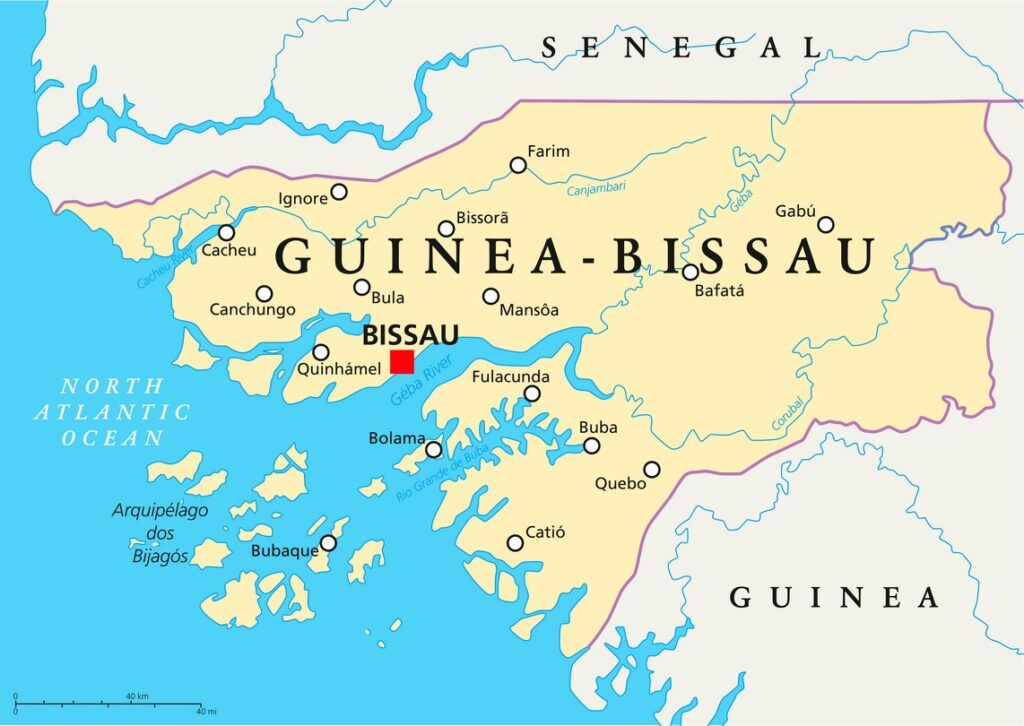
Aliou Ba, Oceans campaigner at Greenpeace describes the Bijagós archipelago as among West Africa’s most ecologically significant marine areas – and one of the last relatively intact coastal ecosystems on the continent.
“Any illegal fishing within its Marine Protected Area is not only a violation of Guinean law, but a direct threat to biodiversity, and local communities’ food and livelihoods,” he says.
Analysis of trade data by The Guardian and DeSmog shows that this fishmeal is finding its way into international supply chains, to make feed for farmed salmon and shrimp.
“It beggars belief that small pelagic fish, which are highly nutritious, are being turned into powder to feed farmed fish, for consumers in wealthier markets,” Vera Coelho, Executive Director at nonprofit Oceana in Europe tells DeSmog.
Illegal fishing
The Hua Xin 17 was anchored belching out black smoke for a total of 157 days in 2025 some 50 kilometres off the coast of Orango Island, which is famous as the home to rare saltwater hippos.
Another offshore fishmeal factory, the Tian Yi He 6, which has been operating as a fishmeal factory near Bijagós for over five years, and has a history of infringing Bissau-Guinean laws, spent 244 days moored at sea in 2025.
The discovery of the Hua Xin 17 by DeSmog and The Guardian, following years of allegations and speculation, adds fresh evidence of the expansion in Guinea-Bissau of off-shore processing factories, which turn over hundreds of tonnes of fresh fish per day.
A group of six Turkish boats appear to be supplying the two factory vessels at sea, according to satellite records on Global Fishing Watch (GFW) a global nonprofit that monitors fishing activity.
Turkish purse seiners, which use expansive nets to encircle and capture whole schools of fish, are licensed to operate within Guinea-Bissau’s Exclusive Economic Zone (EEZ), an area of water extending 200 miles from the coast. But they are not authorized to transship (move fish from one boat to another) at sea in this area – or to fish inside protected Bijagós waters.
But satellite records of the boats’ movements on GFW strongly suggest that four Turkish boats that supply the off-shore factories are fishing illegally inside Marine Protected Areas.
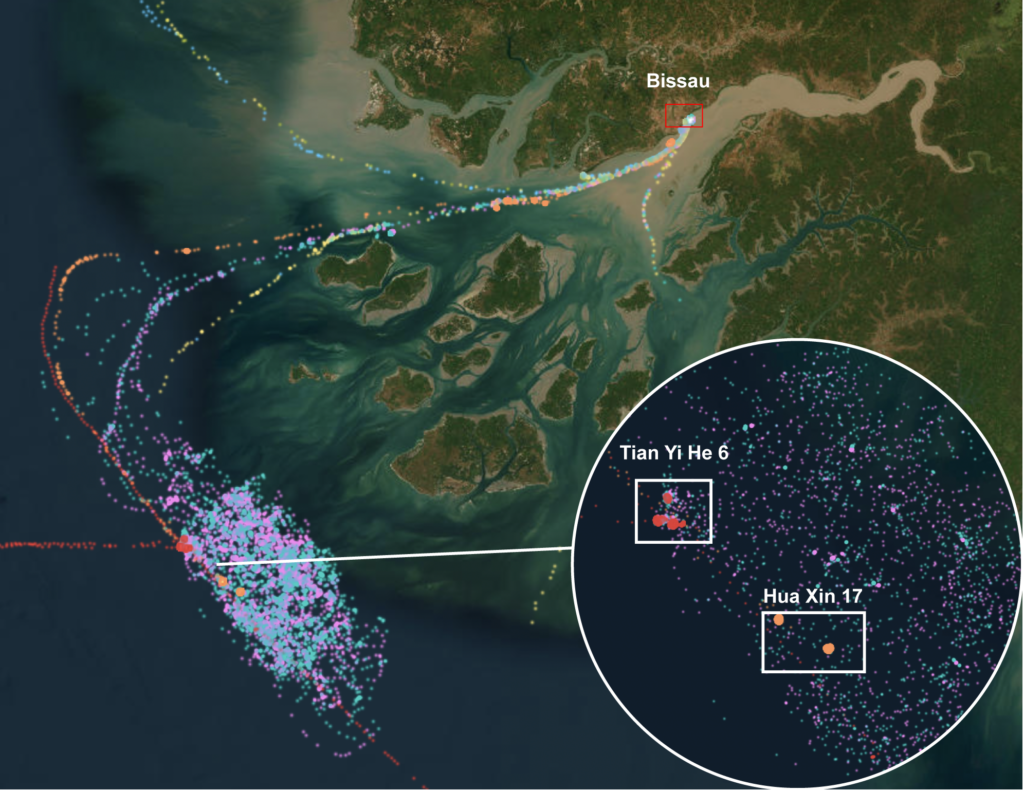
According to the GFW satellite records, as they near the edges of the protected areas, vessels Turk Yilmaz, Ilker Yilmaz, Ilahn Yilmaz 1, and Ilahn Yilmaz 3 routinely disable the AIS signals that broadcast GPS data and vessel identity – a tell-tale sign of Illegal, Unreported, and Unregulated (IUU) fishing.
The signals on the boats, which are all linked to the firm Yilmaz Kardesler Balikcilik, pop up briefly near the two fishmeal factories, and reappear near the port of Bissau, or during voyages south to and from the port at Nouadhibou in Mauritania, a major hub for the fishmeal industry.
The transshipment of fish from these purse seiners at sea to the floating factory usually occurs with the AIS systems turned off, allowing thousands of tonnes of illegally harvested fish to be exported without passing through Bissau ports, illegally entering the market for fishmeal and oil, without trace.
“When foreign distant water fleets operating outside the law, vacuum up these stocks for fishmeal and fish oil to feed animals instead of people in West Africa, the consequences fall hardest on small-scale fishers and coastal communities who have no alternative,” says Greenpeace’s Ba.
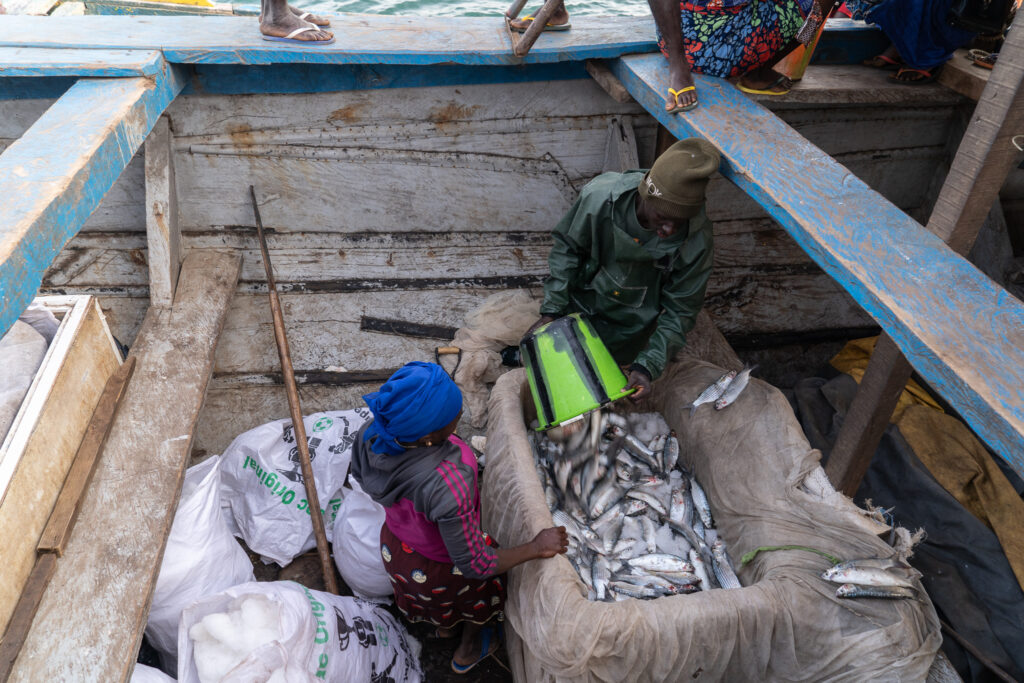
Bandim port. Credit: Davide Mancini
Abuse on board
The records of the boats’ movements and what they appear to be doing is supported by testimony of those on board. A local sailor Antonio (a pseudonym to protect his identity) spent seven months on the Hua Xin 17 in 2024.He reports that 25 crew members alternated in six hour shifts to process sardinella.
A smaller boat ferried sacks of fishmeal to the port, and brought back supplies, he says, also alleging that workers were left isolated at sea off the coast of Guinea-Bissau, which has a poor record of upholding seafarers rights.
Antonio reports harsh conditions for the Guinean crew, who, he says, were mistreated by Chinese managers on board. “They don’t see us as equal to them…” he tells DeSmog at a café in Bissau port. “They only gave us rice to eat. Breakfast, lunch, and dinner – just rice.” The Chinese staff had their own food and separate rooms, while Guineans slept in bunk beds, 10 to a cabin.
Sanitary conditions were dire, he says. Many workers developed skin diseases, likely due to the poor diet, and air pollution from fish processing which is known to cause skin irritation, and breathing problems near fishmeal factories on land.
One man in his forties was very unwell, his entire body swollen up, Antonio recalls. The man was only transported back to Bissau after the intervention of the ship’s interpreter. “If he had died, the captain wouldn’t have cared,” he reports.
The same crew member shared with DeSmog secretly recorded video footage showing tonnes of sardinella fresh from the sea, travelling along conveyor belts.
The video footage, which is confirmed by the boat’s GPS records on Global Fishing Watch, is clear evidence that tonnes of pelagic fish are being processed aboard. And captures two Turkish boats in the illegal act of transshipment.
Lost nutrition
The apparent scale of the off-shore fish processing operations are a double blow to food security and income in Guinea-Bissau, one of the world’s poorest countries.
Fish are the source of a third of animal protein consumed here, and the informal fishing industry employs 225,000 people from a population of 2.2 million, according to the Coalition For Fair Fisheries Arrangements (CFFA). A recent stock assessment showed pelagic species like sardinella to be in “considerable decline”, according to a government official.
“The fishmeal industry is expanding in a context where small pelagic fish are already overexploited and illegal, unreported, and unregulated (IUU) fishing is widespread,” explains Beatrice Gorez from CFFA, which supports artisanal fishers in West Africa. “This threatens artisanal fishers, women fish processors and food security in the entire region.”
The Omega 3 fatty acids contained in low-cost sardinella, and other pelagic fish, are irreplaceable in local diets, in a country where 22 percent of people are malnourished.
“The micronutrients abundant in fish are especially critical in the first 1,000 days of life. And are essential for women who are breast-feeding,” explains Christina Hicks, environmental social scientist at Lancaster University. “The lack of micronutrients will bring problems for the whole society, affecting even future generations.”
The same fatty acids required by growing children are valued by the aquaculture industry, Hicks says. Fish oil high in Omega 3 is an essential ingredient in feed that stimulates the appetite of farmed salmon.
“The industrial processing of sardinella offshore is particularly alarming,” says Ba, who campaigns against the fishmeal industry at Greenpeace. “Sardinella is not just a commercial commodity; it is a critical source of protein for millions of people across West Africa.”
Sanctions and fines
Trygg Mat Tracking (TMT), a Norwegian non-profit fisheries intelligence organisation that works with Guinea-Bissau’s fisheries inspection authority, FISCAP, has tracked fishmeal vessels since 2019 when the Tian Yi He 6 off-shore factory arrived, first flagged to Dominica, later switching to China in early 2020.
TMT’s intelligence reports, produced in collaboration with a group of organisations under the name Joint Analytical Cell, reveal continued breaches of Guinea-Bissau’s fisheries and transshipment laws.
The Tian Yi He 6 was fined three times between 2019 and 2020 for processing fishmeal and oil without authorization and illegal transhipments, including by Turkish seiner Ilhan Yilmaz 3, part of the same fleet that appears in video footage in this Guardian investigation. In total, authorities imposed fines of over £537,000, split between Tian Yi He 6, its captain, and the Turkish vessel.
Infringements included a Senegal-flagged cargo vessel transshipping illegally at sea and taking the processed product back to Dakar port, where it would have been laundered, untraceable, as fishmeal exports from the neighbouring country.
Following the election of a new president in Guinea-Bissau, Umaro Sissoco Embaló, in 2020, all sanctions ceased. Hua Xin 17 arrived in 2024, appearing in the country’s Exclusive Economic Zone (EEZ), along with new Turkish vessels, known to work in the fishmeal industry in Mauritania.
Evading regulation
The expansion of fishmeal operations at sea in Guinea-Bissau follows attempts by the country’s northern neighbours Mauritania, Senegal and Gambia to limit the expansion on land of the industry, which has grown exponentially in the region in the last decade.
Government moves to regulate follow years of outcry from fish workers, advocacy groups and the UN in the face of overfishing, food insecurity and pollution caused by fishmeal factories along the West African coastline.
Industry-driven overfishing further north may be driving boats to Guinea-Bissau, according to biologist Paulo Catry, who has studied aquatic life in the Bijagós for nearly 30 years.
“This species is naturally much more abundant along the coasts of Mauritania and Senegal due to the upwelling phenomenon, which does not affect Guinea-Bissau,” he explains with reference to when colder and nutrient-rich waters are pushed from the deep sea to the surface, attracting large shoals of fish. “Since it has not been exploited as heavily as in the northern countries, this species now appears to be more abundant here.”
Another draw for Chinese and Turkish interests seeking to fish without limits, may be the chronic political instability that has undermined Guinea-Bissau since its independence 1974.
President Emboló was ostensibly overthrown in a military coup in November 2025 and the country is now under transitional military rule.
“As rules tighten up in one area the problem just shifts where governance is weaker or more opaque,” notes Hicks. “It’s no surprise to me that as places that are able to monitor and manage their resources the companies are moving south to places like Guinea-Bissau and Sierra Leone.”
Untraceable fishmeal
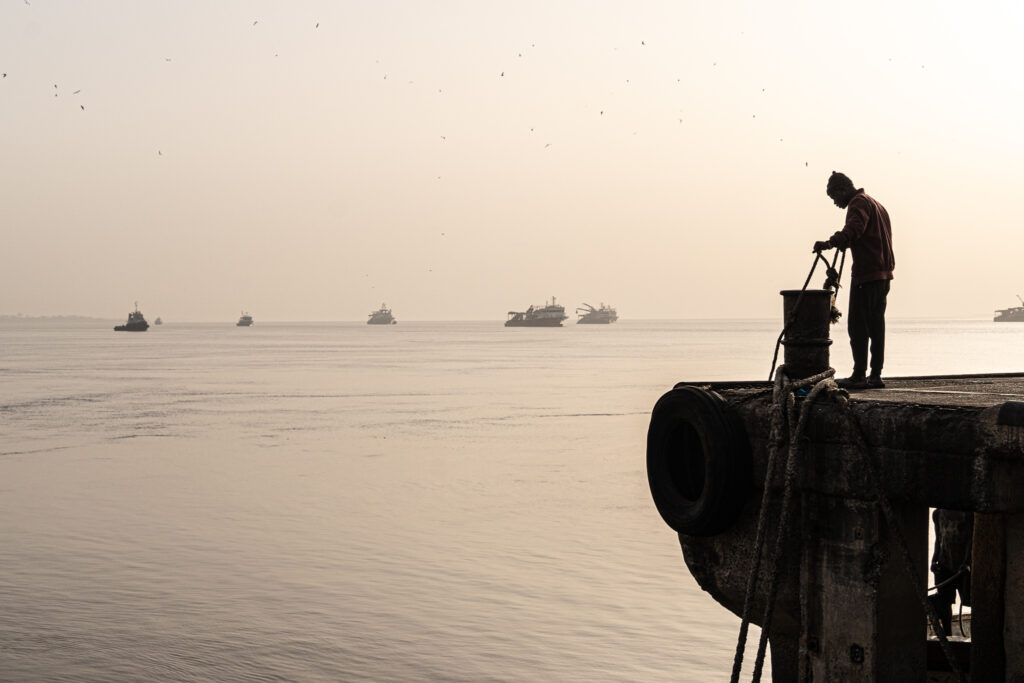
Satellite photographs seen by DeSmog show that both floating factories have illegally transshipped sacks of fishmeal on to cargo vessels that travel on to ports of Bissau and Dakar, in 1-tonne bags, to neighbouring Senegal, captured above by satellite photo.
DeSmog and The Guardian used trade data to trace the onward journey of this fishmeal.
Exports were made from Tian Yi He 6 to companies in Turkey and South America.
The apparent owner of the vessel, Bissau Wang Sheng (BWS) sold at least 13,600 tonnes, with a value of £17.5 million, 2022 to 2024, to Turkish company Feza, which supplies fishmeal and fish oil to seafood farms mainly in Turkey and China.
In that two-year period, Tian Yi He 6 would have taken a minimum of 30,000 tonnes of fresh sardinella per year from the waters around the Bijagós Archipelago, when it takes 4.5 kg of pelagic fish to produce 1 kilo of fishmeal.
On a Yellow Pages pages listing, BWS claimed in 2020 to be producing 3,000 tonnes of fishmeal per month. If true, that would lift the volume of fresh fish consumed to 162,000 tonnes in a year – from just one floating factory.
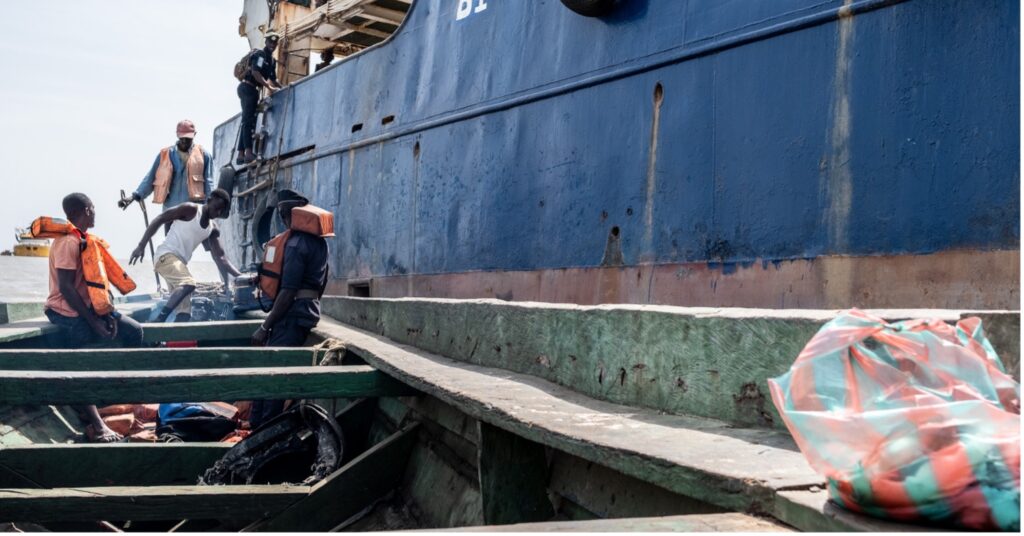
Despite the high volume of fishmeal exports reported in this investigation, Guinea-Bissau’s imports are “invisible to international trade data”, according to an analysis by the International Monetary Fund.
More than half the annual landed value of Guinea-Bissau’s fisheries is captured by illegal and unreported fishing, which cost the country and its regional neighbours – Mauritania, Senegal, The Gambia, Guinea and Sierra Leone – a combined £1.7 billion every year.
Tian Yi He 6’s customers in South America included fish oil brokers in Chile, the world’s second-largest salmon producer.
Shipments totalling 440 tonnes, valued at £1.3 million, were sold in 2023 to Gisis SA, a company in Ecuador, which produces shrimp feed as part of Skretting, Dutch firm Nutreco’s aquaculture feed division.
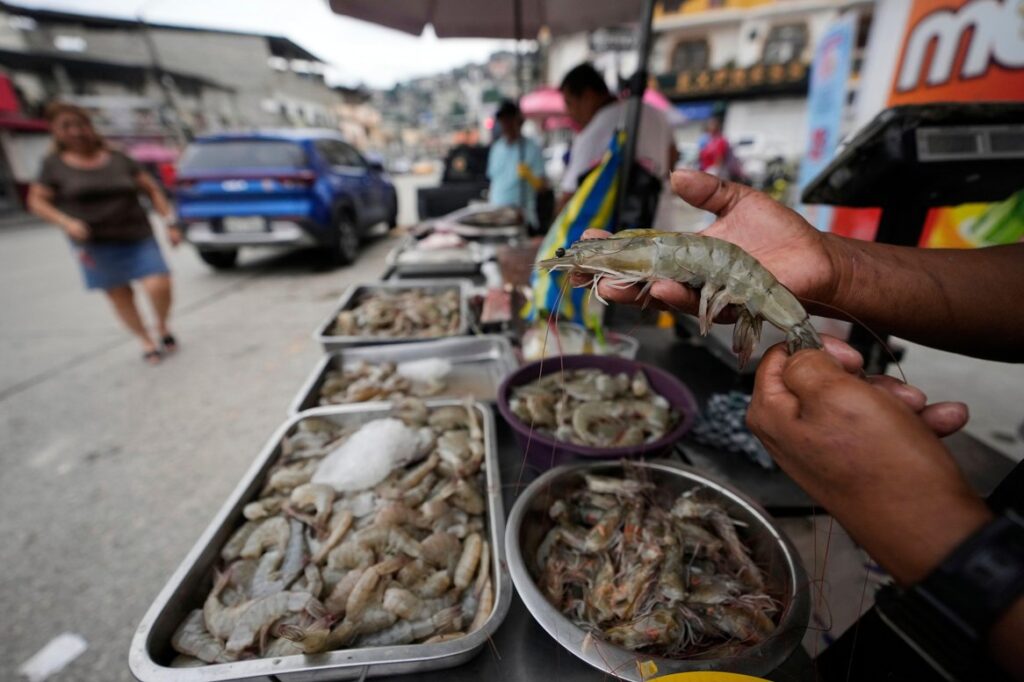
“Fish meal and fish oil can enter the EU market without documentation on the species or its origin – this should not be allowed,” says Oceana’s Coelho. “The lack of traceability and transparency in the trade of these species for the production of aquafeed makes it incredibly difficult to regulate this trade.”
A source at Skretting confirmed that Gisis S.A. made a purchase from Guinea Bissau in 2023 but said they were unable to “verify the accuracy of the claims and whether the fish was caught within the Marine Protected Area”, in a statement to DeSmog and The Guardian.
“At the time, the documentation received from our trader stated that the material complied with all local regulations,” they said. “Additionally, we confirm that there are no other cases from this origin.”
Skretting said it had initiated an internal investigation into DeSmog’s findings. “Ensuring responsible and legal sourcing is fundamental to how we operate,” they said. Stating that the company had a “zero-tolerance policy” regarding IUU fishing, Skretting said it was “committed to acting on any findings and taking corrective and legal measures where necessary.”
Fishmeal ban
The government in Guinea-Bissau did not respond to repeated requests for comment.
But in late January, authorities took the radical step to regulate. The Minister of Fisheries and Maritime Economy announced a sweeping ban on fishmeal and fish oil production on sea and on land, and suspended licenses for purse‑seine fishing of small pelagic fish.
The government was said to be under pressure from Senegal as well as the EU, which has a Sustainable Fisheries Partnership Agreement (SFPA) in place with Guinea-Bissau that bars it from fishing small pelagics to protect food security. The Guardian understands that the evidence of IUU fishing contained in this report was used to push for action.
Guinea-Bissau’s landmark step – going further than any of its neighbours – was hailed as a turning point by advocates Oceana, Greenpeace and TMT. Papa Cá, President of the Guinean Platform of Non-State Actors in Artisanal Fisheries and Aquaculture (PLAGANEPA) has also welcomed the ban.
The challenge lies in enforcement, according to Dyhia Belhabib from Ecotrust Canada. “I don’t think that a ban will make them disappear,” she says. “At this point in time, Guinea-Bissau does not have the capacity to enforce control at sea.” At best, she reflects, if one company is caught and heavily sanctioned, it may result in more caution.
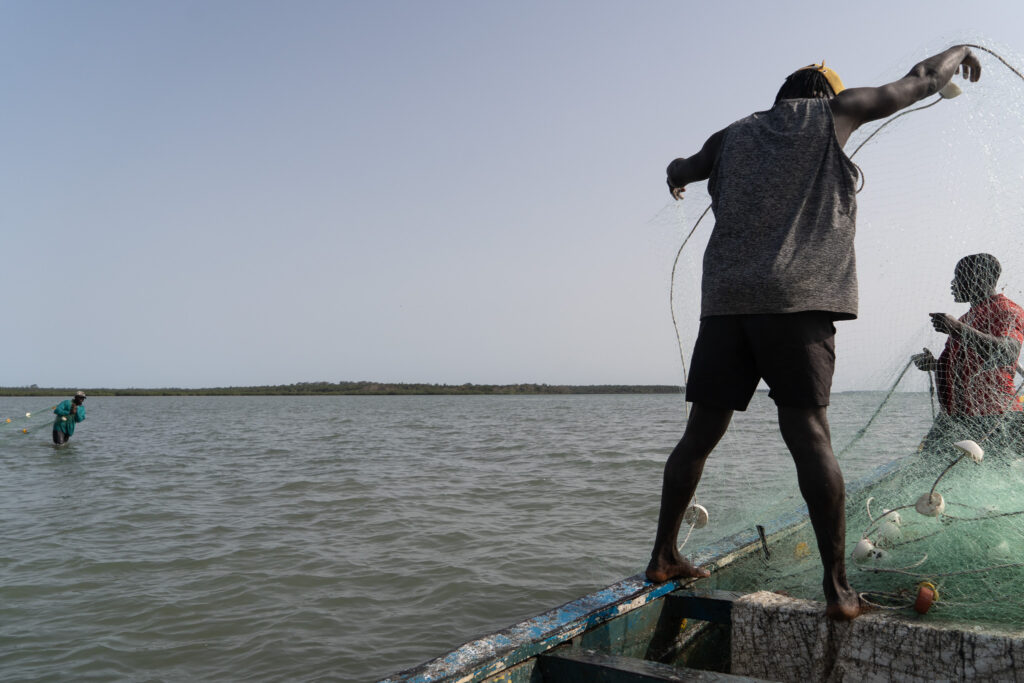
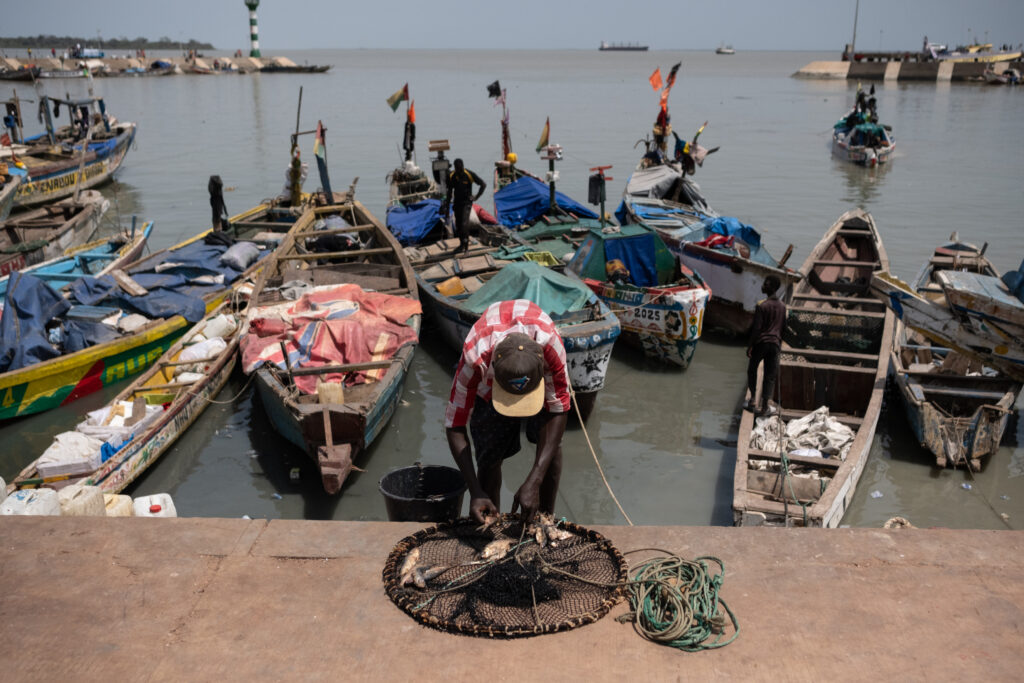
purse seine fishing technique to trap school of fish, abundant in the archipelago. Credit: Davide Mancini
“Even if they stop in Guinea-Bissau, the ships will just move to the next one, in this case to Guinea (Conakry) or go back to Mauritania. Some 60 percent of the vessels doing IUU fishing have a seemingly legal base in the region where they operate,” she says.
For now, the fishmeal boats identified in this investigation are docked. Although, in February, sources at Bissau port reported seeing 20 trucks loaded with fishmeal – hidden under a tarpaulin – waiting to be loaded on a ship for export.
Back on Bubaque island, Papa Cá confirms that the ice machine is still out of order. He points out that local fishers need investment in, among other things, cold storage to help them get fresh fish to market before it spoils.
“Only then can this measure [fishmeal ban] become a real opportunity to improve community incomes and promote food security in the country,” he says.
All the companies mentioned in this story were contacted for comment.
Additional reporting by Regina Lam, Brigitte Wear and Hazel Healy
This story was produced in partnership with the Pulitzer Center’s Ocean Reporting Network.