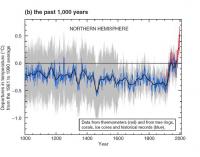
The fabled “hockey stick” – Michael Mann’s graph showing the last decade to be the warmest in a 1,000 years – has re-emerged, stronger and longer than ever.
In a peer-reviewed paper published today in the online version of the Proceedings of the National Academy of Sciences (or see Ross Gelbspan’s post below for the ENN coverage), Mann and six other scientists show that current warming is the most severe in more than 1,300 years – 1,700 if you accept still-controversial data drawns from tree rings.
The hockey stick, a graph featured prominently in the 2001 report of the Intergovernmental Panel on Climate Change, has been under near constant attack since 2003, when economist Ross McKitrick and retired mining promoter Steve McIntyre wrote a paper in the journal Energy and Environment criticizing Mann’s statistical method and his use of tree rings as a means to infer past temperatures.
But the stick has shown remarkable resilience: the accuracy of its representation has been corroborated again and again, by other researchers and with other proxies. Now, Mann, et al, have returned with an even more compelling version.
Be assured that the people who want to argue about this graph will go back to criticizing the 2001 version or will bicker over details of the debate since. But the venerable stick, the shape that appears in every climate reconstruction, is unbroken.