

Despite social media giant TikTok’s ambitious campaigns to combat climate denial, go carbon neutral, and support sustainable advertising on its wildly popular video platform, the company sponsored a Canadian right-wing conference featuring a retinue of long-established climate deniers earlier this month.
TikTok backed the annual meeting of the conservative Canadian political networking organization Canada Strong and Free Network (CSFN), a recent member of the anti-climate Atlas Network of think tanks, on 6-9 May in Ottawa, Ontario.
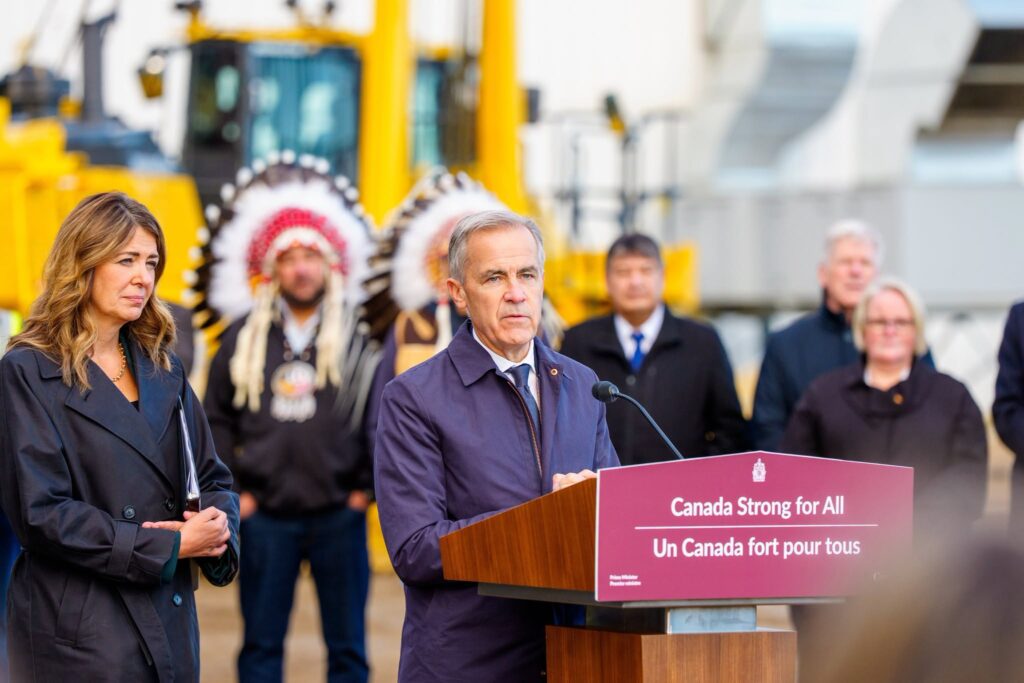
At the event, established climate deniers and former Trump administration Secretary of State Mike Pompeo rubbed shoulders with conservative Canadian politicians, including opposition leader Pierre Poilievre, to listen to speeches decrying what the Alberta Premier, Danielle Smith, called “eco-extremism” in Canadian government.
“Anti-resource, keep-it-in-the-ground, eco-extremism has left us [Canada] less able to provide a secure supply of energy,” said Premier Smith, who earlier this month told a gathering of Christian leaders that building a new oil pipeline to the west coast of Canada is consistent with the teachings of Jesus. “We have to be able to use fossil fuels as the only available alternative [in Alberta], or literally people die.”
TikTok’s sponsorship of an event with such blatant climate misinformation has led experts in climate messaging, such as Polina Zabrodskaya, an advertising creative director, to call TikTok’s contradicting commitments “greenwashing.”
“TikTok’s only true goal is protecting and increasing profits. Being openly anti-environment is bad for business, but being openly anti-fossil-fuel is just as risky. They have to sell to both sides,” Zabrodskaya told DeSmog. “Sponsoring a climate denial conference while sitting on sustainability committees and talking about sustainable advertising is how TikTok covers both flanks.”
TikTok has over a billion users worldwide, and has been a major source of the world’s climate social media content. As of November 2023, TikTok reported that video posts with the hashtags #ClimateChange, #ClimateAction, and #SustainableLiving had received 6.6 billion, 2.5 billion, and 1.9 billion views, respectively.
TikTok has an ambitious advertising policy to combat environmental and climate misinformation, and in 2023, ByteDance, TikTok’s Chinese owner at that time, pledged it would be carbon neutral by 2030.
The company says it is “committed to supporting accurate public discourse” about climate change, and states that it is “not allowed” to post anything “denying the reality, severity, or impact” of climate change, or “misrepresenting scientific facts, data, or research” about climate change, on its site.
However, TikTok’s own rules did not stop it from sponsoring the CSFN conference, where multiple speakers cast doubt on the reality of climate change.
“Radical environmentalism calls humanity parasitical and seeks to prevent the use of resources that deliver prosperity,” said long-time denier and Canadian gas industry lobbyist Timothy Egan in his speech at the conference.
“Half the time when you’re reading about extreme weather about climate, about energy, it’s not from a real journalist, but it’s a journalist paid by an outside foundation to work at a so-called legitimate media outlet,” Brenda Schaffer, an American nonresident senior fellow at the Atlantic Council who previously advised the Azerbaijani oil company SOCAR, said at the event.
Arguing that “net zero is on the back of … the hardest working people,” Schaffer then asked Canadians: “Will your government serve the interests of … the working people of Canada? Or will your policies … consider the interests of elites that meet at Davos, that meet the United Nations?”
TikTok sponsored CSFN’s conference alongside oil giant Koch Industries, a leading climate denial funding machine, Trump-donating tech giants Meta and Uber, and two organizations with a history of positions questioning climate change: Climate Discussion Nexus, a group that describes itself as “citizens concerned about expensive, ill-planned energy policies intended to reduce carbon dioxide emissions,” and Modern Miracle Network (MMN), a pro-oil advocacy group that aims to “shift the conversation surrounding energy to one that … embraces the miracle of modern hydrocarbons in Canada.”

TikTok has “abandoned its claimed commitment to climate information integrity,” Philip Newell, communications co-chair for the Climate Action Against Disinformation coalition, told DeSmog. Previously, research in the respected science journal Nature found that TikTok favored Republican content in 2024 elections — and researchers have also revealed right-wing bias in TikTok content related to elections in Poland, France, and Sweden.
“We can stop pretending it’s not a rigged algorithm,” Newell said.
When asked for comment, both TikTok and CSFN did not respond.
TikTok’s move to sponsor the CSFN conference comes just months after TikTok announced in January that it had finalized a deal to set up a U.S. entity as co-owner with ByteDance to avoid a ban proposed by U.S. President Donald Trump due to concerns that the company could harvest data on Americans for China.
The new American venture is majority-owned by U.S. investors including tech giant Oracle, owned by Larry Ellison, a long-time ally to Trump who has made major donations to the White House ballroom project. Since retaining a 15 percent stake in the TikTok venture, worth about $2 billion, Oracle took control of the U.S.-based TikTok’s algorithm management — which determines what videos users are recommended based on their viewing history.
In the days after the deal, American TikTok users alleged that the platform suppressed anti-Trump content. The allegations included reported instances of users not being able to upload video posts on the shooting of nurse Alex Pretti by U.S. Immigration and Customs Enforcement (ICE) agents, and claims that Tiktok was censoring the word “Epstein.”
Sustainability?
Chock full of streaming video content, TikTok has a higher carbon footprint than other social media companies — including Instagram, even though TikTok has half as many users.
According to an estimate by Paris-based carbon accountancy consultancy Greenly, the platform’s carbon footprint in 2024 was likely larger than Greece, based on data that TikTok’s emissions in the U.S., UK, and France were about 7.6 metric tonnes of greenhouse gasses the previous year.
The BBC has flagged the company’s stringent climate misinformation policy, first introduced in early 2023, for failing to lead to regular compliance in the past. A BBC investigation in June of that year found that of the 365 videos containing climate misinformation that the media outlet identified on TikTok — with a combined total of close to 30 million views — only 5 percent were removed.

TikTok has continued to make big claims about its commitments to climate literacy and sustainability. In the lead-up to the COP28 global climate summit in November of 2023, TikTok pledged $1 million to “tackle climate information” as part of its 2023 #ClimateAction campaign, in partnership with an international team of “scientists and trusted experts” from the UN initiative Verified for Climate.
“We are excited to onboard a team of trusted messengers who will help spread factual, trustworthy climate content to TikTok’s large global audience,” United Nations Under-Secretary-General for Global Communications Melissa Fleming said in a press release for the campaign, which she said would help “turn the tide on denialism, doomism and delay.”
In the last two years, TikTok has positioned itself as a leader, and steward, of sustainable advertising. In March 2024, TikTok joined Ad Net Zero, an ad industry campaign to “tackle the climate emergency by decarbonising ad operations” and “accurately promot[ing] sustainable products and services.” TikTok is also a member of digital marketing association IAB Europe’s Sustainability Standards Committee.
In June 2025, TikTok announced a new campaign, in collaboration with Scope3, a company that evaluates carbon emissions — a tool to help TikTok’s advertisers measure the carbon footprint of their ads.
The disconnect between these commitments and TikTok’s sponsorship of the CSFN conference, Newell told DeSmog, has “proven that TikTok will say anything if they think it will help prevent real public policies from holding them accountable for their role in broadcasting harmful lies at a scale never before possible.”