This story is being published in collaboration with The Tyee, an award-winning independent media outlet based in BC.
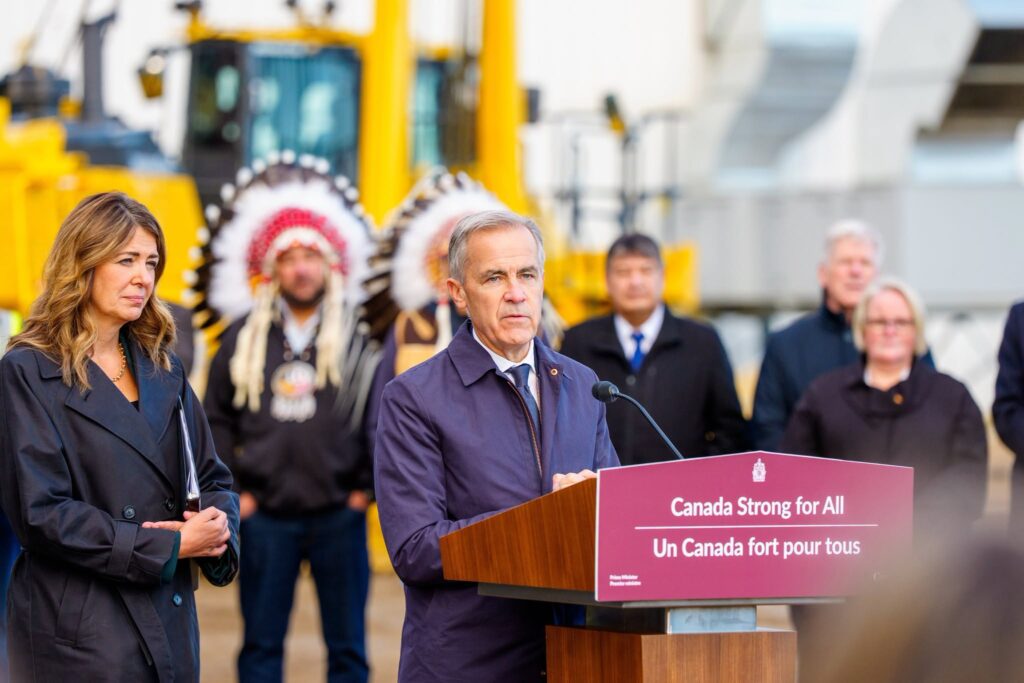
The artificial intelligence strategy announced by Mark Carney in early June promised to create hundreds of thousands of new jobs, boost Canadian productivity and help domestic AI companies, with “a clear goal of improving the lives of all Canadians,” according to the prime minister.
But a top advisory body to Carney’s Liberal government has also quietly identified another policy goal that wasn’t mentioned in the hotly anticipated “AI for All” roadmap. One of the top “public policy benefits to Canada” of constructing a national network of data centres is creating new markets for Canadian natural gas producers.
An internal Privy Council document from 2025 explained that the build-out of vast electricity-consuming data centres across the country can “provide markets for Canadian energy” and lead to “net new energy resources.”
The document, entitled “Investments in Canadian Data Centres”, was obtained by Greenpeace Canada and shared with DeSmog and The Tyee following a release under the Access to Information Act. It was prepared for the Clerk of the Privy Council, one of the top advisors to Prime Minister Carney.
A list of proposed data centres, which provide the computing power for AI, gives clarity on what kind of energy resources the federal government hopes to grow. Massive data centres proposed for Alberta, including the Kevin O’Leary-backed Wonder Valley project, will have their energy needs “supplied by natural gas,” the Privy Council document reads.
Carney could have insisted as part of his AI strategy that data centres be powered by renewable energy, said Keith Stewart, a senior energy strategist with Greenpeace Canada. But Stewart said the document shows that the federal government views AI as part of a fossil fuel growth strategy.
“This makes it clear that one of the main reasons that the Carney government wants to expand AI data centres is that so Big Oil can sell more gas,” Stewart said.
The Privy Council Office didn’t answer detailed questions by publishing time.
Doubts About Net-Zero
A key goal of Carney’s AI strategy is for 60 percent of businesses to adopt AI by 2034, up from about 12 percent currently.The Liberal government plans to support that goal with a $700 million fund to boost AI use among small and medium businesses.
All of that AI use will require a vast expansion of computing power in Canada. And the data centres that provide that power in turn require huge amounts of electricity. That has attracted the interest of Canada’s fossil fuel industry, which for years has predicted that data centres could drive up domestic demand for gas.
Privy Council Clerk Michael Sabia last year met with the Calgary-based company TC Energy, which operates a large network of natural gas pipelines across North America and owns gas-fired power plants.
According to a separate backgrounder prepared for Innovation, Science and Economic Development (ISED) Canada, also obtained by Greenpeace, Sabia and TC Energy discussed how proposed data centres in Alberta could connect to the company’s Natural Gas Pipeline network. “Energy availability and connection continues to be a key rate limiter in how quickly Canada will be able to scale its AI infrastructure,” it reads.
But the document acknowledged powering data centres with gas could impact Canada’s progress towards climate goals. “NRCan officials note that Federal responses to potential proposals will need to balance federal desire to reach net-zero emissions with provincial desires to attract investment and stimulate economic growth,” it reads.
TC Energy didn’t respond to questions about the meeting.
‘Gargantuan’ Gas Projects
The AI data centre proposals in the Privy Council document included three projects, two of which are located in B.C. and one in Quebec. All would be powered by hydroelectricity. These are relatively small projects requiring less than 100 megawatts of electricity.
Projects proposed for Alberta are massive in comparison. O’Leary’s Wonder Valley data centre park would require 7.5 gigawatts of energy, all of it supplied by natural gas. That’s potentially enough energy to power more than 6.5 million homes.
Wonder Valley is a “gargantuan” proposal that would involve constructing one of the top-ten biggest gas plants proposed right now in the world, according to Norway-based energy and climate analyst Ketan Joshi. A separate Gryphon Digital proposal in Alberta meanwhile requires four gigawatts of gas-powered energy, while the Beacon AI project is proposing two gigawatts worth of gas, the document notes.
Natural gas is plentiful and cheap in Alberta, said Werner Antweiler, an economics professor at UBC’s Sauder School of Business.
“It’s coming out of the ground, it’s not transported anywhere,” Antweiler said. “So you don’t have to pay for the pipelines —it’s locally cheap. That basically gives you a lower marginal cost than if you build a data centre running on natural gas somewhere in the United States where you have to actually get the natural gas pipeline there.”
The Privy Council document lists about 15.5 gigawatts of new gas capacity planned for data centres in Canada, although the ISED document notes that “it will not be possible for Alberta to connect all data centre projects in the short term” to the electric grid. Carney’s new AI strategy puts forward a lower estimate, suggesting that Canadian projects will require 5.5 gigawatts of power.
If the high-end scenario of 15.5 gigawatts materializes, it could cause an increase of somewhere between 33 to 63 megatonnes of annual greenhouse gas emissions, Joshi calculates, “effectively undoing the past 15 years of emissions reductions in Canada.”
But even at the lower end the climate impacts are daunting. “I am genuinely shocked by the size of these projects,” said Joshi. “If a tenth of these fossil-fuelled data centres were to be built, the increase in Canada’s emissions would be noticeable and substantial.”
Antweiler concurred that the very large size of the multiple data centres being proposed for Alberta — all powered by natural gas — will lead to a huge increase in Canada’s greenhouse gas emissions, even at the lower end of projections.
He calculated that four gigawatts of new gas-powered data centre capacity “would come to 10 megatonnes of CO2 per year, or about a 3.7 per cent increase in Alberta’s CO2 emissions.”
The Privy Council document doesn’t mention climate change, however. “These projects offer a number of public policy benefits to Canada,” it states. “In addition to the development of net new energy resources, Canada has an economic and innovation interest in seeing domestic Al data centre capacity grow.”
Expansion of Gas
Clean electricity regulations brought in under the previous Liberal government of Justin Trudeau would have limited the amount of fossil fuels that could be used to power data centres.
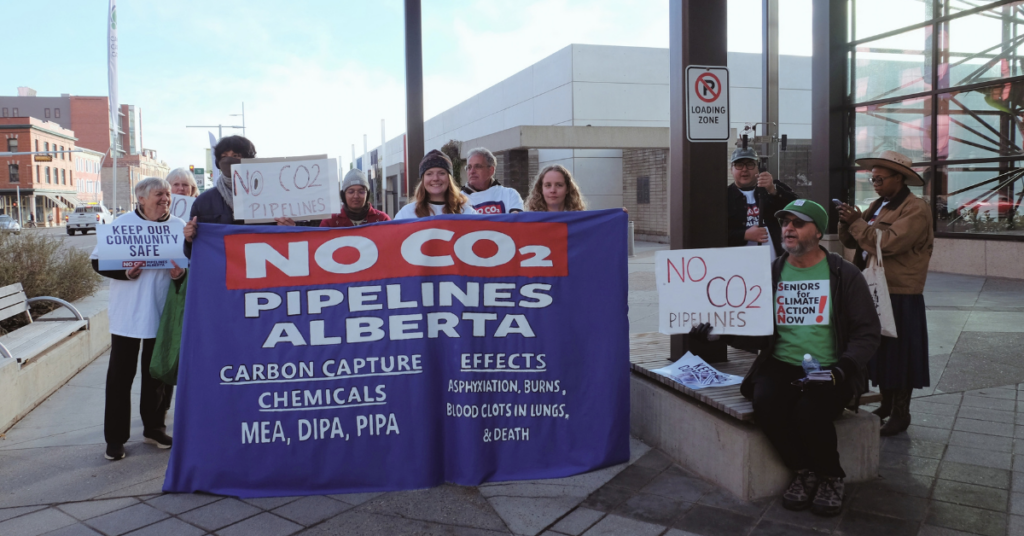
But those regulations were significantly weakened in the Memorandum of Understanding that Carney signed last year with Alberta Premier Danielle Smith, an agreement that also paved the way for a new oil pipeline to the west coast of B.C. and a $20 billion carbon capture and storage project in the Alberta oil patch.
Lobbying records show that the Alberta electricity company Capital Power, which is developing a gas-powered data centre project in the province, lobbied the federal government close to 40 times in the lead-up to the MOU announcement.
Carney’s AI strategy insists that “Canada’s approach will be to link new data centre development with clean energy expansion, robust environmental standards, and tangible benefits for local communities, ensuring that Canada remains at the forefront of sustainable high-performance computing infrastructure.”
But his government released a National Electricity Strategy in May that frames expansion of gas as a key factor in doubling Canada’s electric grid capacity by 2050, while describing renewables as “intermittent,” despite solar being the fastest growing energy source in the world.
Antweiler said building out data centres using renewables is possible — and energy sources like solar and wind can compete with natural gas on price.
“Increasingly renewable energy, even with attached storage, is getting cheaper and cheaper and cheaper,” Antweiler said. But he pointed out that Alberta put a moratorium on wind and solar projects in 2024. Though that has since been lifted, clean energy advocates say there continue to be barriers in the province for investment.
“There’s really no reason to say [date centre development] must be all done by natural gas, if they could allow renewable energy to be provided in the grid,” Antweiler said. “And then basically let the market figure out what is the right supply of electricity as opposed to saying, well, you have to have a natural gas supply.”
To Stewart the emphasis on gas, even when highly economic alternatives like wind and solar are being rapidly deployed around the world, is evidence of the continued political power of Canada’s oil and gas industry.
“The federal government could have easily said data centres have to be powered by new renewable energy sources,” Stewart argued. “Instead, Canadians will get dirtier air alongside higher electricity prices, all so corporate CEOs can try to take away our jobs with AI.”