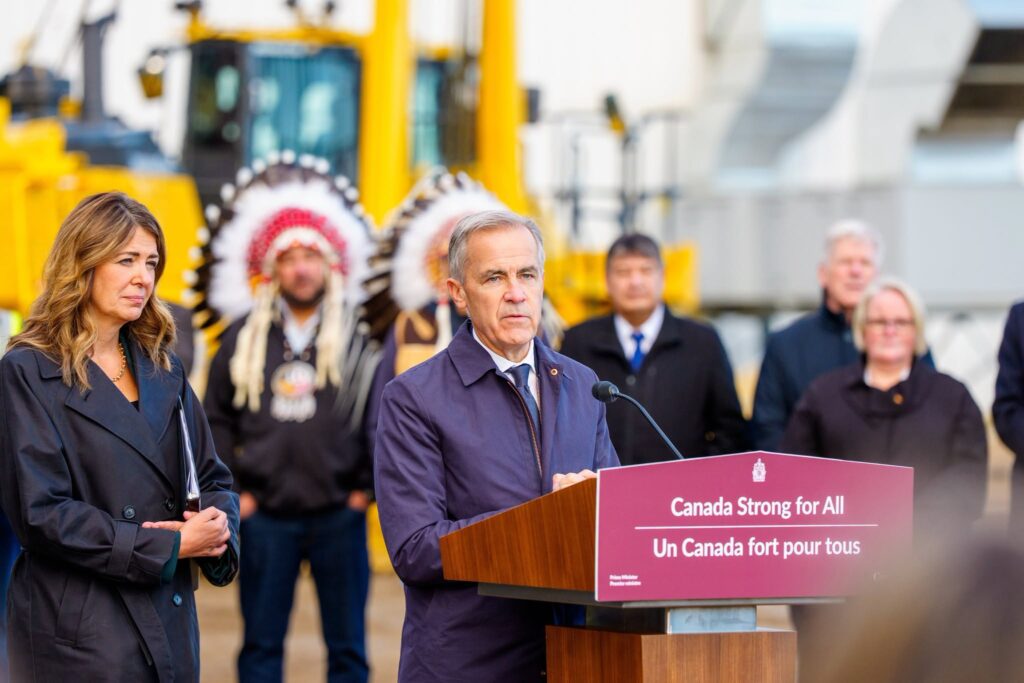

Was it all just bullshit? After bold talk of a “grand bargain” between Ottawa and Alberta, the much-hyped memorandum of understanding between premier Danielle Smith and Prime Minister Mark Carney seems to be devolving into a undignified series of federal capitulations around carbon pricing and clean energy regulations. Seemingly smelling blood in the water, the oil patch continues to crank up their open-air lobbying efforts for ever more policy concessions, including perhaps nixing the Pathways project itself.
The Pathways Alliance carbon capture and storage (CCS) project – long promoted by the five largest bitumen producers as the largest CCS project in the world – never seemed to amount to more than a website and an advertising campaign. No detailed plans were ever made available. No shovels in the ground despite years of public spin, even with the federal government offering a 50 percent tax credit on the $20 billion project.
There now seem to be significant shifts in Pathways’ public messaging – starting with its name. The Pathways Alliance rebranded itself the Oil Sands Alliance in late February, “to better reflect the purpose and mandate of the organization to promote growing the oil sands industry”. After investing four years of expensive advertising effort, why would the largest bitumen producers now be relegating the CCS portion of their alliance to the back seat?
Then in April of this year, former British Columbia Premier Gordon Campbell – a conservative political veteran not given to going off script – told a pro-business audience that carbon capture and storage was a waste of time and money. “It’s time to take off the blinders. Carbon capture and storage is something we’ve talked about in Canada for more than a generation”, Campbell said in a keynote address to the Canada Strong and Free conference in Vancouver. “It doesn’t work. It costs money.”
A week later, Martha Hall Findlay, one of the original co-founders of Pathways Alliance, published a Globe and Mail op–ed saying “this is not the time” to do carbon capture in Canada. She instead equated funding to limit the oil patch’s massive carbon emissions with a cash-strapped household wasting money on “DoorDash, a vacation, or even a donation to a worthy cause that you will feel good about.”
Really? The Pathways Alliance assured the world at the United Nations’ COP27 climate conference in 2022 that its long-delayed CCS project was an important part of the climate solution. “There’s a recognition that there’s a massive decarbonization challenge ahead of us as Canadians and globally”, said Pathways President Kendall Dilling. “No one party can do that on their own, we have to be working together.”
Hall Findlay was not suggesting that Ottawa and Alberta abandon their memorandum of understanding towards building a new bitumen pipeline to the west coast, only that the carbon capture portion of this “grand bargain” should be jettisoned because “the world – and the facts – have changed dramatically.”
What has changed dramatically has been the profitability of Canadian oil companies due to the ongoing war with Iran. Suncor just raked in $2.1 billion in windfall profits for the first three months of 2026 – up $410 million from the same period last year. Canadian Natural Resources Limited likewise saw $2.4 billion in net revenue over the same period, while shoveling $1.5 billion to their mostly non-Canadian shareholders in the form of dividends and buybacks.
Yet these same companies are now saying that they somehow now cannot afford industrial carbon prices of about 50 cents per barrel. Or that their long-delayed Pathways project is apparently beyond their ability to finance, even though the Canadian public is on the hook for 50 percent of the capital costs.
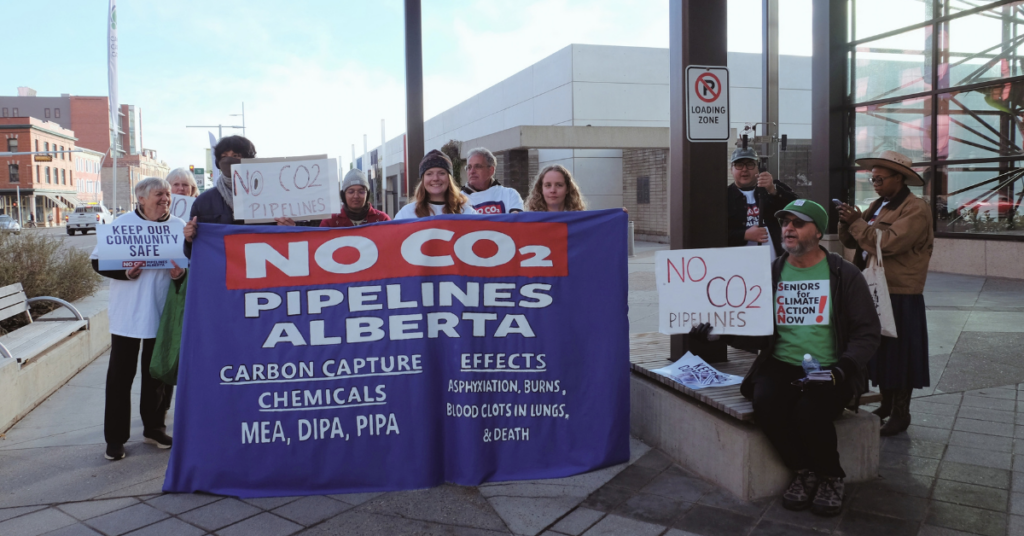
Other clues lie in open view that perhaps the Pathways CCS was merely a useful fiction rather than a serious project. The member companies of Oil Sands Alliance preside over the world’s largest industrial project and have obvious experience delivering large capital installations. Pathways CCS would require a 400 km CO2 pipeline and infrastructure to inject production emissions into an underground reservoir over three times the size of Prince Edward Island.
So where are the detailed planning documents? Why has there not been meaningful Indigenous consultation? Why is industry insisting that this massive endeavor be exempt from a federal impacts assessment? Or that the project was broken into over 120 portions to avoid a provincial environmental assessment?
Instead of delivering on essential planning documents or public consultation for a massive CCS project, the Oil Sands Alliance is turning up the heat on Ottawa to apparently make such requirements go away. The most recent regulatory capitulation is a pending bill to allow cabinet approvals for major infrastructure projects prior to any environmental assessments.
“It’s worse than what [former Prime Minister] Harper did…,” Steven Guilbeault, the Liberal MP and former environment minister told the Toronto Star. “We will have no way of evaluating or understanding…the human health and environment impacts of projects we are approving.” “If this is adopted, is going to be economic development and nothing else will matter.”
And what about the memorandum of understanding between Alberta and Ottawa? “The game is bait and switch,” Professor Amir Attaran of University of Ottawa told DeSmog. “Alberta agreed, and Danielle Smith agreed with Mark Carney that Pathways was part of the deal for a pipeline and relaxing the clean energy regulations. They know they can’t make it work, so now they’re pointing to the conflict in Persian Gulf to get their pipeline without having to do what they promised. It’s all about renegotiating the deal without saying that they lied in the first place to get the deal.”
Perhaps the best place to understand the priorities of the oil patch is in the pages of the Globe and Mail. Hall Findlay’s op-ed audaciously abandons the carbon mitigation project she long publicly championed: “Let’s reframe the effort into a better version of Pathways, one that uses its public-private and federal-provincial collaborations to support more energy production and the building, instead of a CCUS project, of a pipeline to sell more of what we have to the world.”
In other words, a wildly profitable industry wants the taxpayer to fund another pipeline to the Pacific with no emissions abatement. Is that a grand bargain? Or is it just bullshit?