
During the 2025 local elections, Reform UK campaigned for the introduction of a “DOGE for every local authority” – a special unit modelled on billionaire Elon Musk’s “Department of Government Efficiency” in U.S. President Donald Trump’s administration.
Party leader Nigel Farage said his “Department of Local Government Efficiency” (DOLGE) would make sweeping cuts in “fat and lazy” councils “taking the taxpayer for mugs” by wasting money on, among other items, “diversity agendas” and “climate change”.
A year on, Reform now has control of 24 local authorities, after winning another 14 in last week’s (7 May) local elections.
What can these councils expect, based on Reform’s past 12 months in local government, and how will this affect climate policies?
Edward de Quay, a policy analyst at the London School of Economics’ Grantham Institute, gave an indication. “We now know what to expect from a Reform run local authority on net zero and climate change,” he told DeSmog.
“We should be prepared for the majority of those won on 7 May to drop their climate targets and remove climate related language from documents,” adding that “we can also expect further promotion of climate change denial from councillors”.
Climate Targets and Committees Scrapped
Scrapping climate policies is a Reform fixation. The party – which is heavily funded by fossil fuel interests – has vowed to “scrap” the UK’s 2050 net zero emissions target, end subsidies for wind and solar power, fast-track new oil and gas exploration, and open new coal power plants.
In May 2025, Reform won majorities in 10 local authorities: Doncaster, Derbyshire, Durham, Kent, Lancashire, Lincolnshire, Nottinghamshire, North Northamptonshire, West Northamptonshire, and Staffordshire.
Three of these – Durham, Kent, and Staffordshire – passed motions to formally “rescind” their previous declarations acknowledging a “climate emergency”, which had committed the bodies to take climate action.
According to the Grantham Institute, seven of these local authorities scrapped their targets to achieve net zero emissions, to be carbon neutral, or both.
For example, Kent County Council – which Reform has described as its “shop window” for a future Farage government in Westminster – dropped its 2030 net zero target, replacing it with an “energy efficiency plan”. As a council document stated: “KCC’s net zero 2030 target is unattainable and is not deemed to represent best value for money for Kent residents.”
Scientists have warned of a “rapidly closing window” to limit temperatures rises to 1.5C and avoid the worst impacts of climate change, while the entire cost of cutting emissions in the UK to net zero by 2050 is estimated to be less than a single fossil fuel price shock.
Reform has also scrapped a number of climate and environment committees in its local authorities. In Derbyshire, the party abolished the Climate Change, Biodiversity and Carbon Reduction Committee, claiming its work would be covered by other bodies.
In Lincolnshire, it abolished the Flood and Water Management Scrutiny Committee, which oversaw flood defences for the area. As DeSmog has reported, Lincolnshire – which has seen hundreds of homes destroyed in storms over recent years – is one of the country’s most vulnerable regions for flooding.
Reform also pledged to scrap Low Traffic Neighbourhoods (LTNs) – schemes designed to cut traffic and vehicle pollution – in all of the areas it controlled, despite none existing in these local authorities.
Reform’s Missing Net Zero “Savings”
Reform’s has overseen a bonfire of climate pledges, yet the party’s efforts do not appear to have yielded much in the way of money saved.
The party has struggled to find savings in cash-strapped local councils. As one cabinet member in Kent told the Financial Times in October: “Everyone thought we’d come in and there were going to be these huge costs we could cut away but there just aren’t.”
Reform has claimed to have cut more than £300 million from local authority budgets since May 2025 – a figure roughly confirmed by the Financial Times – while the party has also raised council tax by £250 million.
However, very few – if any – of these “savings” appear to have come from scrapping climate policies, and the party has not provided a detailed breakdown of its cuts.
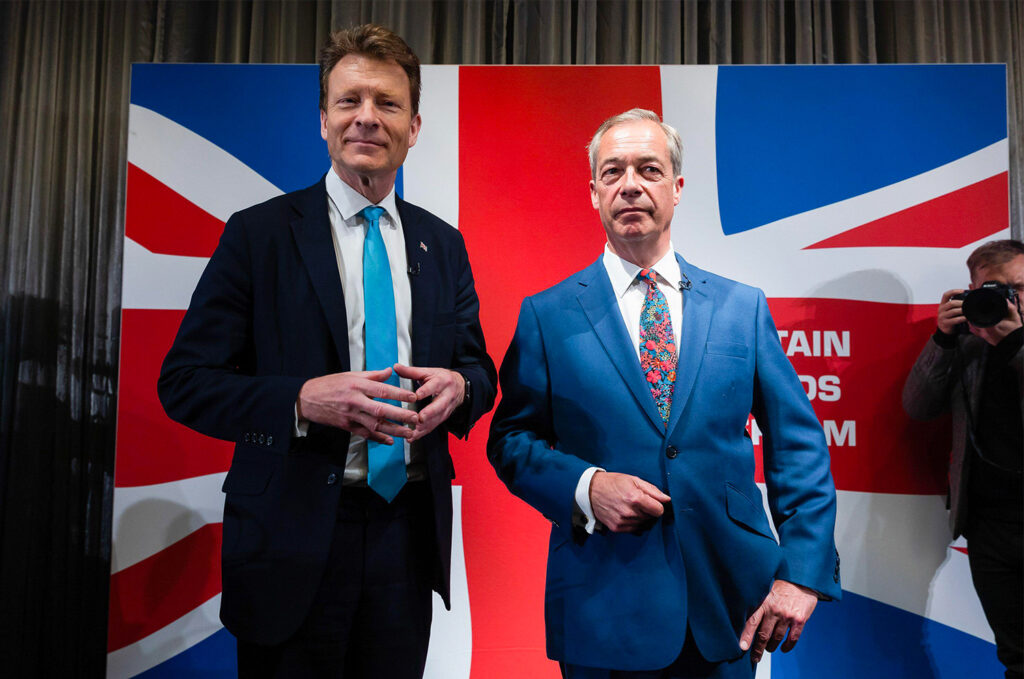
Photo: Sipa US / Alamy
What’s more, the few examples provided by Reform of savings made from slashing climate schemes have been disputed.
Kent County Council claimed it had saved £40 million by “rescinding net zero targets”, adding that this included blocking the installation of solar panels on council buildings and stopping council cars from being replaced with electric vehicles. But these were reportedly “potential capital projects”, for which funding had not yet been allocated.
It has also been pointed out that installing solar panels helps councils to save money, reducing their reliance on volatile energy sources. In Durham, the Reform council scrapped a solar panel decarbonisation scheme that Liberal Democrat councillors said would have saved the authority £77,000 per year.
Reform has put “scrapping net zero” at the centre of its pledge to cut up to £400 billion from public services. However, experts have warned that the party’s anti-climate drive will cause an economic shock, with a report by the New Economics Foundation last year concluding that Reform’s anti-renewables agenda could cost 60,000 jobs and wipe £92 billion off the economy.
Broadcasting Climate Science Denial
While Reform’s net zero purge has not saved much money, it has been used to spread old-school climate denial.
A “background information” document released by Kent County Council to support the rescinding of its climate emergency declaration said: “It is often stated that anthropogenic climate change is ‘settled science’ and that the whole scientific community believes it. However, this is far from the case.”
The document cited various climate science denial groups, including the Global Warming Policy Foundation (GWPF), which has claimed carbon dioxide emissions are “a benefit to the planet”, and the CO2 Coalition, a U.S. group which describes CO2 as “plant food”.
These opinions are matched by Reform’s senior leaders, who reject basic climate science. Farage has himself claimed it’s “absolutely nuts” for CO2 to be considered a pollutant.
And Reform’s councillors have used their positions to further these climate denial narratives. Bert Bingham, Reform’s cabinet minister for transport and environment at Nottinghamshire County Council, told a council meeting in July: “I’ve never seen such nonsense as the anthropogenic global warming hoax.”
The UN’s Intergovernmental Panel on Climate Change (IPCC), the world’s leading climate science body, has said it is “unequivocal” that human influence has caused “unprecedented” global warming.
“What stands out is not only that misinformation is being expressed by elected officials, but that it is being used in motions and debates to support formal decisions,” said Pallavi Sethi in a report by the anti-racism group Hope Not Hate about Reform’s actions in local government.
“This represents a worrying shift where climate misinformation has moved from the margins into local government decision making, which will ultimately affect millions of people.”