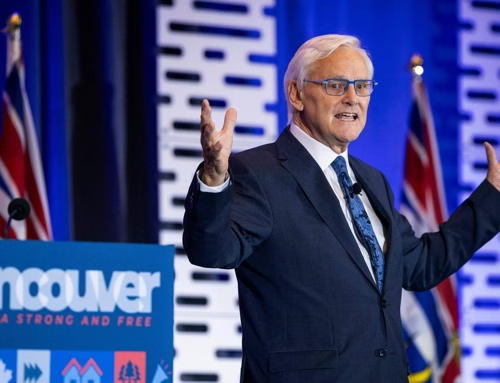
For years, Canadian officials and oil industry backers have pitched carbon capture and storage (CCS) as the solution that would allow Alberta’s oil sands — and the nation’s proposed west coast pipeline — to proceed with a lower climate impact. Now, in a speech at this year’s Canada Strong and Free Network (CSFN) conference in Vancouver, keynote speaker and former British Columbia Premier Gordon Campbell warned the costly, troubled technology has failed to deliver, undercutting a central justification for billions in public subsidies and new oil infrastructure.
This reporter was there in person at the April 24 CSFN gathering. Formerly the Manning Centre for Building Democracy, the CSFN self-describes as supporting “conservative and libertarian activists and ideas in Canada”. Imagine a MAGA-adjacent gabfest featuring speakers mostly cheerleading extractive industries or fear-mongering about First Nations rights. My already low expectations were not exceeded.
However, there was an unexpected utterance of truth from Campbell, who was the first elected leader in North America to bring in a carbon tax. And what does he think about the technology being touted to clean up ballooning emissions from the Alberta oil sands and justifying a new pipeline to the BC coast?
“It’s time to take off the blinders. Carbon capture and storage is something we’ve talked about in Canada for more than a generation, more than 25 years,” he told the conference. “We’ve invested billions of dollars trying to convince ourselves that carbon capture and storage will work. It doesn’t work. It costs money. And that money is money that we take out of other potential productive resources that we could have for Canadians.”
Campbell was certainly not suggesting that fossil fuel extraction be scaled back. His comments instead pointed out that pretending to solve emissions problems with expensive and ineffective carbon capture and storage is an unwise waste of scarce public resources. This unusual truth-bomb from a public figure stands in stark contrast to the theater playing out in Alberta and Ottawa, where CCS is being heavily promoted and backed by billions in public money as a panacea for oil sands climate costs.
Even a Pathways Alliance co-founder is now publicly coming out against the CCS project in a recent Globe and Mail op-ed, equating long-delayed efforts by the oil patch to limit its massive carbon emissions with a cash-strapped household wasting money on a vacation or meal deliveries. Is Big Oil now pivoting away from a marquee carbon capture project it never intended to build?
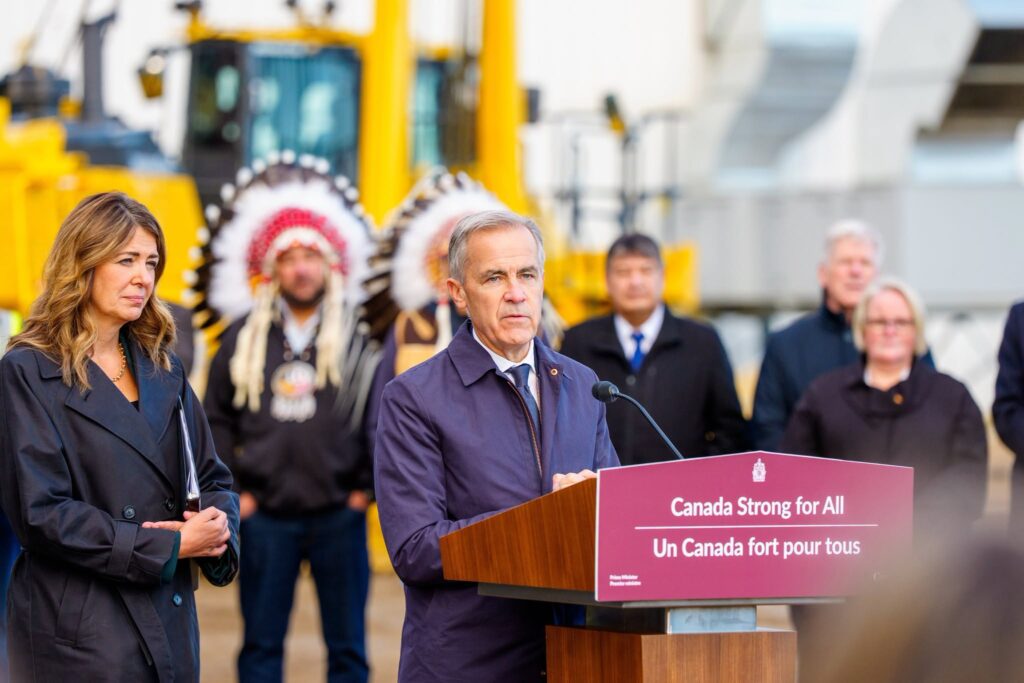
Meanwhile the government of Prime Minister Mark Carney claims that the $20 billion CCS project being promoted by the Pathways Alliance will make “Alberta oil among the lowest carbon intensity-produced barrels of oil in the world.” This multi-billion-dollar boondoggle has been offered as a “grand bargain” between Ottawa and Alberta to facilitate a new bitumen pipeline outlined in their now-overdue memorandum of understanding.
This confident public posturing was made despite internal briefing notes accessed by DeSmog showing Pathways had “…few front end engineering (FEED) studies done and initial cost estimates based on very limited project information”.
DeSmog previously reviewed 12 large scale CCS projects around the world and found “a litany of cost-overruns and missed targets, with a net increase in emissions.” Only 50MT of CO2 are sequestered each year by CCS, representing a mere 0.1 percent of global greenhouse gases.
A recent study published in the prestigious journal Nature showed that a shortage of suitable geological formations worldwide limit CCS to mitigating only a puny portion of dangerous emissions. And even if injecting all production emissions underground was somehow perfectly effective, it would do nothing to alleviate the other 80-90 percent of downstream tailpipe greenhouse gases.
Such shaky fundamentals have apparently had little impact on government enthusiasm for throwing billions in public money towards dubious CSS schemes. The federal government has committed to covering half of the $20 billion estimated cost of the Pathways CCS project in tax credits, and the Alberta government is pledging to shovel billions more towards the highly profitable members of the Pathways Alliance.
Pathways Alliance companies — recently renamed as the Oil Sands Alliance — include Canada Natural Resources Ltd, Cenovus, ConocoPhillips, Imperial Oil, MEG Energy, and Suncor, representing 95 percent of Alberta’s bitumen production. These giants enjoyed $37 billion in combined profit in 2023 and will reap billions more in windfall profits with oil above $100 per barrel due to Trump’s war on Iran.
A ‘Generous Transfer Provision’
A good yardstick of whether the Pathways project is credible is revealed in action, not words. Despite years of public spin and lobbying by Pathways members, the largest bitumen producers still stubbornly refuse to pony up any of their own money towards beginning construction even as Canadians struggle with historically high prices at the gas pump.
If carbon capture is so safe, why has the oil patch lobbied to wash its hands of long-term CCS liabilities? In a system unique to Alberta, the province assumes the long-term risks associated with CO2 storage once a closure certificate has been issued, a concession to the oil industry described as one of the most “generous transfer provisions” of any CCS scheme in the world.
Documents obtained by the Narwhal also revealed that Pathways Alliance president Kendall Dilling asked Ottawa for “assurance that the Pathways pipeline, hub and capture projects would not require a federal review under the Impact Assessment Act.”
In Alberta, regulators allowed the largest CCS project in the world to be broken into over 120 separate proposals to avoid triggering a provincial environmental assessment. Does this kind of maneuvering inspire confidence?
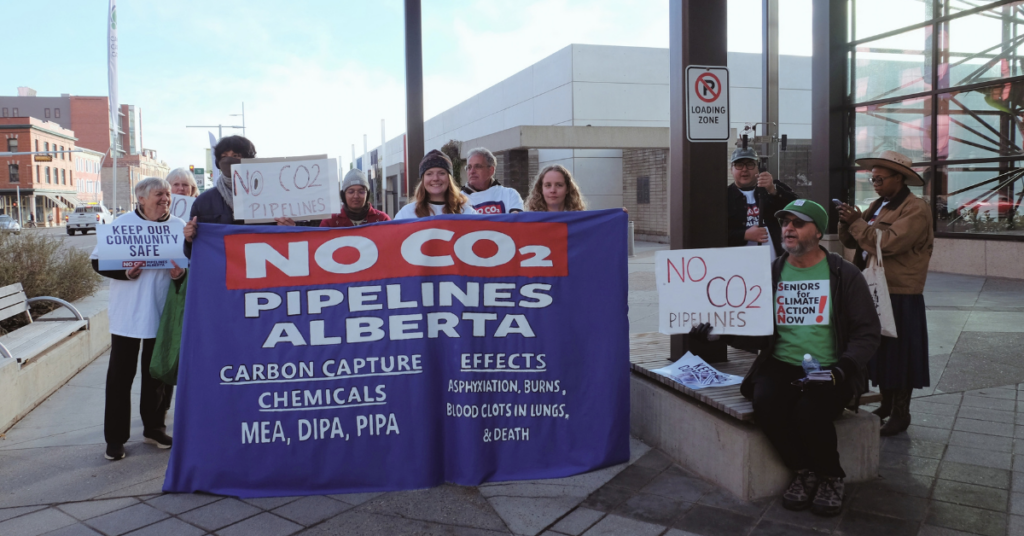
Not for local residents facing risks of a potentially deadly CO2 leak from a pipeline rupture, as occurred in Sataria, Mississippi where 49 people were hospitalized in 2020. Rural Albertans living close to the proposed 600 kilometre CO2 pipeline from the oil sands to Cold Lake have recently come together in an unlikely alliance of farmers and Indigenous leaders opposed to the Pathways project called “No CO2 Pipelines.”
“Thousands of Albertans like me live directly in this project’s ‘hazard zone’”, said Penny Fox, No CO2 Pipelines co-founder, in a press release. “In an explosion, people in our communities are facing anything from breathing issues to brain damage to instant death. So I have one question for the Prime Minister: if you wouldn’t live next to this pipeline, why should we?”
“We’re talking about hundreds of kilometers of pipeline that pass directly through areas where we live, hunt, fish and exercise our treaty rights”, Chief Allan Adam of the Athabasca Chipewyan First Nation has said. “This project endangers our people, our land, our water and wildlife. And yet there has been no consultation, no information sharing, and no formal environmental assessment.”
Gordon Campbell makes a good point. The Pathways project will cost the taxpayers billions and do nothing to contain the vast majority of ultimate oil sands emissions. Other Canadian industries have managed to cut greenhouse gases by one quarter since 2005, while bitumen producers have seen their emissions explode by 143 percent over the same period.
Why should highly profitable oil industry laggards still expect public handouts before cleaning up their own mess?