

Corporate Canada insists that partnering with First Nations on new natural resources projects will bring prosperity to Indigenous communities and address the country’s long history of colonialism.
But there is also a simpler and more transactional reason that companies have for years embraced the idea of so-called “economic reconciliation”. When a natural resources project is able to bring on an Indigenous partner, it speeds up approval times and reduces political and regulatory risk.
That’s according to representatives of mining and fossil fuel companies who spoke candidly about the economic benefits of Indigenous partnerships during a recent economic reconciliation conference in Ottawa.
“I think a lot of mining companies would love nations to take equity ownership in their projects, especially early stage ones, because it helps de-risk the project,” said Sharon G. K. Singh, a lawyer and co-head of McMillan LLP’s Indigenous and Environment practices, according to audio obtained by DeSmog from the event.
When asked who benefits from the lower risk in this situation, Singh replied that she didn’t have time to provide a lengthy response, but that “one needs to be clear on what we mean by participation before one can answer for whom does it de-risk for.”
(On July 30, 2026, Sharon Singh contacted DeSmog to say that while she had been quoted accurately, her comments were made in a broader context that equity participation is not in and of itself sufficient. In a subsequent email, Singh told DeSmog that “Without alignment and a strong foundation of project acceptance built on multiple factors for an Indigenous community at the outset, equity is not a solution. Too often, equity is viewed as a mechanism for accelerating project approvals.”)
Matthew Jackson, Vice President, Indigenous Partnerships and Business Development at Hydro One, an electricity transmission utility in the province of Ontario, similarly advocated for Indigenous equity partnership as a means to reduce legal and political conflicts as much as speeding up processes overall.
“We had First Nation governments who were refusing to work with us… we had the provincial government concerned with our ability to deliver,” said Jackson in a presentation on the Aamjiwnaang First Nation and Kettle & Stony Point First Nation’s acquisition of a 20 percent stake in a new transmission line.
Jackson said that after the equity model was adopted the project timeline was expedited by as much as 40 percent.
DeSmog attempted to contact Jackson, but Hydro One media relations replied he was not available, offering instead that any point Jackson made at the conference should only be applied narrowly to his experience with Ontario Indigenous communities, in the context of his work with Hydro One.
Natural resources companies are completely missing the point of reconciliation when they view it only terms of getting their projects approved faster, argued Janelle Lapointe, Senior Advisor, Indigenous Strategic Approach, with the non-profit David Suzuki Foundation.
“It is deeply concerning that Indigenous partnerships are framed as a way to “de-risk” projects,” she told DeSmog. “This framing reduces the rights, laws and jurisdiction to a transactional tool for project approval. We are not here to help governments or corporations manage investor uncertainty, but to exercise inherent authority over our lands and waters for future generations.”
‘De-risked for whom?’
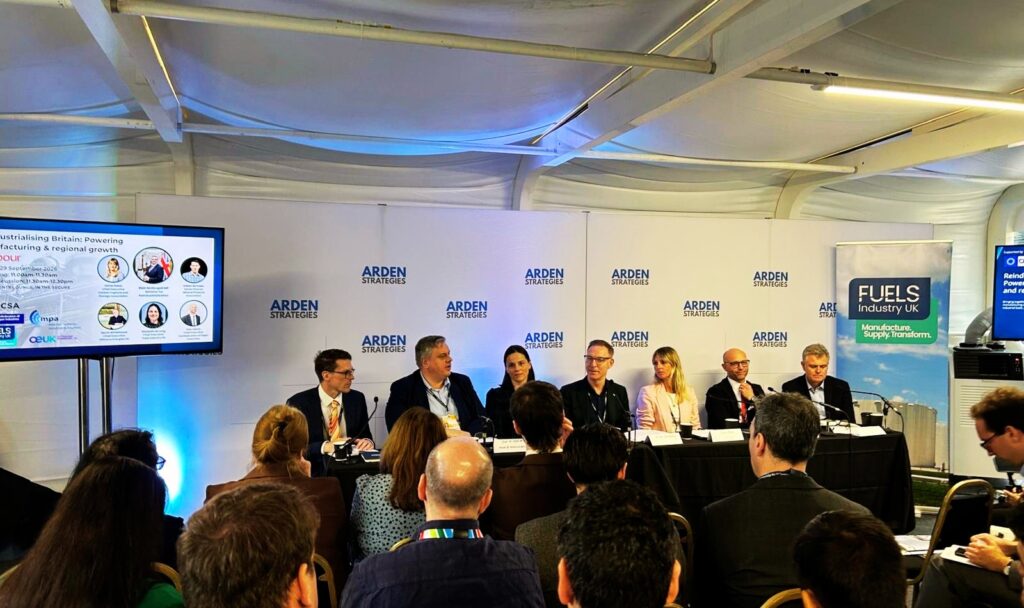
The Economic Reconciliation Summit was held in Ottawa on April 14. The conference is a project of Canada 2020, which claims to be Canada’s “leading, independent progressive think-tank.” Canada 2020’s partners include major players from the world of tech and energy, such as Meta, Amazon, TC Energy, Enbridge, ATCO, and the Canadian Association of Petroleum Producers.
“Project delays driven by permitting bottlenecks and consultation failures cost Indigenous communities, industry, and Canada alike,” reads a description for one panel at the summit.
The event featured industry panelists including Mark Cameron, Vice President, External Relations for the Pathways Alliance, a consortium of Canada’s largest oil sands producers. Cameron acknowledged that industry is forced to reckon with a long line of court decisions protecting Indigenous rights when advancing new projects.
“Aboriginal rights are constitutionally entrenched,” said Cameron. “There’s a generation of jurisprudence behind it… and on top of that, we’ve layered on Canada’s adhesion to UNDRIP… so we can’t walk away from these obvious issues.”
Cameron did not reply to DeSmog’s request for comment.
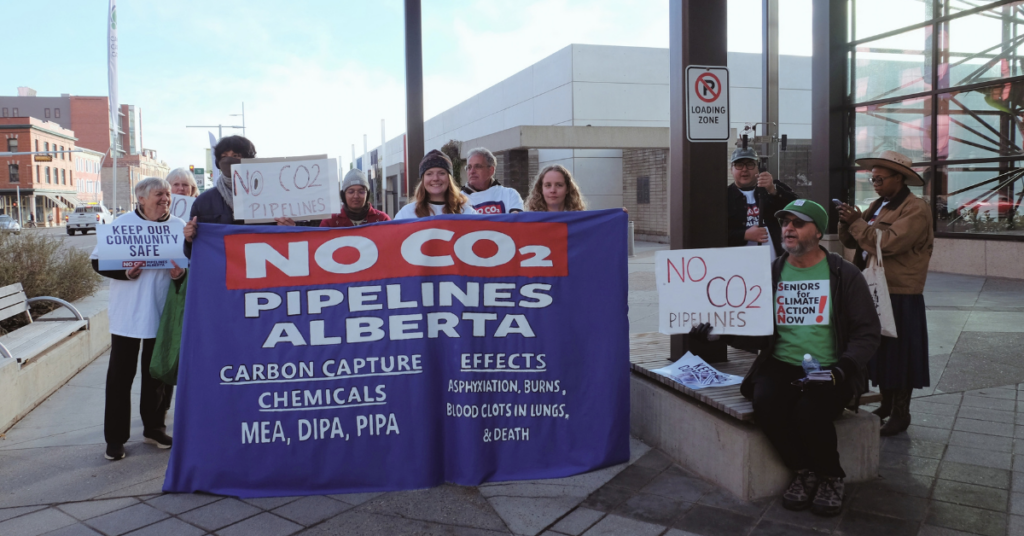
Pathways plans on building a $20 billion (CAD) carbon capture and storage hub in northern Alberta, including a 400-kilometre CO2 pipeline network. In 2023, DeSmog reported that Cold Lake First Nations chief Kelsey Jacko said Pathways Alliance had not consulted with his community.
Kristan Straub, CEO of the Canada Indigenous Loan Guarantee Corporation (CILGC), was explicit about the gains companies can expect by partnering with First Nations, saying “Indigenous equity ownership strengthens projects by aligning interests, increasing certainty over the long-term, and gives legitimacy to projects.” CILGC is a crown corporation that’s mandated to support Indigenous economic participation by providing loan guarantees that enable Indigenous ownership in major projects.
DeSmog attempted to reach Straub for comment through GILGC, but received no response.
Raylene Whitford, a Métis chartered accountant and former energy executive found this concerning: “I think a key issue here is that Indigenous equity participation in major projects is increasingly being conflated with the right to free, prior and informed consent,” said Whitford in a statement to DeSmog. “Governments and project proponents use the broad language of ‘Indigenous support’ to blur that distinction.”
Whitford argues equity participation should not be treated as de facto consent.
“A project is only meaningfully de-risked when all impacted Indigenous Nations have consented to the project proceeding, regardless of whether any one Nation has a financial interest in it. So when governments, industry, or investors describe Indigenous equity partnerships as a way to ‘de-risk’ resource projects, we have to ask: de-risked for whom?”
Lapointe noted that Indigenous partnerships do not de-risk projects for communities themselves. “In many cases, we are the ones asked to shoulder the greatest risks of threats to ecosystems, social division, economic dependence on volatile industries, financial risks, and stranded assets,” Lapointe explained.
‘Shield against opponents’
Securing Indigenous partnership in resource projects has been a trend in recent years, with companies in the fossil fuel and mining sectors, as well as Canadian politicians, advocating for Indigenous equity stakes.
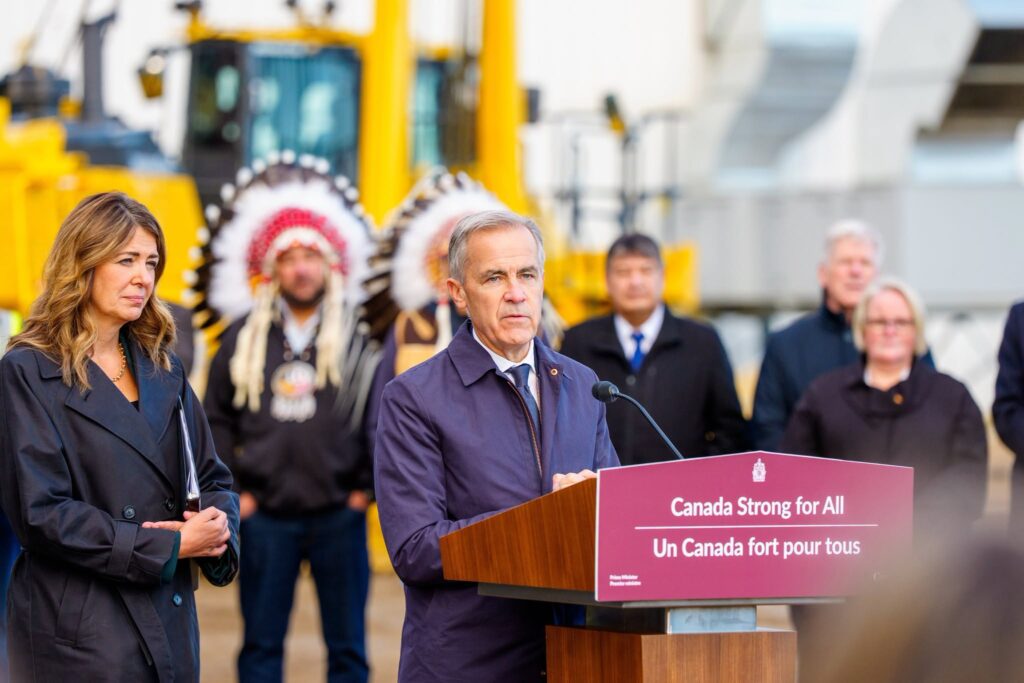
Encouraging Indigenous economic participation as a central aspect of reconciliation is emphasized by both Canadian Prime Minister Mark Carney as much as opposition leader Pierre Poilievre. A March 2025 statement ahead of a meeting with Indigenous leaders indicated Carney wanted to “embed meaningful reconciliation with Indigenous communities, ensuring that their leadership and perspectives are integral to building a thriving, inclusive economy.” In a statement made on Canada’s National Day for Truth and Reconciliation, Poilievre said a Conservative government would pursue economic reconciliation: “unlocking responsible resource development with willing Indigenous partners, creating good-paying jobs, [and] building revenue for communities.”
Though this approach has over the years been framed as being for the economic benefit of Indigenous communities, it also has clear political benefits for natural resource companies. Enlisting pro-industry Indigenous voices to support projects is part of a campaign to provide “a shield against opponents,” according to detailed strategy documents from the Macdonald Laurier Institute, an Ottawa-based conservative think tank, obtained by DeSmog.
Fossil fuel sector insiders have also referred to Indigenous participation as the ‘magic sauce’ to getting the green light for new development projects.
Yet some under-resourced Indigenous communities have few options when it comes to economic development on their territories. The promise of financial gains, even when they come at the expense of the environment, can be compelling.
“In some places, people are dealing with hard choices,” said Kai Nagata, Energy and Democracy Director with Dogwood. “I think there are communities where the best available option seems like it’s with a big project.”
While Nagata recognizes that there are some examples where industry has followed through on their promises and developed good relationships with Indigenous communities, there are other examples he described as “outright predatory.”
Lapointe argues that extraction is not the only path forward to Indigenous prosperity.
“Indigenous leaders worldwide have been clear that what is needed is a transition way from fossil fuels that respects full decision making as Rights and Title holders, and allows the ability to withdraw consent at any time,” said Lapointe. “It is troubling that in this time of global leadership for a just transition, Canada is moving towards a watered-down version of reconciliation and attempting to tie Indigenous communities closer to extractive projects.”
CLARIFICATION (08/03/2026): This article has been updated to include comments sent by Sharon Singh.