

The midterm elections brought a blue wave for Democrats and a green wave against data centers, helping to flip a number of key races in areas firmly opposed to AI expansion.
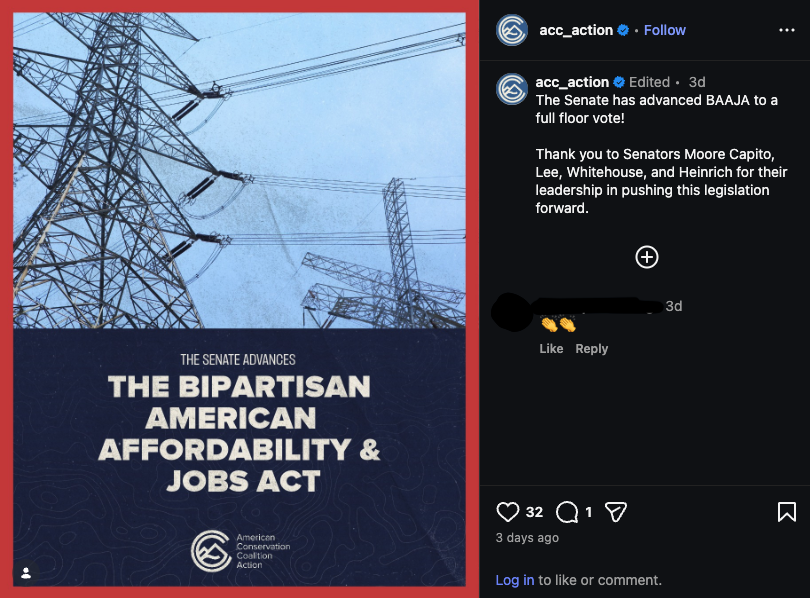
But a divisive bill that’s currently advancing through Congress — known as the Bipartisan American Affordability and Jobs Act (BAAJA) — could provide a last-ditch effort for companies seeking approval for construction of projects like data centers on federal public lands.
Among those leading the lobbying and public relations push to pass the Senate’s permitting reform bill, are a trifecta of overlapping special interest groups: AI companies, fossil fuel giants, and a conservation group that once hailed itself as the Republican environmentalist’s alternative called The American Conservation Coalition (ACC) and its 501(c)(4) sister organization.
An investigation by DeSmog has found that in the past year the ACC, which runs chapters across college campuses and has roughly 150,000 members, has come out in favor of data centers and has pushed messaging that they are a strategic neccesity.
It’s partnered with AI and gas companies to influence stakeholders. Since 2025, the ACC and American Conservation Coalition Action, collectively, have hosted at least three “energy freedom” events with U.S. Cabinet secretaries as headliners, published “energy dominance” study guides and electric transmission reform frameworks aimed at policymakers, and most recently spent $300,000 lobbying to pass two federal bills — including BAAJA — that would make building data centers easier, DeSmog found. ACC has acted with financial support from some of the companies with the most to gain from data center growth — Amazon, Anthropic, ExxonMobil, and Continental Resources — as well as right-leaning nonprofits and foundations.
“Reforming America’s broken permitting system is a generational opportunity to unleash clean, firm energy projects, like nuclear and geothermal, as well as transmission buildout to meet rising energy demand,” ACC Vice President of Communications Karly Matthews said in a statement provided to DeSmog. “Permitting reform should not mean a negation of all environmental standards, but our current anti-building mindset cannot continue.”
In an ACC report on the environmental impacts of data centers, the organization wrote that data centers should “Invest in affordable, reliable, and clean American power by…deploying innovative sources such as advanced nuclear, geothermal, and renewables + storage.”
Conservative Environmentalism Takes on ‘Stuck’ Data Center Conversation
When a group of Republican college students launched the American Conservation Coalition in 2018 during President Trump’s first term, they introduced it as the right’s alternative to liberal environmental groups.
The ACC promoted the idea of conservative environmentalism and sought to offer environmental solutions without big government to engage “conservatives disaffected by alarmist climate change rhetoric.”
News articles at the time promoted the ACC as Republicans with a climate conscience.
“Meet the 20-year-old Republican with an environmental agenda,” read one Grist headline.
“Climate change is finally getting political cred with Republicans,” read another Axios article.
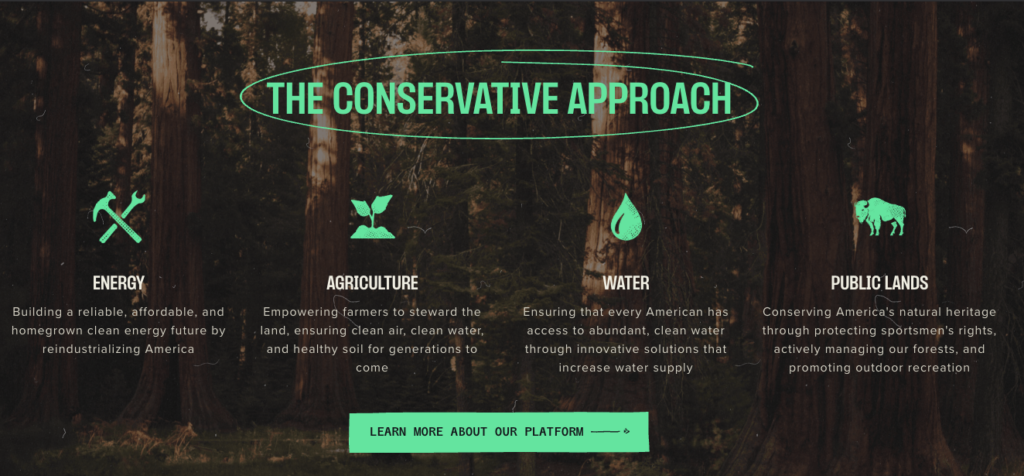
The ACC’s mandate was simple. Republicans cared about environmental issues, but they didn’t have a place in their party to express it. The group offered them a way to get behind three pillars: renewable energy, supporting farmers (in part through water conservation), and protecting public lands. Among their initial “principles of conservative environmentalism,” was stewardship of the natural world and preferences for market-based solutions.
The ACC frequently invoked former president Theodore Roosevelt, who was responsible for greatly expanding the early national park system.
“This topic of environmental conservation is seen as a left-wing issue, however Mr. Teddy Roosevelt, arguably the father of the modern environmental movement, was a conservative,” read one ACC blog post from 2020. “Although the Democratic Party seems to have wielded the reins on environmental policy, the Conservative Sensibility has its roots in being stewards of the environment.”
But in recent years, the coalition has pivoted to advocating strongly for a new policy linked to an issue many could argue is the antithesis to environmentalism and land conservation: data centers.
“The data center conversation is stuck in an all-or-nothing power struggle between AI-accelerationists and skeptics calling for a moratorium,” wrote ACC President Chris Barnard in a Substack post from September. “Local communities are rejecting data center developments across the country, in large part over environmental and land use concerns. The better answer is to build more creatively, not to block building altogether.”
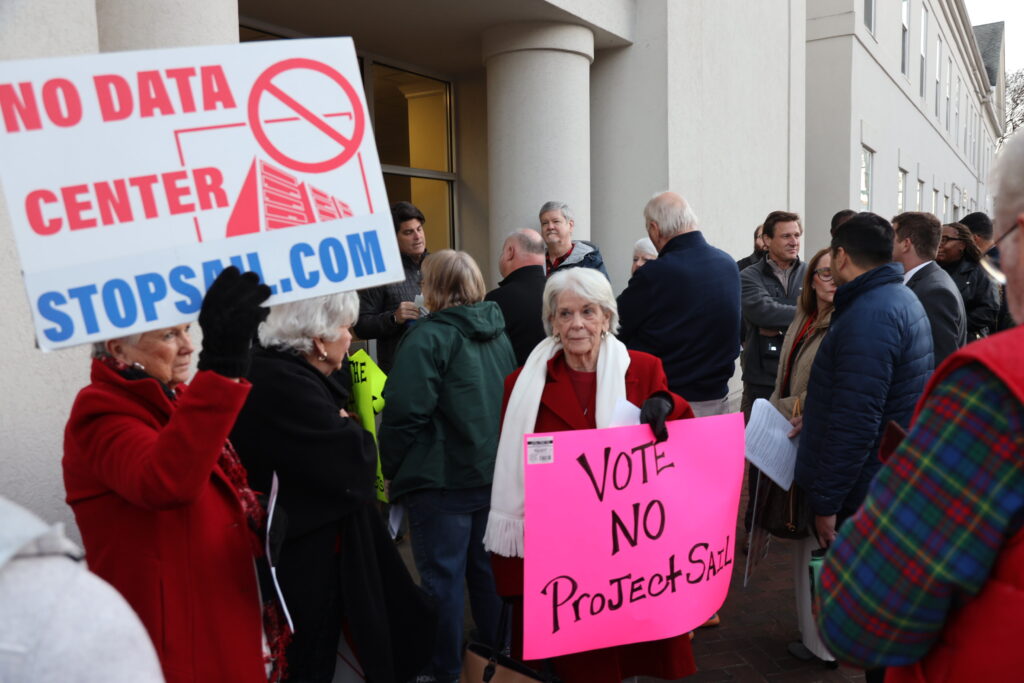
Demand for data centers has skyrocketed in the past year, and with it has come a rush to find more land to build on and more energy to power them. The Bureau of Land Management (BLM) currently is considering proposals to build at least 17 data center campuses on western public lands, according to data from the Center for Western Priorities.
Environmental reviews and regulations under the Endangered Species Act, Clean Water Act, and others can slow down the approval process for all major construction projects on federal land. BAAJA, the permitting reform bill, would overhaul federal permitting for energy infrastructure and offer a streamlined way for companies to get approval to build. It would make it easier to upgrade the electric grid and build new transmission lines, and proponents say the bill puts necessary controls on new data centers, making sure companies pay their fair share of electricity costs and infrastructure upkeep.
But the issue is controversial among some conservationists and environmentalists, who argue public lands should be protected from all development and worry that BAAJA could bring harm to endangered species and add to climate emissions because in addition to data centers, the bill will also make it easier to greenlight gas infrastructure projects.
As a result, environmentalists, clean energy advocates, and tribal organizations are split over whether passing such a bill would ultimately benefit the country, or hurt it.
A similar proposition put before California voters this past election was supported by utilities PG&E and California Edison and gas company Sempra Energy, but failed to pass with nearly 56 percent opposing efforts to roll back the state’s environmental review process to speed up certain proposals.
Several industries, including renewables, are poised to benefit from the federal permitting bill, and tech companies and fossil fuel interests are among those throwing their wallets behind BAAJA.
The Data Center Coalition, whose members include Amazon, Google, and Microsoft spent $480,000 on lobbying between July and September, including on the permitting reform bill, according to an analysis by The Washington Sun. Other groups that divulged they are lobbying on the permitting bill include major industry trade groups the American Petroleum Institute (API), the Edison Electric Institute, and the National Mining Association.
API went as far as handing out tacos to staffers on Capitol Hill earlier this week from their “BAAJA on the Hill” truck.
The Corporate Energy Buyers Association and the Electricity Customer Alliance, two industry groups that represent Amazon, Google, Meta, and other tech companies, have also endorsed the bill.
Alongside tech and gas companies championing permitting reform has been the ACC.
“We have long advocated for modernization of the permitting process to unlock clean, American energy,” the ACC’s Matthews told DeSmog by email.
On Tour with Big Tech and Big Oil
Last fall, the ACC’s president Chris Barnard found himself in a familiar setting, surrounded by college students. It was September 2025 and Barnard was speaking in front of an audience at Massachusetts Institute of Technology as part of the first stop of The Energy Freedom Tour, which was promoted as spotlighting “real solutions for American energy abundance & innovation.”
The ACC was co-hosting the event with The Hamm Institute for American Energy, an institute based out of Oklahoma State University created through donations from oil tycoon Harold Hamm, an early and influential Trump donor who built oil and gas company Continental Resources.
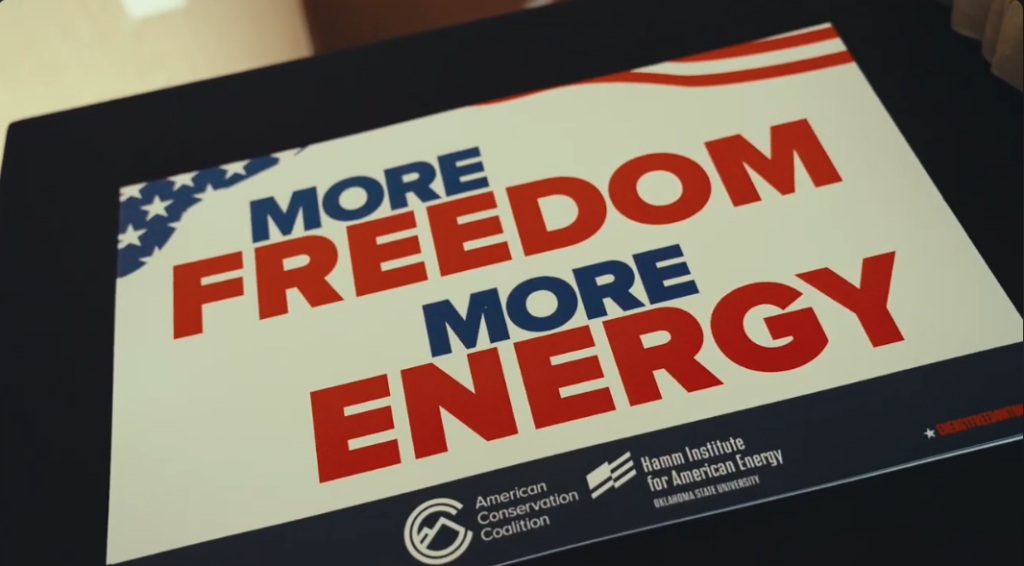
“From the global AI race to domestic reindustrialization, we need more energy than ever before,” the ACC wrote of the tour online. “The Energy Freedom Tour is here to rise to that challenge, championing an all-of-the-above approach to unleash reliable, affordable, and clean American energy.”
The Energy Freedom college tour boasted high profile speakers including Google’s head of energy market development, the CEOs of major power companies Southern Company and Duke Energy, Energy Secretary Chris Wright, and Interior Secretary Doug Burgum. Burgum reportedly stands to gain from data center build outs and has invested heavily in the AI industry, according to a recent ProPublica investigation.
The tour was sponsored by gas companies Continental Resources, Devon Energy, and Ascent Resources. The late Charlie Kirk’s Turning Point USA also sponsored the stop at Texas A&M.
“Innovate, build, win” read one of the event’s slogans.
This past June the ACC co-hosted another event called the Energy Imperatives Summit in Washington, D.C. It was a two day conference that centered on three pillars: “tech-neutral permitting reform, capital deployment, and public-private innovation.”
“We once built in America, and we believe that we can do so again. By pursuing bipartisan permitting reforms and increasing certainty to advance new energy projects and innovation, we’re ensuring that the United States does not just keep pace in the global energy race, but leads it throughout the 21st century,” Barnard said, according to a press release about the conference.
The event’s sponsors, alongside renewable energy companies, included gas giant ExxonMobil and AI company Anthropic. Anthropic’s data center energy lead, Google’s head of energy and sustainability policy, and Meta’s principal of energy strategy also spoke on a panel titled “Power AI.”ACC’s president Barnard interviewed gas company CEO Toby Rice of EQT about exporting liquefied natural gas (LNG) and as Rice said “win[ning] the race for AI in the West.”
Later that month, Barnard penned an op-ed published in The National Review, with the headline: “Energy Companies Need Permitting Certainty.” He published another article in August with The Washington Post, this time pushing for data centers to be built on Superfund sites.
He called it a “match made in heaven.”
ACC spokesperson Karly Matthews told DeSmog by email, “We do not support unrestricted data center development and have explicitly said data centers do not belong on prime farmland, for example.”
Shifting Funding, Shifting Priorities
When the ACC first launched, it received donations from several of the same left-leaning environmental groups, including the Environmental Defense Fund and the National Audubon Society, each year. But in recent years, much of its funding has come from groups and family foundations with ties to the tech and gas industries, DeSmog’s investigation has found.
According to the most recently available tax filings from 2025, it generated nearly $7.5 million in revenue. That same year the ACC received $100,000 from Atlas Network, a coalition of pro-free market think tanks that has taken money from both Exxon in the past and from DonorsTrust, a non-profit likened to the “dark money ATM” for conservative groups. And $50,000 from the foundation of Douglas Frey, an entrepreneur who owned an oil servicing company.
In 2024, the ACC received $100,000 for “special initiatives” from the tech founder David Packard’s family foundation. The ACC also received at least $20,000 from Amazon’s Public Policy Office between 2023 and 2025, according to the company’s own political engagement statements.
The conservation group has also dealt out its own money.
During the 2025 and 2026 campaigns, the American Conservation Coalition Political Action Committee gave nearly $50,000 in donations, including to several Republican candidates who ran on pro-data center and energy abundance platforms, according to the Federal Election Commission. They included Iowa’s Joe Mitchell, who had strong data center ties, Colorado’s Gabe Evans who supported permitting reform and “energy dominance” and whose district is home to a recently approved data center, Colorado’s Jeff Hurd, a pro-infrastructure candidate with a data center in his district who reportedly received at least $105,000 from the ACC, and Wisconsin’s Michael Alfonso who supports fossil fuel production and local data center control. Only Alfonso and Hurd won their November elections.
ACC Action didn’t respond when asked by a user on Instagram to name one environmental cause Alfonso supported that made him deserve ACC’s financial support. The commenter followed up saying: “Seriously? So sad and shameful that you can’t name just ONE conservation issue Alfonso supports… Just further proof that ACC is a sham propaganda organization group.”
According to its federal lobbying reports, ACC Action also spent money on federal lobbying efforts. The organization spent $300,000 in the first three quarters of this year on issues of “Energy infrastructure and electric transmission siting and federal permitting; legislation and policy on energy permitting reform.” The disclosures named BAAJA and the SPEED ACT, another bill that focuses primarily on reforming federal environmental reviews that has passed the House and is now awaiting Senate action, as focus areas.
In April the ACC released an “electric transmission reform framework” with a coalition of conservative groups: R Street Institute, C3 Solutions, Pacific Legal Foundation, Americans for Prosperity, and the Abundance Institute.The latter two are both Koch funded.
In August, the ACC and the Republican environmental nonprofit ConservAmerica announced a strategic partnership to tackle “overlapping policy initiatives, including data center development, public lands management, technological innovation, and unleashing American energy development.”
And this October, the ACC partnered with American Moment, one of the “key nodes” in developing Project 2025, to write what it called an “Energy Dominance Study Guide,” aimed at junior and mid-level staffers and policymakers to teach them “what the United States must do to turn energy dominance into projects that actually get built.” The ACC paid American Moment more than $374,000 to “educate about critical energy dominance issues” according to its 2025 tax filings. Other groups the conservation group gave money to included $25,000 to The Breakthrough Institute for its 2025 “Abundance Conference,” which was sponsored by tech-industry coalition Chamber of Progress and Koch-founded StandTogether Trust. And about $10,000 to the State Policy Network for its conference. SPN is a right-wing network of conservative think tanks, many of which are funded by billionaire fossil fuel and chemicals industrialist Charles Koch.
Building ‘Big, Beautiful Things’
This fall, the ACC and ACC Action’s support of permitting reform picked up pace. In late October, supporters of BAAJA sent a letter to Senate leadership urging them to promptly take the bill up for a vote and pass it.
“Congress has an opportunity to deliver meaningful, bipartisan permitting reform. We urge you to seize this moment and advance BAAJA without delay to protect property rights, promote energy abundance, and restore America’s ability to build,” the letter read.
It was signed by several conservative nonprofits and think tanks, including multiple climate science denial groups such as Americans for Prosperity, The Manhattan Institute, the Energy and Environment Legal Institute, the 60 Plus Association — and ACC Action.
Late last week, House Democratic leader Hakeem Jeffries said the permitting bill fell short and criticized it for a “failure to adequately protect tribal sovereignty.” Several tribal and environmental organizations maintained that criticism even after changes to the bill over the weekend attempted to address concerns.
Yet, several energy companies as well as some clean energy focused groups urged the Senate to pass the bill, despite the lame duck session. Nearly all Republican Senators and 22 Democrats voted to advance the permitting reform bill on Monday, paving the way for its passage in the coming weeks. A potential hurdle though, is President Trump’s announcement on Monday that he wouldn’t approve wind projects, a negotiation sticking point which may threaten the legislation’s prospects in the House.
The ACC has continued its messaging blitz online. It’s running active ads on X and Meta that frames the bill as a fix to the energy crisis.
“Americans want affordable energy, tell congress: Pass permitting reform,” one ad reads.
The ad links to a prewritten letter for people to send to their members of Congress.
The ACC’s call to action reads: “America once built big, beautiful things and we can do so again. Tell your members of Congress to support bipartisan efforts for permitting reform to unleash American energy and reindustrialize our nation.”