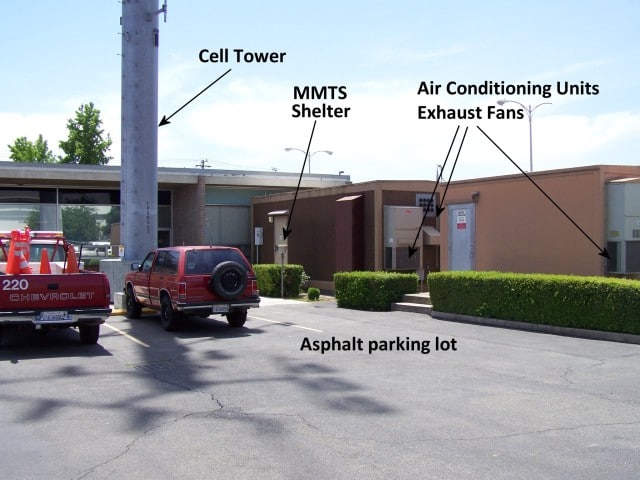
Another climate change denier myth – this one a favorite of Anthony Watts and his “Watts Up With That” blog – has just bit the dust.
Many skeptics for years have sought to explain away decades of climate research by showing slides of weather station thermometers sited next to heating vents or surrounded by asphalt.
This much-touted “urban heat island effect” was supposed to trump all those fancy graphs and equations that egghead scientists were fixated on. Except it’s not true.
A recent peer-reviewed paper in the Journal of Geophysical Research looked at data from 114 weather stations from across the US over the last twenty years and compared measurements from locations that were well sited and those that weren’t.
They did find an overall bias, but it was towards cooling rather warming.
According to the authors,
“the bias is counter intuitive to photographic documentation of poor exposure because associated instrument changes have led to an artificial negative (“cool”) bias in maximum temperatures and only a slight positive (“warm”) bias in minimum temperatures.”
Oops.
This is latest in an expanding body of science that has looked at the urban heat island effect in excruciating detail and found nothing to undermine the observed and disturbing warming in the US over the last several decades.
The IPCC found that: Over the Northern Hemisphere land areas where urban heat islands are most apparent, both the trends of lower-tropospheric temperature and surface air temperature show no significant differences. In fact, the lower-tropospheric temperatures warm at a slightly greater rate over North America (about 0.28°C/decade using satellite data) than do the surface temperatures (0.27°C/decade), although again the difference is not statistically significant.
Another paper in Climate Change in 2007 stated: Studies that have looked at hemispheric and global scales conclude that any urban-related trend is an order of magnitude smaller than decadal and longer time-scale trends evident in the series (e.g., Jones et al., 1990; Peterson et al., 1999)…Thus, the global land warming trend discussed is very unlikely to be influenced significantly by increasing urbanization (Parker, 2006).
While such dense scientific prose is not as photogenic as a picture of a weather station in a parking lot, the fact is that science has thoroughly picked over this red herring.
This myth is now officially busted.