
With some analysts predicting the global price of oil to see another drop, many oil majors have deployed their parachutes and jumped from the hydraulic fracturing (“fracking”) projects rapidly nose-diving across the world.
As The Wall Street Journal recently reported, the unconvetional shale oil and gas boom is still predominantly U.S.-centric, likely to remain so for years to come.
“Chevron Corp., Exxon Mobil Corp. and Royal Dutch Shell PLC have packed up nearly all of their hydraulic fracturing wildcatting in Europe, Russia and China,” wrote The Wall Street Journal.
“Chevron halted its last European fracking operations in February when it pulled out of Romania. Shell said it is cutting world-wide shale spending by 30% in places including Turkey, Ukraine and Argentina. Exxon has pulled out of Poland and Hungary, and its German fracking operations are on hold.”
Though the fracking boom has taken off in the U.S. like no other place on Earth, the U.S. actually possesses less than 10 percent of the world’s estimated shale reserves, according to The Journal.
Despite this resource allotment discrepency, the U.S. Energy Information Administration (EIA) recently revealed that only four countries in the world have produced fracked oil or gas at a commercial-scale: the United States, Canada, China and Argentina.
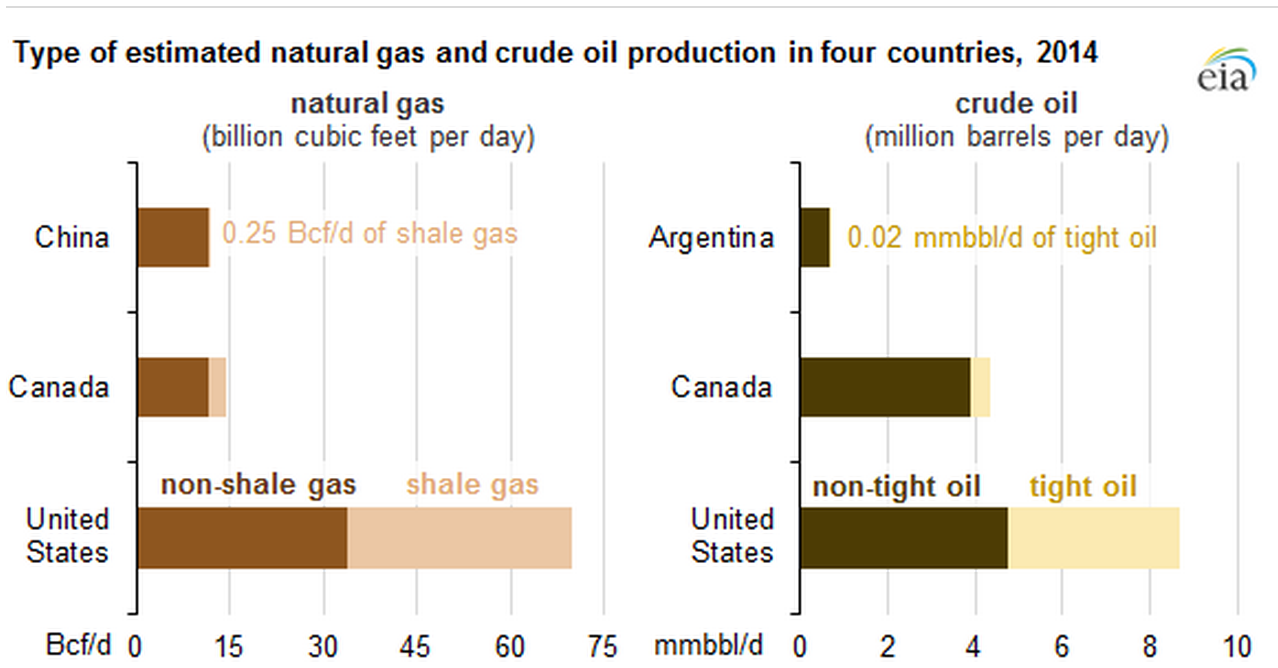
Image Credit: U.S. Energy Information Administration
False Premises, False Promises?
As Post Carbon Institute has pointed out in two major reports, estimated reserves often prove over-inflated compared to the actual ultimate productivity of fracking fields.
While Post Carbon’s sample data focused on U.S. shale fields, the new EIA data appears to back up the organization’s long-standing thesis, albeit on a global scale. That is, the global fracking boom has in large part been based on false premises and accompanying false promises.
EIA‘s role here is crucial, serving as an entity which often initially trumpets the estimated reserves of shale basins and then quietly back-pedals with downgrades months or years later. As reported previously on DeSmog, John Krohn — former communications director for industry front group Energy in Depth — now serves as a spokesman for EIA.
“A view filled with false premises is bound to generate promises,” Asher Miller, executive director for Post Carbon Institute said in an October 2014 press release announcing his orgnazation’s report titled, “Drilling Deeper.”
“The Department of Energy’s oil and natural gas forecasts prepared by the EIA are failed attempts to paint a picture of the country’s energy future for government policymakers and businesses…We should not confuse oil and gas industry salesmanship with the accurate information the country needs to provide a sound basis for U.S. energy policy.”
Fracking may eventually go global in a major way. But unlike in the U.S., it doesn’t look like there will be any books to write about a global shale boom anytime soon.
Image Credit: Niyazz | Shutterstock