
In his spare time, David Levy, owner of Petrotechnologies, a company that makes specialty parts for the oil and gas industry, monitors the fossil fuel industry across southwest Louisiana from the sky. He transformed his flying hobby into an act of stewardship by surveying oil and gas industry sites to check for environmental hazards, like oil spills and toppled storage tanks.
Following back-to-back hurricanes last year, Levy took me up with him so I could photograph the storms’ aftermath. We found oil slicks from oil and gas wells scattered throughout the wetlands.
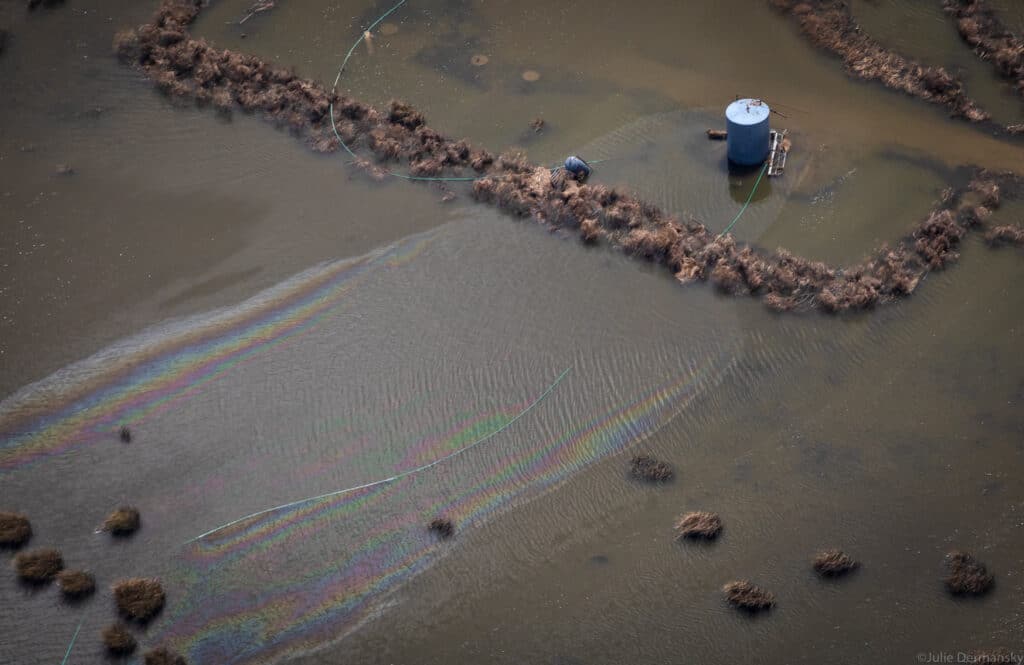
Now, Levy is focusing his flights on surveying orphaned well sites to document the severity of the situation. When regulators can no longer locate a well’s responsible owner, or if the owner is known but bankrupt, a well is classified as orphaned. Once officially classified as orphaned, the site becomes the state’s responsibly and is added to a list of sites that need to be plugged and cleaned up.
The number of orphaned wells in oil and gas producing states nationwide continues to increase, as does the amount of planet warming methane emissions leaking from them. To deal with the issue, a series of bills have been introduced to grant federal funding to states, giving them the resources to tackle the problem.
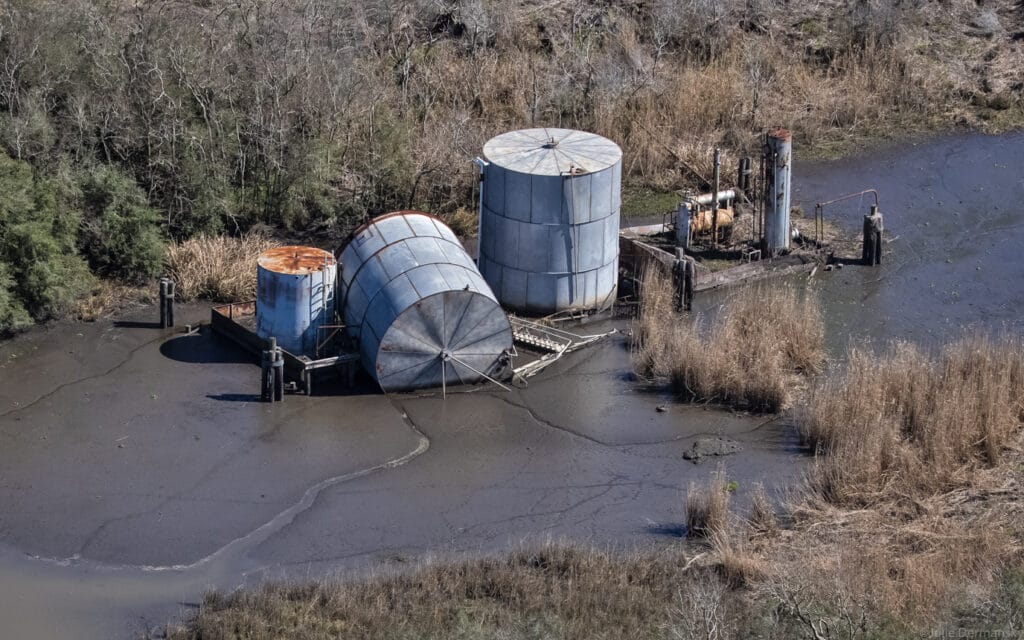
“I love Louisiana’s wetlands. There is no other place like it in the world,” Levy said, a few hundred feet off the ground, the last time he took me up to photograph well sites in Vermillion Parish, near the border with Texas on the Gulf Coast. A few seconds later after we circled a well site with toppled rusty tanks he added: “It is criminal what we are allowing to be done to it.”

David Levy in his plane on the runway in New Iberia. Credit: Julie Dermansky 
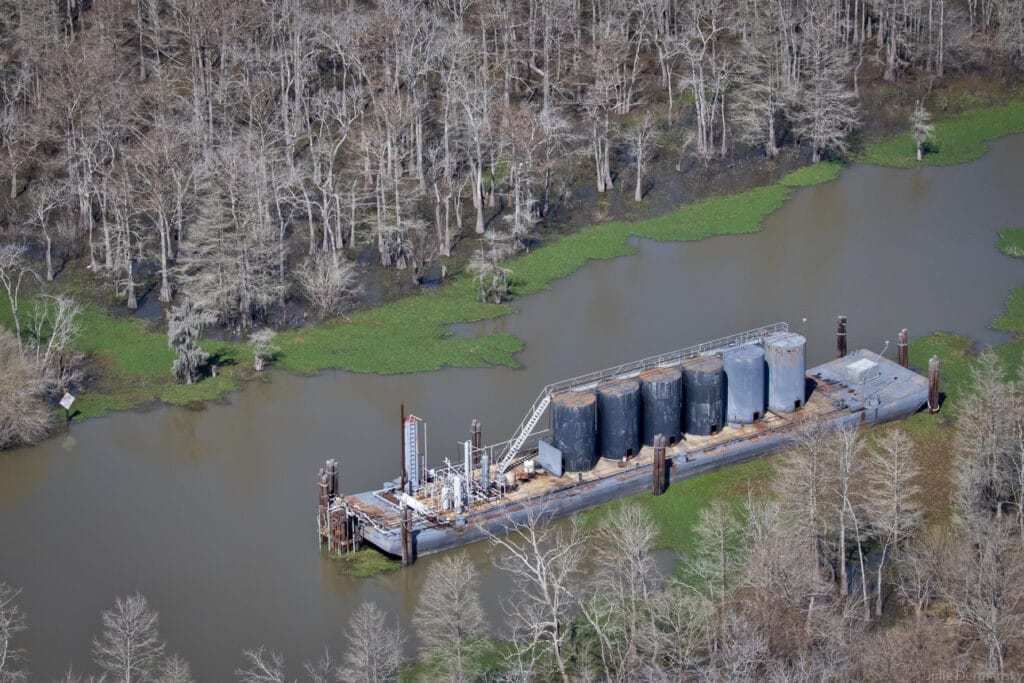
Orphaned well site in the Atchafalaya Basin. Credit: Julie Dermanksy

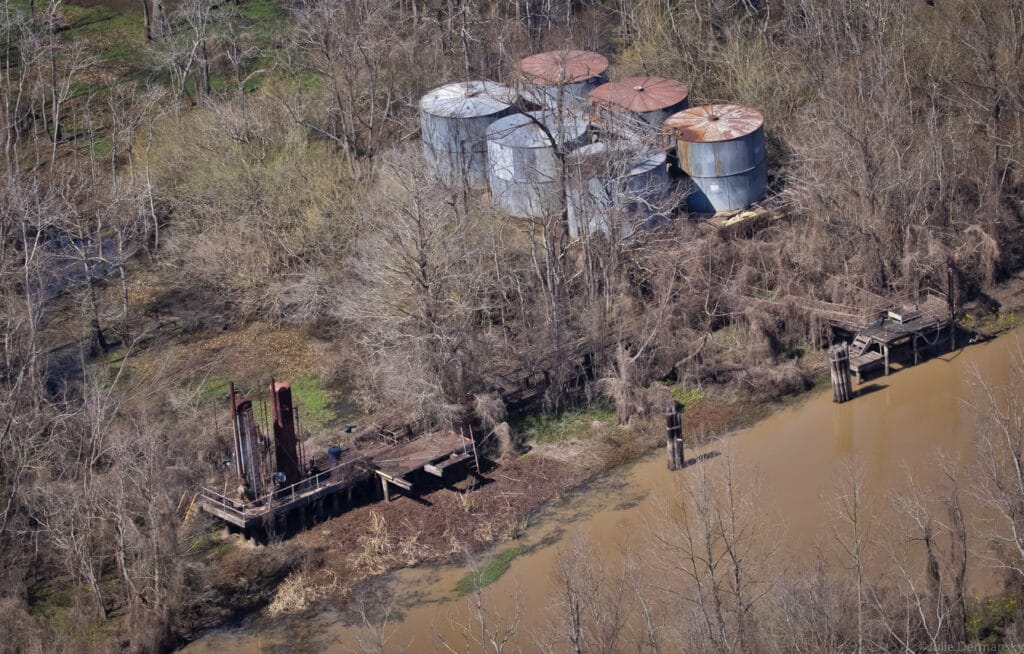
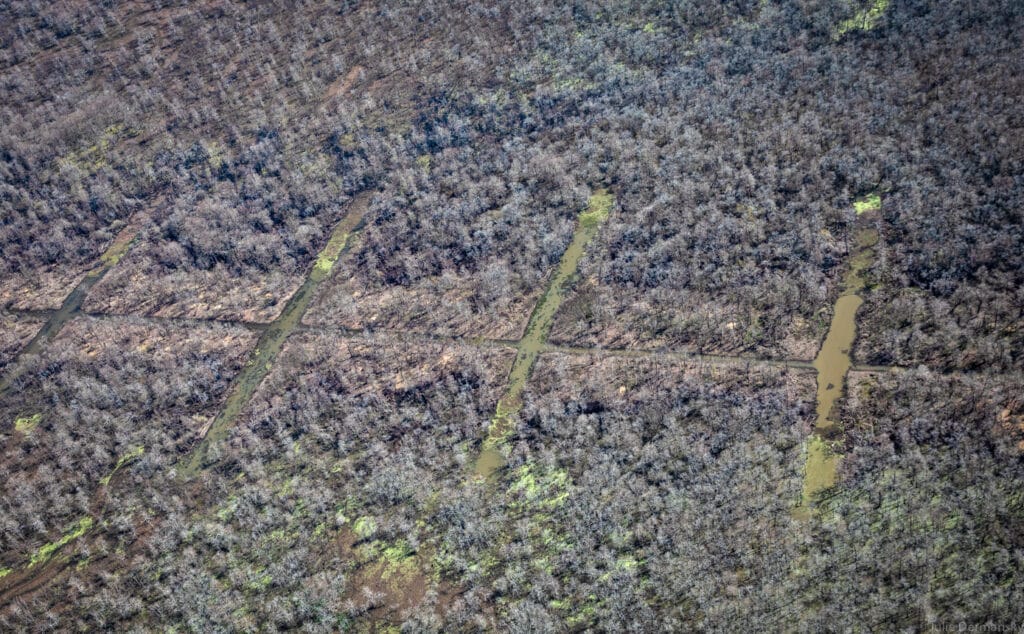
Levy believes orphaned wells aren’t being monitored properly. And he thinks it’s disgraceful that the Louisiana legislature and the regulators haven’t strengthened current rules that limit a private firm’s responsibility to plug and abandoned wells if they choose to close up shop. It has become commonplace in oil and gas producing states like Louisiana for well operators to walk away from unprofitable well sites, leaving it to the state to deal with the mess, and the public to pay for it.
There are tens of thousands of known orphaned oil and gas wells in the United States and thousands of abandoned wells that were never properly plugged that are leaking methane and emitting other toxins that threaten the environment and contribute to global warming.
Mounting scientific studies have shown that methane, the main component of natural gas, is not the bridge fuel the Obama Administration sold the nation as the fracking industry boomed under its watch. In fact, methane is up to 86 times more potent than carbon dioxide in the first 20 years after entering the atmosphere.
Now, the Biden Administration’s infrastructure plan is poised to take action combatting the climate crisis by eliminating the leaking methane at orphaned well sites. The American Jobs Plan calls on Congress to spend $16 billion over 10 years to reclaim orphaned wells and mines.
Following the roll out of the infrastructure plan, U.S. Senators Ben Ray Luján (D-N.M.) and Kevin Cramer (R-N.D.) introduced The REGROW Act, which calls for nearly $5 billion in federal funds to be given to state regulatory agencies to clean up orphan well sites on public, private, and tribal lands. The bill would aim to eliminate methane emissions and create jobs.
And on April 8, New Mexico Congresswoman Teressa Leger Fernández introduced a similar bill that includes new regulations, the Orphaned Wells Cleanup and Jobs Act of 2021. Her bill would authorize $7.725 billion to clean up the more than 56,000 known orphaned oil and gas wells across the country, cut methane emissions, and create more stringent rules for well operators including raising the bonds they must pay in order to reduce the taxpayer’s burden if a well operator walks away without properly cleaning up the site.
During an April 15 hearing on Fernández’s bill, by the House Committee on Natural Resources Subcommittee on Energy and Mineral Resources, there were signs of bipartisan support. Representatives from both parties agreed that states do not have enough money or resources to clean up their orphan wells and welcome federal money.
GOP committee leaders warned, however, that the bill would need to be amended before they sign off. Unhappy with the provisions to strengthen regulations, they argued that if bond rates go up more companies could go bankrupt creating an influx of new orphaned wells.
Those provisions are what make Fernández’s bill more appealing to some supporters than the REGROW Act. They argue that those companies which cannot afford to set aside enough money to cover plugging their wells — effectively serving as a basic insurance policy — are on the path toward insolvency anyway.
Calling for a Smarter Solution
Several well-established environmental organizations have endorsed the REGROW Act including the Environmental Defense Fund and the National Wildlife Organization. Those groups also support Fernández’s Orphaned Wells Cleanup and Jobs bill along with the Wilderness Society and Earthworks, among others. But there are also many environmental advocates who see both bills as a Band-Aid that won’t cover the growing wound.
Some environmental advocates are critical of any solution that gives federal money to state regulators that allowed the orphan well situation to fester in the first place.
In an April 25 editorial, Bob Marshall, a Pulitzer Prize-winning Louisiana environmental journalist, described giving federal money to states to deal with the orphan well issue as a “corrupting influence of money in our politics.” He explained: “It is those entities that make money in the oil field then cut and run when it is no longer profitable leaving tax payers paying for that clean up, that back politicians that stand in the way for mandating higher bonds who will profit.”
Marshall hailed Megan Milliken Biven’s “Abandoned Well Act” (AWA) that calls for the creation of a federal Abandoned Well Administration to oversee the initial cleanup as a smarter solution. Biven, a Louisiana native, has spent close to a decade working for the Bureau of Ocean Energy Management before moving to Vienna, Austria, where she is a public policy professional and a writer who has spent a lot of time thinking about solutions to American’s methane-leaking well problem. Biven’s AWA bill calls for realistic bonding requirements and levee fees on the oil and gas industry to pay for future cleanups. Under her bill, the federal government, not the states, would create a new federal workforce of displaced oil and gas workers.
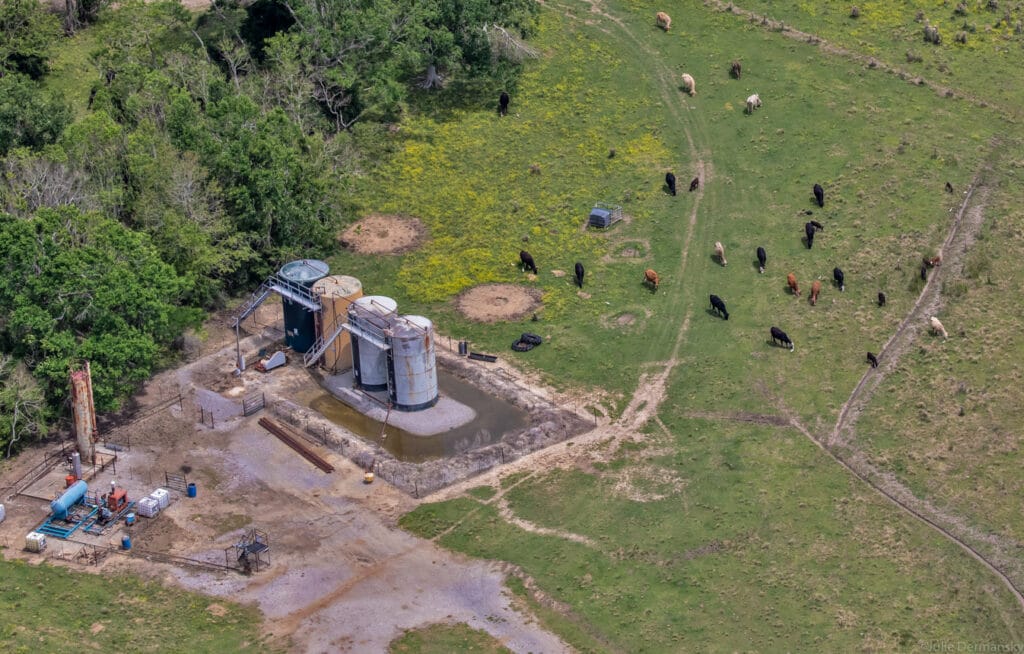

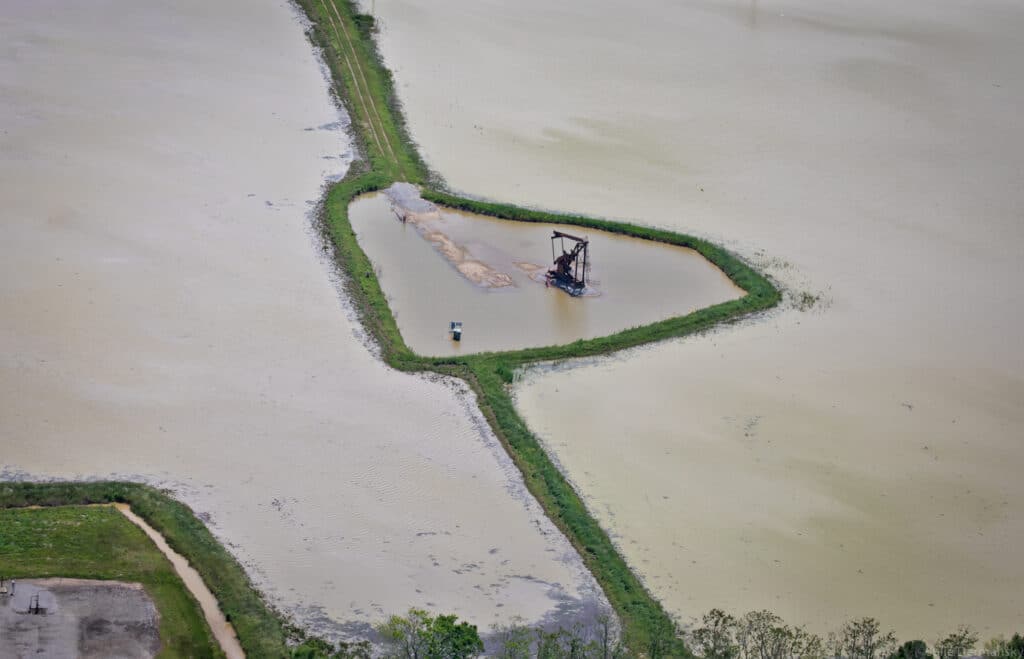
Oil derrick at a well site in Vermillion Parish, LA. Credit: Julie Dermansky 
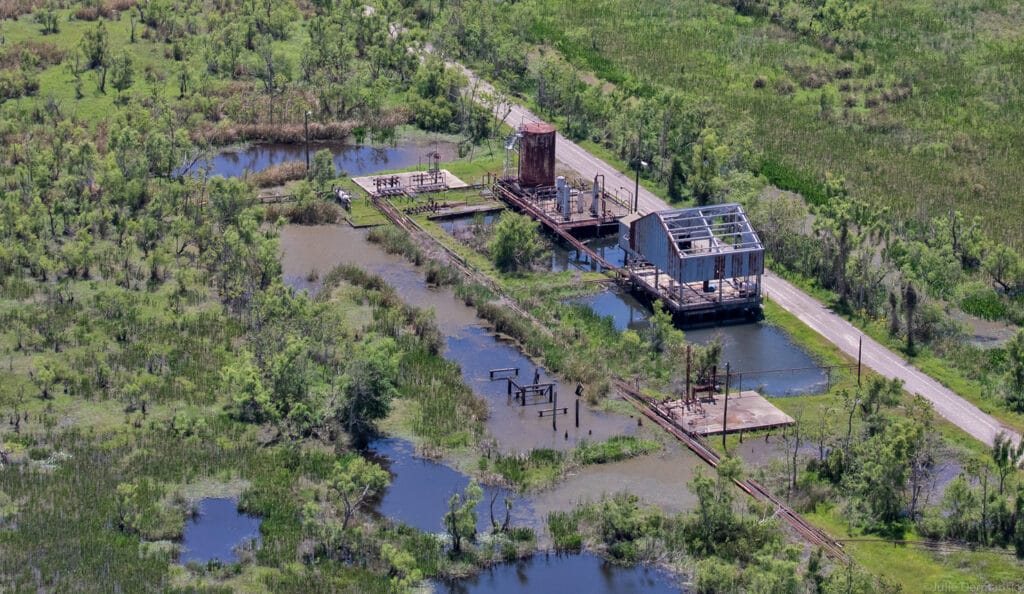
Well site in Vermilion Parish, LA. Credit: Julie Dermansky
Though Biven’s bill, which she introduced herself in a January 2021 Current Affairs article isn’t on the table, her plan is gaining attention.
Biven warns that the funneling of federal money to states to augment state orphan well programs will provide a temporary stimulus to a few oilfield service firms but it won’t stop “the hemorrhaging of oil and gas jobs.” And while plugging thousands of wells in oil and gas fields across the country would cut back harmful methane releases, it doesn’t do enough; methane emissions, she says, must also be stopped at wells that have operators along with the wells that have been plugged.
The AWA bill calls for the creation of a workforce that deals with wells at every stage. This is because, once a well is drilled, it requires monitoring, even when it’s no longer operational. Wells sites that have been plugged and abandoned, even if done properly, can also end up leaking methane down the line.
Making clear the scope of the issue and the role of orphaned wells within it, Biven writes in Current Affairs: “Every single oil and gas well that has ever been drilled is at risk of leaking in the future and needs to be monitored and maintained in perpetuity. Oil and gas wells are forever.”
She warns of the misleading rhetoric used by those pushing the idea that federal money can be used to stop methane releases and increase jobs for oil and gas workers. Biven says that “the devil is in the details. Most of the proposals shared some common features: Federal Money → State Orphan Well/Federal Orphan Well Program → Private Contractor → ‘Plug and Abandonment’ work.”
In other words, if federal money goes to the states to deal with the orphaned well problem, it will likely flow to favored contracting firms and lead to temporary jobs at best.

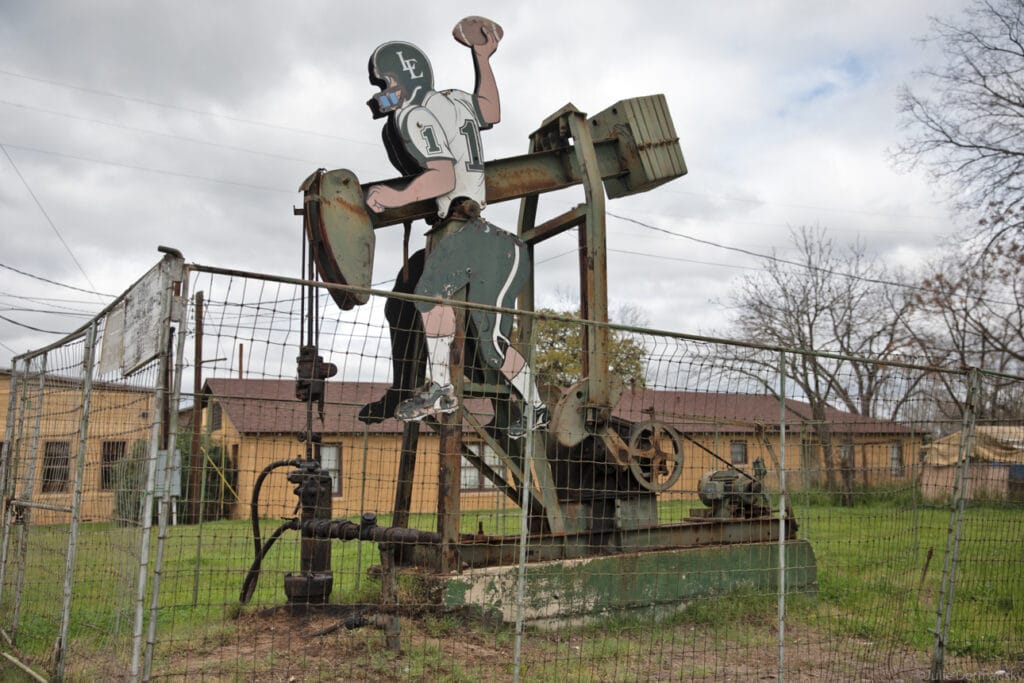
Well site in Luling, Texas. Credit: Julie Dermansky 
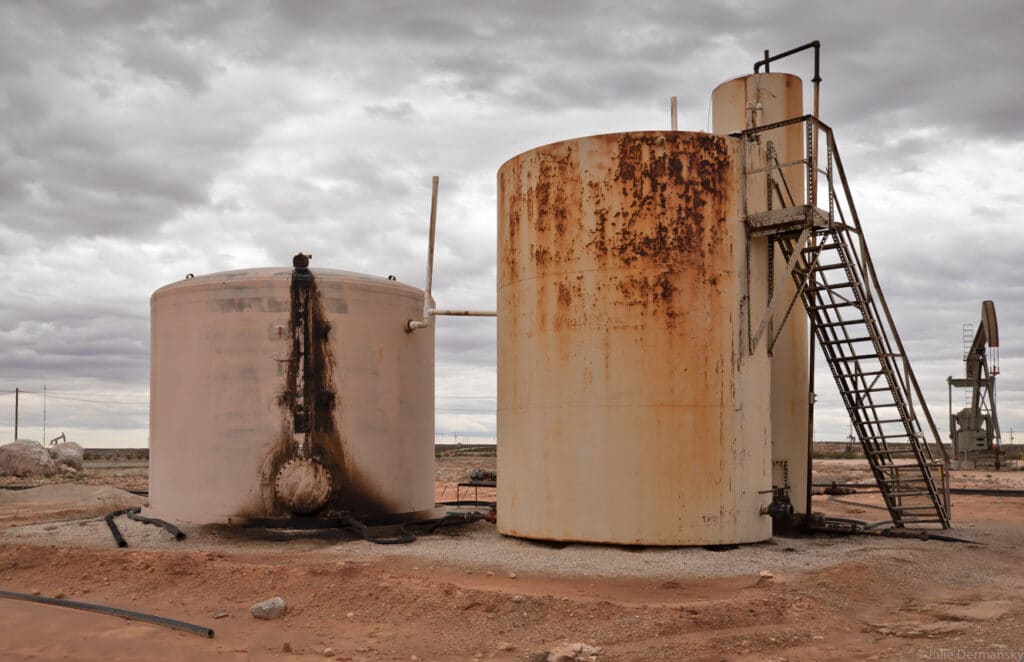
Permian Basin oil well with visible oil spill on Federal land in New Mexico. Credit: Julie Dermansky
“In New Mexico,” she writes, “higher-end estimates for a federal grant program to merely plug the identified 700 orphaned oil wells are estimated to support just 100 jobs. In Louisiana, plugging all of the documented orphan wells would employ 1,000 oil workers full-time for just one year. Since many of the approved firms on the OSR’s approved contractor list participate in the state’s Transitional Work Program, there’s a good chance many of those workers will be incarcerated Louisianans, and, in addition to being slave labor, will not actually add to the state’s employment rolls. Ohio recently increased the scale of its own orphan well program but discovered that because the government was exclusively reliant on private contractors, it could not find enough qualified contracting firms in Ohio to bid on jobs. So why structure it this way? Why not recruit unemployed workers directly to work in a state program? There are certainly enough unemployed oil and gas workers to go around.”
Senior Researcher Ted Boettner, with the Ohio River Valley Institute, testified at the April 15 hearing for Fernández’s orphaned wells bill, referenced Biven’s concepts.
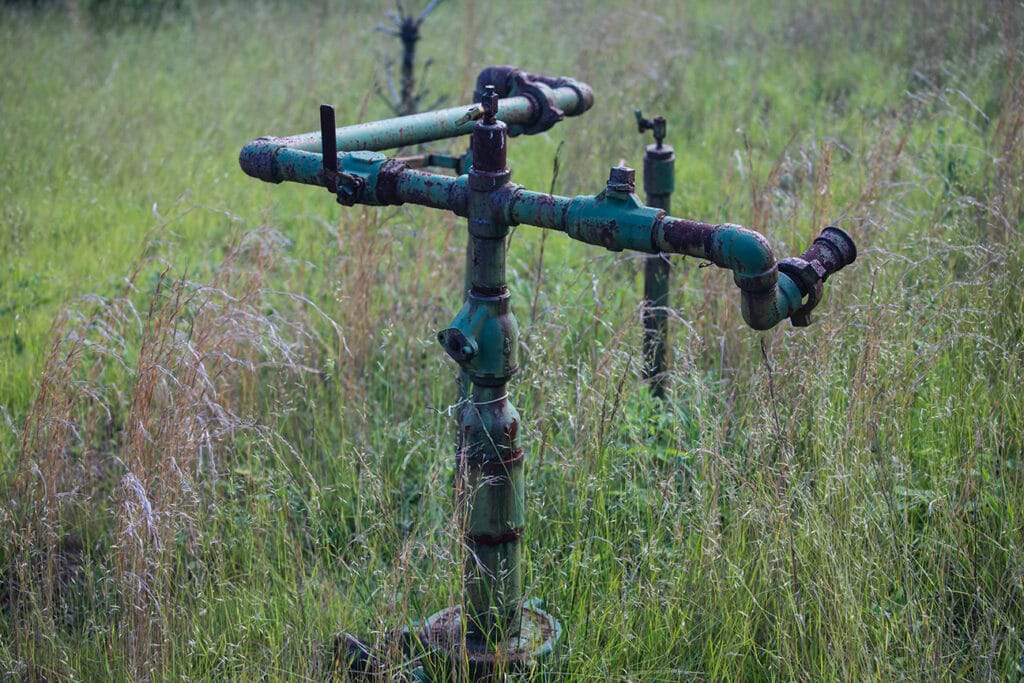
In a report on orphaned wells and abandoned mines in Appalachia, Boettner explained that a federal program is needed that can continuously monitor and remediate these abandoned well sites. The report points out that there “are an estimated 538,000 unplugged abandoned oil and gas wells in the Ohio River Valley states of Ohio, Pennsylvania, West Virginia, and Kentucky alone. Plugging these wells could cost upwards of $34 billion.”
Addressing the orphan well problem nationwide will be a massive undertaking. In 2018, only 2,372 orphan wells were plugged in the U.S. At this rate, it would take nearly 900 years for states to plug the estimated 2 million abandoned oil and gas wells across the nation.
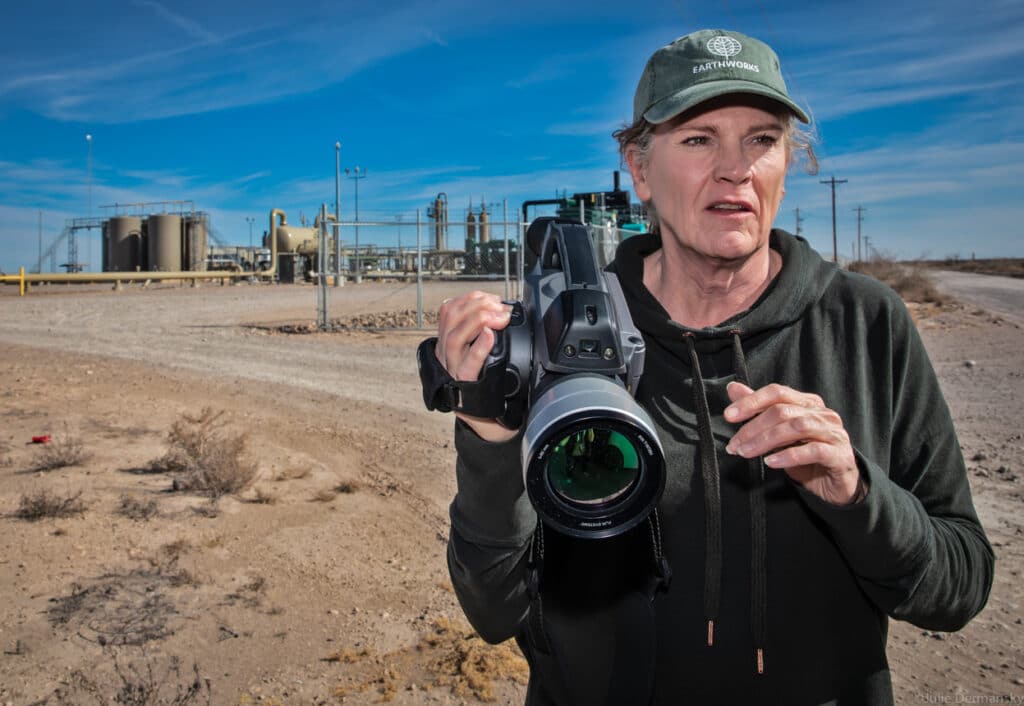
Sharon Wilson, the Texas coordinator of Earthworks, is against any solution that includes giving money to state regulatory agencies to fix the country’s orphaned well problem. Asked if that’s the way to go, she says “Hell, No.”
Measuring Methane Emissions
Wilson uses an optical gas imaging (OGI) camera, which makes otherwise invisible emissions visible, to identify methane leaks at oil and gas industry sites. For the last few years, Wilson has been focused on documenting methane releases in the Permian Basin, one of America’s most productive oil fields. On one of her trips that I joined in early 2020 before the pandemic spread, she found fugitive emissions at almost every site we visited; that includes active and orphaned wells.
She submits reports detailing her findings to the state regulators. While on occasion regulatory actions were taken by regulators as result of her work, she finds that most of the sites where she identifies leaking methane continue to spew emissions.
While regulators are aware that many sites are leaking methane, the emissions aren’t acutely measured in Texas and other oil and gas producing states, she points out. That is why report after report about methane emissions from wells reveal the number of estimated emissions is greater than the figures the EPA has been using, which are based on figures provided by the oil and gas companies themselves.
A 2018 report organized by the Environmental Defense Fund, found that the U.S. oil and gas supply chain is leaking roughly 60 percent more methane than reported in previous Environmental Protection Agency (EPA) estimates. And a new study by McGill University found “that annual methane emissions from abandoned oil and gas (AOG) wells in Canada and the U.S. have been greatly underestimated — by as much as 150% in Canada, and by 20% in the U.S. Indeed, the research suggests that methane gas emissions from AOG wells are currently the 10th and 11th largest sources of anthropogenic methane emission in the US and Canada, respectively.”
The McGill report explains the difficulty in estimating overall methane emissions from AOG wells due to a lack of information about both the quantities of methane gas being emitted annually from AOG wells and the number of AOG wells themselves.
“Regulators in Texas have proven that they are incapable of fixing this problem,” Wilson said which is why she also supports Biven’s AWA bill.
Levy, who has spent 30 years working in Louisiana’s oil and gas industry is another fan of Biven’s bill. While he supports the federal government stepping in to fix the orphaned bill problem, he says that leaving it to the regulators that allowed the mess to happen under their watch — and which he sees regularly from his plane — makes no sense.
Like Wilson, Levy sees state regulators’ lack of will to act over methane emissions as a big problem. “It points to total regulatory capture,” he said.
“Not nearly enough is being done to identify methane leaks at oil and gas well site,” Levy said. And while the actual methane being leaked is invisible to the naked eye, he can still identify sites that need attention and where methane leaks are highly probable.
‘Expendable’ Planet
The Environmental Protection Agency’s Clean Air Act leaves methane pollution from oil and gas wells largely unregulated. So it is not surprising oil and gas producing state like Louisiana aren’t focused on identifying methane leaks.
The Louisiana Department of Environmental Quality (LDEQ), the agency responsible for air quality, has no role in identifying releases from oil and gas wells, according to Gregory Langley, LDEQ spokesperson. “DEQ relies on DNR (the Department of Natural Resource) to inform DEQ of fugitive emissions from oil and gas wells,” Langley said in an email.
The Department of Natural Resource (DNR) doesn’t have an optical gas imaging (OGI) camera, a tool used by the oil and gas industry that would detect leaking methane. Instead, its agents rely on eyes and ears to find methane leaks, according to Patrick Courreges, communications director at DNR. When inspecting oil and gas well sites, agents listen for detectable noises and any signs of bubbling to identify possible methane leaks.
“Oil and gas regulation does not exist in any meaningful way. It’s so implausible and shocking that I think most people just short out when confronted with the facts,” Biven wrote in an email. If the EPA introduces national inspection, enforcement, and penalty standards, states would at least have a chance to tackle the leaking methane issue, says Biven. But she points out that even if the Fernandez bill passes, “without physical inspections, with appropriate tools to measure methane at the wellhead, and actual enforcement powers ensconced in law to force compliance — it’s just paper.”
Regardless of the rules, Levy believes that while society transitions to renewable energy, it is possible for the fossil fuel industry to operate in a much cleaner way than what he is seeing. He plans to continue documenting orphaned wells site and posting what he finds on social media so people can see what is going on in Louisiana’s oil fields.
“There is no need to leak so much methane, or to have sites scattered throughout the landscape that are a danger to people and the environment.” Levy said. “But greed knows no bounds these days — it is as if this planet is expendable.”