

At a Tuesday campaign rally for Republican Senate candidate Ken Paxton in Lubbock, Texas, President Trump announced the U.S. Environmental Protection Agency’s (EPA) proposal to roll back a Biden-era methane rule, setting up a likely future showdown in how the agency oversees climate pollution under the Clean Air Act.
The proposal marks a break from the agency’s previous approaches to greenhouse gas regulation by maintaining that — for now — the EPA still has the authority to regulate climate pollution from the oil and gas industry, though it might revisit this decision later. With affordability top of mind for many midterm voters, however, the President framed the move in economic terms.
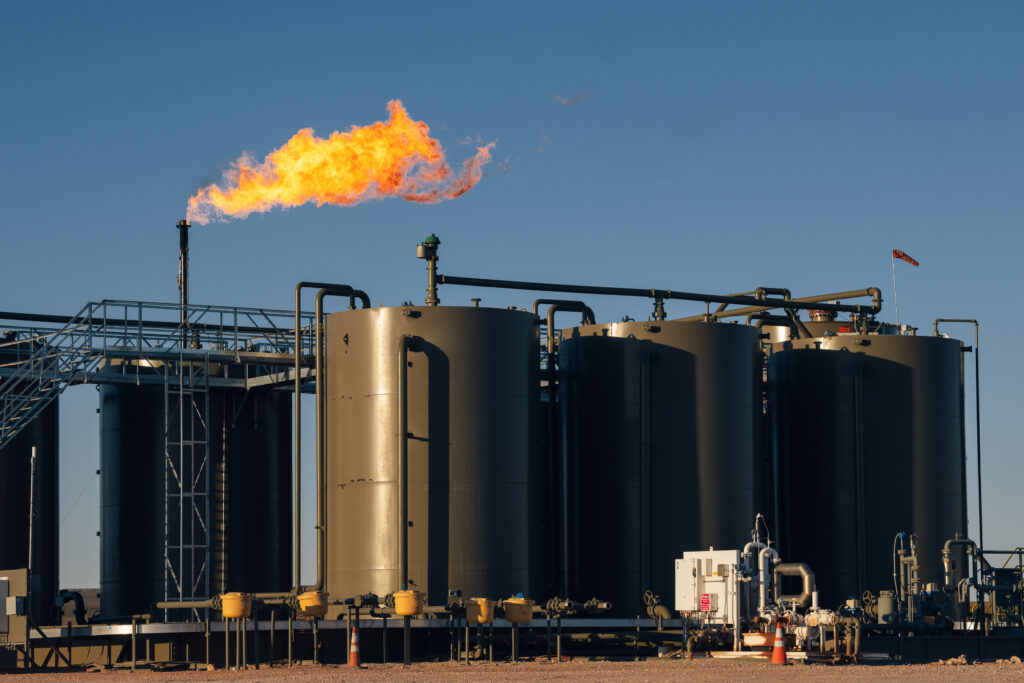
“Tonight I’m officially terminating Biden’s expensive and unnecessary methane regulations,” Trump announced to the crowd, located near the oil-rich Permian Basin. The new plan would loosen federal requirements for oil and gas operators to detect and repair leaks, ease restrictions on gas flaring, and eliminate the Super Emitter Program, a third-party monitoring and reporting system designed to identify major releases of methane, known as a climate super pollutant.
Trump said the proposal, which addressed a 2024 rule known as OOOOb/c, would “save consumers and energy producers $45 billion in costs, unlock vast quantities of Texas natural gas, and produce 210 million barrels of oil.” Under President Biden, the EPA estimated the rule would prevent the release of 58 million tons of methane and 16 million tons of volatile organic compounds (VOCs), leading to major public health and climate benefits. Climate change already is raising costs for American households by an estimated $400 to $900 annually, according to a 2025 Brookings report.
Trump’s Lubbock announcement follows a series of sweeping deregulatory moves by the EPA in which the agency has stated it does not have the authority to regulate the greenhouse gas emissions that cause climate change under the Clean Air Act. EPA’s most notable decision came in February when the agency rescinded the 2009 endangerment finding, the U.S. government’s scientific finding that greenhouse gases harm human health and the environment and the legal basis for its rules addressing climate change. More recently, the EPA stated in September that it would no longer limit climate pollution for power plants, a move which would likely extend the lifespan of coal-fired power plants.
In the wake of these decisions, however, legal experts and environmental advocates say that the EPA is attempting to assert power unevenly. On the one hand, the agency says it lacks the legal authority to regulate greenhouse gas emissions from cars, trucks, power plants, and industrial sources under the Clean Air Act. On the other, the latest EPA proposal relies on, in some cases in the same section of, the Clean Air Act to regulate methane, a greenhouse gas, from the oil and gas industry.
In its latest proposed rule, the EPA addresses this tension, acknowledging that “stakeholders have also raised concerns” about the agency’s authority to regulate the oil and gas sector’s greenhouse gas emissions under the landmark air pollution law. Depending on the agency’s final handling of the issue with fossil fuel-fired power plants, the EPA states it could then use a “future rulemaking” to resolve the issue in the oil and gas sector. (The EPA is accepting public comments on its proposed repeal of its authority to regulate greenhouse gas emissions for fossil fuel-fired power plants until Nov. 2.)
Attacking EPA’s ‘flawed legal basis’
In 1999, the oil and gas industry’s largest trade group, the American Petroleum Institute (API), organized a meeting over whether it should “coordinate a multi-industry, trade group response” to the threat of what it called EPA’s “flawed legal basis” for regulating greenhouse gas pollution, including carbon dioxide and methane, under the Clean Air Act. In 2024, the API filed a legal challenge over the OOOOb/c rule, which was eventually consolidated into a lawsuit with states and other industry trade groups. That suit has been paused while the agency reconsiders the rule.
Parts of the oil and gas industry have flagged this distinction in how the Trump EPA is handling two different greenhouse gases under the same law. Shortly after the EPA repealed the endangerment finding, the Domestic Energy Producers Alliance (DEPA), an oil and gas trade association founded by fracking magnate and Trump donor Harold Hamm, wrote a letter to the EPA, thanking the agency for “restoring the rule of law.” The group called out “methane and other greenhouse gas emission requirements for the oil and gas sector” among its examples of “major regulations based on the Endangerment Finding.”
A few months later, after the agency published an update on its proposed reconsideration of the OOOOb/c methane rule, DEPA wrote in an internal newsletter that EPA “does not explain its legal reasoning for continuing to regulate methane emissions when it has found that it does not have the authority to regulate carbon dioxide (CO2) emissions from vehicles and has proposed it does not have the authority to regulate power plants’ CO2 emissions.”
On Tuesday in Corpus Christi, the president called out Hamm by name at another midterms rally shortly before the one announcing the methane rule rollback. “Harold Hamm is here, the great oilman,” said Trump, looking around the audience. “Hi, Harold.”
‘The Very Definition of Arbitary’
Legal experts and environmental advocates say the EPA’s inconsistency leaves unresolved important legal questions about the federal government’s authority to regulate climate pollution, potentially keeping the door open to upend federal methane regulation entirely.
“Treating similar pollutants under the same statute differently, with no stated reason or evidence, is the very definition of arbitrary and capricious decision making,” said Alejandro Camacho, a law professor at the University of California, Los Angeles.
Camacho argues that if the EPA adopts a broad theory limiting its authority over greenhouse gases, it must explain why that theory doesn’t also undermine its authority to regulate methane. “States have already sued over the power plant repeal, as have health and environmental groups, and they can and should attack this inconsistency too,” he added.
The EPA’s proposal nods to the industry’s questioning of its authority and points to the agency’s history of handling the oil and gas sector separately, “but the agency hasn’t explained how it will navigate it,” said Rosalie Winn, senior director and lead counsel on methane and clean air policy for the Environmental Defense Fund.
Mary Sasso, an attorney for the Clean Air Task Force, said the agency’s decision to defer the question could leave the future of methane regulation uncertain. “I think that there’s very real concerns that we could see changes to EPA’s interpretation of its own authority finalized in some type of regulation that would be really damaging for public health and the environment,” she said.
Camacho agrees, and warned that the deferral could foreshadow future agency backtracking. “The deferral is less a reasoned distinction than a placeholder for the next rollback,” he said.
The administration also argues that the proposed changes will reduce regulatory costs, encourage domestic energy production, and help lower prices for consumers. “Since day one, President Trump has been putting real money back into the hands of American people by putting American energy back in the hands of the American workers, businesses, and communities,” said Interior Secretary Doug Burgum in a press statement about the proposal.
Consumer savings uncertain
Although the EPA estimates that the proposed rollback to the methane rule would save consumers tens of billions of dollars, the relationship between domestic production and consumer prices is more complicated, according to the U.S. Energy Information Administration. In an emailed response to DeSmog, the EPA said its estimate reflected the anticipated cost oil and gas operators would save by not having to comply with regulations, their excess profits, and consumer savings. The proposed rule reflects this calculation in its Regulatory Impact Analysis section, but does not provide further details on how the agency determined these figures. These figures are not independently established consumer savings.
“As much as it would be easy to paint oil executives as cartoonish villains hiking prices while families suffer, individuals have little to no control over benchmark oil prices,” said Kelly Mitchell, the executive director of the oil and gas watchdog Fieldnotes.
“The administration may claim that new rules will incentivize new production, bringing online supply to counter the barrels trapped behind the Strait of Hormuz,” Mitchell said. “However, these new rules are primarily designed to help operators of marginal wells — wells that produce fewer than 15 barrels per day.”

Mitchell questioned whether the benefits of the rollback would reach consumers, arguing that changes would primarily reduce costs for oil and gas operators without guaranteeing lower prices at the pump. “We’re left with an outcome where oil companies get to war profiteer, avoid using any of those profits to clean up a major pollution source, and fail to reduce prices. Now they have the gall to look us in the eyes and tell us this is a gift to the American consumer.”
Since rescinding the endangerment finding, the EPA no longer accounts for the cost of harms from additional climate pollution — only the economic harms — which does not figure into the new rule’s estimated savings. Meanwhile, in a study recapping the last decade of climate-induced health harms, the Lancet reported a record high of 710,000 heat-related deaths in 2023 — and almost 72 percent of them caused by climate change.
The proposed rule places particular emphasis on a class of low-producing facilities known as marginal wells, which typically produce relatively small amounts of oil and gas. The Trump administration alleges that regulations established under the previous administration stymied these wells. “Under crooked Joe Biden, ‘Dumocrats’ crushed the small oil and gas operators,” Trump said during the rally Tuesday. “There are small operators, they’re great operators too, I know so many of them — with crippling regulations and methane that caused prices to skyrocket.”
The EPA says many of these wells are family-owned operations that struggle with the costs of complying with Biden-era standards, but an Environmental Defense analysis found that nearly half of all marginal wells are owned by just 93 corporations.
The proposed methane rule reconsideration is the latest development in a broader campaign to weaken federal methane protections under the purview of Aaron Szabo, a former registered lobbyist for a member of a major trade group pushing for these rollbacks. Earlier this month, Szabo stepped down as the head of the EPA Office of Air and Radiation. Last month, DeSmog reported that members of the oil and gas industry had simultaneously voiced public support for federal methane rules while covertly working to “eviscerate”them during the second Trump administration, according to an investigation published by Fieldnotes.
The proposed changes to the OOOOb/c methane rule are not yet final. The EPA says it will provide at least 45 days for public commentafter publication in the Federal Register, including a public hearing.