

In 2011, Turkish President Recep Tayyip Erdoğan made a bold move. At a time when no non-African leader had visited Mogadishu in nearly two decades, he took the trip to the conflict-torn capital of Somalia.
Battered by al Shabaab rebels and severe drought, Somalia was in the midst of widespread famine and displacement. During his visit to Mogadishu, Erdoğan called for greater global attention to the country’s plight and promised extensive humanitarian funding to address the crisis.
Fifteen years later, what began as humanitarian cooperation has sprawled into an ever-closer strategic partnership spanning fisheries, space technology, education, healthcare, aviation, regional diplomacy, security, trade, infrastructure — and oil.
According to documents obtained by Nordic Monitor, an investigative media outlet run by exiled Turkish journalists, a recent agreement between the two nations has given the Turkish Petroleum Corporation (TPAO), Turkey’s state-owned oil company, exclusive drilling rights in three large offshore blocks of gas and oil off the coast of Somalia along with extraordinary financial concessions. The deal is being met with heavy scepticism by Somali MPs, who question whether it really benefits the country, and driving a rise in anti-Turkish sentiment among the public.
But the government of President Hassan Sheikh Mohamud is continuing to bet on its Turkish partnership: A Turkish drilling vessel arrived in Somali waters in April 2026 to begin prospecting for oil.
“Turkey is probably the pre-eminent foreign power in Somalia today”, said Rashid Abdi, chief analyst at Sahan Global, a think tank delivering analysis on the Horn of Africa.
MP Mursal Khalif claims the president deceived the parliament when he signed the contract with TPAO. “We were told that the government was about to reach an agreement with Turkey on maritime security”, he told DeSmog. “We had no idea they also were discussing oil and gas”.
His rebuke came on the eve of this year’s United Nations climate talks (known as COP31), hosted by Turkey in the Mediterranean port city of Antalya.
As the conference opened on Monday, Erdoğan announced the discovery of two new oil fields in southeastern Turkey and said that they would increase production in the region to more than 100,000 barrels of oil a day within around 12-18 months.
The worldwide phase-out of fossil fuels — which is crucial to staving off catastrophic global heating — has for years been one of the most divisive issues at these negotiations.
“The message from Türkiye could not be more contradictory,” said Dr Jeni Miller, executive director of the Global Climate and Health Alliance, in a statement. “This sends a deeply troubling message to countries and communities whose lives, homes and futures are already at stake due to increasingly severe climate impacts, caused by fossil fuel emissions.”
Somalia’s Ministry of Petroleum and Mineral Resources, the Turkish embassy in Mogadishu, and TPAO did not respond to requests for comment.
Financial Favors for Turkey
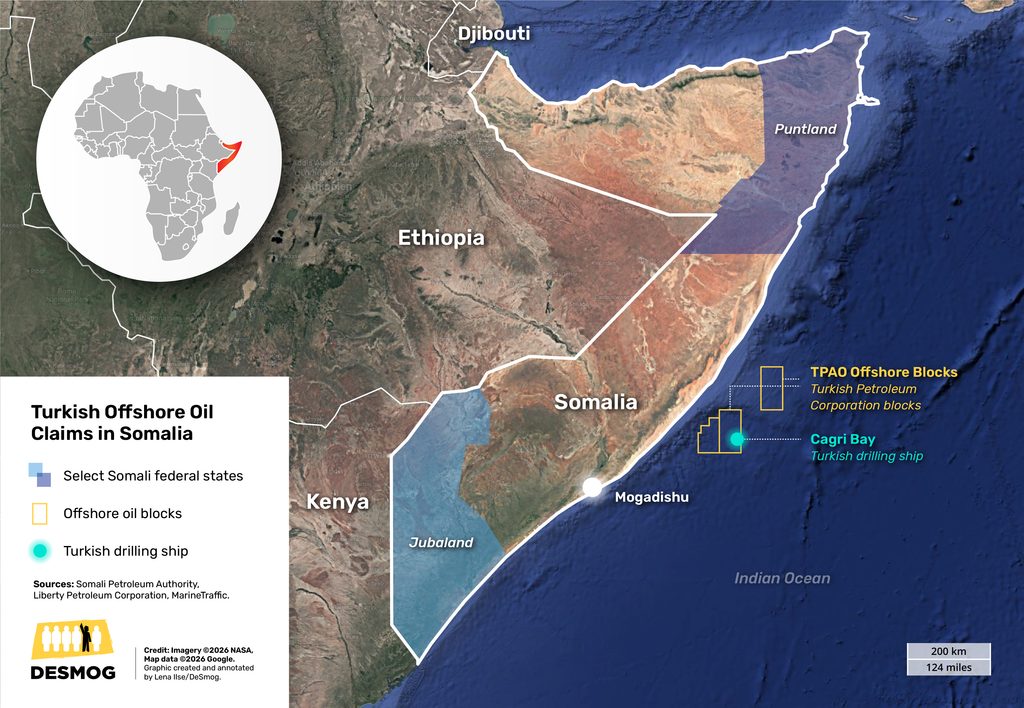
The Somali federal government granted TPAO exclusive rights to three large offshore blocks of oil and gas, each measuring approximately 5,000 square kilometres (1,930 square miles), according the documents obtained by Nordic Monitor, without any competitive bidding process.
And not only that: If the leaks are to be believed, Somalia is due to reimburse Turkey for exploration expenses and allow it to keep 95 percent of the production revenues.
Furthermore, Turkey reportedly retains the right to have any disputes resolved in its own capitol city, Ankara, rather than in Mogadishu or through international arbitration.
An exploration and production agreement was signed on 7 March 2024, but the wider public only began to get a sense of the full scope of the contract in May 2025.
The deal is “illegitimate”, according to MP Ahmed Abdi Koshin, the secretary of the Somali Defence Committee, because President Mohamud never presented it to Somalia’s federal parliament for ratification — or even to his own Council of Ministers.
“The fact is that we lawmakers don’t know anything about the contents of this deal, as it was never debated in parliament,” Ahmed told DeSmog. “This is a deal struck in secrecy between the Turkish government and President Hassan Sheikh Mohamud”.
Turkish President Erdoğan said in May that Ankara aims to complete exploration within six to nine months, while analysts say actual production will not begin until the early 2030s.
Turkey’s offshore drilling is expected to reach a depth of 7,500 meters (24,606 feet) making it one of the world’s deepest offshore operations. Researchers estimate that there are upwards of 20 billion barrels of commercially viable crude oil, which would generate significant heat-trapping carbon emissions if extracted and burned as fuel, making the climate crisis worse.
Both advocates and detractors of the deal acknowledge that it has transformative potential for Somalia. Where they disagree is on who will benefit.
‘Plunder Our Resources’
President Mohamud and government ministers have hailed the drilling as a milestone. They argue that the contract signed with TPAO is crucial to Somalia’s economic recovery after decades of continuous conflict.
MP Ahmed Abdi Koshin is sceptical, fearing that Somalia’s abundant natural resources will not translate into tangible development for the Somali people.
“My fear is that Turkey will plunder our resources without ensuring that Somalia benefits. That is what it looks like at present”, he said.
One especially contentious aspect of the arrangement is that no resource-sharing agreement exists between Somalia’s federal government and the semi-autonomous regions of Puntland and Jubaland. It’s not certain how they will react if the Turks start to drill in what both regions consider their waters, said Rashid, the chief analyst at think tank Sahan Global.
“They would probably treat it as an act of hostility. And remember, Puntland has its own navy”, he said.
Oil exploration is likely to intensify tensions between Mogadishu and both Puntland and Jubaland, said Rashid.
A precedent was set in July, when Puntland refused SOMTURK — a fisheries joint venture established between Somalia and Turkey — the right to operate in waters off Puntland without the regional state’s prior approval. This followed Mogadishu’s decision to license SOMTURK to oversee the issuance and management of all commercial fishing licenses within Somalia.
“The question of how to manage Somalia’s natural resources is increasingly a point of contention between the federal government and Somalia’s regional states”, Rashid said.
Mursal Khalif, an MP representing Jubaland, believes that the Turkish oil deal could deepen the long-running rift between the central government and Somalia’s semi-autonomous states.
“This is a deal shrouded in secrecy”, Mursal told DeSmog, “and it blatantly undermines member states such as Jubaland and Puntland. Further confrontation due to this deal cannot be ruled out”.
Mursal noted that according to the opposition, President Mohamud has ruled the country without a constitutional mandate since he declared “a transitional period towards democratic elections” when his term ended in May 2026 — a move many perceived as a power grab.
Recently, Mohamud’s government announced that Somalia would hold a presidential election on 15 May next year. Mursal wants any new Somali government to scrutinise the oil deal with the Turks afresh.
“The next administration will have to rescind the deal and take it to parliament”, he said, “so we can have a proper debate about how we want our natural resources to be managed”.
A ‘Predatory Power’
The oil agreement underscores Turkey’s growing reputation as a “predatory power” in Somalia, said Ahmed Abdi Koshin, the MP, a perception that is souring many Somalis on the two nations’ relationship.
“At first, it was all about our humanitarian needs, and Turkey was welcomed into Somalia at a time of real hardship. But today it’s clear that Turkey is not here to develop our country, but solely to protect their own interests,” Ahmed said.
Mursal agreed. “The Turks have been our close friends since they came to our rescue during the drought in 2011, and they have had a lot of goodwill among the Somali people. That is now changing”.
An important factor behind the increasing anti-Turkish sentiment is the battle between federal Somali forces and the terrorist group al Shabaab in the country’s South West State, bordered to the north by Ethiopia and to the west by Jubaland.
Turkey, reportedly, is supporting the federal government in the fight with drones and fighter aircraft, as well as logistical support and military training.
While the Mohamud government claims that the Somali-Turkish military campaign is a legitimate effort to counter terrorism, the South West State’s regional administration says it is intended to weaken political opposition to the Mogadishu government.
Civilians are regularly caught in the crossfire, leading the regional administration to accuse Turkey of human rights abuses and even war crimes.
“Recently, the resentment towards Turkey has grown to such an extent that we have seen Turkish flags being burned in the streets in South West State”, said Sahan Global’s Rashid. “People believe that Turkey has managed to capture the Somali state”.
So far, the changing public perception of Turkey’s influence in Somalia does not seem to have altered views in either Ankara or Mogadishu. Presidents Erdoğan and Mohamud appear to remain committed to each other and to the exploration of oil and gas off Somalia’s coast.
“Turkey has fully aligned itself with the president. It only talks to the federal government, and it doesn’t seem to understand that you can’t do that in Somalia today”, said Rashid. “The country is so politically fragile and fragmented that you can’t simply bypass the republic’s member states without risking the eruption of chaos”.