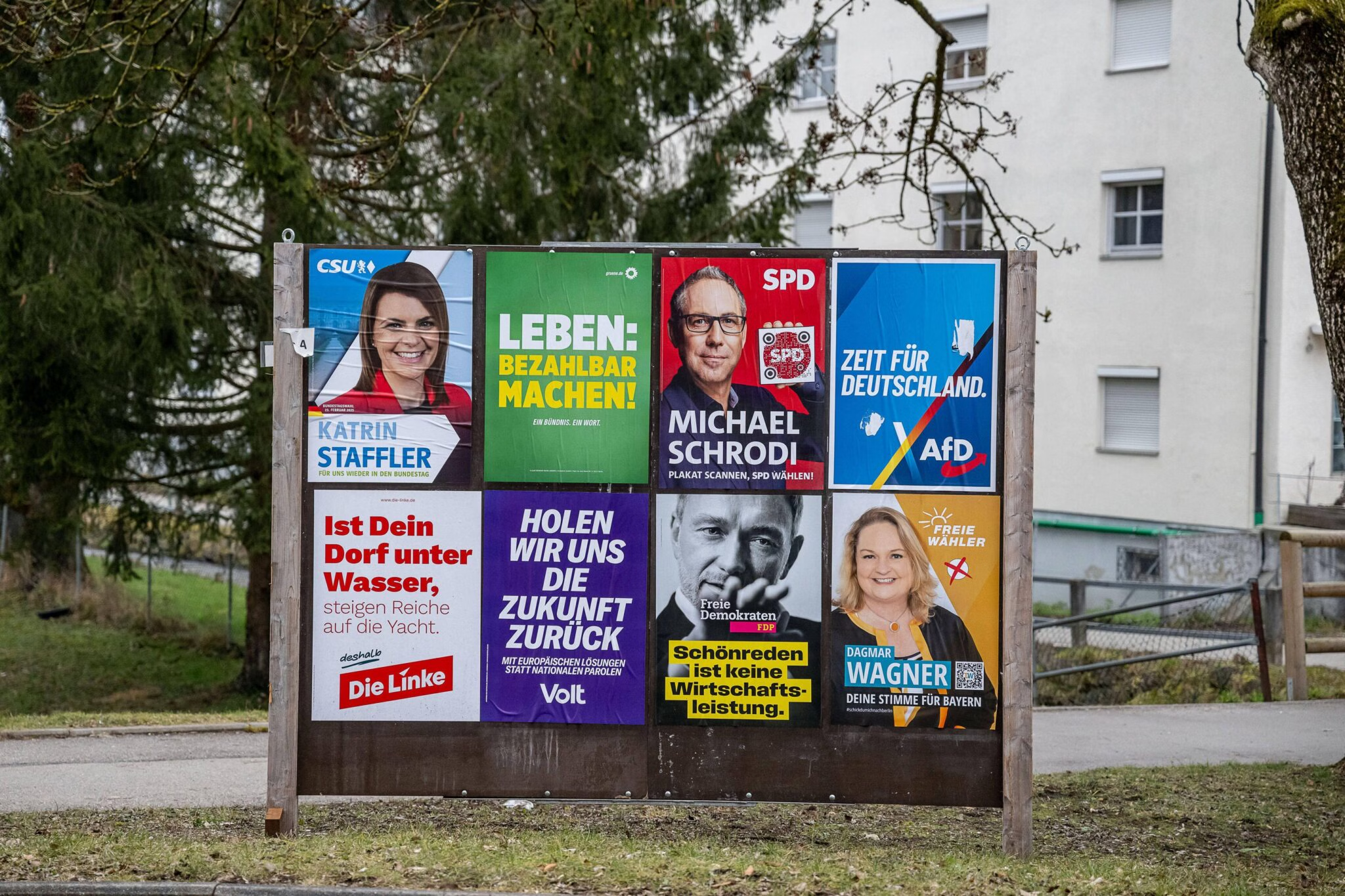
As tens of millions of Germans head to the polls this Sunday (February 23), one topic has been conspicuously absent from the headlines.
In the wake of the hottest year on record – both in Germany and the world – the word “climate” has barely featured on election posters plastering the streets, and has been largely avoided in talk shows and interviews.
This is a striking omission from a country which dictates the pace of climate action within the European Union, and which boasts an ambitious target to decarbonise by 2045.
Climate may be absent from the election campaign in name, but the subject has played a major role in defining recent German politics – with debates over energy and industrial policy leading to this weekend’s snap election.
Meanwhile, anti-green attacks have been thinly disguised in debates that have centred around economy, security and migration.
The far right Alternative for Germany Party (AfD), which is second in the polls, has repeatedly denied human-caused climate change and has pledged to leave the Paris Agreement. And Friedrich Merz of the conservative Christian Democrats (CDU) – widely tipped to be the next chancellor – has described wind turbines as “ugly” while backing a dash for polluting gas.
Despite the antipathy exhibited by most politicians towards green policies, the majority of Germans are deeply concerned about the climate.
Voters of all parties – with the exception of the AfD – strongly support climate action, according to a survey by public broadcaster ZDF on Wednesday. Last week, thousands of people protested in over 150 cities across Germany to call for more climate protection, democracy and to express concerns about a political shift to the right.
The avoidance of climate in political discourse could be strategic on the part of the candidates, suggests Nadja Hirsch from the Munich-based Institute for Climate Psychology.
“No elections can be won right now on the topic of climate,” said Hirsch, a former member of European Parliament for the economically liberal Free Democrats (FDP).
Voters currently feel more directly affected by the topics of migration and the economic situation rather than by climate change, she believes.
“If I can no longer afford something I was used to, it has a direct impact on my everyday life,” explained Hirsch. “People only deal with a problem when it is actually happening.”
Denial and Delay
While pro-climate statements have been thin on the ground, voters have been faced with a stream of anti-green rhetoric from the political right.
This is most apparent from the AfD, but politicians from the Free Democrats and Merz’s Christian Democrats have also used their platforms to cast doubt on clean renewable energy and to advocate for fossil fuels.
During an official election debate on ZDF, AfD chancellor candidate Alice Weidel told over five million viewers that wind energy was more expensive than coal and that Germany’s energy prices were the highest in the world. Both statements are false, and were not debunked in the course of the programme.
Weidel was even more emphatic in a speech made from the AfD national party conference in Saxony last month. “We will tear down all wind turbines,” she said. “Down with these windmills of shame.”
The AfD has also received a boost from Donald Trump’s economic advisor and the world’s richest man, Elon Musk, who endorsed the party on his social media platform X in December and wrote that it was Germany’s “last spark of hope” in an opinion piece in the Welt am Sonntag newspaper.
In January, Musk hosted a livestream chat with AfD party leader Alice Weidel and made a controversial appearance at an AfD rally by video link. During their livestream conversation, Musk and Weidel delved into energy policy but failed to mention the AfD’s official position on climate – that humanity’s driving role in climate change is “not scientifically proven”.
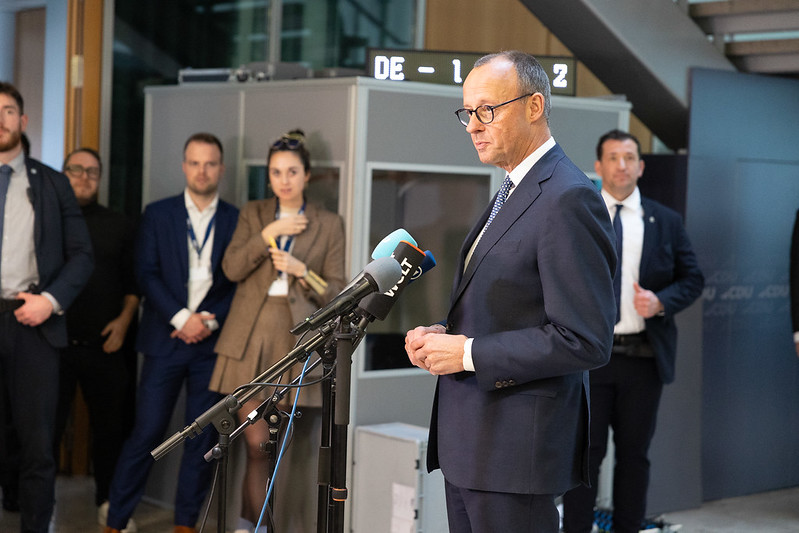
Rejecting the AfD’s climate-denialist stance, the conservative chancellor candidate Friedrich Merz has nonetheless signalled that he would be willing to delay green policies.
In November, just a day after the coalition collapsed, Merz gave an interview to broadcaster ZDF, describing wind turbines as “ugly” and wind energy as a transitional “bridge technology”. In late 2023, CDU worked with the AfD and Free Democrats to limit wind energy at the regional level in the state of Thüringen.
And in Bavaria, restrictive regulations on wind power led by the CDU’s sister party, the CSU, have caused the federal state to lag in development of the wind sector over the past decade.
Nationwide, however, the growing wind sector is now producing close to a third of Germany’s electricity, and overall renewables are now feeding over half of the country’s grid. But conservatives still doubt the reliability of wind and solar to anchor the country’s power production as renewable technologies develop further.
Merz said last month that “we must build 50 new gas power stations as fast as possible” to shore up the country’s future power demand. The CDU is also floating a return to nuclear power, to be developed alongside gas and renewables, with plans to phase out coal by 2038.
His party’s election programme also states that the 2035 EU-wide ban on selling new petrol and diesel cars should be reversed and that the fleet limits for car manufacturers should be “reviewed”.
Even for Germany’s Greens and the Left, climate protection has taken a backseat this election cycle. Both parties have pushed climate action in their manifestos, but appear to have toned down their advocacy in public debates, in contrast to the 2021 ballot.
Pascoe Sabido, a campaigner at the Brussels-based transparency non-profit Corporate Europe Observatory, says that the widely amplified undermining of green policies could have ramifications across the EU – including for Europe’s Green Deal, which is currently facing a series of attacks from an empowered political right.
“Germany completely sets the tone in Europe, be that in leading or blocking climate policy,” Sabido told DeSmog.
“The real risk to climate policy is less from denial and more from delay – the argument that it’s too costly, too quick. And that doesn’t need the AfD, as the CDU/CSU have already proven themselves the masters of this strategy, both in Berlin and Brussels.
“The AfD’s political position and its popular support will make delaying action easy and palatable, but at other times their denialism will be used to make the CDU/CSU appear to be the grown-ups.”
Government in Crisis
Sunday’s elections follow several years of geopolitical and economic turmoil which have put debates over energy front and centre in Germany.
In November 2021, a coalition of Social Democrats (SPD), Greens, and Free Democrats took power after 16 years of centre-right CDU leadership, with climate playing a key role in the leftward shift.
But just three months following the election, Russia’s full-scale invasion of Ukraine in February 2022 sent shockwaves through a German economy heavily reliant on Russian energy, driving soaring fuel prices, the country’s highest inflation in five decades and stagnating economic growth.
With Germany importing over half of its gas from Russia until the invasion, the ruling government voted with the opposition CDU to pass a May 2022 law accelerating the construction of the country’s first liquified natural gas (LNG) import terminals with estimated costs rising as high as over £8 billion in federal funding.
Large-scale investments in LNG were promoted by Germany’s powerful gas lobby and U.S. exporters eager for a spot in Europe’s largest gas market, a move previously pushed for by the first Trump administration.
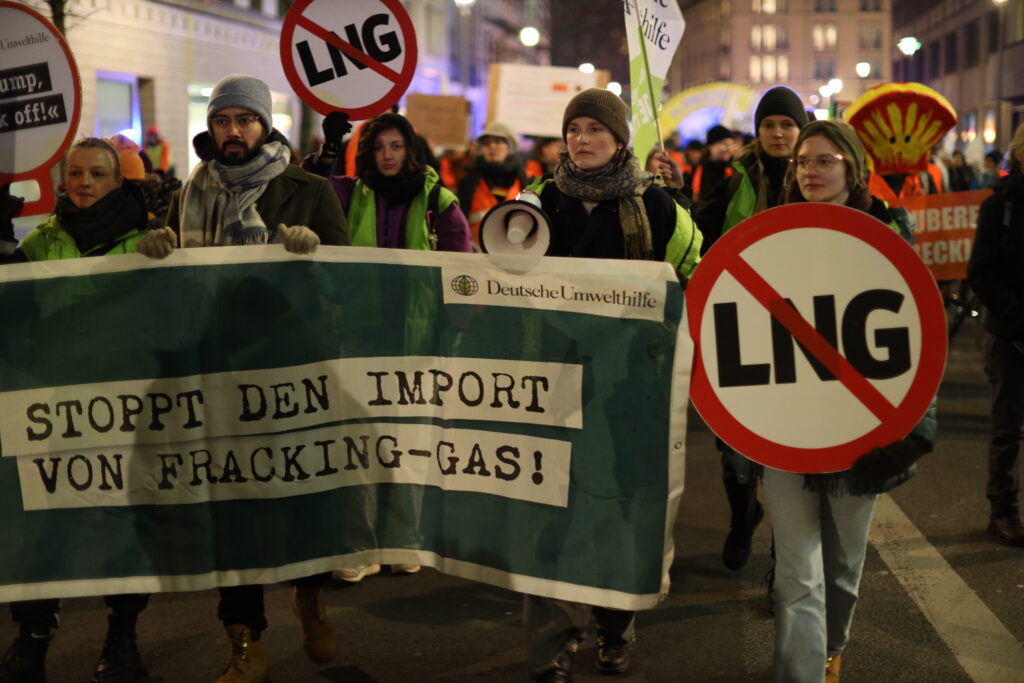
The new gas-build out has been heavily criticised by environmental groups who see it as betrayal of the coalition’s climate commitments.
“In recent years, Germany has built up massive LNG overcapacities in order to import large quantities of fracked gas from the USA,” said Sascha Müller-Kraenner, director of Hannover-based nonprofit Environmental Action Germany (Deutsche Umwelthilfe) in a press statement on Wednesday.
The new German import terminals are currently operating at about 12 percent capacity according to Brussels-based think tank Bruegel, far below the rates of neighbouring LNG importers such as France and Belgium.
“Instead of deepening fossil dependencies and building up supply chains that violate human rights, the next German government must massively accelerate the expansion of genuine alternatives such as solar, wind and battery storage – and at the same time increase energy efficiency in all sectors,” Müller-Kraenner added.
But the government’s unity over gas infrastructure did not translate to other sectors. In November, Germany’s ruling “Traffic Light Coalition” collapsed amid disputes over the federal budget. One of the major rifts between the Free Democrats and its Social Democrat and Green partners had been over a law to phase out oil and gas heating, with the Free Democrats opposing the costs and new regulations of the climate-focused measure.
‘Damage to Business’
While politicians shy away from overt commitments to climate action, Germany’s industrial sector is calling for greater clarity.
Last February, German chemicals giant BASF hosted a closed-door gathering of industry leaders and European Commission president and CDU member Ursula von der Leyen at its production site in Antwerp, Belgium, aimed at crafting a “European Industrial Deal” to restore economic competitiveness.
Then-BASF’s chief executive Martin Brudermüller was serving as president of Europe’s leading chemicals lobby Cefic at the time. The lobby is seen by environmental critics as pushing for deregulation and increased subsidies for the highly-polluting chemical sector.
Rising energy prices have especially increased production costs in Europe. In 2024, BASF enacted a cost-cutting plan which included laying off 700 workers at its flagship production plant in Ludwigshafen, Germany. Meanwhile, the company is building a giant £8 billion chemical park in China, with the first phase completed in 2022.
Not investing in green initiatives could damage Germany’s economy in the long term, say some industry representatives.
Companies which won’t move towards a climate-friendly production and economic model could “lose market shares and damage their business model,” Artur Siemens, spokesman of IG Metall, told DeSmog. IG Metall is Germany’s largest union, representing over two million workers in the metals and manufacturing industries, largely in the automotive sector.
In China – one of the most important sales markets for German goods – the majority of new car registrations are now electric. “German manufacturers are in danger of being left behind here, partly because they have invested too late and not consistently enough in e-mobility,” Siemens added.
The German auto industry is in crisis mode. Europe’s biggest carmaker Volkswagen is planning to cut thousands of jobs in Germany. Mass layoffs are also on the horizon at other automakers in Germany like Ford, affecting many of the industry’s multiple suppliers.
In order to save jobs and boost economic growth, union IG Metall has called on the government to “massively invest” in infrastructure, particularly in renewables, and to ensure “competitive energy prices”.
Janek Steitz, lead for climate and industry policy at the Dezernat Zukunft research institute, told DeSmog it was “essential” for the government to restructure Germany’s economic model through investment in retraining people and in attracting new industries. “What harms the economy most is not protecting the climate,” he said.
Cost of Inaction
The issues pushed by the far right Alternative for Germany (AfD) and by its political opponents are already being aggravated by climate change.
According to a report by Germany’s federal intelligence service, published last week, climate change threatens national security and leads to political instability, increased migration and higher food prices.
The report also found that damage from extreme weather events in Germany between 2000 and 2021 came to an estimated €145 billion (£120 bn). The climate crisis is “the greatest security challenge of our time”, German Foreign Minister Annalena Baerbock wrote in the report’s foreword.
Political scientist Achim Brunnengräber, from the Free University of Berlin, described the current strategy of most parties and corporations as “climate protection, but not at the expense of deindustrialisation in Germany or the freedom of citizens”.
Instead of talking about what climate protection costs, we should be asking how much we will have to pay if we do nothing, added Claudia Kemfert, head of energy, transportation, and environment at the German Institute for Economic Research (DIW).
“The costs of doing nothing are disproportionately higher than the costs of acting,” she told DeSmog. “Climate protection creates enormous economic opportunities and jobs fit for the future.”
Whatever the shape of Germany’s next ruling coalition, legal protections are in place. The German Climate Protection Act requires every new government to launch an immediate climate protection programme within 12 months, or risk the threat of lawsuits and multi-million euro fines from the European Union.
They are also under pressure from activists. Climate youth movement Fridays for Future has called on the next government to start phasing out gas and to tighten the country’s climate action law again. In spring 2024, the coalition government of social-democrats, greens and liberals agreed to a reform of the climate law which weakened the responsibility of individual ministries to cut down on emissions.
“Ultimately,” said Linda Kastrup, of Fridays for Future Germany, “it depends on the next chancellor whether the Paris Climate Agreement and the preservation of our livelihoods are considered important or not.”
Editing by Phoebe Cooke