
In the wildest dreams of tech billionaires, humans colonize the solar system on giant space stations, dodge mortality by uploading their brains into computers, and solve climate change in a single swoop of god-like AI-generated genius.
It’s a hubris that has led Big Tech companies, which until recently were seen as corporate climate leaders with ambitious clean energy goals, to run full-tilt towards oil and gas — powering the rapid expansion of their monstrously energy-hungry AI data centers with natural gas, and holding court with Trump energy officials who deny climate science while championing American fossil fuel “energy dominance.”
To all of this, Adam Becker, an astrophysicist and science journalist, basically says – Um. No.
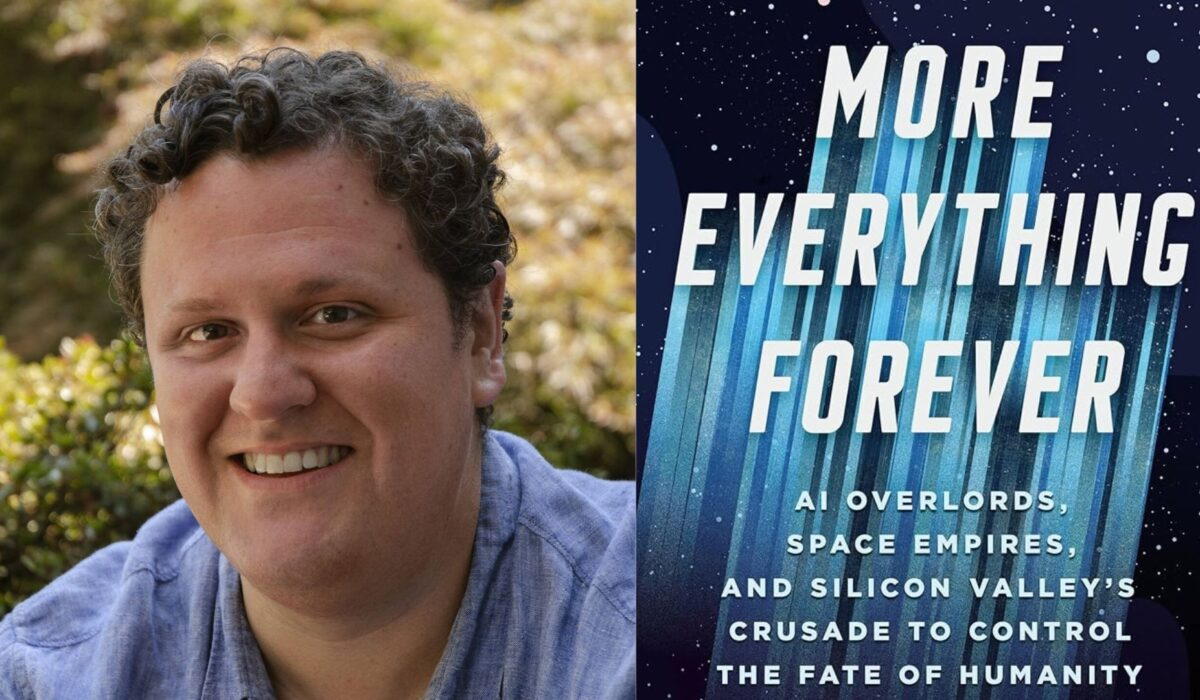
Becker’s book, More Everything Forever: AI Overlords, Space Empires, and Silicon Valley’s Crusade to Control the Fate of Humanity, exposes how tech billionaires’ sci-fi inspired fantasies about ever-more technology making everything, endlessly, better are basically, well — terrible. These billionaires’ promises, in Becker’s careful accounting, veer from what he says is “wildly implausible” to “profoundly immoral” – and ultimately paves the way for a descent into oligarchy.
They’re also, in Becker’s view, emerging as the root of a new, Silicon Valley-styled “insidious form of climate denial” – replete with its own set of what he calls greenwashing tactics.
DeSmog reporter Rei Takver spoke with Becker about what he thinks drives this new kind of climate denialism, and its consequences.
This interview has been condensed and edited for concision and clarity.
Rei Takver: You’ve said that writing More Everything Forever started after uncovering that evangelical Christian tech billionaire and Palantir founder Peter Thiel was funding a science magazine, Inference: International Review of Science, that was publishing not only creationism, but full-on climate science contrarianism. Why did Thiel’s climate denial take you over the edge?
Adam Becker: People take Silicon Valley’s ideas about science and technology very seriously, as though the leaders of the tech industry actually know anything about science or tech. It’s an understandable mistake to make, but it’s a mistake. When I started thinking about what I already knew about that, I realized that there was this through-line in Silicon Valley of climate denial of a kind, usually not the outright climate denial that you find in that Thiel-funded magazine, but a more insidious form of climate denial that minimizes climate change as a problem and says, “Oh, this is something that we can solve later, once we’ve built an [artificial intelligence] god, or gone to space.”
Rei Takver: When I see the phrase “more everything forever,” it conjures visions of endless power — more oil, more gas, more nuclear, forever. You’ve written about how many of these tech billionaires, such as OpenAI CEO Sam Altman, love dreaming about tapping into endless sources of infinite energy — often alongside the Trump administration. Why do you think Altman, and a wide selection of other tech leaders are aligning with the Trump administration’s aggressively fossil-fuel dominant AI energy policy?
Adam Becker: Let me answer your question with a segue. Nuclear fusion is one of these false promises of the tech industry, right? There’s a company, Helion, saying that they’re going to get a nuclear fusion power plant online at commercially competitive rates by 2028. I’m a physicist. That’s delusional. More realistically, we’re talking 40 years, and even that is probably optimistic — 2028 is not going to happen. Guess who’s the single largest investor in Helion and chairman of the board? It is Sam Altman. In an interview in January he was asked, what’s the best way to combat climate change? And he said, oh, we need to loosen up permitting for nuclear fusion plants, something that doesn’t exist and will not exist for probably decades.
Rei Takver: I wonder if Altman knows that himself. He’s written in his personal blog that “the 22nd century is going to be the century of atomic energy,” but also that he’s “unsure” how we’ll power the 21st century. Well, it does seem like he has some idea, since OpenAI is firing up gas turbines to run data centers already.
Adam Becker: I think it’s important to take a careful look at the world view here. Altman hired a Trump natural gas dude [to lead OpenAI’s global energy strategy] because he wants to build out as much AI infrastructure as possible, and he wants to get people to give him as much money as they can — before either the AI bubble pops or they succeed in building an AI god, which is not going to happen.
Rei Takver: Hasn’t Altman even said he believes AGI, artificial general intelligence, a supercomputer that in theory would match or exceed the intelligence of a human being, is going to solve climate change when it’s invented?
Adam Becker: Yeah, he said back in 2023 that climate change isn’t going to be that big a deal for a super intelligent AGI, because we can just ask it for three wishes to solve global warming. That’s not a viable plan. That’s not even a concept of a plan. The thing about these insane, futuristic visions that Altman and other tech billionaires are trying to sell the rest of us on is that it allows them to justify any action that they possibly want to take. As in, sure, we can just burn as many fossil fuels as we want right now, because the AGI is going to solve it for us.
Eric Schmidt, former CEO of Google, billionaire venture capitalist, and CEO of a space company [Relativity Space], said a little over a year ago now that“we’re not going to hit the climate goals anyway because we’re not organized to do it,” so we need to just burn as much energy as possible, get into AGI now, so the AI will solve climate change for us. That’s a better climate plan.
Solar and renewables are cheaper than they’ve ever been, and more reliable than they’ve ever been, but sure, buddy, we’re not going to meet our climate goals, even if we try. Whatever. I’m sure that the solution is to have people invest in the companies in your venture capitalist portfolio, which, by the way, includes another one of these boondoggle fusion companies.
Rei Takver: Microsoft and its founder Bill Gates have also been backtracking on climate issues recently. Last year, Microsoft announced publicly that its own climate targets had been a “moonshot,” and Bill Gates recently argued that AI will do more to solve climate change than worsen it.
Adam Becker: The idea that tech will save us, and is the only thing that will save us, and will solve every single problem, is something that you see over and over again in the tech industry. It is the idea that, his time, we found the thing that’s going to save the world, the World Wide Web! Oh, no. no, no. What’s going to save people is social media — look at the Arab Spring! Oh, no, no. What’s going to save the world is AI! No. What’s going to save the world is AI data centers in space!
Rei Takver: Speaking of data centers in space, Jeff Bezos is a huge fan, and also a huge fan of expansive space colonization that would see trillions of humans across the solar system. What is going on with this?
Adam Becker: Bezos said recently that he “doesn’t see how anybody can be discouraged who is alive right now” because “in the next couple of decades, there will be millions of people living in space.” No, that’s definitely not happening. You are wrong. The only reason you could actually say that with a straight face was you just don’t believe anything that anyone with expertise tells you about the world, or don’t bother to seek it out in the first place before you make statements.
Rei Takver: And part of the reason that Bezos says we need these space colonies is because he thinks there’s just not enough energy on Earth.
Adam Becker: Bezos is right about the fact that if our energy usage growth continues at the current rate, in a few hundred years we will not be able to keep growing our energy usage, because we’ll be using all the energy that the sun delivers to Earth in the form of sunlight. He’s right about that, too. The problem is, first of all, we’re not even going to get close to that. There’s all sorts of reasons why our energy usage is going to have to stop growing way before that point. Even if it doesn’t stop before that point, the waste heat from thermodynamic limits would boil the oceans.
The other way Bezos goes wrong is that after he says “Earth is the best planet,” he then says, so therefore, since we have to go into space to keep growth going, we need to build giant artificial space stations, and then we can have Earth as a kind of like planetary preserve.
Rei Takver: Which doesn’t have any congruence with the fact that his company just sponsored a summit where a bunch of fossil fuel companies came together with Trump energy officials to fantasize about building out more carbon belching, everything in the name of building out AI infrastructure.
Adam Becker: Yup. We get more, everything, forever.
Rei Takver: Elon Musk is also really into space colonies — in his case, on Mars. Musk says humans need to be multi-planetary because we need a backup, and weirdly, he seems to talk more about asteroids hitting the Earth than climate change. Why do you think that is?
Adam Becker: I’m going to quote [astronomer] Lucianne Walcowicz on this. They speculate, and I think they’re probably right, that an asteroid hitting Earth is something that a billionaire can’t be culpable for, right? Billionaires are not complicit in the fact that planet-killing asteroids exist, right? That’s just a fact about the solar system. Of course, it’s also true that if one of those asteroids hit here, it would still be nicer to be on Earth than it would be on Mars. And it’s also true that Mars gets hit with more asteroids than the Earth does.
Musk talks about terraforming Mars … if we have the technology to terraform Mars, why not just use that technology to solve climate change here on Earth? If such technology existed, it would absolutely be easier to use it here to fix climate change, because stopping climate change and getting the climate back into a good state that is compatible with advanced human civilization is so much easier than terraforming Mars. And yet, we have not shown ourselves capable of getting climate change under control. Mars is just a terrible idea as a backup for humanity for so many reasons. Even the idea of a backup for humanity is inherently problematic.
Rei Takver: Totally. In going after a “backup” planet, Musk is not just abdicating responsibility about climate change in a hypothetical future, he’s abdicating responsibility for the climate, and humanity, here and now.
Adam Becker: Oh yeah, I mean, look at the un-permitted natural gas plants that Musk is using to power an xAI data center in Tennessee. These tech billionaires are using these futuristic visions of their technologies to justify continuing extractive practices and continuing to accumulate power and wealth that’s always going to be at the expense of lots of other people. And I don’t think that they’re acting in their own enlightened self interest, right? What good is your money if civilization collapses due to a climate crisis?
Rei Takver: How much would you say we should be thinking of these tech bro fantasies and these tech bros as explicitly anti-climate?
Adam Becker: That’s exactly what they are. They do not care about the climate because they don’t see it as a problem, which is a form of climate denial, right? They think, we’ll fix it in post, basically, right? That’s essentially Sam Altman’s answer about climate change is: “Oh, yeah, we’ll get to AI and then we can fix everything else with that.” That’s not going to happen. And they just don’t think that anything else is as important as these futuristic fantasies that they have about AI in space and, you know, having more everything forever. Even the nuclear fusion stuff, where they say, “Oh yeah, this is green energy.” It’s not going to happen. And so what it is, is essentially a form of greenwashing, by using false promises of a futuristic green energy technology that is not going to arrive in time, if ever, as an excuse to temporarily use fossil fuels as transition to this technology that will never come, instead of just using the abundant, cheap green energy technology that we have now.
Adam Becker’s More Everything Forever can be purchased in the U.S., UK, and Canada.
Subscribe to our newsletter
Stay up to date with DeSmog news and alerts