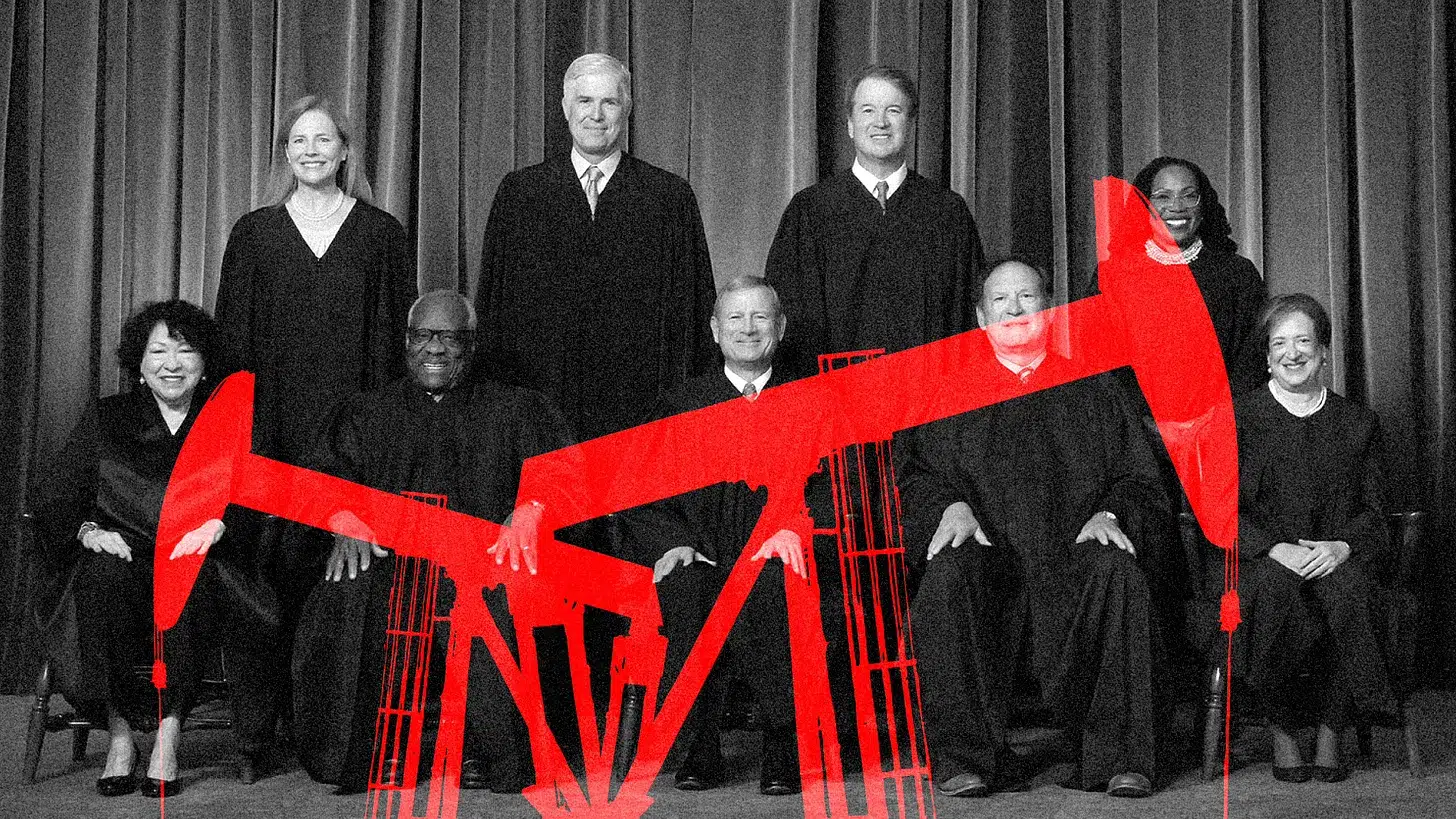
For the first time, the U.S. Supreme Court has granted oil companies’ request to weigh in on whether climate accountability lawsuits are preempted by federal law — setting the stage for a battle that could determine if dozens of similar cases are allowed to move toward trial.
The decision means the court will hear arguments from ExxonMobil and Suncor Energy to overturn an earlier ruling by the Colorado Supreme Court, which decided that a case brought by Boulder, Colorado, could move ahead in state court. You can read more about the companies’ petition in ExxonKnews and DeSmog’s previous coverage.
Oil companies have previously and repeatedly asked the Supreme Court to take up issues in the lawsuits, which point to growing evidence that the companies spent decades deceiving the public about climate change and blocked the transition to renewable energy. Since a narrow procedural ruling in 2021, the companies were rejected each time.
But two factors were different this time: the Trump administration urged the justices to take the oil companies’ petition in Boulder’s case, and Justice Samuel Alito participated in discussion of the case, despite recusing himself in the past.
Subscribe to our newsletter
Stay up to date with DeSmog news and alerts
Alito owns up to $15,000 in stock in ConocoPhillips and between $15,000 and $50,000 in Phillips 66. Those companies are defendants in other cities’ and states’ climate lawsuits, whose fate could be determined by a ruling in Boulder’s case.
Alito clearly acknowledged his conflict of interest in the past, because he recused himself from considering several other appeals related to the climate accountability lawsuits — including a nearly identical petition in Honolulu’s case, which the Supreme Court rejected last year. He even recused himself in Boulder’s case when it was brought before the high court on a jurisdictional question in 2023.
Back then, Exxon’s lawyers argued that Boulder’s case was an “ideal vehicle” for Supreme Court review because it “involves a smaller group of defendants and thus is less likely than those [other climate deception] cases to present recusal issues.” Translation: the companies that posed financial conflicts for some justices were not parties in this specific case. (Amy Coney Barrett’s father was a longtime lawyer for Shell and had a leadership role at the American Petroleum Institute).
Alito has not always recused from cases that would impact companies in which he has financial investments. When oil-funded Republican attorneys general petitioned the court to shut down similar state lawsuits in which ConocoPhillips and Phillips66 were defendants, he not only participated in reviewing the request, but also joined Justice Clarence Thomas in a dissent arguing the court should have taken it.
But Alito did recuse himself from a case the Supreme Court heard in January about oil companies’ liability for coastal damage in Louisiana, even though ConocoPhillips and Phillips66 were not direct defendants in that case, either. That was because ConocoPhillips is the parent company of Burlington Resources Oil and Gas Company, a defendant in the lawsuit in the lower courts, but not part of the oil companies’ arguments before the Supreme Court.
According to his 2024 financial disclosure, Alito also invested up to $100,000 in a high-dividend yield that listed Exxon as its third largest holding as of January.
In 2023, the Supreme Court published an unenforceable code of conduct which stated that a justice should recuse from hearing a case if their “impartiality might reasonably be questioned,” including because that justice or their spouse has “a financial interest in the subject matter in controversy or in a party to the proceeding, or any other interest that could be affected substantially by the outcome of the proceeding.”
The code qualifies that “ownership in a mutual or common investment fund that holds securities is not a ‘financial interest’ in such securities unless the judge participates in the management of the fund.” It also says that ““the rule of necessity may override the rule of disqualification” — in other words, if a tie-breaking vote is needed, a judge with conflicts of interest may be asked to participate.
Lisa Graves, executive director of national investigative watchdog group True North Research, said it was “no coincidence” that the court took up Exxon’s plea. Between Alito’s financial ties to oil companies, Justice Amy Coney Barrett’s father’s long employment for the oil industry, Clarence Thomas’s relationship with the Koch brothers, and the influence of Leonard Leo, who helped pick many of the justices on today’s court and has worked hand in hand with Koch networks, the court is “captured with the help of carbon cash,” Graves said.
Exxon and Suncor have also had help from the Trump administration and the GOP in getting their petition before the court. After an executive order from the President instructing the Department of Justice to block the cases, the DOJ submitted an unsolicited brief in support of the companies’ request. More than 100 Republican members of Congress also filed a brief on behalf of the companies, asking the justices to protect the industry from cases that “would restructure the American energy industry if not bankrupt it altogether.”
Big Oil and Leonard Leo muster their forces
As some climate lawsuits have inched closer to trial, the fossil fuel industry has gotten more desperate to stop them. “I have to win every case that is brought,” said Exxon assistant general counsel Justin Anderson at a November panel discussion hosted by the Federalist Society, a conservative legal advocacy group funded in part by fossil fuel interests and co-chaired by Leonard Leo. “They just need to find one they can get through — and that’s why it is so important for the Supreme Court to take this case.”
The U.S. oil lobby and their allies in state and federal government — along with the same Leo network that helped stack the court — have been ramping up pressure on lawmakers to pass a “liability waiver,” or a bill that would immunize the fossil fuel industry from such lawsuits. Last week, U.S. Representative Harriet Hageman (R-WY) said she was working to draft such a bill.
At the state level, lawmakers in Utah and Oklahoma have introduced bills that would shield fossil fuel companies from climate liability; Utah’s is now awaiting the governor’s signature. Those bills appear to draw from a model bill published by Consumer Defense, a Leonard Leo-linked project, the New York Times reported. Alliance for Consumers, another Leo-tied project, has also been behind other broader state bills that would limit corporate liability. The Leo network has also pressured the Supreme Court to step into the climate accountability cases on behalf of oil companies.
The DOJ has also attempted, unsuccessfully, to preemptively block Michigan and Hawaiʻi from filing climate lawsuits against fossil fuel companies.
“It’s a bad sign for sure” for the plaintiffs that the justices took the case, said Pat Parenteau, an environmental law professor and senior fellow at Vermont Law School. But, Parenteau noted, the court may not end up ruling on the preemption question at all. In their decision to grant review, the justices said they would consider the question of whether the court has jurisdiction over the case, considering there has not yet been any final decision from a lower court on its merits.
While the Trump administration has backed the industry in fighting the lawsuits, its EPA also recently repealed the Endangerment Finding, the scientific finding behind federal greenhouse gas regulation in the United States. That decision could undermine the companies’ preemption argument and open up a new front for litigation against the fossil fuel industry.
Boulder’s lawsuit argues that the companies violated state laws like public nuisance, trespass and conspiracy, among others, and should help communities pay to adapt and recover from increasingly devastating and expensive climate disasters.
“The Colorado Supreme Court’s decision was correct in holding that these state law claims for in-state injuries can continue in state court,” said Michelle Harrison of legal advocacy nonprofit EarthRights International, who serves as co-counsel for Boulder. “Exxon’s ever-evolving arguments as to why they should be immunized from such claims are baseless.”
Exxon is represented in the Boulder case by Paul Weiss, a law firm that has worked to defend a wide range of corporate clients from liability and, last year, cut a deal to work for Trump. The firm’s longtime chairman recently resigned after his name appeared multiple times in emails with Jeffrey Epstein.
This month, the firm notified courts in Connecticut, Hawaiʻi, Maine and Washington state that they would no longer be representing Exxon in pending climate lawsuits there.
Subscribe to our newsletter
Stay up to date with DeSmog news and alerts