
A French PR executive with links to the gas industry appears to be behind an online campaign to discredit clean heating, it can be revealed.
The new investigation by DeSmog and Politico found boutique Paris-based PR firm Digital Tellers is linked to a web of connected Facebook groups and accounts, which regularly share false claims about the cost, noise and reliability of heat pumps.
Electricity-powered heat pumps, which draw air from outside homes and transfer it into heating, are critical to Europe’s plans to reduce its reliance on volatile, planet-heating gas.
Studies show that this low-carbon technology is up to three times more efficient than gas boilers, and, when properly installed, can halve households’ heating bills.
But posts disseminated in the Facebook groups by several inauthentic accounts describe heat pumps as “useless” and compare them to a “lawn mower that never stops”, while installers are branded “swindlers” (“margoulins”) and “environmental fraudsters” (“éco-délinquants”).

This investigation was published in partnership with Politico.
Three of the graphics – which were posted in the groups by an admin and regular contributor – appear to be AI-generated, and deploy antisemitic tropes, with heat pump installers shown as conmen, with hooked noses, open shirts and gold chains, alongside examples of poor workmanship.
“The drawings associate these visual tropes with money and social climbing,” explains Jonas Pardo, an antisemitism expert at French antiracist organisation Boussole. Pardo noted that it is difficult to know “whether the prompt that generated these images contained the word ‘Jew’ or whether it is the AI itself that represents what is deemed dishonest enrichment using the codes of antisemitic caricature”.
DeSmog located the source of heat pump disinformation in seven Facebook groups, the first of which appeared in February 2021 – around the same time that The Digital Tellers was hired to do communications for a gas trade group, Les Professionnels du Gaz (PG), in a contract that included social media strategy, community management and content creation.
On the surface, the groups look like informal grassroots hubs, which offer practical heating advice to consumers and installers. Several have neutral names such as “heat pumps France – opinion” or “hybrid heat pumps and boilers – advice and opinion”.
However, DeSmog found The Digital Tellers director Barthélémy Vaudon – under the Facebook profile “Barth Vaudon” – was an administrator on all seven groups pushing out disinformation, alongside other personal Facebook admin accounts that appear to be inauthentic. Two of Vaudon’s PR colleagues were also members of three of the Facebook groups.
The anti-heat pump or pro-gas messaging which is shared on the seven groups is amplified by personal accounts linked to the PR executive, one profile linked to a gas trade group, and the same inauthentic accounts that pose as admins of the groups. Inauthentic accounts are defined by Meta, Facebook’s parent company, as “using deceptive behaviours to conceal the identity of the organisation behind a campaign, to make it appear more trustworthy or popular than it is”.
Content is also reshared by accounts linked to Vaudon personally, such as his candidacy campaign page for recent local elections in France and even the metal band he plays in.
As well as boosting misleading claims about heat pumps, the network of groups champion gas heating and advocate for delay tactics, such as hybrid heat pumps and “green” gas, both of which would extend the lifespan of fossil fuels.
In a statement sent to DeSmog and Politico, a spokesperson for The Digital Tellers disputed the allegations, and said it refused to “disclose information that is the property of our clients”.
The Professionnels du Gaz, and the freelancer employed to run social media for the account, did not respond to any of DeSmog and Politico’s requests for comment or clarification. Vaudon and his colleagues also did not respond to requests for comment. Meta declined to comment on record.
“When a PR firm is linked to a social media network spreading misleading climate narratives, it undermines the public interest and risks derailing the transition to clean energy,“ said Henry Peck, head of campaigning at the environmental and human rights non-profit Global Witness. “The PR and advertising industry can no longer justify promoting fossil fuel clients.”
A 2025 report from the International Panel on the Information Environment (Ipie), which reviewed 300 studies, found that action to address the climate crisis is being obstructed and delayed by misleading information, from fossil fuel companies and others.
“This kind of campaign brings false statements about heat pumps into the public domain,” said Laurent Cordonnier, a disinformation expert at Institut Montaigne, a Paris-based policy think tank. “Once they’re stuck in people’s heads, fact-checking becomes useless. The damage is done.”

Heat Pump Myths
“They capture the air and suck up our money”. “The cold snap proved that heat pumps are useless when temperatures drop below zero!” “Heat pump installers are crooks”.
These are among the many false or misleading claims found on “Energy transition and scams!” (Transition énergétique et arnaques!), one of the largest, with over 3,000 members, and most active of the seven Facebook groups identified in the investigation.
The network of groups were all set up between February 2021 and March 2023, and amplify a number of widespread myths about heat pumps, as well as spreading false narratives about gas heating. They do this by creating their own posts as well as by sharing links to misleading material, including videos.
Content shared on the groups plays on widely circulated myths that heat pumps don’t work when it’s cold, and that gas heating is more efficient and reliable. They also regularly exaggerate and inflate the cost of heat pumps, with dozens of posts repeating the false claim that installation costs €29,000 euros – a figure that is around double the average cost in France, and which experts told DeSmog was “totally absurd”.
Many of these false claims are shared by “Sofiane Bnd”, an apparently inauthentic account, which also posts images of botched installations, or even exploding heat pumps, often accompanied by a derisory comment. Some of these appear to be AI-generated.
Heat pumps are up to three times more efficient than gas boilers, even at temperatures well below freezing, according to peer-reviewed analysis by clean heating experts at the Regulatory Assistance Project (RAP). The heating systems have the highest sales rates in Europe’s coldest countries – Sweden, Finland and Norway.
Noise complaints posted on the groups also appear to be grossly exaggerated. A 2024 report commissioned by UK heat pump producer Nesta found that even in a worst case scenario, multiple heat pumps would be “unlikely to be individually distinguishable from background noise”.
Although heat pump sales are higher in France than the UK and Germany, France’s national grid operator warned in December that the country is still lagging behind its own electricity demand targets.
In response to the energy crisis unleashed by the US-Israel war on Iran and Lebanon, the French government announced in April it was rolling out a more ambitious electrification plan in the name of energy sovereignty, including measures to accelerate gas heating phase-out and boost heat pump installations.
EU law says member states should plan for a complete phase-out of fossil fuel boilers by 2040. However, in France, fossil fuel boiler sales increased in 2025 compared with 2022–2023 levels, while heat pump sales declined, following an increase relating to the energy shock caused by Russia’s full-scale invasion of Ukraine.
The Facebook groups under review had between 300 to 5,000 members, and a combined membership of nearly 15,000. But the network’s relatively small Facebook audience “does not necessarily reduce its effectiveness,” says Cordonnier of Institut Montaigne.
“When disinformation is disseminated in a targeted way within the right groups, it can reach specific audiences, notably people planning renovation work, replacing their heating system, or tradespeople,” he said.
“Its circulation on Facebook rather than Instagram is no coincidence: this network reaches more older users with a certain level of purchasing power.”
‘Damn Oil Boiler Salesman’
The investigation identified around 10 inauthentic Facebook accounts in the misinformation network, all involved in spreading false claims on heat pumps and pro-gas messaging.
These accounts, which feature scant personal information, use similar wording in messages, and frequently engage with each other’s posts to boost their reach. They are also “admins” and members of the same groups, where they both post and participate in discussions.
Two Facebook profiles, named after the PR executive Barthélémy Vaudon and a member of his metal band, were added by the inauthentic profiles to three of the seven groups on the day of their creation, and subsequently added to the remaining four.
Recurrent misleading claims from one highly active profile raised suspicions among legitimate Facebook group members. One reacted angrily to heat pump myths shared by “Sofiane Bnd”, stating: “in my opinion, Sofiane is just a damn oil boiler salesman.”
By far the most active admins on all seven groups – 23 of the 28 identified – are either inauthentic profiles or Barth Vaudon, according to DeSmog’s Facebook analysis. The other five admin accounts are largely inactive, or have posted just once.
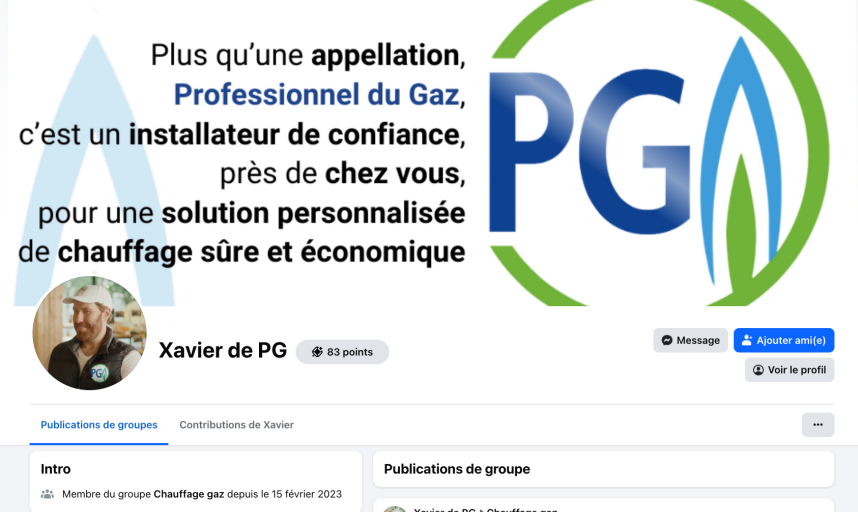
The account “Xavier de PG” also features in the network, frequently sharing gas industry content, including campaign videos to promote gas boilers. DeSmog found that the account was added by “Barth Vaudon” to one of the seven Facebook groups, and is a member of five others in the network.
Xavier de PG appears to be a marketing account for Les Professionnels du Gaz (PG) – featuring a profile picture of a smiling man with the trade association’s logo on his jacket. PG also has a separate official Facebook account under its name, which uses a photograph of the same man as its cover photo.
Professionnels du Gaz, a trade group made up of 13,500 gas heating installation and maintenance businesses, says its main aim is to improve the quality and safety of domestic gas installations, and to advocate for the industry. It also manages a certification programme, which is aimed at helping consumers identify skilled gas industry professionals.
PG’s logo features on The Digital Tellers’ home page, among both past and present clients. These include public institutions, such as local governments, and France’s Ministry of Higher Education and Research. The Digital Tellers has also worked for the Citizens’ Climate Convention, a French citizens’ assembly of 150 people, selected at random and tasked with proposing measures to cut greenhouse gas emissions.

DeSmog also found that The Digital Tellers was hired in 2025 to refresh a website of PG’s sister organisation, HabitA+, which manages PG’s gas installer certification system. Both PG and HabitA+ are led by the same director, Romain Ruillard, and are registered at the same address.
PG also paid The Digital Tellers to carry out work on its social media and community engagement strategies, services it provided via a freelancer. In 2023, this freelancer stated on his LinkedIn CV and portfolio that he’d led on PG’s social media strategy and community management since 2021. His showreel suggests he had worked on promoting hybrid heat pumps, as well as a 2024 campaign to promote the use of “green” gas at festivals.
As France’s main label for trusted gas boiler installers, PG plays a major role in representing the gas professionals directly in contact with consumers. The trade association works closely with the country’s main gas distributor GRDF, with whom it shares a close professional relationship.
PG and GRDF have worked together on a number of campaigns promoting gas heating, which were frequently shared on the network of Facebook groups. These included “Choose green gas” (Choisir le GazVert) — an ongoing campaign launched in 2024, and “Back to heating” (Rentrée du Chauffage), an annual autumn advertising campaign to promote gas boilers. They also previously ran a lobbying campaign to maintain tax breaks for gas boilers.
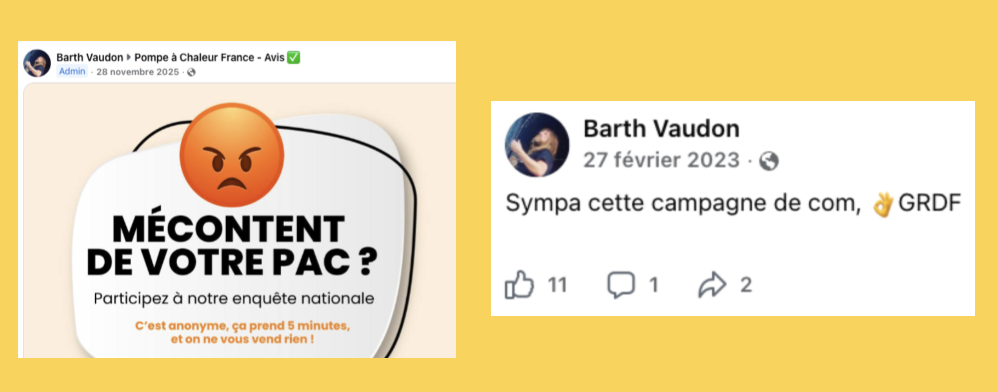
Vaudon himself shared an advertising campaign promoting hybrid heat pumps on one Facebook group in the network, commenting: “That GRDF ad campaign is pretty cool.”
Two representatives from GRDF sit on PG’s board, alongside two trade groups for the building sector, and one representing heating and ventilation maintenance workers (Synasav).
DeSmog uncovered a commercial relationship between Synasav and Barthélémy Vaudon. Company documents show that in November 2022, Vaudon, together with his business partners and Synasav director, Cyril Radici, set up Content Web Media — a digital publishing company behind the energy specialist website ActuEnergie.
Vaudon and several inauthentic accounts identified by this investigation regularly share ActuEnergie content on the Facebook groups, including a survey prompting negative feedback about heat pumps (shown above).
Synasav and Radici, who earlier this month was appointed to the board of the French Heat Pump Association (AFPAC), did not respond to DeSmog’s requests for comment.

‘Green Gas for Dummies’
The network of Facebook accounts not only undermine and mock clean heating, but also make misleading claims about alternatives relying on gas. Hybrid heat pumps are described as the “best solution”, while green gas is “the future”.
According to Dan Meller, author of Breaking France free from fossil gas, hybrid heat pumps “keep us tethered to an expensive gas network”.
“They only make economic sense under very specific conditions — when high peak power is needed but overall energy demand remains low,” he said. “Such cases are very rare. In most situations, a standalone heat pump is the simpler, more cost-effective, and more energy efficient solution.”
As part of its new electrification plan, the French Ministry of Economy and Finance has announced a ban in new buildings of all gas boilers, including hybrid heat pumps, by the end of this year.

The network of Facebook accounts also makes the case for biomethane or “green gas”, particularly on one group, “Green gas for dummies!” (“Le Gaz vert pour les nuls!”).
In France, gas industry lobbyists promote biomethane — fermented organic matter which is purified and injected into the gas grid — as playing a key role in transitioning away from fossil fuel heating.
But studies show biomethane can account for only a fraction of total gas demand in countries like the UK and France, due to finite sustainable resources, as well as cost. In 2025, active biomethane facilities supplied only 3.9 percent of France’s gas consumption.
France aims to triple its biomethane production capacity by 2030, but its potential “remains limited” despite these ambitious targets, comments David Marchal, program director at French environmental agency Ademe.
“We must prioritise its use where there is no alternative to gas,” he told Desmog. “In heating, there is an alternative in most cases, unlike in some heavy industry sectors.”
Delay tactics can serve to prolong fossil fuel infrastructures, while also discrediting and delaying the uptake of electric-based technologies, says Nicolas Nace, energy transition campaigner at Greenpeace.
“Disinformation about heat pumps follows the same playbook as the attacks on renewable energy and electric vehicles: exaggerated criticism, distortion of facts, and an emphasis on sporadic instances of scams,” Nace told DeSmog.
“Overall, French people have a fairly positive view of the technology, but their understanding of heat pumps remains limited. It’s precisely that lack of knowledge that makes such disinformation campaigns so effective, slowing down the transition to clean heating.”
Editing by Phoebe Cooke and Hazel Healy
Additional research by Brigitte Wear