A version of this article also appeared on investigative site The Detail
Northern Ireland’s largest source of drinking water is besieged by toxic pollution linked to a government drive to accelerate pig and poultry farming, new research shows.
‘Mapped: The scale of pig and poultry farming in Northern Ireland’ tracks the rise in intensive farming and correlating decline in water quality over the 13 years since the launch of a national plan to accelerate the growth of farming, fishing, food and drink production.
The small nation of 1.9 million has the highest density of pigs and poultry in the UK, with more chickens and pigs than Scotland and Wales combined, the research shows.
Published today (9 July) by Friends of the Earth Northern Ireland and multimedia research agency Materiality, the report finds that the harmful nutrients from the excess manure created by intensive farming directly impact the soils and water in Northern Ireland – while the vast majority of the profitable animal products are exported elsewhere.
Over 63 percent of poultry, eggs and pork by revenue are sold in England, Scotland and Wales, the data shows. According to the report, Northern Ireland – which makes up just six percent of the UK’s land mass and three percent of its population – consumes only a small proportion of its produce but has been left to deal with the resulting manure, with devastating environmental consequences.
The research includes newly released figures dating back to 2012 – the year before the ‘Going for Growth’ strategy was approved by the Northern Ireland Executive without any official environment assessments to identify or protect against pollution.
Poultry numbers rose by a third (34 percent) since then, with a 74 percent increase in pigs. This resulted in a 51 percent rise in manure, which contains the nutrients phosphorus, nitrates and ammonia which harm ecosystems, pollute the air, soil and waterways when excessively applied to land.
In 2024 alone, over 138 million chickens and 1.9 million pigs were slaughtered in Northern Ireland, the research found.
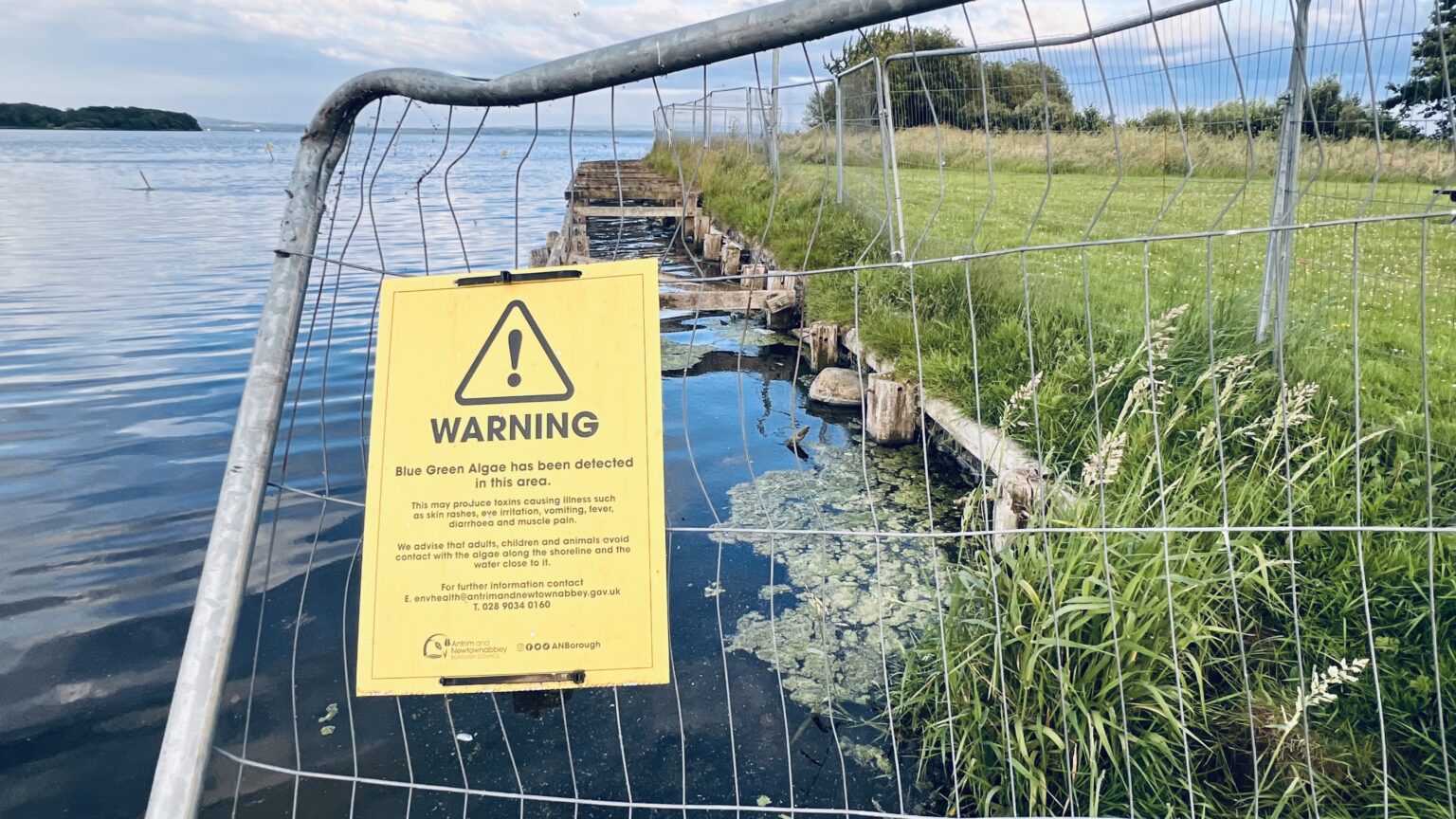
Lough Neagh, the UK’s largest lake, which provides half of Northern Ireland’s drinking water, has been consumed by toxic cyanobacteria since 2023 — killing wildlife, costing jobs and leaving it unsafe for recreation. These blue-green algal blooms now coat the lake’s surface every year and are so extreme they can be seen from space.
Newly released official data reveals that 64 percent of poultry and 61 percent of pigs were raised in the area that drains into Lough Neagh.
The report also highlights how levels of phosphorus – the main agricultural pollutant feeding blue-green algae – rose rapidly after the Going for Growth strategy was introduced, and has remained dangerously high ever since.
“Northern Ireland has become a sacrifice zone to feed the UK’s appetite for chicken and pork,” said Friends of the Earth NI director James Orr, commenting on the report.
“We have a model of factory farming where most of the profits and meat go overseas and we are left drowning in shit. The huge amounts of pig waste and chicken litter spread as fertiliser on already saturated fields has disastrous consequences for lakes providing our drinking water. We need to turn off the tap of toxic waste.”

Destination Manure
The report pinpoints the location of intensive livestock farms across Northern Ireland, using data from planning applications, Freedom of Information requests, maps, intensive permit databases and government data.
According to the analysis, Northern Ireland has 1,006 farms raising poultry and 403 farms keeping pigs, with 211 poultry farms and 14 pig farms licensed as intensive – which means they can stock up to 21 million poultry and over 95,000 pigs.
County Tyrone holds the highest volume of pigs and poultry at 54 birds and 1.5 pigs per person, compared to national averages of 13 birds per capita and 52 pigs per square kilometre. Great Britain, on the other hand, has an average of two chickens per person and 17 pigs per sq km.
Northern Ireland’s largest county Tyrone, which borders Lough Neagh, also produces the largest share of poultry manure and pig manure, at 43 percent and 33 percent respectively.
Overall, the report identified a 66 percent rise in poultry litter – contaminated bedding scraped from the floor of chicken houses containing urine, manure, feathers and food waste – which is high in the nutrient phosphorus on which toxic algal blooms thrive.
The research also found a 48 percent increase in pig manure in Northern Ireland from 2012. By comparison, cattle manure increased by three percent and sheep waste fell by eight percent.
Pigs produced four times as much waste as poultry, but the chicken litter produced in 2025 contained three times more phosphate, which drastically reduces oxygen levels in water bodies, leading to a process known as eutrophication.
This can lead to major ecosystem disruption, killing plants, insects, fish and the wildlife that depend on them for food.
Northern Ireland’s intensive farms are required to inform the Department for Agriculture, Environment and Rural Affairs where their manure is going, because it pollutes water bodies when too much is added to fields for plantlife to use.
Documents analysed for the report also show that all of the 1.26 million tonnes of manure from intensive pig farms feeding major producers Cranswick and Sofina (Karro) is spread on domestic fields.

Supplying GB
The report identifies the major Northern Ireland companies across the poultry meat, eggs and pig sector who sub-contract farmers and supply supermarkets.
Pilgrim’s, Cranswick, Sofina and Ready Egg (Skea Eggs) supply most major UK retailers, including Aldi, Asda, Iceland, Lidl, Morrisons, M&S, Ocado, Sainsbury’s, Tesco and Waitrose.
Waitrose, Ocado, Morrisons and Aldi do not operate shops in Northern Ireland.
Pilgrim’s is owned by Brazil-based JBS, which is the largest meat producer in the world. It is Northern Ireland’s dominant poultry company, with two slaughterhouses in Ballymena and Dungannon and a feed mill in Randalstown.
All of the retailers were contacted for comment. Most did not respond to questions about how they will address concerns about factory farming impacts on Lough Neagh and other waterbodies.
A spokesperson for Waitrose said “no pork and a minimal amount of eggs” is sourced from Northern Ireland, while M&S said it “takes pollution extremely seriously” and its suppliers and farmers are “third-party farm assured”.
Pilgrim’s Europe (also known as Moy Park) has agreed a number of litter strategies with Northern Ireland’s Environment Agency since 2014. However, the report shows that the company spread far more poultry litter on Northern Ireland fields than agreed.
According to Pilgrim’s Europe July 2025 litter strategy, just one percent would be spread on land, but actual figures came to 21 percent.
Planning applications related to broilers – chickens that are bred exclusively for meat – that cited both Going for Growth and Moy Park accounted for 99 percent of the broiler population capacity increase from applications made on Pilgrim’s behalf.
A Pilgrim’s spokesperson said the company has “been working towards fully-off land broiler litter management” over the past decade, and hopes to send more to anaerobic digestion (AD) plants – facilities which break down food waste with bacteria, with the resulting gas used to generate electricity.
“Poultry is a highly regulated industry,” they added, “with the majority of our farms subject to integrated pollution prevention and control [IPPC] permitting and monitoring to minimise environmental impact.”
Analysis of company forms provided to DAERA giving the destination of all poultry litter from intensive farms since 2018 show 41 percent goes to AD plants, 29 to mushroom growers, with nearly four percent incinerated. Over a fifth (21.5 percent) is spread on land, directly polluting fields and water bodies.
In terms of location, four percent of the polluting litter is sent to Great Britain to be incinerated and the rest, bar an unaccounted two percent, stays on the island of Ireland, with 71 percent remaining in Northern Ireland.

Water Testing Gaps
According to Northern Ireland’s Agri-Food and Biosciences Institute (AFBI), around 60 percent of the chemical elements polluting Lough Neagh are from agriculture, over 20 percent from sewage and the rest from septic tanks, industry and households.
Department for Agriculture, Environment and Rural Affairs (DAERA) minister Andrew Muir, who has served in the role since February 2024, said Going for Growth was a “mistake” after blue-green algae choked Lough Neagh. He has repeatedly warned that the recovery could take decades.
This report has uncovered a series of gaps in water quality testing by Northern Ireland Environment Agency and DAERA up to Lough Neagh’s crisis point in 2023, including a reduction in testing frequency in 2016 and 2017 when NIEA moved to a “temporary quarterly programme” because of resource issues. This “was reversed in 2017 due to excessive data gaps”.
A DAERA spokesperson added that multiple testing sites were closed in 2022, but that several new investigative sites were opened in 2024 “in response to the blue-green algae issue”.
The department also said it considers Lough Neagh’s one long term testing site at Toomebridge as the “most representative of the lake chemistry”.
Scientist and anaerobic digestion expert, Les Gornall, says phosphorus is the main driver of harmful algal blooms in water bodies, with soluble reactive phosphorus (SRP) levels indicating whether one will occur.
When the SRP reaches 0.05mg/l, the food supply “enables the blue-green algae to grow faster than they are consumed or washed out, and they accumulate on the surface of the water,” he explained. When this happens, it results in a “hazardous algal bloom”.
Analysis of water quality data provided by DAERA through Freedom of Information requests shows SRP levels in Lough Neagh have been at algae-causing levels since 2012.
They fell between 2012 and 2013, but grew to well above the 0.05mg/l needed to cause an algal bloom in 2021 before a gradual decline.
The report also revealed that Lough Neagh has the fewest long-term water quality monitoring sites compared to the biggest lakes in England, Ireland, Scotland and Wales’ – which could all fit inside its 38,000 hectares.
DAERA launched a £37 million soil nutrient health scheme in 2022, inviting farmers to find out where they are spreading so much manure it could pollute water, through soil sample tests.
These tests were carried out in four tranches, with the three completed areas containing too much phosphate in the soil on average – resulting in excess nutrients that could cause water pollution.
Pilgrim’s Europe disputed the findings of Friends of the Earth NI’s report, stating it “intentionally relies on out of date information – some over 10+ years old – and incorrect assumptions, and does not accurately represent where we are as a company today”.
They said 80 percent of their poultry litter in Northern Ireland was used off land and that they have plans to remove all of this off land by 2028.
Minister Liz Kimmins, who oversees waste and drinking water infrastructure and planning policy in Northern Ireland, says her “priority is dealing with wastewater infrastructure” and that a solution requires “a whole government approach”.
Friends of the Earth Northern Ireland is now calling for a moratorium on new factory farms and a reduction in animal numbers with a just transition for farmers.
“The people of Northern Ireland and our rivers and lakes need a breathing space from the relentless pollution,” said director James Orr.
“We can easily reduce the number of caged animals and redirect existing and future funding towards a just transition – a transition that benefits farmers instead of the profiteering by global agrifood corporations.”
Additional research by Clare Carlile. Editing by Phoebe Cooke