


Pennsylvania real estate executive Brian O’Neill sought the help of an attorney at the United States Department of State to lobby state and federal officials to waive national federal air pollution limits on his proposed gas-fired power plants in the Philadelphia suburbs, emails obtained via a public records request show.
The power plants are crucial components of O’Neill’s plans to construct a giant AI data center complex spanning the communities of Upper Merion and Plymouth townships, in Montgomery County. Combined, the data centers would consume one-gigawatt of energy — enough to power the equivalent of about 800,000 homes.
The documents, shared by the No Conshy Data Centers community group, and published by DeSmog, open a new window into O’Neill’s lobbying of state officials in 2025 and early 2026, as he sought to pave the way for his company, MLP Ventures, to move ahead with the project.
The State Department official, Michael Tierney, worked in 2023 as legal counsel for Pennsylvania Governor Josh Shapiro (D). He helped O’Neill coordinate his data center plans with state officials in early 2025, while working as a private attorney.
In March 2025, Tierney took his initial role in the Trump administration as general counsel at USAID. He remained copied on emails related to O’Neill’s project, however, and subsequently attended a May 2025 meeting about the project that also included a state official and O’Neill.
Tierney moved to the State Department as a deputy legal adviser in October 2025.
The Shapiro administration said in response to a request for comment that, “When Mr. Tierney contacted the Shapiro Administration, the Administration understood him to be an outside advisor engaged by MLP Ventures — one of several attorneys and consultants working for the developer,” and that every communication with Tierney “came through his private sector email address.”
“Mr. Tierney did not disclose his federal employment in those conversations,” the Shapiro administration said.
RELATED: How Pennsylvania Governor’s Office Helped Push for Huge Data Centers in the Philadelphia Suburbs
On December 26, 2025, O’Neill emailed Tierney and asked him to help set up talks with the U.S. Environmental Protection Agency (EPA) and the Pennsylvania Public Utility Commission (PUC), federal and
state agencies that handle various forms of planning and permitting for major power generation projects.
At this time, MLP Ventures was in the process of closing a deal with a major data center company by December 31, O’Neill said, but faced a years-long wait to secure the huge amounts of power needed to run the project from the grid. O’Neill’s solution was to add construction of “behind-the-meter power” to his plans: on-site power generation in the form of generators and natural gas turbines.
However, O’Neill was concerned that federal limits on air pollution could present a roadblock to his gas-fired power generation plans. Montgomery County is designated by the EPA as a “non-attainment zone”, meaning that concentrations of key air pollutants exceed national air quality standards. This designation sharply reduces the emissions allowed from new sources of pollution, such as power plants.
O’Neill was focused in particular on the annual cap of 25 tons on emissions of volatile organic compounds (VOCs), airborne chemicals which increase the risk of asthma, cancer, cardiovascular disease, and other illnesses.
“Is there any flexibility in that 25-ton number?” O’Neill asked Tierney, one of five points he said he wished to discuss with the EPA and PUC.
O’Neill said that “emissions reduction credits,” a pollution allowance that companies can buy from other companies that have reduced emissions, were not available in the region, “making the 25-ton limitation difficult to achieve.”
Since utilities were unable to provide the huge amount of power his project needed in “a timely manner,” O’Neill asked Tierney if the EPA could provide waivers to the emissions limits.
“Are there strategies the EPA is working on, similar to what they have done with coal-firing plants, to reduce these limits?” O’Neill asked. “Can we implement a strategy in partnership with the EPA?”
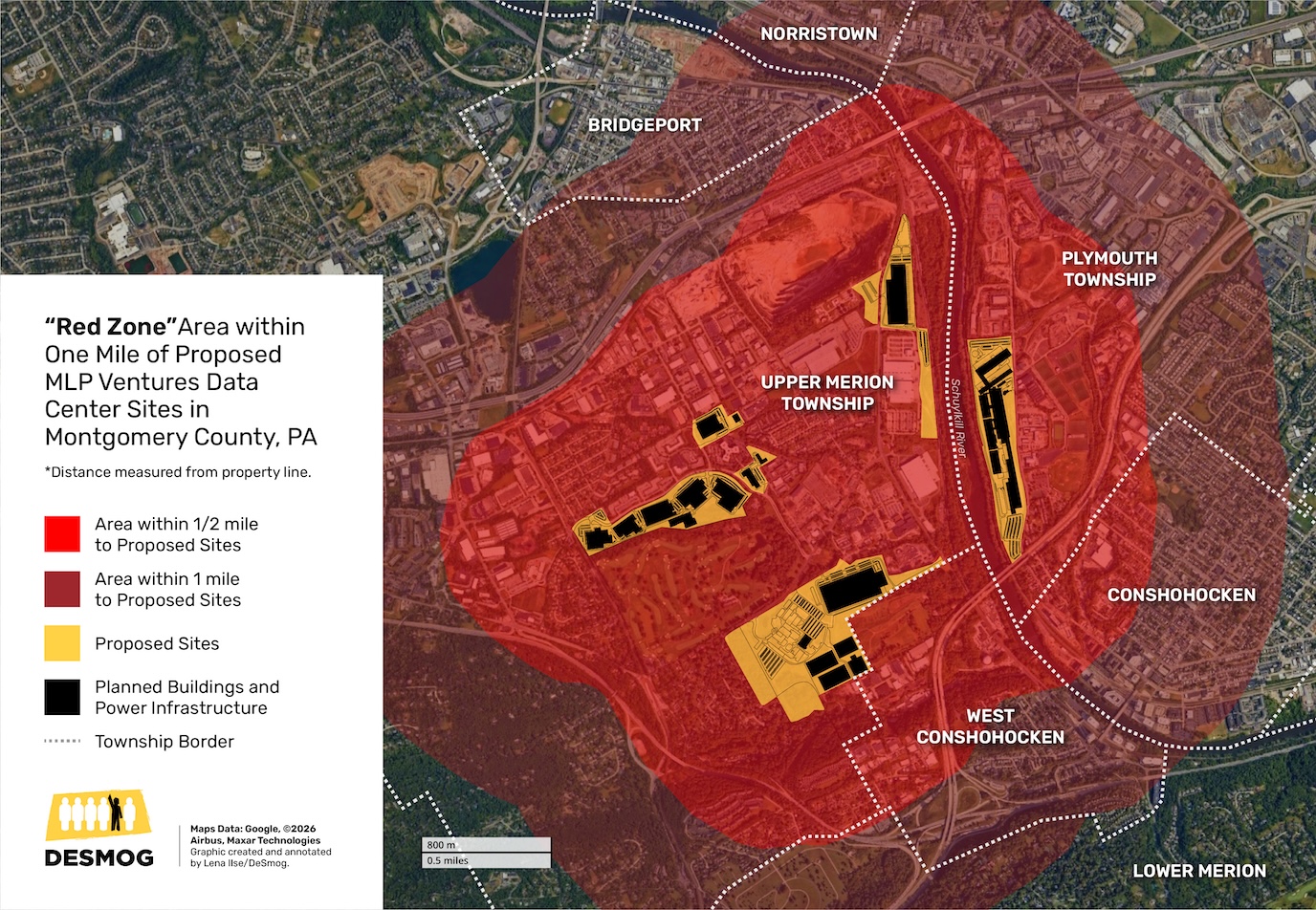


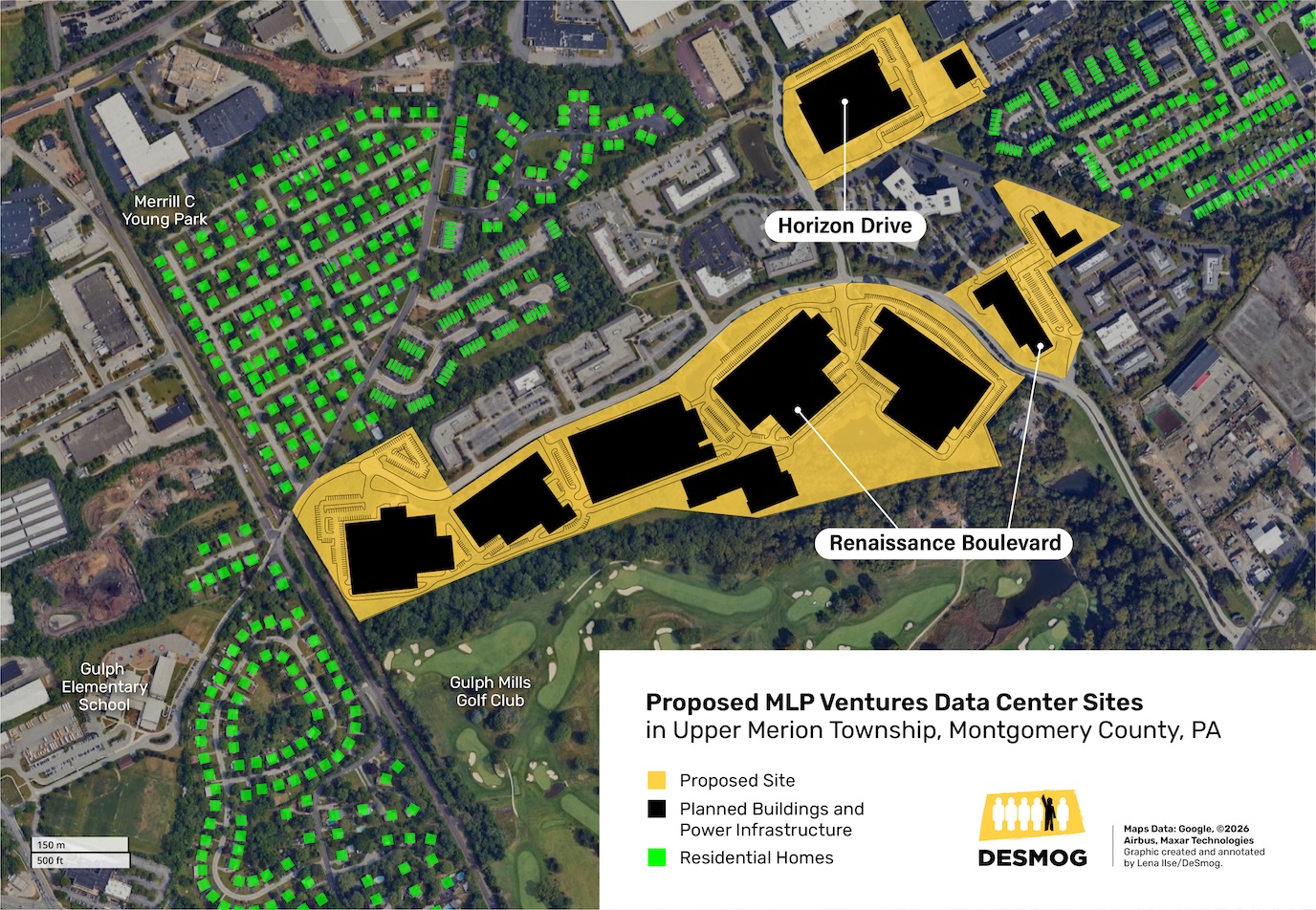
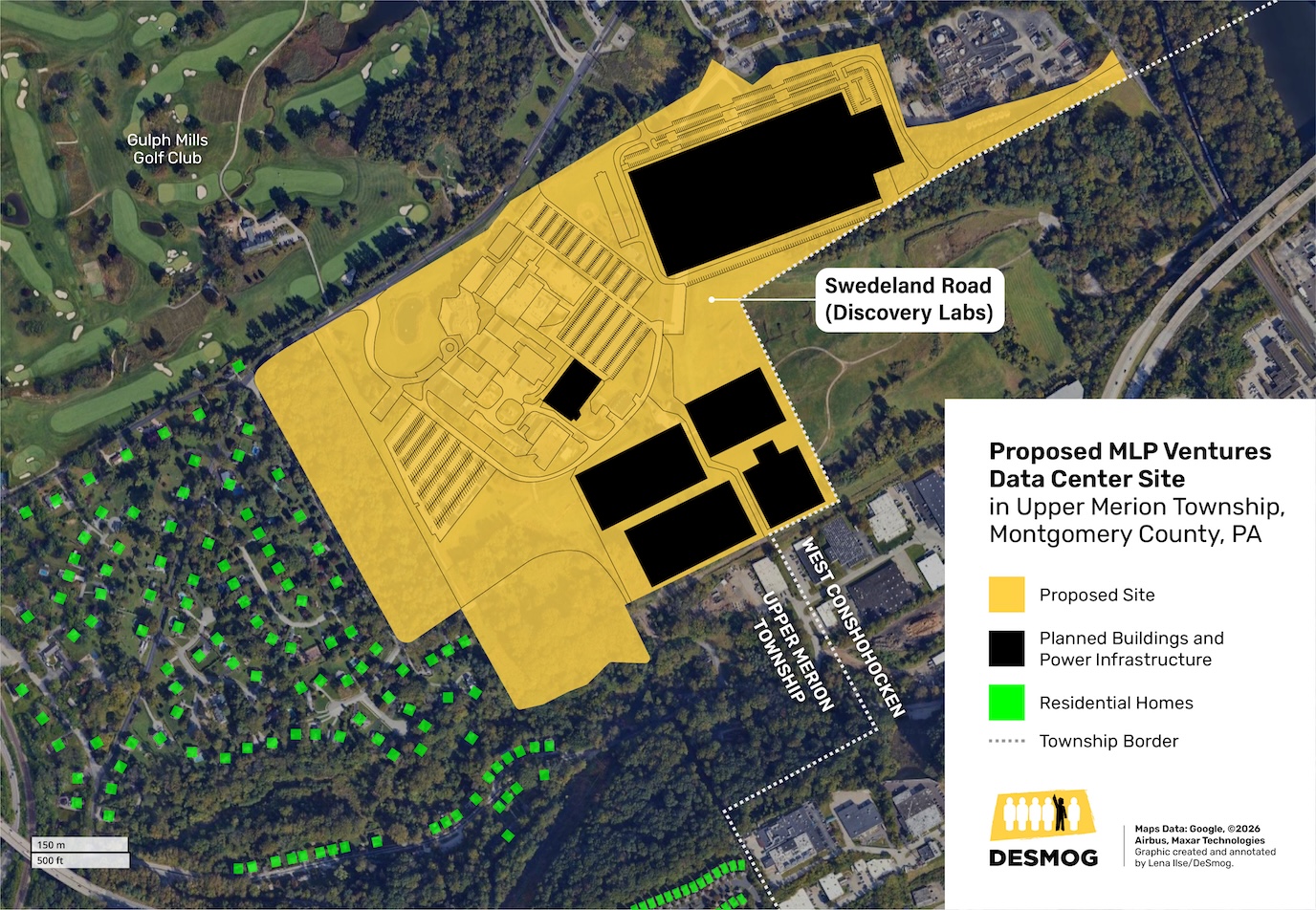
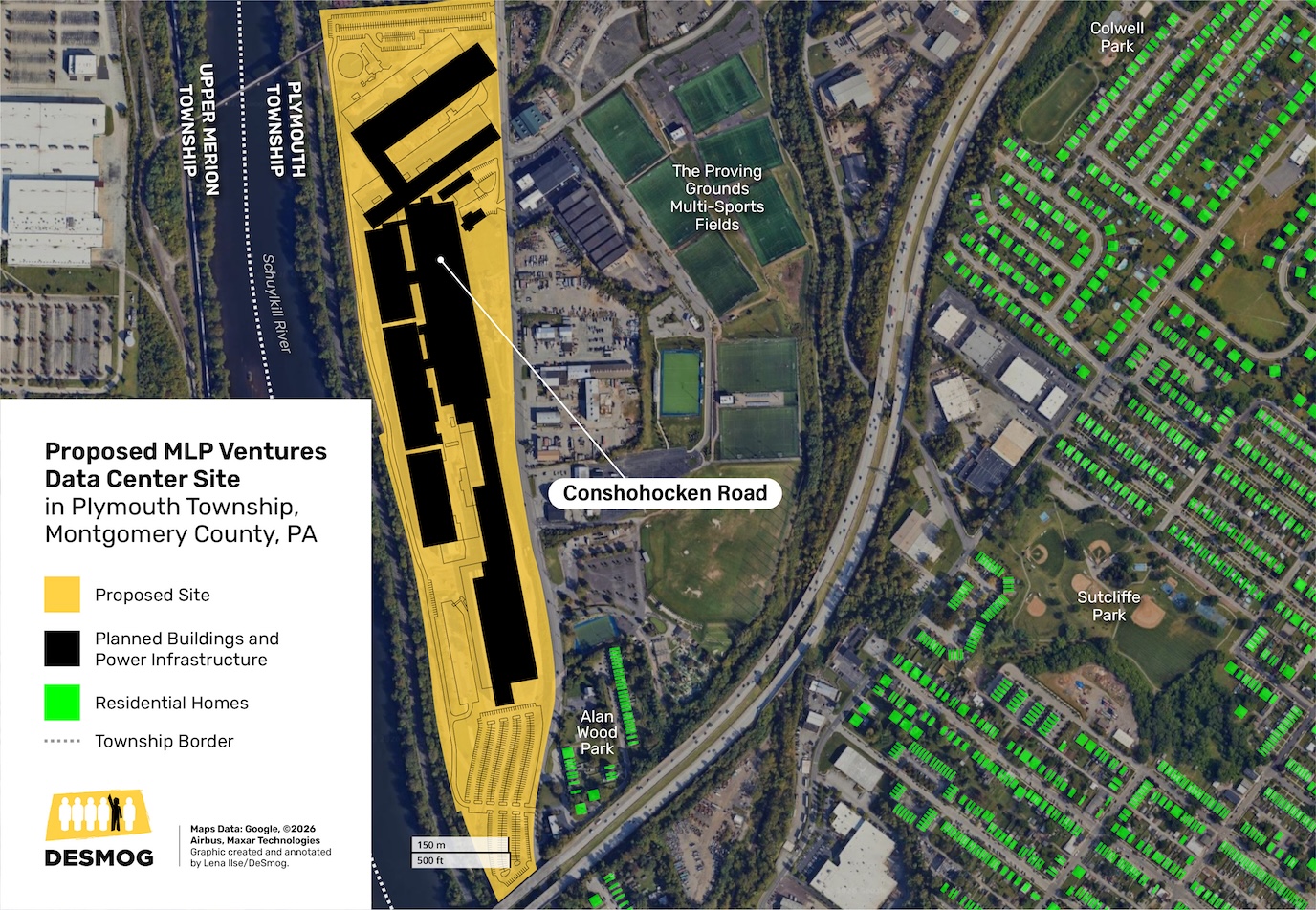


(Credit: Lena Ilse/DeSmog)
In addition, O’Neill wanted to “get on the phone with someone senior” at the PUC [Pennsylvania Public Utility Commission], noting that, “I do not think PA or the US wants to fall behind China and other countries in the development of data centers and AI.”
Existing air pollution standards were “put in during the “green movement’” and “may not be appropriate or applicable to today,” O’Neill added.
“The time urgency of this is immediate,” he wrote Tierney, noting that a deal on his “$10 to $20 billion of economic development” was due to close within six days.
O’Neill named Digital Realty, an Austin, Texas-based real estate investment trust listed on the Fortune 500, and one of the world’s top data center companies, as a potential partner in his center project, according to emails previously reported by DeSmog.
Less than two weeks after O’Neill reached out with his December 26, 2025 request, Tierney was in contact with officials at the Pennsylvania Public Utility Commission, emails show.
“Following our calls, please see below email to me from MLP Ventures CEO. Thank you for helping us arrange a meeting with a senior PUC official,” Tierney wrote Matthew Wurst, chief of staff for Pennsylvania Public Utility Commission Chairman Stephen DeFrank, on January 5, 2026, forwarding O’Neill’s email about reducing emissions standards.
The State Department did not immediately respond to a request for comment or make Tierney available for comment.
On January 7, MLP Ventures and the Pennsylvania Public Utility Commission held a video call, according to meeting records.
Later that day, O’Neill emailed the CEOs of Philadelphia-area utility PECO and its Chicago-based owner Exelon with a series of requests related to securing power from the grid in tandem with on-site power generation, including “confirmation that my power from [grid operator] PJM, PECO and Exelon can be expedited if we allow you to disconnect on high demand days.”
O’Neill wrote that “I am well aware of the pressure to not raise rates on individual consumers, and I applaud those initiatives. I am therefore providing an off-grid alternative and based on that, I want to make sure that my transaction closes and moves forward.”
Copied on the email were officials from the Pennsylvania Office of Transformation & Opportunity, an agency that expedites large industrial projects, the Pennsylvania Public Utility Commission, and the Pennsylvania Department of Environmental Protection (DEP), an agency that O’Neill had identified to Tierney in his December email as “extraordinarily cooperative.”
The DEP said, in response to a request for comment, that it “met with MLP Ventures for routine explanations on how the state permitting process works,” and that it has not received any permit applications for data center projects in Montgomery County. “Any communications with potential applicants do not represent DEP approval or advocacy for a particular project or outcome or the Governor’s policy opinion on a proposal.”
On January 12, PECO replied to an inquiry from Matthew Wurst, the Pennsylvania Public Utility Commission chief of staff, titled “MLB [sic] Inquiry/ PECO Information.” The specifics of Wurst’s inquiry are not clear, because the version included in the public records release is fully redacted.
In response to a request for comment, the PUC stated that its communications with MLP Ventures “involved inquiries concerning power generation, environmental oversight and grid interconnection issues. Consistent with the Commission’s normal practice, PUC staff worked to provide information and clarify the Commission’s role and jurisdiction regarding those issues.”
The PUC stated that it is routinely in touch with officials, businesses, government agencies and other stakeholders in utility-related projects, terming these communications “an important part of being a responsive regulatory agency, particularly as Pennsylvania and the broader region work through increasingly complex questions involving energy infrastructure and large new electric loads.”
MLP Ventures, Digital Realty, PECO, Exelon, the EPA, and USAID did not respond to requests for comment.
By early March, when O’Neill’s MLP Ventures formally applied to build a gigawatt-scale data center complex in Upper Merion Township, state officials had been confidentially coordinating the project with O’Neill for more than a year.
The proposal has ignited opposition from local community members concerned about air pollution, sound and light impacts, falling home values, rising utility bills, and other potential harms.
At a May 27 public meeting in Upper Merion, O’Neill presented his plans for on-site power generation to hundreds of local residents, addressing what he called “myths” about data centers with “facts.”
O’Neill said that it was a perception that “data centers reduce air quality,” but that it was “not true.” MLP Ventures was “spending billions of dollars on emissions control equipment,” O’Neill told local residents.
Tierney, the State Department attorney, was nominated by President Donald Trump in April to serve as assistant secretary of the Office of Accountability and Whistleblower Protection at the Department of Veteran’s Affairs. His confirmation in the U.S. Senate is pending.
Upper Merion officials are scheduled to vote on whether to approve or deny MLP Ventures’ plans at public hearing on August 13. Hearings on whether to approve the company’s plans in Plymouth Township are ongoing and expected to last several months.

The reporting for this story was supported by the Fund for Investigative Journalism.