

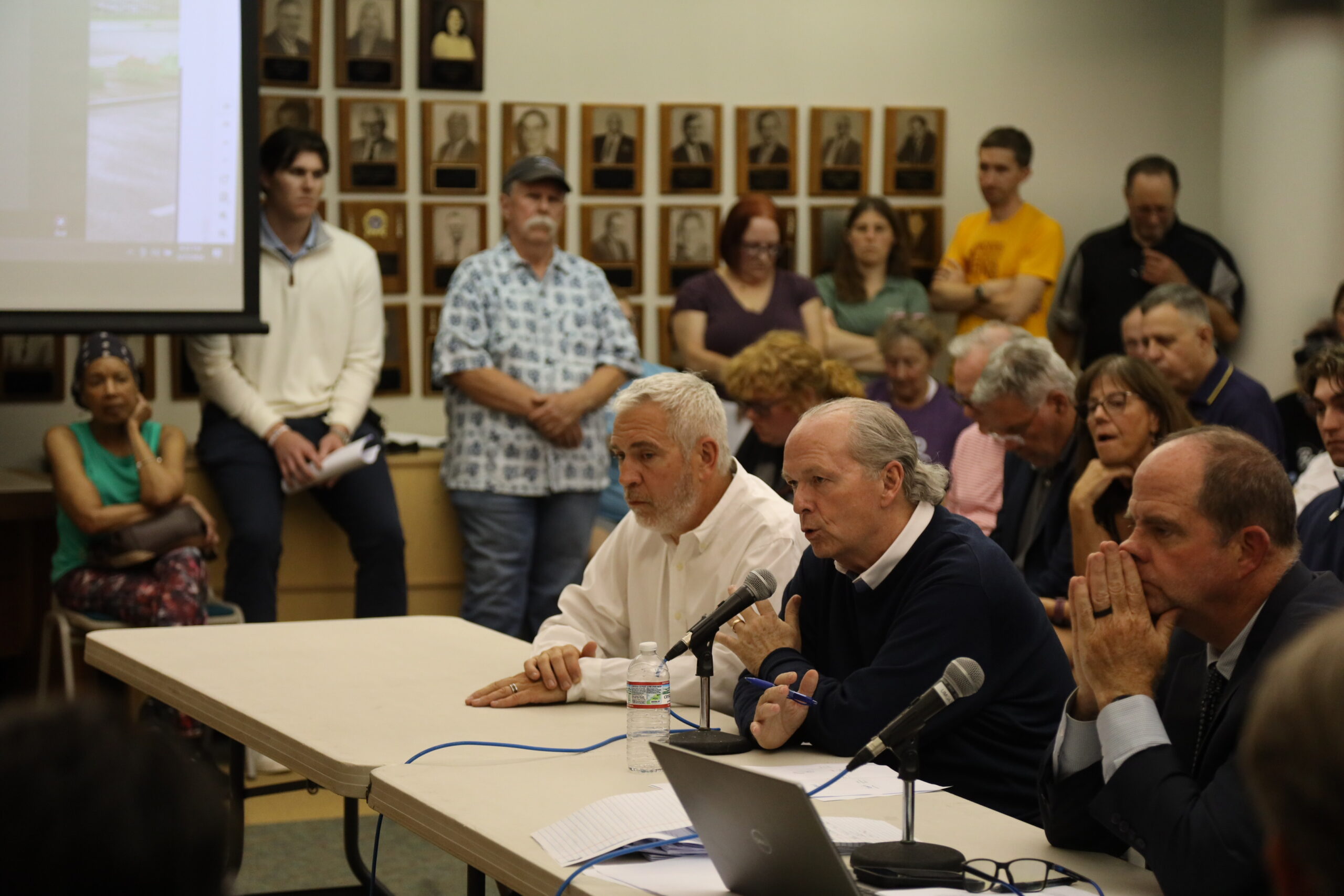
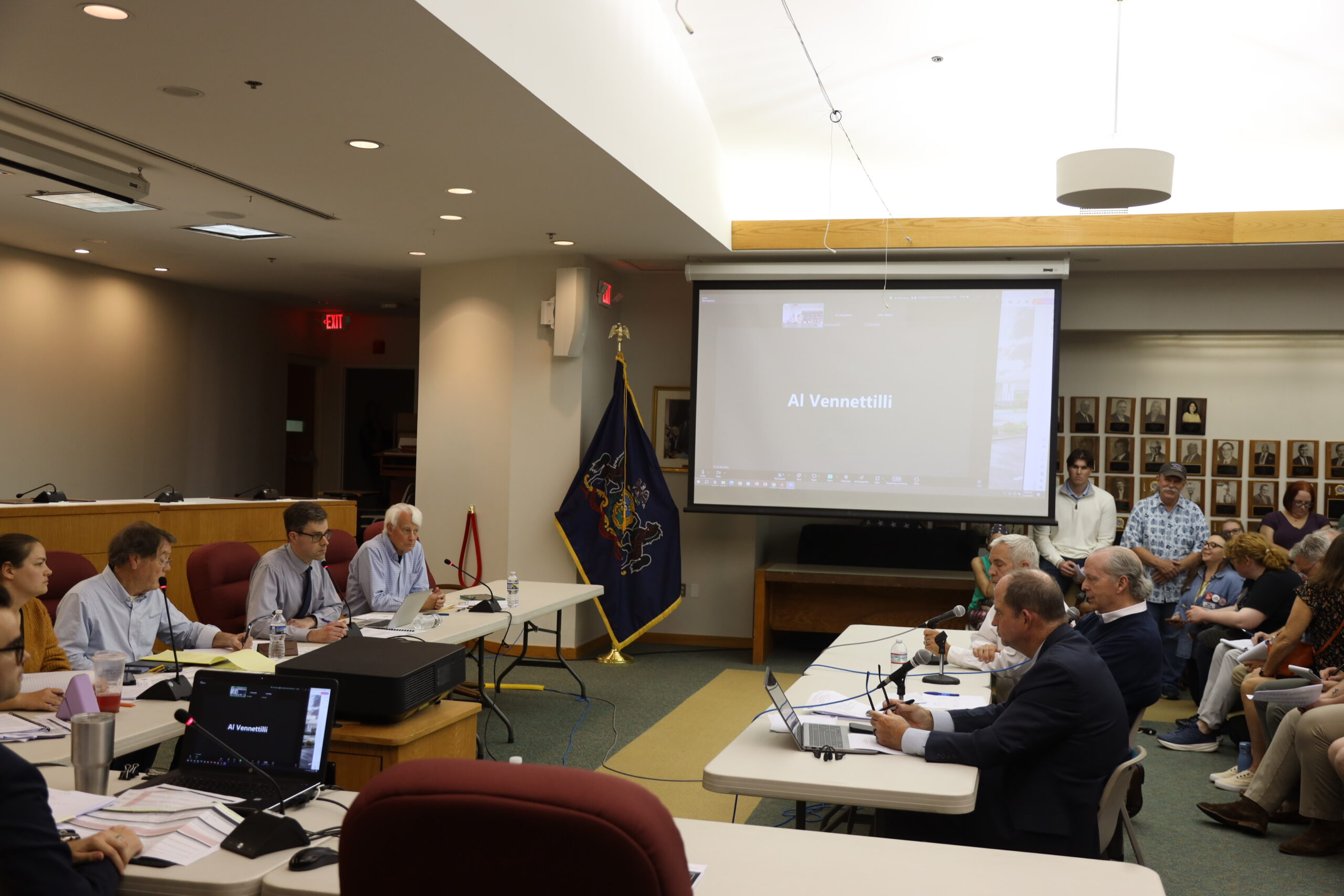
Freedom Hall, packed with more than 200 people, was jammed to capacity. Hundreds more people gathered in the lobby in stifling heat, many wearing “No Data Centers” stickers on their T-shirts. Inside the meeting room, Pennsylvania real estate executive Brian O’Neill was presenting plans for an enormous data center complex to the Upper Merion Township Planning Commission. An improvised sound system piped his voice to those stuck outside.
“We make cell and gene therapies which cure genetic diseases and cancer,” O’Neill said, referring to his company’s Discovery Labs medical research center in Upper Merion which he now wants to augment with AI data centers.
As O’Neill listed his project’s potential benefits, including a promised 54 percent increase in local tax revenue, the crowd grew agitated. “We don’t want it!” somebody yelled.
“I’ll get on with the show,” said O’Neill, flipping through a PowerPoint presentation, amid booing from the crowd in the lobby. The data centers would be quiet, conserve water, and emit no air pollution, O’Neill promised. “Liar!’’ another person shouted.
The crowd had converged on the Upper Merion Township Building on the evening of May 27, soon after learning about O’Neill’s plans to build a cluster of data centers and gas-fired power plants in the middle of their suburban community. Located in Pennsylvania’s Montgomery County, about 15 miles northwest of downtown Philadelphia, Upper Merion is home to 36,000 people. The area is best known to outsiders for its huge King of Prussia Mall and the Valley Forge National Historical Park, where George Washington’s Continental Army endured a brutal winter during the Revolutionary War.
Now, Upper Merion is part of a nationwide backlash against the artificial intelligence (AI) industry and its insatiable demand for new data centers — and the power plants and high-voltage transmission lines that supply the vast amounts of electricity needed to run them. Many Democratic and Republican politicians have endorsed the buildout — setting them at odds with affected communities heading into the 2026 midterm elections and state governor’s race in November.
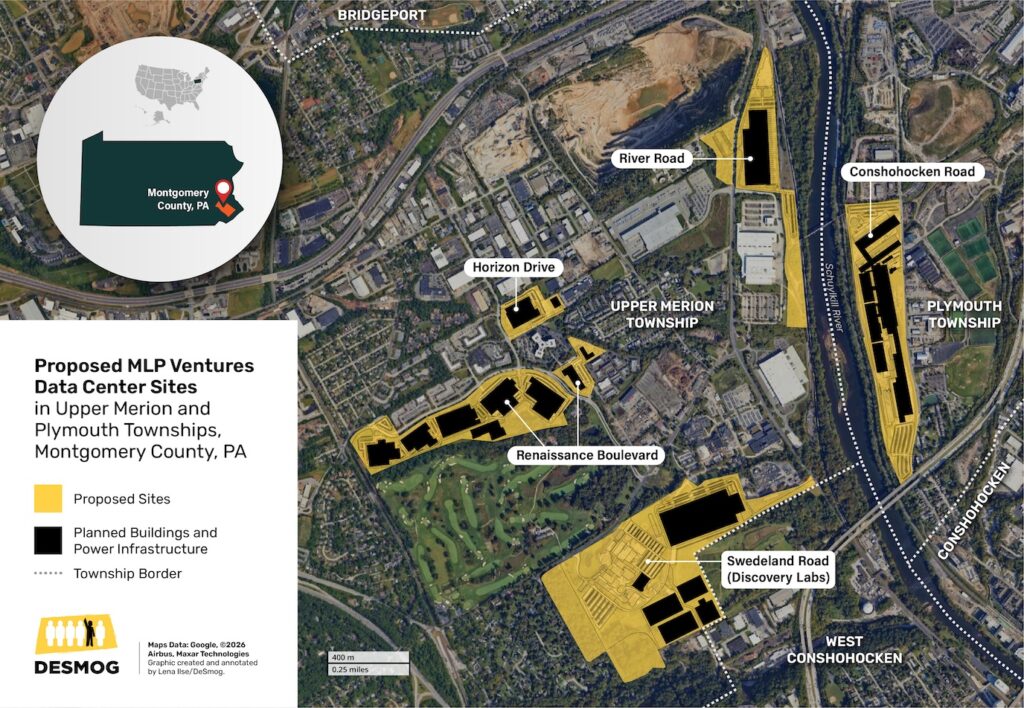
The meeting was a rare opportunity for Pennsylvania residents to come face-to-face with a major player in the digital real estate boom. With 4.6 million square feet of floor space, the Upper Merion computing complex would be seven times larger than the Philadelphia Museum of Art, and include gas-fired power plants generating one gigawatt of electricity, which is enough to power the equivalent of about 800,000 homes. Though O’Neill didn’t speak about the size of the investment, one company document costs the data center project at $35.16 billion. In adjacent Plymouth Township, O’Neill’s company MLP Ventures is planning to build a smaller, two-million-square-foot data center complex, also with on-site power generation, at the site of a shuttered steel plant.
Since early 2025, companies have filed dozens of applications for new data centers in Pennsylvania, spurred on by support from Governor Josh Shapiro (D), who has declared the state “all in on AI.” Like O’Neill’s projects, many are accompanied by plans for new gas-fired power plants dedicated to feeding the racks of computing units storing, processing, and analyzing the ever-growing mountains of data behind AI apps like ChatGPT, Claude, and Gemini, and automated technologies ranging from self-driving cars to surveillance systems.
Public opposition to data centers has snowballed in response, with residents fearing air, noise, and light pollution, climate-heating impacts, depletion of water resources, falling home values, and the destruction of natural areas.
Locals are also troubled that months before data center proposals are made public, developers are secretly lobbying local and state officials — typically under non-disclosure agreements (NDAs) — to expedite their plans, leaving communities with little time to organize.
State and local officials often contend that their work with developers to review zoning codes, secure power supplies, and negotiate new data center regulations is a legally mandated part of their role — and that the use of NDAs is standard in planning large projects in the United States.






In the case of Upper Merion, MLP Ventures and the Shapiro administration were in frequent contact for more than a year before the company submitted its plans to township officials in March 2026, according to emails obtained with a public records request by the No Conshy Data Centers community group, and shared with DeSmog. At the time, most local residents were unaware of the data center plans.
O’Neill appears to have been in almost daily contact with Ben Kirshner, the chief officer of the Office of Transformation & Opportunity, a state agency created by Gov. Shapiro in 2023 to expedite major industrial projects.
“I can’t remember a day where Brian [O’Neill] hasn’t called me multiple times regarding the data center site we’ve been working on together for several months,” Kirshner wrote in a July 2025 email to officials from the Department of Community & Economic Development (DCED), a state agency.
The previous year, MLP Ventures had approached Upper Merion Township supervisors through an attorney to ask that they classify data centers under the category “warehouses” in the zoning code. The township formally granted the request in August 2025.
Zach Davis, chair of the Upper Merion Township Environmental Advisory Council, which promotes environmental initiatives and makes local policy recommendations, said he heard increasing talk of data centers from area officials in the fall of 2025, but that it took several more months for O’Neill’s proposal to become clear. “It kind of went zero-to-60 really quickly,” Davis said.
In early March this year, O’Neill’s company submitted plans for its data center complex, spread across five sites. Days later, township supervisors passed a new law that put stricter regulations on data centers, which they had been working on for over a year — increasing buffers to residences from 150 ft. to 1,000 ft., and excluding data centers from a zone that had previously been eligible under the “warehouse” definition. The new regulations would have made O’Neill’s project impossible to complete as planned, but Pennsylvania law requires proposals to be evaluated under the rules in place at the time of their submission, so the stricter rules wouldn’t apply.
“That was the real kicker for us,” said Patti Erickson, a member of the Hughes Park KOP [King of Prussia] Civic Association in Upper Merion.

‘We Have One Shot’
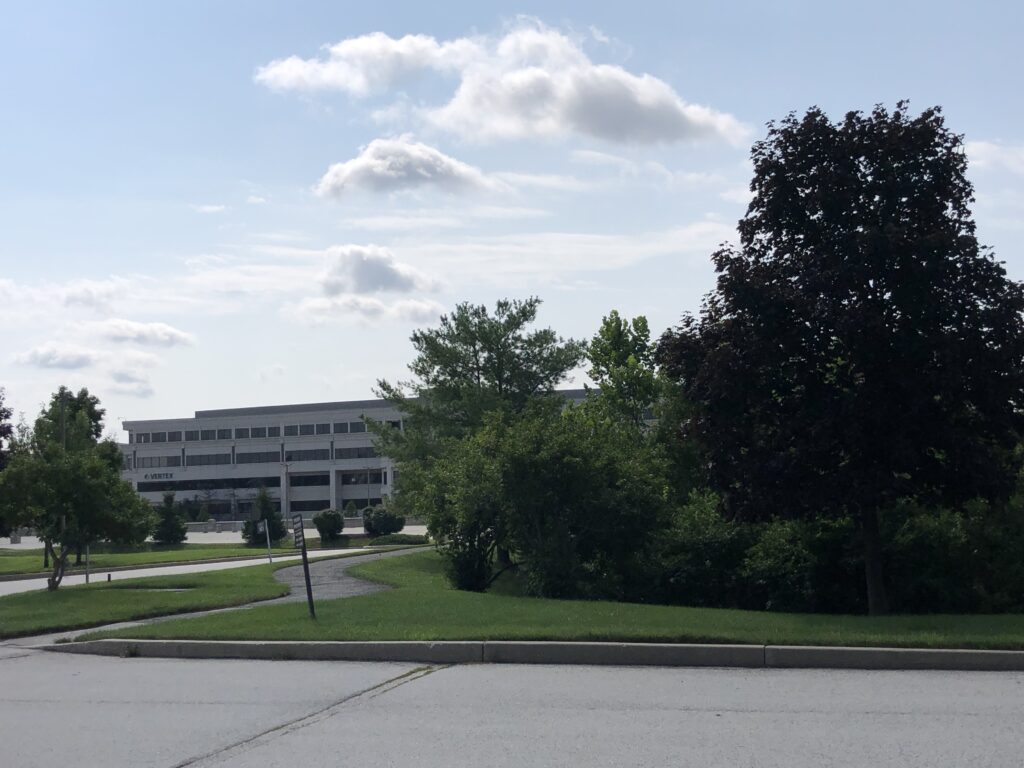
Brian O’Neill started out in real estate in the 1980s, rising from doing factory-to-office conversions in West Conshohocken, another Philadelphia suburb adjacent to Upper Merion Township, to managing a billion-dollar-plus property portfolio, according to a 2006 profile in Philadelphia Magazine. Across his career, O’Neill has invested in projects ranging from luxury apartments and a Rhode Island country club to drug rehabilitation facilities and office parks, such as the Renaissance Boulevard complex in Upper Merion where MLP Ventures is headquartered.
Now, in his mid-60s, O’Neill is moving into the hottest market in commercial real estate — AI data centers.
The emails open a window into the hand-in-glove collaboration between state officials and his MLP Ventures as both sides sought to clear the way for the data centers in the year before the company submitted its plans to the township.
In February 2025, the Office of Transformation & Opportunity’s Kirshner began making arrangements to bring together representatives of MLP Ventures and Philadelphia-based power utility PECO to discuss supplying the one gigawatt of power that the data center complex would need. At that time, there was no data center complex in the world built to consume that much electricity. (Since then, Amazon, Meta, xAI, and other companies have started construction on gigawatt-scale data centers.)
“Prob easier for all of us to come to Philly and agree,” Kirshner wrote in an email to PECO and MLP Ventures, kicking off planning for the in-person meeting between the companies in Philadelphia.
On February 25, 2025, O’Neill emailed Kirshner to inform him that he wanted to bring an unnamed “50 billion dollar company” interested in partnering to develop the Upper Merion data center complex.
“Essential that that meeting is flawless […] We have one shot,” O’Neill wrote.
“I think we signed the NDA,” Kirshner emailed back later that day, referring to a non-disclosure agreement. “You can be more open with me on the company name.”
O’Neill then revealed that the company was Digital Realty, an Austin, Texas-based real estate investment trust listed on the Fortune 500 and one of the world’s top data center companies.
Digital Realty declined to comment.
On March 7, 2025, staff from the Office of Transformation & Opportunity, PECO, and MLP Ventures met in Philadelphia about the data center plans, according to meeting records. It is unclear whether Digital Realty took part.
Despite these efforts, securing a power contract for the project proved challenging.
On May 7, 2025, an MLP Ventures employee emailed Kirshner to brief him on a planned meeting with Valley Forge, PA-based PJM, the largest electric transmission operator in the United States, which oversees the Mid-Atlantic region’s power grid. Kirshner replied via email two days later: “I think Sam Robinson [Governor Josh Shapiro’s deputy chief of staff] sent a note on your behalf too. Let me know if you get pushback from [PJM].”
On July 23, 2025, in an email with the subject “Quick Update,” Kirshner wrote O’Neill that, “while…I have pushed [PECO] repeatedly and daily, it [the power contract] is not a document that’s in control to send out. We are following up with them daily. Will keep you posted.”
Two days later, Kirshner wrote Department of Community & Economic Development staff, informing them of Digital Realty’s involvement in the Upper Merion project, and that O’Neill was calling him “multiple times” a day about the project.
“If anyone from DCED [Department of Community & Economic Development] wants to get yelled at everyday let me know, ill tag out of this :),” Kirshner wrote.
O’Neill later wrote to Kirshner to express his gratitude.
“Thank you for all the things you do for our company to expedite regulation, PECO relations, and your other sage advice,” said O’Neill in a September 17, 2025 email. “We deeply appreciate your commitment to getting business done and your practical approach.”
On October 1, 2025 Kirshner met with O’Neill at Discovery Labs in Upper Merion, according to meeting records. Minutes of the meeting do not appear in the records.
The next week, on October 7, 2025 an MLP Ventures employee emailed Kirshner asking for assistance regarding a proposed draft agreement to source 1.65 gigawatts of power from PECO. “Could you help push PECO in accepting the edits and returning back to us on PECO letterhead?” the employee wrote. A reply from Kirshner does not appear in the records.
The next day, the employee wrote Kirshner that MLP Ventures had received the agreement from PECO. “FYI, we received the PECO Will Serve letter last night. Thanks [sic] you,” he wrote.
But in the following months, MLP Ventures was unable to close a binding deal, subsequent emails showed.
The Shapiro administration said that the Office of Transformation & Opportunity’s role was limited to “answering preliminary questions about Commonwealth [of Pennsylvania] processes and permitting — as it does for hundreds of businesses across Pennsylvania” and that part of that role involved “introductions between the data center developer and stakeholders,” including utility companies. “OTO did not draft correspondence between the developer and PECO or negotiate on behalf of either party.”
PECO said that, “Under Pennsylvania law, PECO is required to interconnect all customers seeking service within its service territory on a non-discriminatory basis, consistent with these safety and reliability obligations.”
PJM said that, “When contacted by MLP Ventures, PJM referred them to the electric distribution company who would be responsible for working with a data center developer on their request.“

State Support
O’Neill’s push for help to power his data center vision was by no means the first time he had sought help from state officials.
In 2023, MLP Ventures had lobbied state officials for about $240 million in project financing to help meet estimated project costs at Discovery Labs of $1.1 billion, building on previous grants of close to $10 million. In response, Gov. Shapiro’s Legislative Office, which liaises between the governor and state lawmakers, directed state employees to examine funding options for Discovery Labs.
It appears that these talks hit a dead end, however. By late 2023, more than a dozen contractors issued O’Neill over $125 million in claims for unpaid construction costs at the site, according to the Philadelphia Business Journal.
MLP Ventures did not dispute the claims, according to the Philadelphia Business Journal, and O’Neill said that he would pay the contractors within a matter of weeks, once a complex refinancing of the site was closed.
“Consistent with his unkept promises of the prior two plus years, [O’Neill] represented that financing for this new data center project was imminent and that subcontractors would be paid once these new loans closed,” alleges a lawsuit filed by a contractor on November 12, 2025 in Montgomery Country.
O’Neill was also looking for other ways to shore up public funding.
The Montgomery County Redevelopment Authority, a county agency, had secured $1 million in state grants in 2019 to develop the Discovery Labs site. The grant included $500,000 dedicated to road improvements — but by February 2025 the funds were unspent, and the Pennsylvania Department of Community & Economic Development had denied the authority’s fourth request for a deadline extension.
Nevertheless, after the March 2025 meeting with PECO in Philadelphia, an MLP Ventures employee wrote to Kirshner requesting an extension of the deadline to spend the $500,000 road-improvement grant, “based on our conversation with PECO today regarding data centers” and the need to facilitate access for power infrastructure upgrades. Not long after this direct appeal, the Department of Community & Economic Development extended the grant deadline by an additional 12 months.
“I very much appreciate your assistance, agree to a one-year extension, and understand that it is the final extension and will utilize within one year,” wrote the MLP Ventures employee to Kirshner on March 14, 2025.
In response to requests for comment, the Montgomery County Redevelopment Authority said that it was not aware of MLP Ventures’ request to extend the grant deadline. The Shapiro administration said that the Office of Transformation & Opportunity does not administer this type of grant.
MLP Ventures and O’Neill did not respond to requests for comment.

Towards the end of the year, O’Neill asked state officials to intervene on a fee assessed on his Upper Merion properties through a loan program known as Property Assessed Clean Energy (PACE).
PACE participants receive loans for energy efficiency upgrades to buildings and are required to repay a percentage of the loan to local governments and the state’s Sustainable Energy Fund.
MLP Ventures’ payment to this fund was set to increase from $150,000 to $1,470,389 between 2025 and 2026, according to O’Neill. “Can we do something about this ??” he asked Kirshner in a December 22, 2025 email, with the word “outrageous” in the subject line.
Kirshner replied that while he would be on vacation until January, “my team will run with this while I’m gone.”
The Shapiro administration said in response to questions that the Office of Transformation & Opportunity “did not set, administer, negotiate, or alter the fee, and it did not advocate that Montgomery County, the Sustainable Energy Fund, or any other decision-maker change its policies or assessment.”
Risk to Neighborhoods
As the wait to secure power from PECO dragged on, MLP Ventures began to consider a question that data center developers entangled in complex negotiations with utility companies are increasingly asking: What if we generate our own electricity on site?
Known as “behind-the-meter power,” this option is being adopted by tech and energy companies from Pennsylvania to Texas who are increasingly incorporating new gas-fired power plants into their projects, raising fears over the associated climate-heating carbon dioxide and methane emissions.
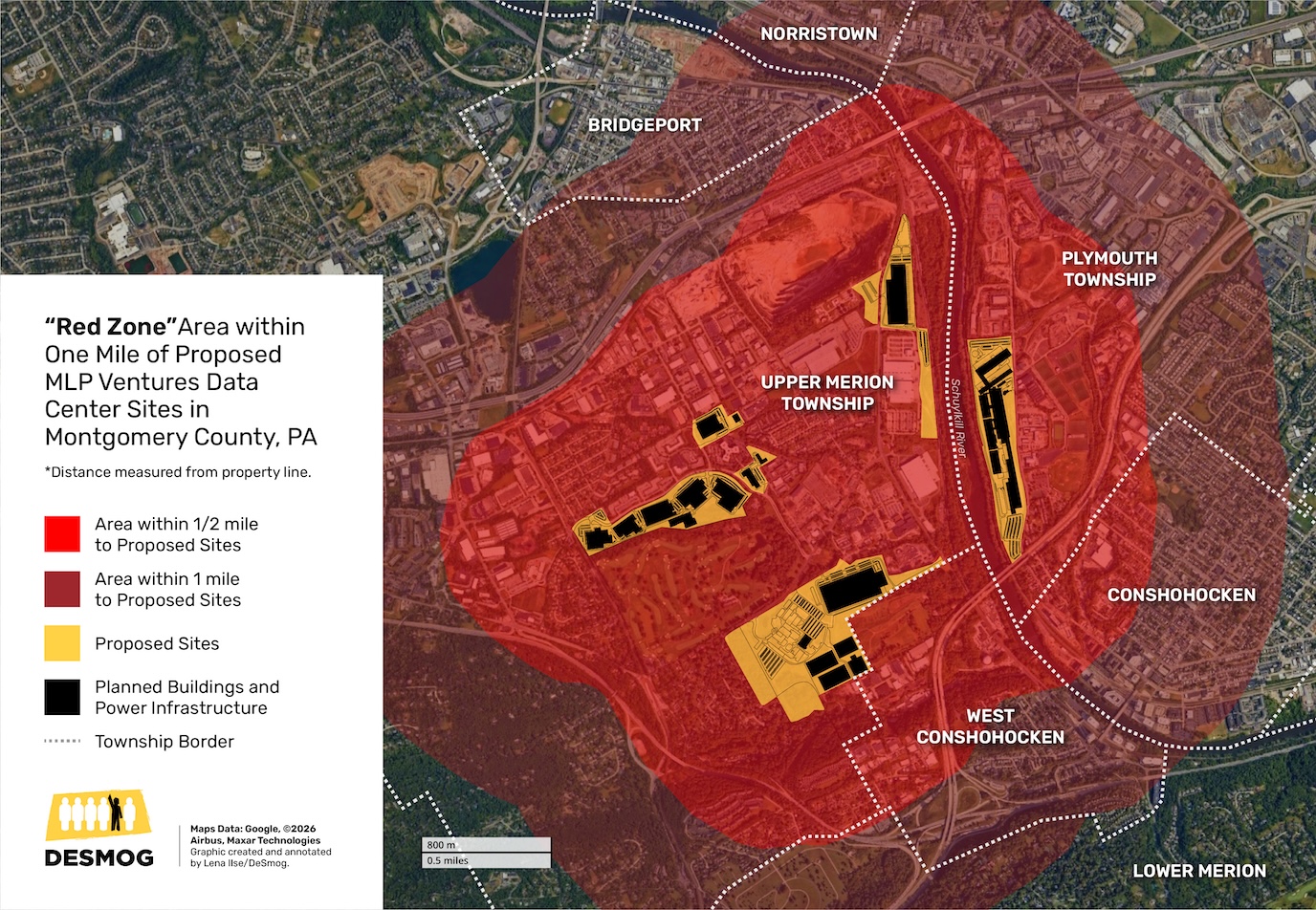
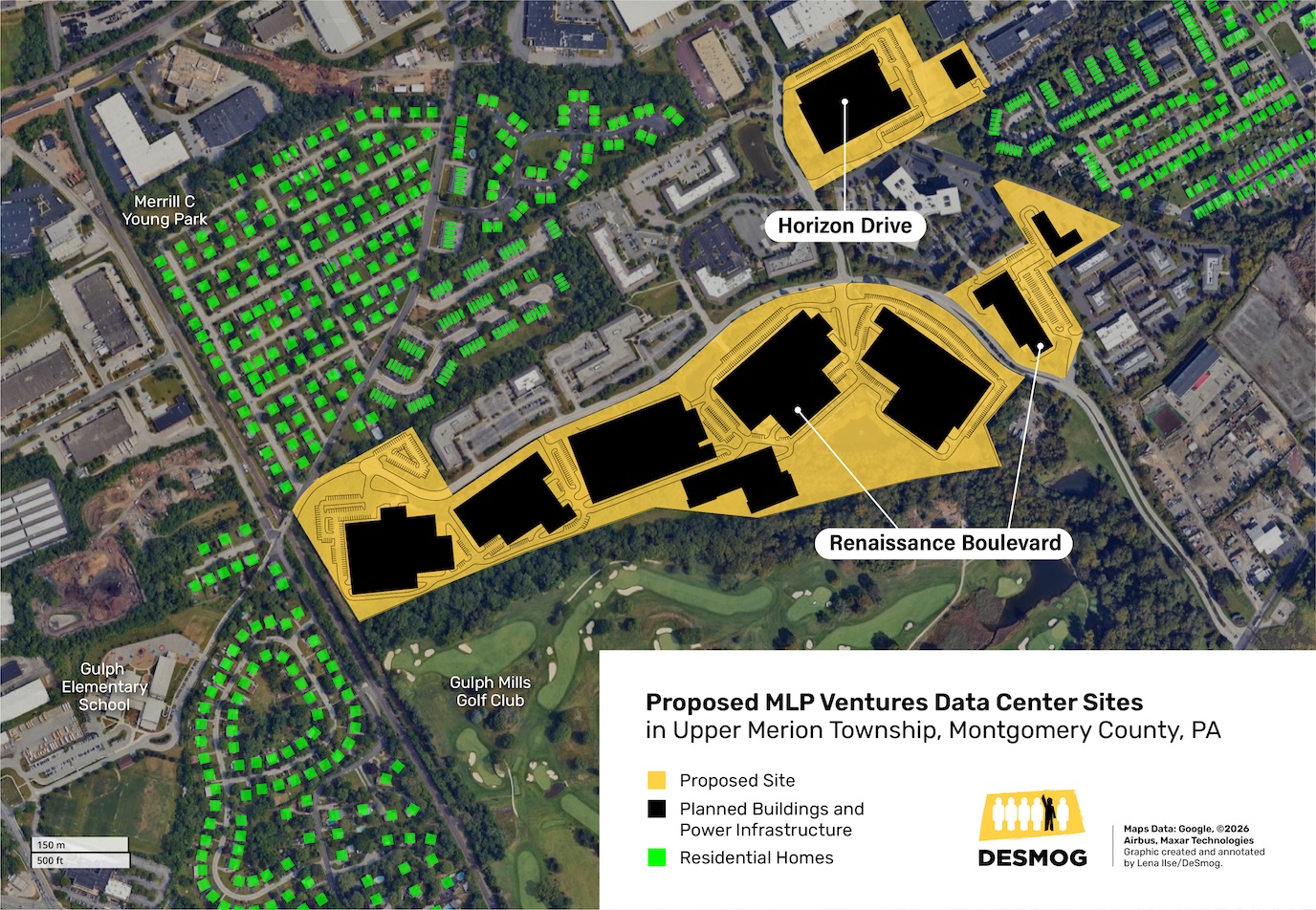
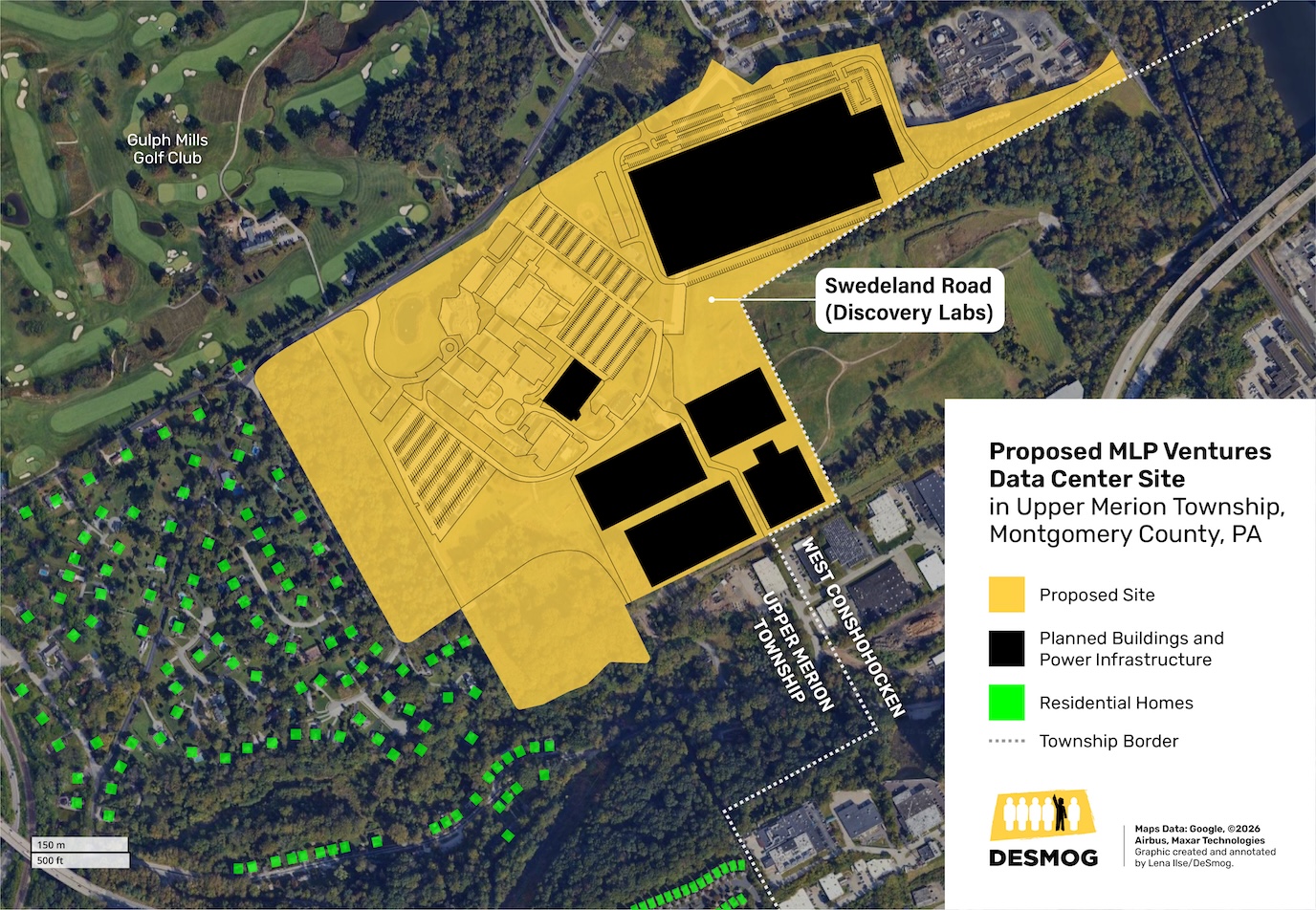
Similar proposals by MLP Ventures would put gas-fired power plants within a half-mile radius of hundreds of homes in Upper Merion and Plymouth townships, as well as local businesses, playgrounds, sports fields, and Upper Merion Township’s Gulph Elementary School, according to a DeSmog mapping analysis.
Thousands of homes in the neighboring towns of Bridgeport, Conshohocken, Norristown, and West Conshohocken fall within a one-mile radius of the proposed power plants.


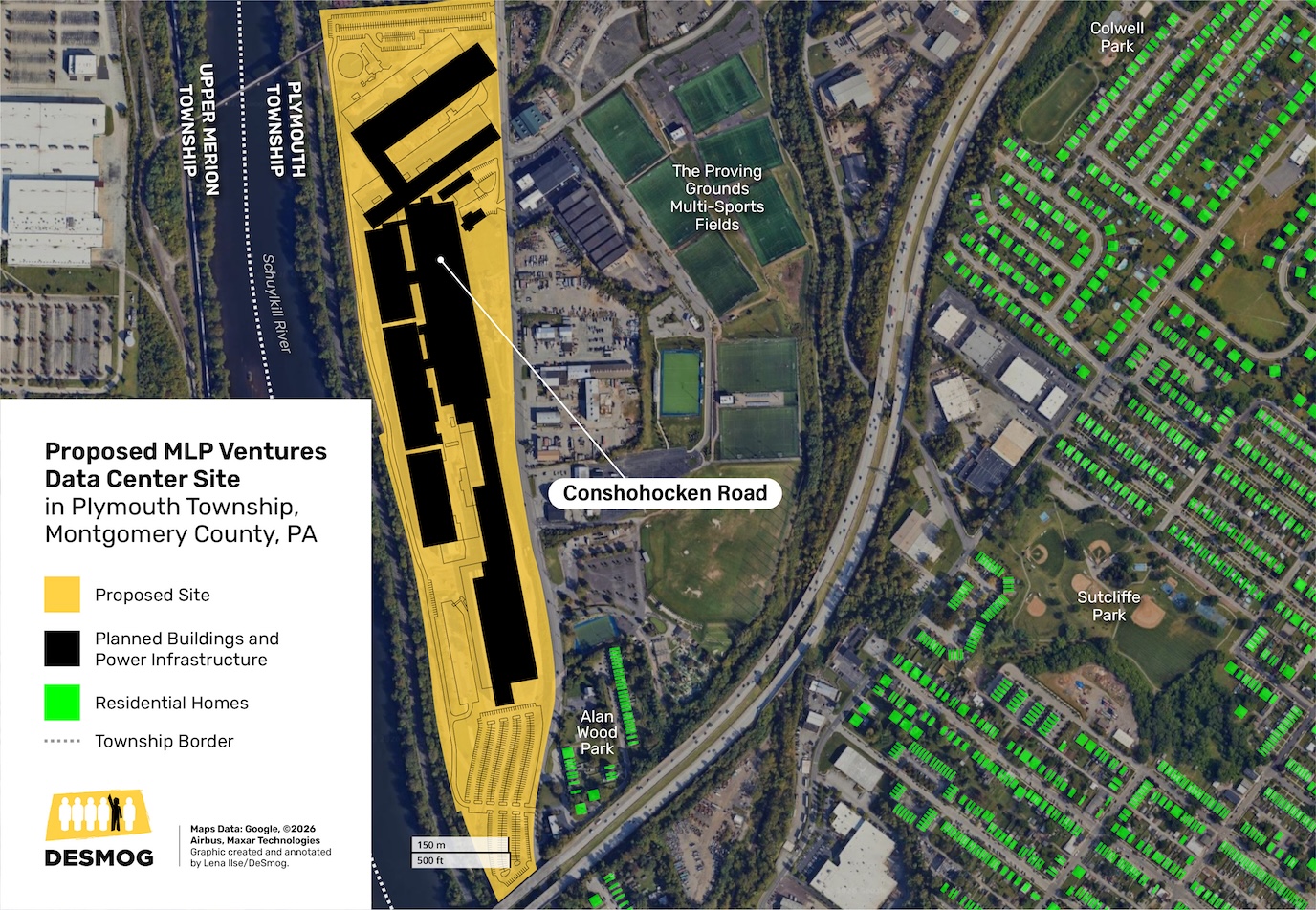
(Credit: Lena Ilse/DeSmog)
The combustion of natural gas and diesel fuel at other operating and proposed gigawatt-scale data center sites studied in Mississippi, Virginia, and West Virginia will emit toxic air pollutants that increase risks of asthma, cancer, and cardiovascular disease, public health researchers at Harvard University have estimated, generating tens of millions of dollars in yearly medical costs at each site.
On September 4, 2025, O’Neill wrote Kirshner to request fast-track environmental permitting for his plan to build another data center complex, complete with an 800-megawatt power plant, in Plymouth Township, across the Schuylkill River from Upper Merion.
Later that day, Kirshner replied that he had forwarded the request to the state Department of Environmental Protection (DEP).
Five days later, on September 9, 2025, state officials hosted a video call with MLP Ventures to discuss “Fast Track Treatment from DEP” for the Plymouth Township data center and power complex, according to meeting records.
The Shapiro administration told DeSmog that MLP Ventures was not accepted into the Office of Transformation & Opportunity’s fast-track permitting program.
MLP Ventures’ plans for Plymouth Township hit another snag in mid-November, 2025 when local officials voided its data center application on the grounds that the company had not yet signed a contract to buy the project site. (MLP Ventures has since resubmitted its proposal for further review).
In addition to his plans to build on-site power in Plymouth Township, O’Neill was also considering a similar model for Upper Merion, emails show.
In late December 2025, O’Neill wrote Kirshner, who was on vacation, an email with the subject line, “Hi are you back on the grid.” Kirshner replied, “Not until next week… I can still help via email. What do you need?”
“Need to talk about peco, pjm and excelon [sic]. We need to produce our own power and need to discuss legislation and policy to help,” O’Neill replied, referring to Exelon, PECO’s Chicago-based owner. “DEP has been great but we need to avoid ngo’s [non-governmental organizations] from holding up projects with no risk.”
O’Neill also made a suggestion: Require anyone appealing a local or state data center approval to post a bond double to the value of a proposed project, such as a $4 billion bond to appeal a $2 billion project — a move that would effectively render such appeals impossible.
Kirshner replied to O’Neill’s questions about power generation by suggesting that he meet with Jacob Finkel, Gov. Shapiro’s deputy chief of staff, noting that “all energy policy goes through him.”
On January 7, 2026, Kirshner emailed Finkel to set up a call with O’Neill to “discuss [O’Neill’s] latest ideas for PA and the utilities.”
Five days later, O’Neill emailed David Vahos, then the president and CEO of PECO, to share his plans for on-site power generation at the Upper Merion data center. Kirshner was copied on the email.
“I have been working closely with our state of Pennsylvania governor’s office, PUC [Pennsylvania Public Utility Commission], DEP, EPA [the U.S. Environmental Protection Agency], and other federal, state, and local regulatory agencies to map a path forward for substantial behind-the-meter power,” O’Neill wrote.
Later in January, it was Kirshner’s turn to reach out to O’Neill for help. The Shapiro administration was drafting new guidelines for data center development in Pennsylvania, and Kirshner asked O’Neill if he could put him in touch with contacts at Digital Realty, the Fortune 500 developer.
A few days later, on February 3, 2026, O’Neill wrote to two Digital Realty senior executives with an invitation to join a group of data center developers active in Pennsylvania convened by Gov. Shapiro, “Ben Kirshner, my dear friend in the Governor’s office is copied on this email. The Governor would like to invite you to a small group of players in the data enter business including Google, AWS, Oracle, etc. Please respond to Ben immediately, this is a time sensitive matter.”
The invitation appeared to be related to the Governor’s Responsible Industrial Development Standards, or “GRID,” a new voluntary framework announced by Gov. Shapiro in his annual budget address on February 3.
Shapiro stated in his address that GRID would incentivize data center developers to hire local workers, adopt strict environmental standards, and engage transparently with communities. “Too many of these projects have been shrouded in secrecy, with local communities left in the dark about who is coming in and what they’re building,” Shapiro said.
In response to questions from DeSmog, the Shapiro administration said that it had consulted stakeholders from the data center, energy, utility, labor, business, environmental, and community sectors to inform the GRID standards. “MLP Ventures/Digital Realty was given the opportunity to provide feedback early in the GRID standards development process,” according to the governor’s office, “but did not respond.”
On March 6, 2026, following a meeting between MLP Ventures and Amazon, O’Neill emailed Kirshner to reiterate his suggestion that anyone appealing local, state or federal approvals for data centers be required to post a bond double to the value of a proposed project.
“In conversations, [Amazon] have pointed out to us that they have been appealed in EVERY project at EVERY turn,” wrote O’Neill in the email, which was published in April by the Concerned Citizens of Montour County, a community group opposing data centers and gas-fired power projects in a rural area about 100 miles northwest of Philadelphia, and first covered by Heatmap News.
“We want to make sure we are not going to get appealed frivolously by people that just want to slow us down for sport as they are currently doing to Amazon,” O’Neill added.
Colby Wesner, member of the Concerned Citizens of Montour County, described O’Neill’s level of access to state officials as “nauseating.”
“I guess there’s no compassion or empathy towards what people are fighting for,” said Wesner. “This isn’t a sport to us. We’re fighting for our communities, our livelihoods, our peace of life. Trust me, it’s not a fun ‘sport’ to be playing.”
Amazon declined to comment.
On March 25, 2026, O’Neill wrote to Kirshner again. “I need to get with [the Pennsylvania Department of Environmental Protection] on two topics,” he stated, including “individual power plants for individual buildings being permitted individually.”
Megan McDonough, Pennsylvania director of the nonprofit Food & Water Watch, said that the request reminded her of a strategy used by companies operating in Pennsylvania’s Marcellus Shale gas field: breaking down polluting infrastructure such as drilling sites and compressor stations into smaller units to avoid triggering emissions regulations. The companies get infrastructure “permitted on a piecemeal basis so they don’t actually have to follow the rules,” McDonough said.
‘We Do Not Consent!’
Many of the Upper Merion residents packed into Freedom Hall on May 27, 2026 wanted to comment on MLP Ventures’ data center plans, including its proposal for on-site power plants.
“First of all we live in a great country,” O’Neill said, standing to face the crowd inside Freedom Hall. “The ability for all of you to come out and give us your opinion is a great, great benefit of being American […] I’d like to work together to create a win-win.”
O’Neill said that MLP Ventures had earned the right to be trusted after 30 years of business in Upper Merion and that his properties were always well-maintained, with walking trails open to the public. “I drove through them tonight just to make sure there wasn’t a blade of grass out of place,” he said.
“You’re worried and I don’t blame you for being worried,” O’Neill added, saying that he hoped to dispel “myths” about data centers by stating “facts.”
O’Neill said that the project would be a model data center using a “closed-loop” cooling system to save water; generate its own power by burning “renewable gas”; encase generators in sound-proofing equipment; and even sell electricity back to the grid.
“I’ve never heard of renewable gas,” commission member Kenn Brown responded, noting the climate-heating impacts of natural gas, a fossil fuel, and saying “it’s getting hotter and hotter.”
Eight days earlier, on May 19, 2026, the temperature in Philadelphia had spiked to a monthly record-setting 98 degrees Fahrenheit, 23 degrees above the average daily high.
As O’Neill’s presentation tipped past the two-hour mark, a man standing in the back of Freedom Hall grew irate. “We do not consent!” he shouted in the direction of O’Neill and the commissioners. As police officers stepped forward in response, three of the commission members briefly retreated through a door behind their desks until the situation calmed.
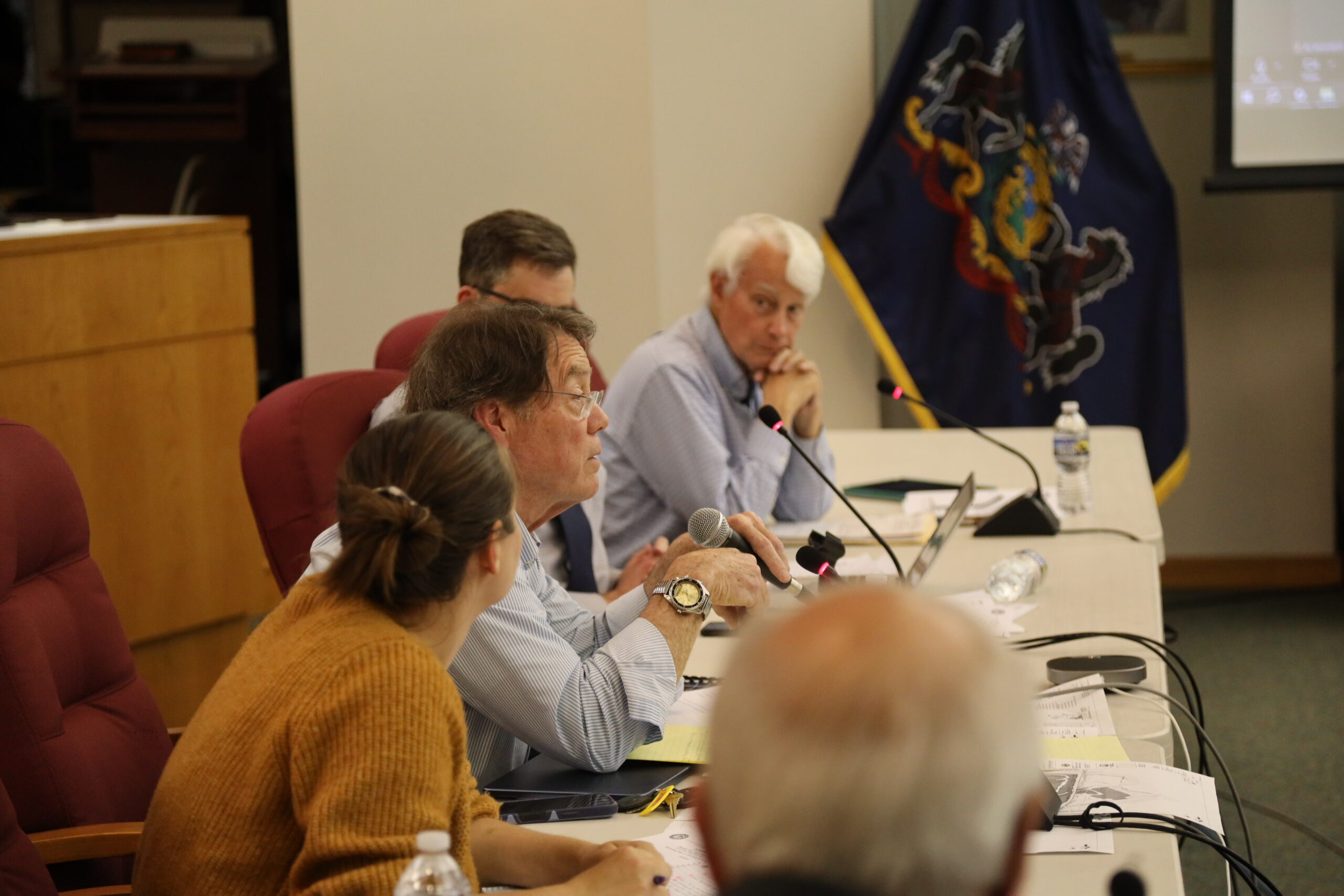
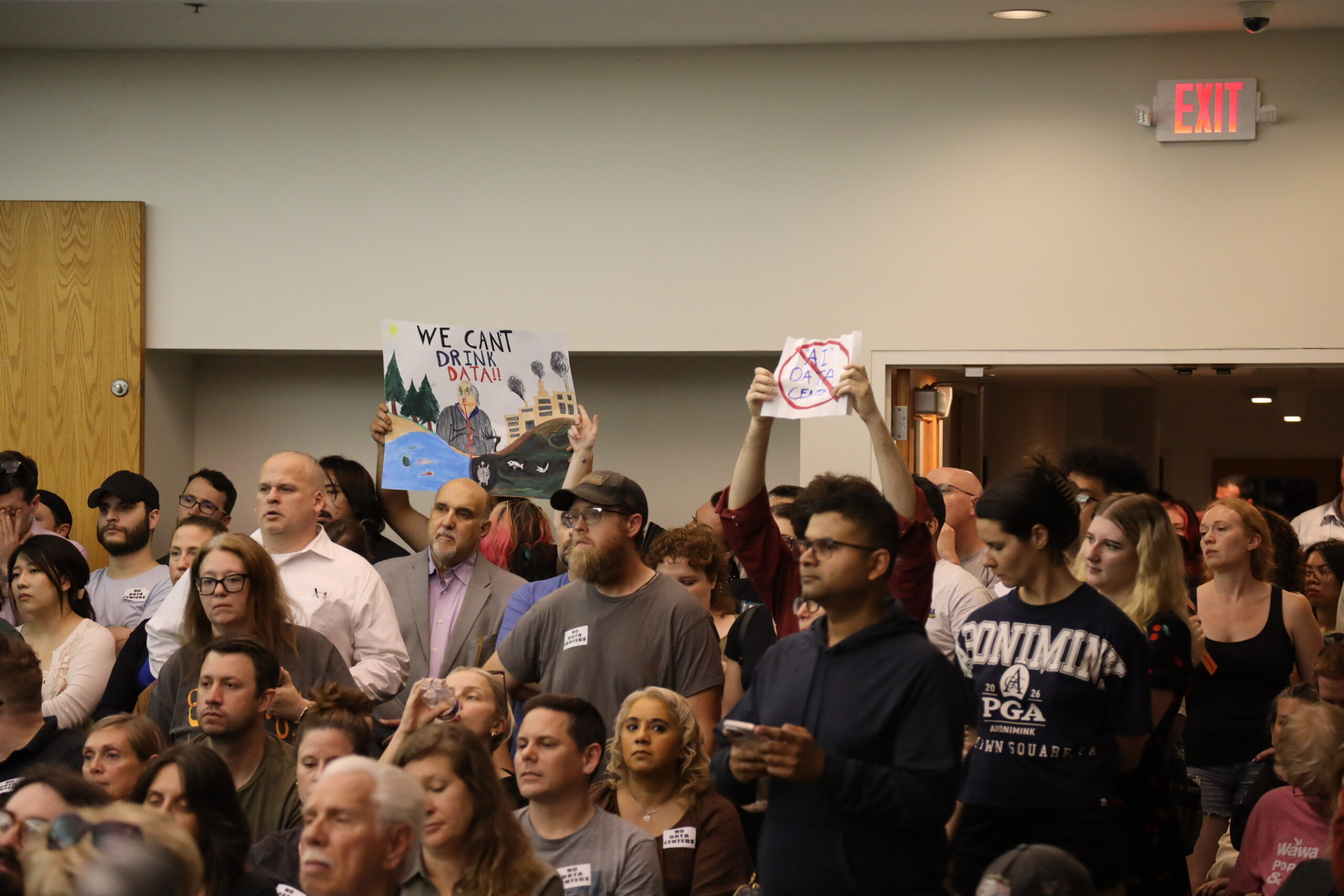
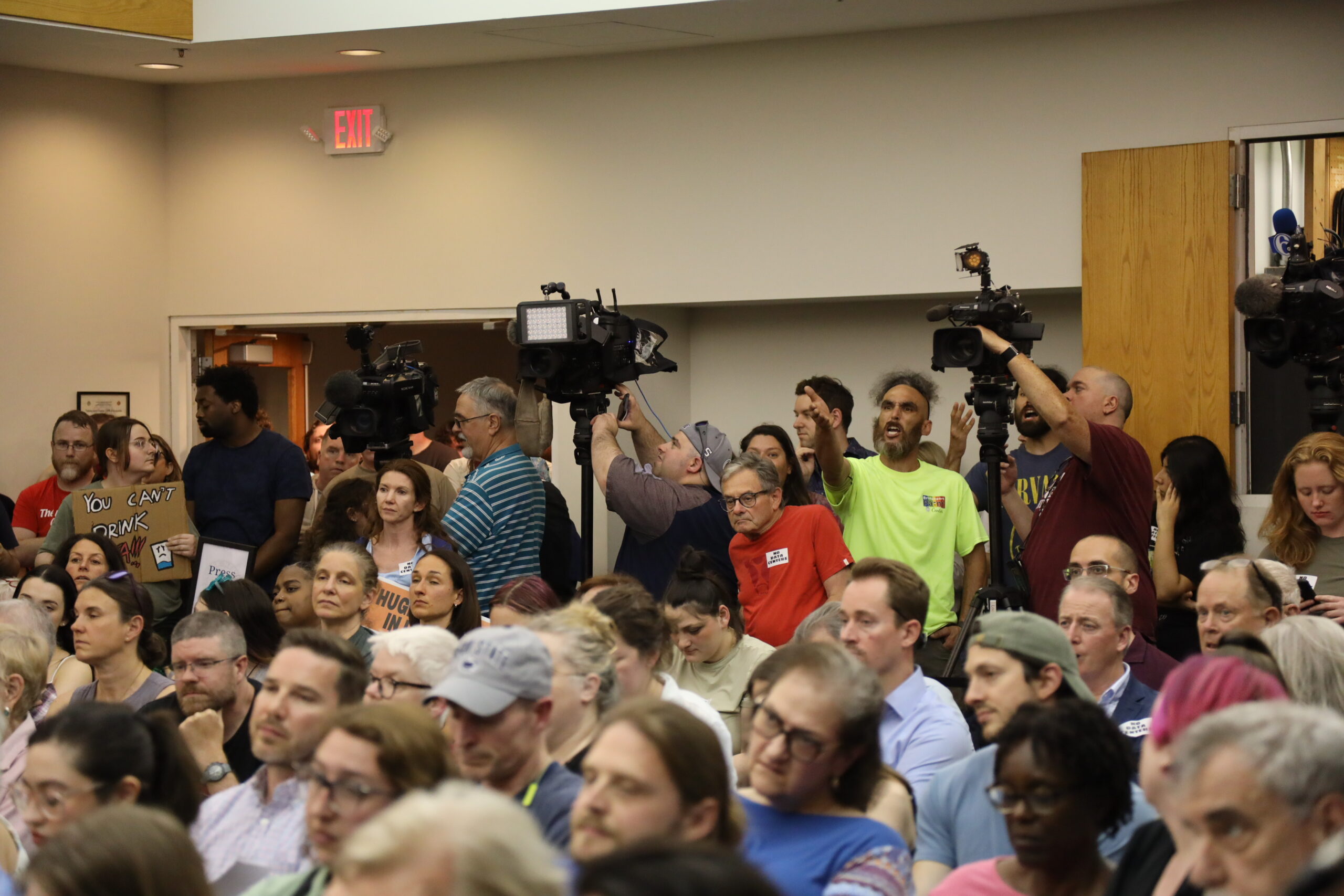
Shortly after 9:30 pm — two-and-a-half-hours into the meeting — public comments commenced.
Upper Merion Township tax collector Evelyn Ankers was the first of more than 35 residents to speak, telling the meeting that MLP Ventures had owed about $2 million in delinquent taxes between 2023 and 2024 through its subsidiary Innovation 411 Fee Owner LLC. While it had finally paid up in 2025, the company still owed its 2025 school taxes. “With all due respect, I think the best way to increase property tax revenue in Upper Merion is to pay the taxes,” Ankers said, to rousing applause.
Courtney Smith said that the township had “falsely” classified data centers as warehouses in 2025, citing emails and attached letters that she had obtained via a public records request that appeared to suggest that MLP Ventures’ attorney had written the opinion justifying the move. “There’s no written documentation by our township officials that supports or justifies the township’s conclusion,” Smith said.
Upper Merion’s five supervisors and zoning officer did not respond to request for comment on what procedures the township used to define data centers as warehouses in 2025.
“It seems that in a rush to submit these proposals before our AI data center ordinance was even passed, Mr. O’Neill’s company is adopting the tech bro motto of ‘Move fast and break things,’” said Zach Davis, the chair of the township’s environmental advisory council. “But this isn’t just an app or a useless piece of software. What they want to do is break our community to make a quick buck.”
O’Neill’s depiction of a cleanly powered data center was a “fantasy,” John Shanley said, a point he emphasized by describing the increase in air pollution created by Elon Musk’s xAI data center in Memphis, Tennessee, where dozens of gas turbines run without federal air permits. “We’ve all read the ongoing stream of data center horror stories for residents unfortunate enough to live near these hyperscale campuses, many of whom were kept in the dark while years of planning took place,” Shanley said. “In plain English, these data centers are millions of square feet of gas turbine power plants.”
Kabindra Shakya, an environmental science professor at Villanova University and Upper Merion resident, urged “not putting such a data center in a dense neighborhood like this.” Shakya, who studies air pollution impacts on human health, rejected O’Neill’s claims of sourcing “renewable gas” as “greenwashing.”
“There is nothing called renewable gas,” he said.
Laura Rendón-Garcia described a “sense of hopelessness” in “a world with a frightening and unstable future.”
“When we see our rivers run dry, food supplies change and costs increase, when we see projects such as this quietly rush for approval while public services are on standby, I feel like everything around me is just collapsing in a way I haven’t seen before,” Garcia said.
Other residents brought up Upper Merion’s legacy of environmental contamination from four federally designated “Superfund” toxic waste clean-up sites. (One of O’Neill’s five planned data centers would sit atop one such plot). Locals also questioned whether the data centers could be used by private surveillance companies or by U.S. Immigration and Customs Enforcement (ICE).
“This brings a lot of stress to the community,” said Basit Rasool. “It’s unfair. It’s very unfair.”

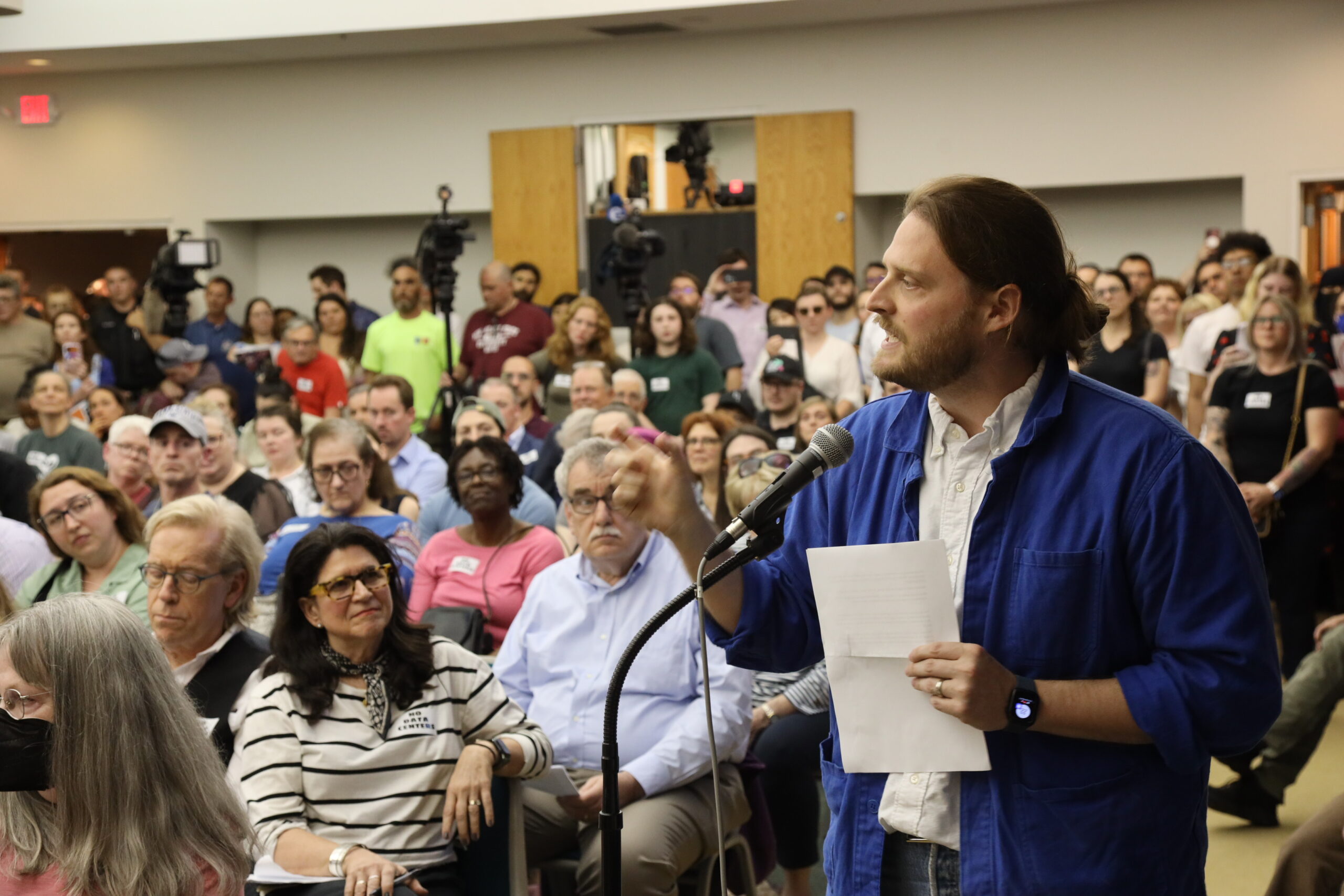


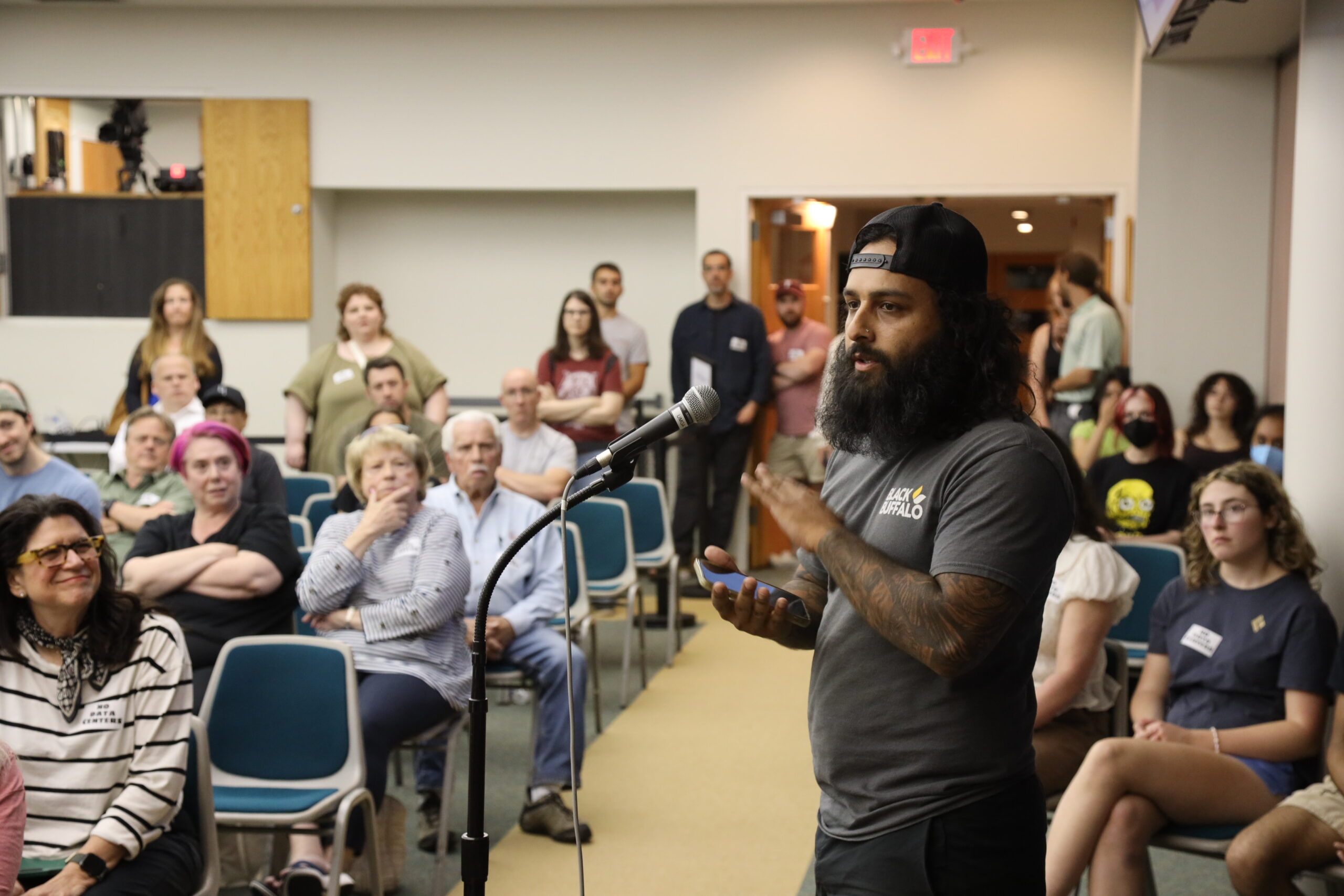

By the time the meeting was adjourned at 11:32 p.m., the crowds packing the lobby outside Freedom Hall had dissipated and seats in the meeting room had cleared. The remaining few dozen people trickled out into the night.
The next day, O’Neill wrote Kirshner an email with the subject, “Hi can we talk.” The Office of Transformation & Opportunity replied by scheduling a video call with O’Neill for the following day, May 29, 2026, according to meeting records. Details of the call were not disclosed in the records.
The Upper Merion Township Board of Supervisors said in a June statement to residents, “We hear your concerns clearly, and your input is necessary and welcomed […] We are asking state officials, who have greater legislative authority, to enact a temporary moratorium and also to preserve local municipal control over zoning for data centers, housing, and other land-use issues.”
‘Approval by Tantrum’
Two months after the highly charged meeting in Freedom Hall on May 27, 2026, O’Neill brought his plans before the Upper Merion Township Planning Commission once again.
This time the venue was the Upper Merion Middle School auditorium — which proved big enough to accommodate the large crowd that gathered.
The July 22, 2026 session quickly grew contentious. “There are still a number of outstanding items that have not been addressed at any point,” commission chair Matthew Popek told O’Neill.
O’Neill, flanked by a four-member team, said he took “great offense” that township officials hadn’t invited him to speak more about his project before the meeting, and added that he would have happily emailed them more information.
“I’m struggling to understand why we have to send you an email at this point when we spent four-and-half-hours in May between us and the public bringing up a number of questions,” replied Popek.
“If you read those transcripts [of the May 27, 2026 meeting] as I have, you’re going to see that I answered every question patiently while you allowed five hours of demeaning conversation and unruly behavior in the room,” O’Neill countered.
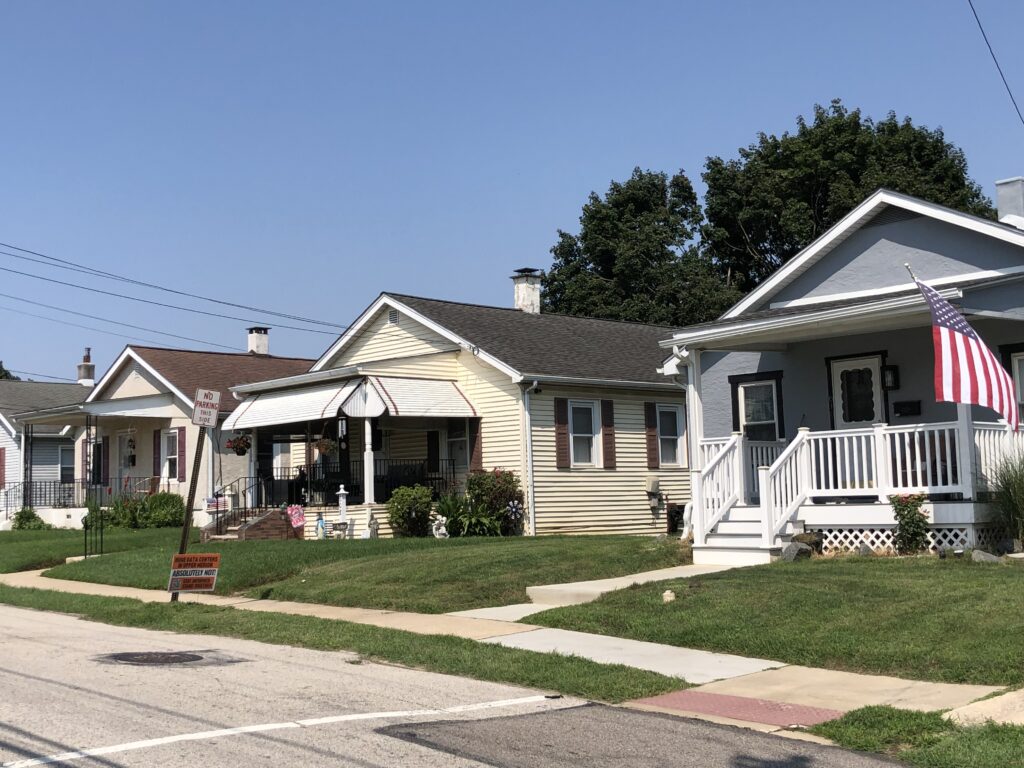
Power generation was a major bone of contention. Upper Merion Township’s zoning officer had emailed a letter to MLP Ventures two days earlier stating that the on-site power generation envisioned by the company didn’t fit the “warehouse” definition that the township had originally granted data centers in August 2025. O’Neill told the commission that the township was unjustly reversing its initial agreement to zone his data centers as warehouses due to mounting public pressure.
The commission members weren’t satisfied with O’Neill’s answers, noting that MLP Ventures’ plans were missing key details including building heights, storm water engineering plans, and the number of gas-fired generators envisaged for the site.
O’Neill replied that he was being “skewered,” alleging that the commission members were “doing everything in their power to be politically correct in front of an audience versus giving me a fair hearing.”
After two-and-a-half hours of back and forth between commission members and O’Neill’s team, public comments began. One resident, Josh Stevens, spoke in support of the project. “Let’s not let fear of the unknown, Ludditism, and naked immorality prevent us from doing the right thing, prevent us from accepting this data center, embracing prosperity, capitalism, and technology,” he said, leading to boos from the crowd.
Twenty people spoke against the project, citing concerns including impacts on wildlife, noise pollution and public health.
Kristin Richardson, who lives in a neighborhood bordering the data center site, said that the complex would harm the health of her son, who has autism, daily seizures, and sensory processing disorders. “Placing a data center immediately outside of our neighborhood, Hughes Park, will with its continuous humming and vibration create sensory stimulation which will increase his seizure risk,” she said. “This proposal does not simply change the view from my backyard. It changes whether or not this home remains a safe place for my medically fragile child.”
State Sen. Katie Muth (D), who represents part of Montgomery County and has introduced a bill for a three-year statewide moratorium on data centers, also spoke out against the plans.
“This proximity to humans is truly the problem with this project,” Muth said, “You’re in one of the most densely populated areas, [a] growing housing market, and you just want to slap [down] a giant industrial operation.”

Just past 11 p.m., the planning commission voted 4-0 to advise the Upper Merion Township Board of Supervisors to deny the site plans presented by O’Neill at its next meeting on August 13.
The following week, neighboring Plymouth Township issued a sharply worded reprimand to O’Neill after he filed a legal challenge against conditions imposed by the council on his planned project site.
The council described O’Neill’s move as a blatant attempt to demand “approval by tantrum.”
”The Township will not entertain such theatrics,” the council said in a statement.
Hearings on the legal challenge that began in June are expected to continue for several months.
Gov. Shapiro weighed in on the situation in Plymouth Township on his official Facebook page, posting that “This is the exact wrong way to do development here in Pennsylvania. I’m a hell no.”
In response to DeSmog’s request for comment, the Shapiro administration said: “It is clear the local community doesn’t want this data center and now the developer is trying to bully his way into approval. The Governor does not support this project moving forward. Furthermore, this project has not secured the power it needs to move forward and has not applied for any state permits it would need to move forward. The [Plymouth] Township Council has been clear they are opposed to this project.”
The administration did not respond to DeSmog’s question on whether Gov. Shapiro had taken a stance regarding MLP Ventures’ data center and power generation project in Upper Merion.
Zach Davis, the Upper Merion environmental council chair, says the mass mobilization against MLP Ventures’ data centers far exceeds anything he’s seen in his nine years on the council. “This is the most unifying issue I’ve ever seen in my life.”

The reporting for this story was supported by the Fund for Investigative Journalism.