


More than a century ago, Czech writer Karel Čapek invented the word “robot” for his play R.U.R., Rossum’s Universal Robots, about a factory that churned out humanoid machines whose mission was to liberate real people from work. Instead, the robots fomented a rebellion and killed off the human race.
Some version of this tale has played out in dozens of books and movies ever since. Now, with the runaway expansion of artificial intelligence (AI) and the data centers needed to feed its insatiable maw, we will have the dubious privilege of seeing if life imitates art.
Yet, if the AI data center buildout continues to be powered by fossil fuels, killer robots will be the least of our worries. The same companies that pioneered the first sustainable energy commitments in the aughts are now driving the biggest climate bomb since the advent of fracking.
With the urgent local impacts of AI data centers on communities driving the headlines — skyrocketing energy bills, air and noise pollution, obscene water use — the impact of runaway AI on the climate is easy to miss. But in the aftermath of a heat wave in Europe that killed at least 1,300 people, and a Fourth of July weekend where Americans themselves were BBQed in record-breaking heat, including at least 25 confirmed deaths, we have to look at AI from one more angle: a global climate challenge.
Data centers need more power than most countries, and that power is fossil-fueled.
New research documents that global data center electricity use surpasses all but that of 10 countries, and is projected to double over the next four years: If data centers were a country, by 2030 it is projected to be the world’s sixth-largest consumer of electricity and producing nearly 400 million metric tons of planet-heating carbon dioxide (CO2) a year. That’s roughly the equivalent of Australia’s annual emissions.
The electricity powering data centers is not clean, much less renewable. Globally, coal and gas provide just under 60 percent of data center power supply. Gas is the single biggest power source for data centers in the United States, and that gas is mostly methane, which traps heat 80 times more effectively than CO2 on a 20-year time scale.
Check out our ongoing coverage of Big Tech’s broken climate pledges, community opposition to the AI data center buildout, and more in DeSmog’s Tech vs. Climate series.
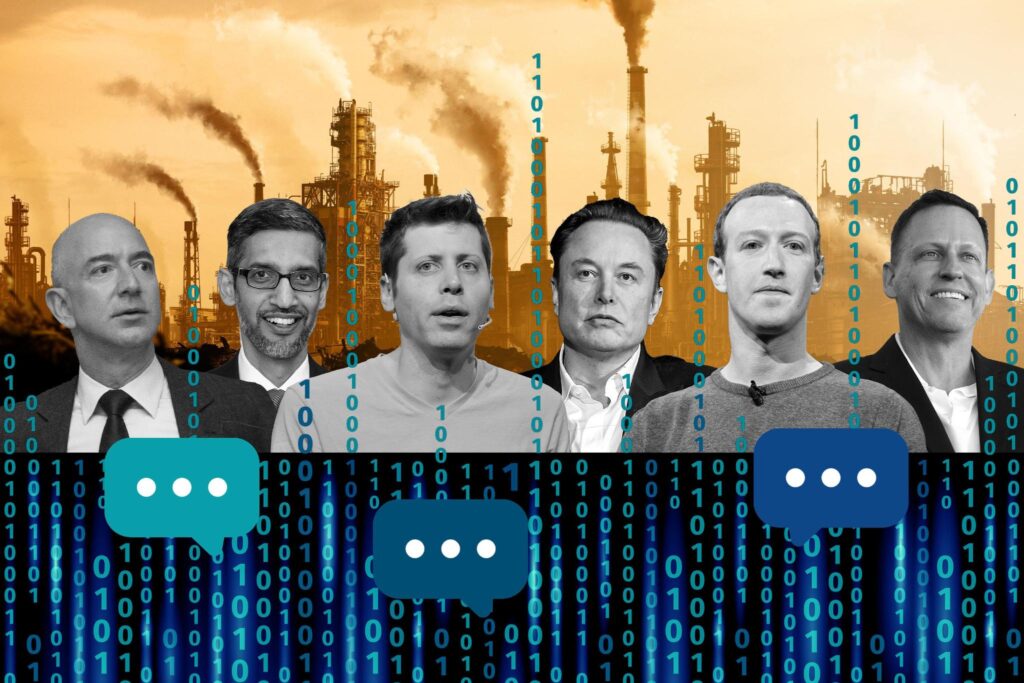
Big Tech is not only using fossil fuels to power AI but selling AI to find more fossil fuels.
Companies like Google and OpenAI promised that AI would accelerate the transition to renewable energy and drive a new generation of climate solutions. But Big Tech is not just powering AI with fossil fuels. It is selling AI tools to the oil and gas industry to turbocharge new fossil fuel exploration, discovery and recovery. Let that sink in. Big Tech is selling AI to Big Oil to find more fossil fuels to burn, faster.
Microsoft is the top cloud provider for the oil and gas industry. Amazon follows in second place while Google is third. And chip manufacturer and AI innovator Nvidia, which has established goals to reduce greenhouse gas emissions by 2030, is now partnering with oil companies to build “AI Factories for Energy.” These are the same companies, together with Meta and more, that promised to zero out emissions before 2040. Instead, Big Tech companies are driving the buildout of a new generation of gas plants and some are even bringing coal back from the dead.
Today, the National Academies of Sciences, Engineering and Medicine is publishing a report assessing the state of climate attribution science that is expected to verify the deep connections between fossil-fueled climate change and extreme weather. These findings will be wind in the sails of lawsuits seeking to hold fossil fuel companies accountable for the devastating impacts of extreme weather on people and communities. They also serve to expose Big Tech’s role as an accomplice in perpetuating climate chaos.
By doubling down on fossil fuels, Big Tech is burning public trust at both ends.
Big Tech companies have missed a chance to build public trust by prioritizing renewable energy in the buildout. Instead, the race to be fastest and first has blinded former clean energy champs to the catastrophic harms they are causing communities and the climate.
Even as more and more AI data centers are going off grid – an opportunity to build renewable-plus-battery-storage facilities fit for the 21st century – companies such as Meta, Amazon, and Microsoft are doubling down on gas and diesel power. While renewable energy is not a panacea for all the complex challenges data centers pose, including water, land use, economic, and equity concerns, it is crucial to the climate and, therefore, to every person on the planet.
Americans don’t want better AI; they want happy, whole communities.
People are keenly aware that AI is a Pandora’s box, and most already believe its risks outweigh the benefits. If public opinion were driving the pace of AI and data center deployment, we would have long since entered a cooling off period: 80 percent of Americans believe the government should regulate AI for safety, even if that means slowing down development. Instead we have a race car without brakes.
A recent headline quipped that opposition to data centers is “the most bipartisan issue since beer.” Neighbors are banding together to block individual projects and communities are winning moratoriums at the city, county, and state levels. This week, New York Governor Kathy Hochul issued an executive order placing a one-year ban on hyperscale data centers. Her order instructs state agencies to put together regulatory guidelines to “protect ratepayers, the environment, the energy grid and communities across the state.” This mandate is the first statewide moratorium in the country.
These are hopeful signs, but not enough. While 75 hyperscale data center projects were successfully blocked in the first quarter of 2026 in the U.S., this is a fraction of the hundreds of hyperscale data centers in the works, or the 4,500 data centers now operating in the U.S. If technology companies want to avoid going down with Big Oil as climate villains, they will not build another data center without 100 percent renewable energy, they will slash their profligate water use, and they will immediately stop their gutless sale of proprietary AI to fossil fuel companies. All of this after, and if, they get the green light from communities they would impact.
The myth of AI was that it would lead to human flourishing and progress. Yet, in the span of a few short years, Big Tech has gone from promising climate breakthroughs to breaking the climate. Thankfully, an empowered citizenry is successfully fighting AI data centers in their neighborhoods. Now we need local, state, and federal officials to enact regulations backing the will of the people. Isn’t that what democracy is all about?