
There are nearly 21 gigawatt’s worth of gas-powered data centres proposed right now for Alberta, a fossil fuel build-out that if ever realized would register on a global scale, requiring potentially hundreds of billions of litres of freshwater and causing Canada’s emissions to soar.
That’s the scenario that emerges from data compiled by provincial regulators, projections from gas representatives at an industry event attended by DeSmog, and analysis from an independent expert astounded at the scale of Alberta’s proposed AI ambitions.
“That amount of power demand in a single location sounds absurdly high,” researcher Alex de Vries told DeSmog in reaction to the Alberta data centre proposals. de Vries is a PhD candidate at the Vrije Universiteit Amsterdam and tracks developments in cryptocurrency and AI from an economic and sustainability perspective on his platform, Digiconomist.
“My estimate for the total global power demand of AI systems is, well, in the range of 20 gigawatts,” he explained.“You’re talking about a number that is potentially half a percent of global electricity consumption by itself just for data centres in Alberta.” Yet that’s the scale of ambition currently being discussed in the province, home to the world’s fourth–largest oil reserves and globally significant reserves of gas.
“There’s another 20 gigawatts of projects in development or in the queue,” Mike Shaw, vice president of business and commercial of ATCO, a Calgary-based energy developer, said at the Global Energy Show Canada in June.
Shaw was referring to the Alberta Energy Systems Operator’s September 2025 update of the amount of energy requested for connection to Alberta’s energy grid for data centres, a figure it put last year at 20.7 GW.
This figure is even higher than the 15.5 GW of gas capacity for all of Canada predicted by a Privy Council document that DeSmog reported on in June, and has massive implications for the country’s climate targets.
“If that power is generated through natural gas, that’s going to have a huge carbon footprint associated with it,” de Vries said.
And that’s far from the only environmental concern. He estimated, based on requirements for other data centres he’s studied, that 20 gigawatts of additional gas-powered AI infrastructure would consume around 200 billion litres of water.
“You’re going to effectively triple your water consumption to generate all this power,” he explained. “If there’s already droughts, that’s not gonna make things better.”
‘Data centres as digital pipelines’
Pembina Pipeline Corp. and two other partners were recently given the go-ahead to build a 932-megawatt gas plant that will eventually power a recently announced Meta data centre with permits to double capacity in the future.
But the gas industry views this as just the beginning of a massive build-out.
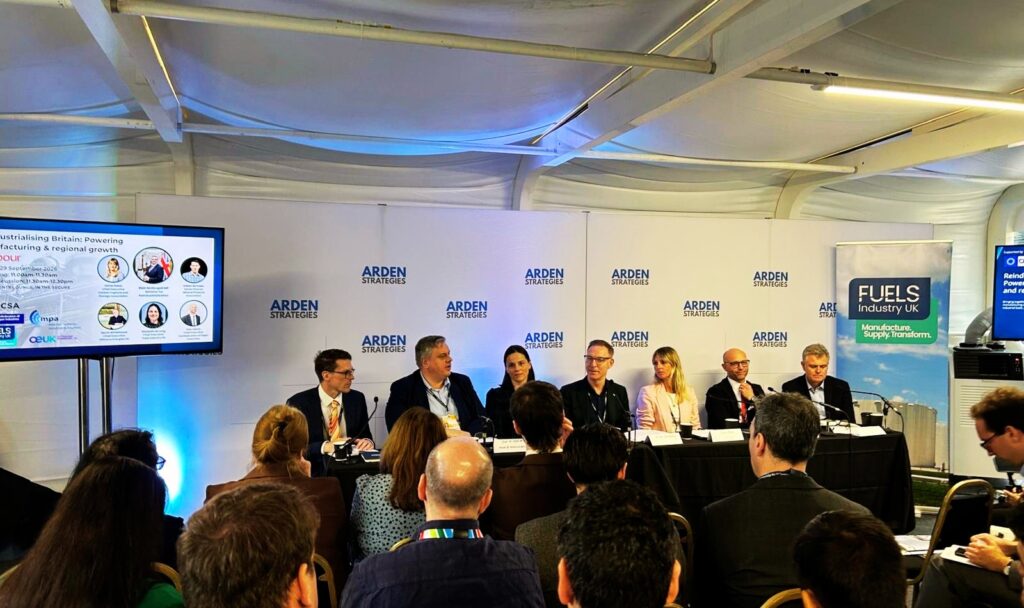
“I think what we’re seeing, certainly here in Alberta, they’ve set some great, bold aspirations: $100 billion of AI investments in the years ahead,” Shaw from ATCO explained. Shaw’s comments came while taking part on a panel called “Advancing Data Centres in Alberta and Canada” at the Global Energy Show in Calgary in June.
The large multi-day event involved an exhibition of energy companies and two concurrent conferences: an executive conference featuring speakers from government and industry, and an “energy influencers” conference to bring “together the community delivering today’s energy systems across oil and gas, new energy and digital infrastructure.”
In late 2025, the Alberta government passed legislation to encourage data centre proponents to bring their own generation (often referred to as BYOG), meaning installing gas turbines at data centre projects, which aligns with the province’s plan to double its oil and gas production.
Wes Callum, senior vice president of power generation for Beacon Data Centers, celebrated Alberta’s data centre push on the same panel that Shaw participated in. “Further south [in the U.S.] there’s a whole bunch of restrictions and obstacles, and then you have Alberta. So Alberta is deregulated, it’s an energy-only market, there’s abundant and cheap gas.”
Alberta’s Minister of Technology and Innovation, Nate Glubish, recently stated that he views “data centers as digital pipelines and digital refineries for us to help get the value from our natural gas to global markets.”
During another panel at the Global Energy Show, Glubish promised that “some gigawatt-scale announcements are coming in Alberta that aren’t just press releases, these are shovels in the ground, permits complete, financing in place, and we’re 12 to 18 months away from the first campus being turned on.”
The minister added, “Western Canada has what the world needs, we can build things faster, and we have the gas to supply what the world needs.”
Neither Shaw, Callum or Minister Glubish’s office responded to DeSmog’s requests for comment.
Abandoning Emissions Targets
Even the strongest AI boosters acknowledge that 20 GW’s worth of projects is an extremely ambitious goal, especially considering that Alberta’s grid currently has capacity for just 1.2 gigawatt’s worth of new data centres.
Shaw predicted that the final build-out is “probably not actually going to be 20 gigawatts.”
Yet, a highly ambitious goal, even if unattainable in the current context, is the pretext for industry to make urgent regulatory demands on policymakers. “We’ve got over 20 gigawatts of large-load applications. There’s clear interest. It’s super important to get the project across the line in a short space of time to ensure that the rest of the market can see Alberta as number one,” Callum said.
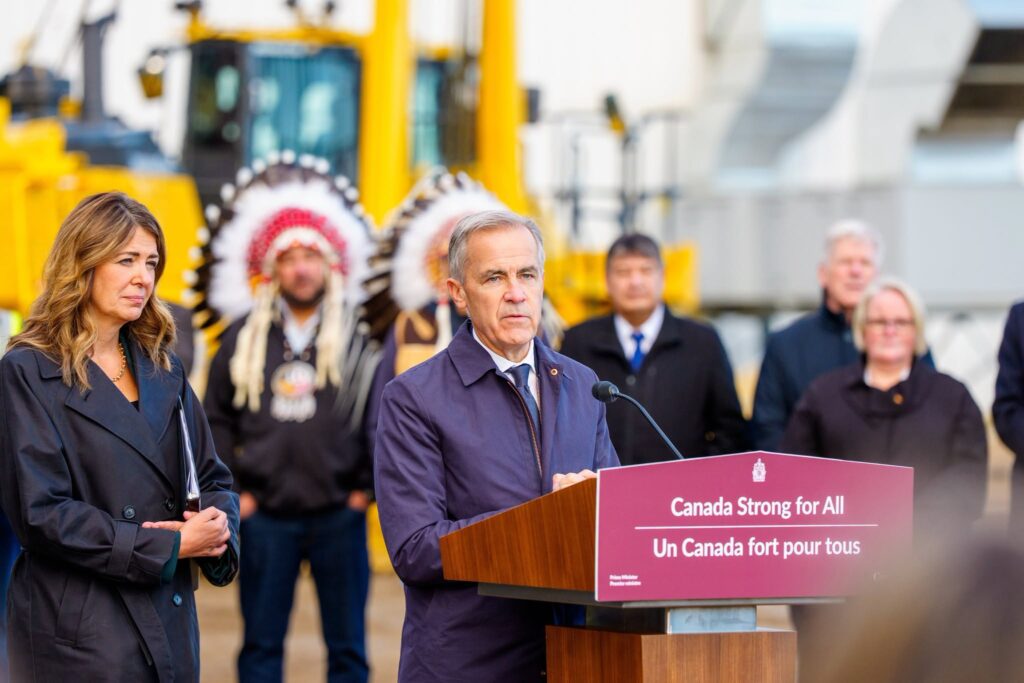
It appears the federal government is taking industry’s demands seriously. Prime Minister Mark Carney has formally abandoned his previous Liberal Party government’s climate plan, calling it “too expensive” and “divisive.”
DeSmog recently reported on internal federal government documents from 2025 that estimated 15.5 gigawatts of new gas capacity is needed to power proposed data centres across the country. One Privy Council document named the “development of net new energy resources” as a top public policy goal for data centre development. These private assessments didn’t appear in the Carney government’s recent “AI for All” strategy document.
If Canada runs 15.5 gigawatts of data centre power on gas as outlined by the Privy Council, this would result in 33 to 63 megatonnes of annual greenhouse gas emissions. A 20-gigawatt use would result in even higher emissions.
The fossil fuel industry in Canada has viewed data centres as a growth opportunity for gas demand for several years. DeSmog recently revealed that Canadian gas companies have been celebrating AI data centres as a big growth sector on investor calls, in some cases predicting opportunities to sell billions of cubic feet of gas per day.
The CEO of Advantage Energy, Scott Burrows, recently summarized the situation stating, “the whole industry is falling all over ourselves to find a way to draw investment here to increase demand for our energy and to avoid the commodity otherwise being wasted at rock-bottom prices.”
Community Pushback
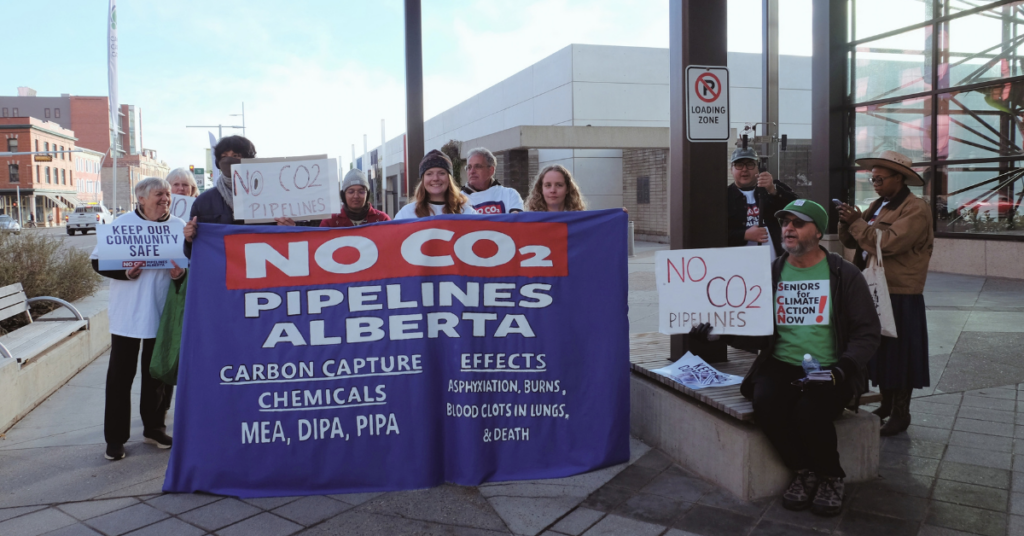
Despite the gas industry’s optimism, communities across the country are opposing AI data centre projects over concerns ranging from environmental impacts and water use to noise pollution and excess heat from the complexes.
In late June, activists organized protests against data centres in a dozen cities across Canada, bringing out hundreds in British Columbia, Alberta, Saskatchewan, Ontario and New Brunswick. After weeks of local organizing, the City Council of Hamilton, Ontario, considered passing a ban on data centre development, but it was recently voted down despite protest from locals.
Panelists at the Global Energy Show were aware of the threat posed by community opposition to data centres. Shaw noted he is observing “specific projects here in Alberta that are facing huge community pushback” and “[t]he public is not in support of these developments in their backyard.”
Shaw said the solution is “ground game and getting the community support, and help and perception should be goal number one.” Callum followed this by underlining the need for getting “the right studies done beforehand to really understand the effects” of projects, and “get that messaging right.”
But, ultimately, he argued that the best solution to grassroots opposition is for projects to be moved along as quickly as possible.