
With only two months until a binding agreement on a major $20 billion carbon capture project is to be finalized, Albertans living in communities that could be directly impacted by the project say they still have not been consulted.
“Industry and government have had two years to answer our questions, and they still haven’t,” Amil Shapka of No CO2 Pipelines Alberta, a grassroots organization opposing the project, said in a statement to DeSmog.
Shapka’s comments came after government officials, industry representatives, and technology advocates met in Edmonton in mid-September for the annual Carbon Capture Canada convention, which is Canada’s largest expo on carbon capture, utilization, and sequestration technology.
Members of the No CO2 Pipelines Alberta coalition protested outside, and in the weeks since have been calling on government officials to cancel the project.
Though the importance of public consultation with Indigenous and non-Indigenous communities was mentioned as a necessity at many of the convention’s keynote addresses and panel discussions, protesters feel left out in the cold.
“We’re standing outside this convention today because our homes, our farms, our health and our water are what’s actually on the line here,” said Shapka. “The people who’ll actually live with the disastrous impacts of this pipeline can’t even get into the room.”
“This is a decision that could trample [First Nations’] Treaty rights and bulldoze the consent of the Indigenous communities whose land this pipeline would cross,” added Nigel Robinson, a representative of Keepers of the Water & No CO2 Pipelines Alberta.
“People’s Rights Are Being Signed Away”
A carbon capture project fact sheet document, published by Oil Sands Alliance in March 2026, mentioned public consultation a dozen times as a crucial factor in developing and maintaining relationships with potentially affected communities. According to the same document, the consultation and engagement process is currently listed as “ongoing.”
Alain Moore, Oil Sands Alliance’s director of communications, did not respond to DeSmog’s request for comment.
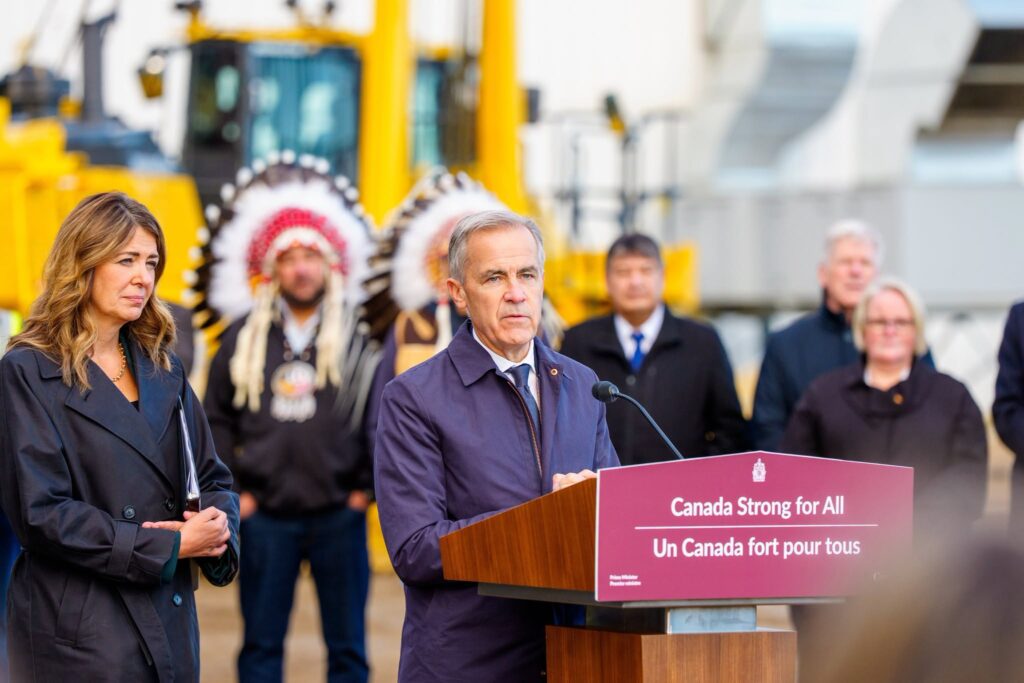
On July 2, 2026, Canada’s federal government and the government of Alberta signed a Memorandum of Understanding (MOU) with the Oil Sands Alliance, an industry consortium of Canada’s five largest oil sands producers formerly known as the Pathways Alliance. The agreement set a date of November 15, 2026, for the two levels of government and the oil companies involved in the project to sign binding obligations to move it forward. The project, called Pathways Plus, ties the development of a new oil pipeline to Canada’s Pacific coast with the development of the Pathways carbon capture project.
The project aims to develop a 650-kilometre long carbon dioxide pipeline network in Northeastern Alberta, with a carbon sequestration site near the community of Cold Lake. Despite a notable reduction in the total emissions the project is promising to capture, its considerable pipeline and sequestration infrastructure requirements may place it among the largest carbon capture projects in the world.
Despite the MOU, community members living near the proposed pipeline route say they still haven’t been properly consulted on the project.
About two dozen members of the No CO2 Pipelines Alberta coalition were part of the September protest outside the Edmonton Convention Centre. “We came out today because while industry insiders are toasting an unproven technology behind these doors, real people’s rights are being signed away outside them,” said Robinson.
DeSmog has previously reported on the grassroots effort opposing the development of the Pathways project. No CO2 Pipelines Alberta has been organizing town hall events to inform communities along the pipeline route of the proposed plan and the potential harms associated with the project.
Rural landowners and Indigenous members from the No CO2 Pipelines coalition told DeSmog that they have received little information about the project, and have not been given any updates since the MOU announcement in July.
Jesse Cardinal, Executive Director for the Indigenous organization Keepers of the Water, said that her organization had to reach out to the federal government to schedule a meeting. “We have had no response. We are going to Ottawa next month to speak with some government representatives about CCUS and will have a better idea of [a] response then.”
Major Concerns And Major Questions Remain
Residents along the proposed carbon capture pipeline corridor have major health and environmental concerns, notably related to a potential for the pipeline to leak, or rupture and explode.
A rare limnic eruption under Cameroun’s Lake Nyos in 1986 released between 100,000 and 300,000 tonnes of concentrated carbon dioxide gas, killing nearly 1800 people, approximately 3500 cattle, and other animals in a 25 kilometer radius. More recently, in February 2020, a ruptured carbon dioxide pipeline released over 31,000 barrels of CO2, hospitalizing more than 40 people and forcing the evacuation of roughly 300 residents around Satartia, Mississippi. The No CO2 Pipelines coalition is also concerned that the Pathways project lacks plans for cleanup and has not undergone an environmental assessment.
Whether the Pathways project will be built is still unclear, and financing remains a major obstacle. Originally estimated to cost $16.5 billion (CAD), recent estimates put the project in the $20-30 billion (CAD) range.
In a recent interview with Reuters, Oil Sands Alliance president Kendall Dilling said that the oil companies involved have a target date of late-2027 for a final investment decision. Despite a considerable drop in the project’s anticipated carbon dioxide capture and sequestration capability, Dilling told conference attendees the reduction was only “slightly smaller.” Asked about this by DeSmog later, Dilling said it was more an issue of timing than the actual capacity of the project.
“Carbon capture and storage (CCS) projects in the oil and gas sector are highly expensive and often underperform,” said Steven Haig, policy advisor for International Institute for Sustainable Development (IISD)’s Energy Program.
“Despite decades of experience with the technology, the sector has not demonstrated that it can scale CCS as promised,” said Haig in a statement to DeSmog. “Given that oil and gas production is currently Canada’s largest source of carbon pollution, CCS projects cannot be relied on to significantly offset emissions from the industry now or in the future.”