
This story builds off reporting from Drilled, a true-crime podcast and investigative reporting project about climate change.
Dr. Amil Shapka was having a quiet day in the rural Alberta community of St. Paul when a worried neighbour showed up at his doorstep. The man, a senior citizen, had been approached by agents from Canadian National Resources Limited (CNRL), one of Canada’s largest oil and gas companies.
The oil company agents were scouting routes for a new pipeline. But this proposed piece of infrastructure would be carrying a different product from what Shapka’s community was used to—carbon dioxide.
Shapka was alarmed, and soon too were many inhabitants of the County of St. Paul, a rural community roughly 140 kilometres northeast of Edmonton. St. Paul is not far from Cold Lake, Alberta, ground-zero for a $20 billion carbon capture and storage (CCS) project that received the go-ahead from Canada’s federal government in July.
Shapka’s elderly neighbour had “questions about whether he should sign the easement for a [CO2] pipeline,” Shapka told DeSmog in an interview. “There had been no talk of it in the community, nothing in the local papers, nothing in the coffee shops.”
Soon residents were learning about a 2020 carbon pipeline explosion in Satartia, Mississippi, which led to more than 45 people being hospitalized as leaking CO2 made its way through the rural community. The prospect of another major disaster quickly mobilized the residents of St. Paul county.
“It’s unacceptable that our communities will become home to the world’s largest toxic CO2 dumping ground,” Shapka recently said.
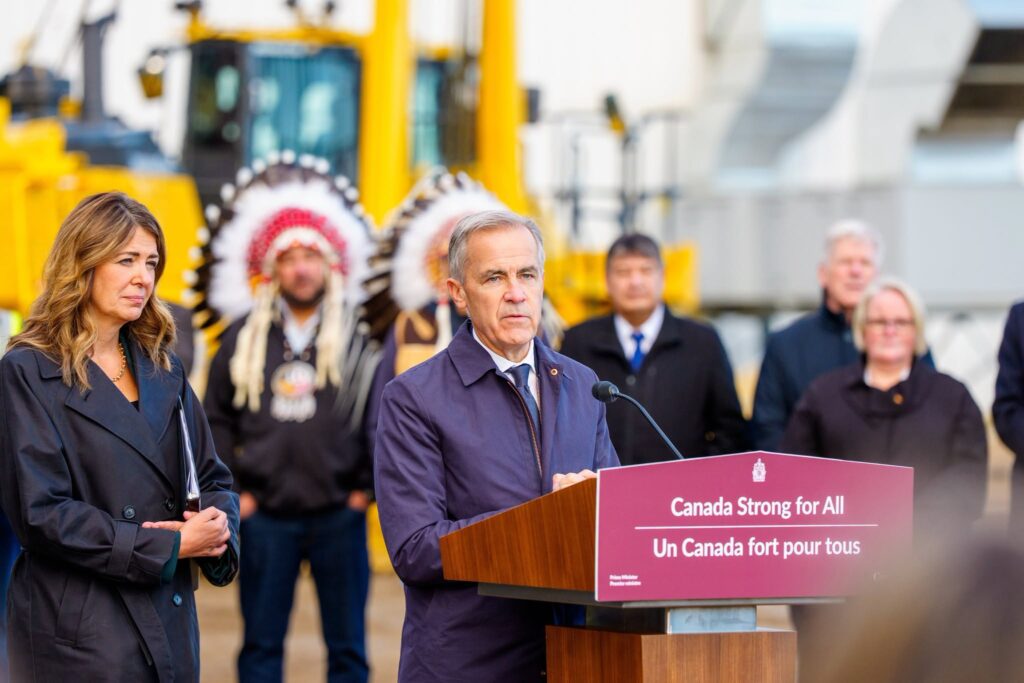
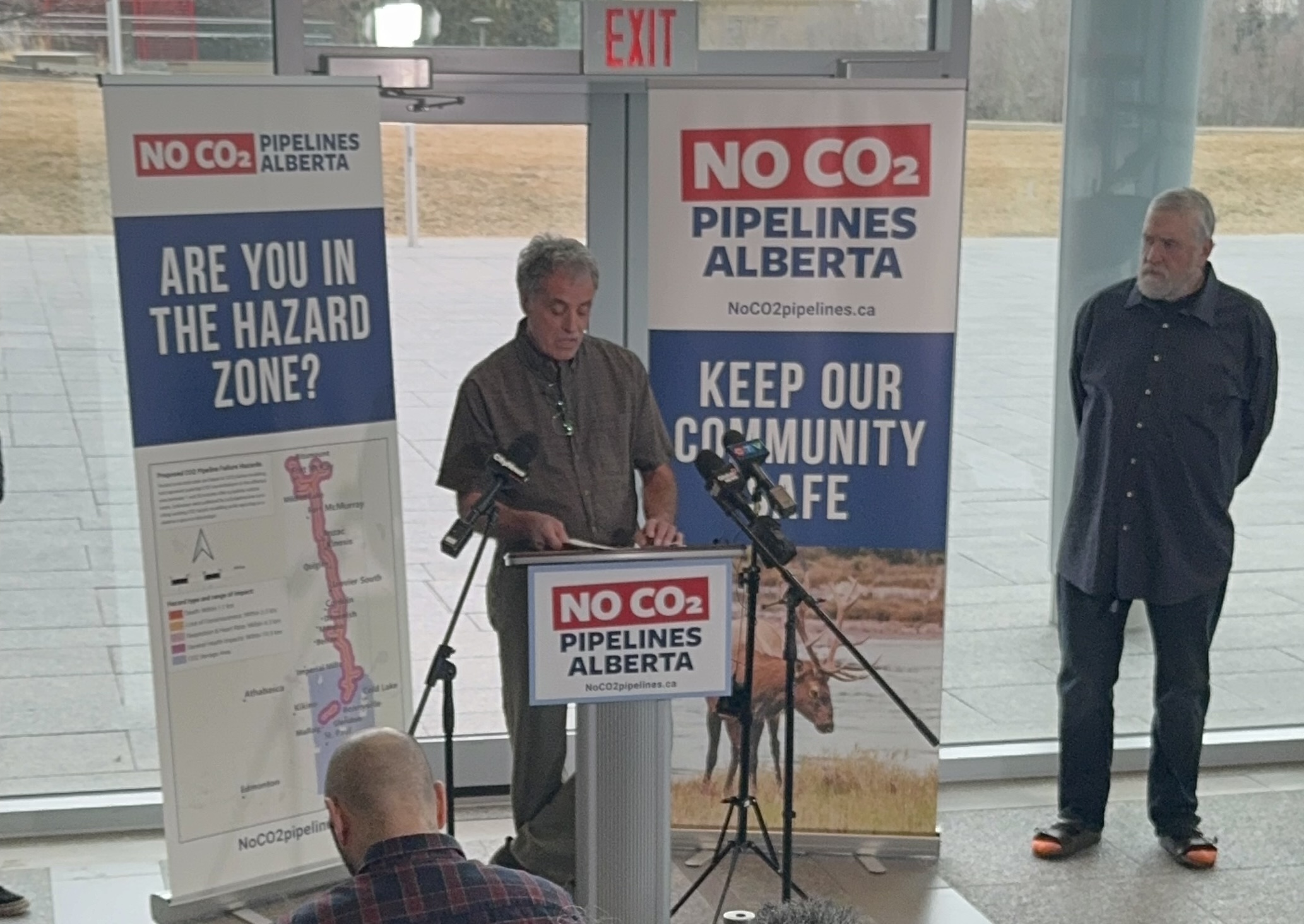
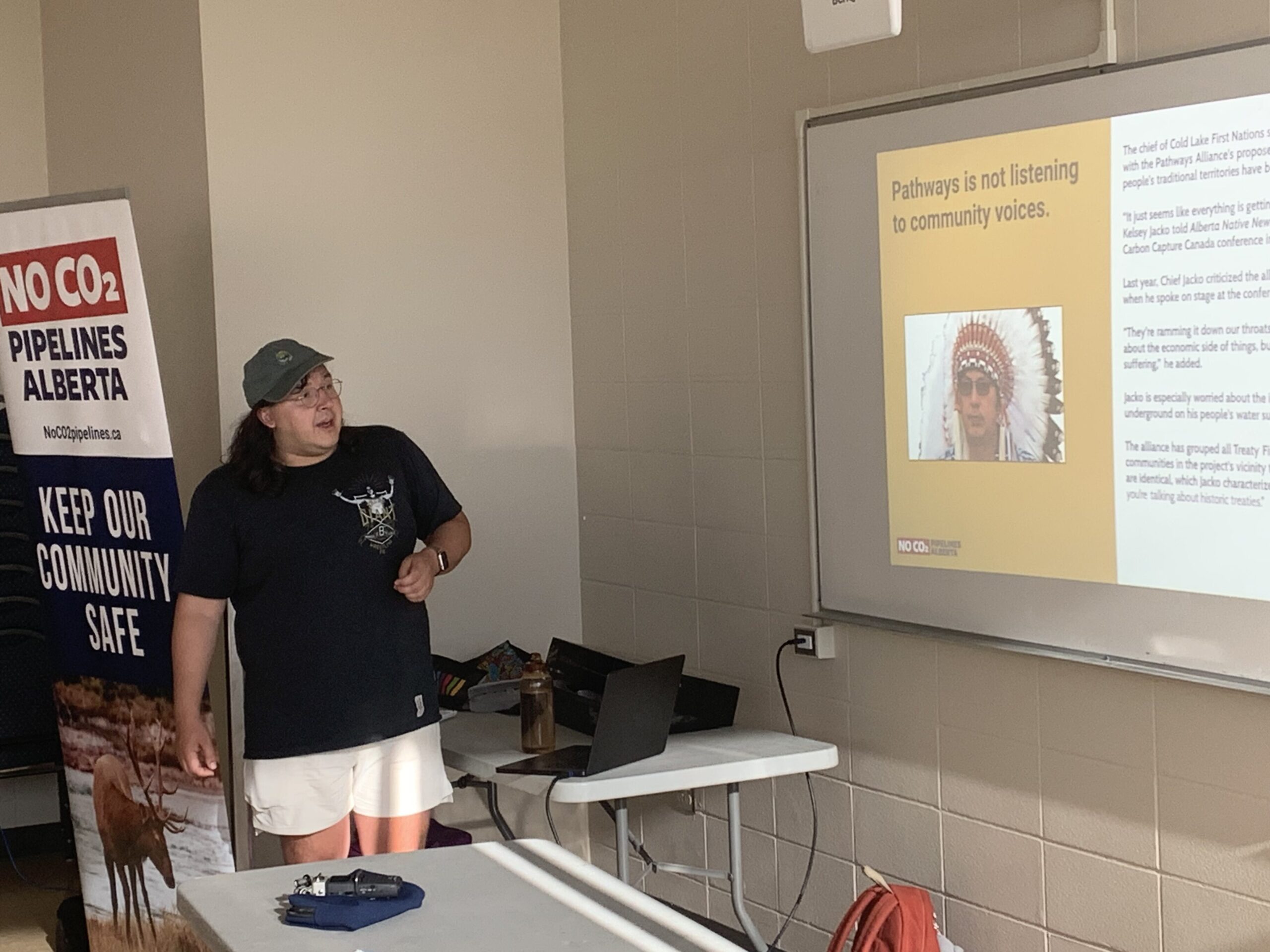
Earlier this year, Shapka helped launch No CO2 Pipelines Alberta, an organization that has become one of the loudest voices against the carbon capture and storage mega-project backed by the Liberal government of Prime Minister Mark Carney, the United Conservative Party government of Alberta Premier Danielle Smith, and the country’s largest oil companies. In early July, these parties signed a non-binding agreement to move forward on this project as an extension of a Memorandum of Understanding (MOU) agreed to last November between Canada’s federal government and the government of the oil-rich province of Alberta.
At a time when environmentalism has been portrayed by conservatives and fossil fuel boosters as something that only appeals to progressive urban elites, No CO2 Pipelines is uniting Indigenous communities, farmers, landowners, and other concerned parties who oppose the siting of CCS infrastructure in their communities.
This is just one front in an international grassroots push back against carbon capture not primarily led by traditional environmental groups or progressive politicians, but on-the-ground alliances of people motivated by fears about the dangers of CO2, and feeling left in the dark by their elected officials.
“There had been no public consultation,” Shapka said of the day when he learned of the CO2 pipeline from his neighbour. “So we kind of did what we could, started the town hall, and have been looking for answers ever since.”
The Fight Against CO2 Pipelines in Iowa
Two-thousand miles to the southeast, in Iowa, a similar grassroots opposition campaign has been building against CO2 pipelines. This U.S. pushback has been documented at length by the investigative reporters at Drilled, and you can hear some of the voices from that revolt in an episode of Drilled’s new podcast series Carbon Cowboys, which is embedded below.
In 2021, as the Drilled episode explains, Republican megadonor Bruce Rastetter proposed a massive carbon capture project—Midwest Carbon Express—which was supposed to help decarbonize ethanol plants. Rastetter was well-known, if not well-liked in the area.
A decade earlier, in 2011, he’d become front page news for a supposedly sustainable agricultural project in Tanzania. The only problem was that the land he intended to develop was occupied by 160,000 people, and he had involved Iowa State University in what was essentially an eviction and expropriation project. By 2021, Rastetter had a new project, one he may have figured environmentalists as much as Big Agriculture could support: carbon capture.
Instead, Rastetter discovered opposition to carbon capture was as bipartisan as it was grassroots. Even his conservative political allies wouldn’t support him on it. Public meetings opposing the carbon capture project were packed with people, and those making presentations made for strange bedfellows. One meeting included former Iowa congressman Steve King, known for his ultraconservative political views. But representatives from the Sierra Club, a progressive environmental group, were also present. Summit Carbon Solutions, Rastetter’s company, was pitching his carbon capture project as a solution to climate change, and asking landowners for easements to build its 1,000-mile carbon dioxide pipeline network.
Ultimately, both Iowa and South Dakota passed statewide bans on eminent domain, such that Summit Carbon couldn’t push through carbon dioxide pipelines. While South Dakota’s ban was signed by the governor and remains in place, Iowa Governor Kim Reynolds vetoed the bill, calling it poorly written legislation. Rastetter is the top individual donor to Reynolds’ political campaigns.
The eminent domain issue related to Summit’s Midwest Carbon Express project is now being tested in North Dakota courtrooms. Landowners there are now facing seizure of their land, and are issuing a consolidated appeal of the North Dakota Public Service Commission’s (PSC) approval of a permit for the project.
The PSC had rejected Summit Carbon’s first attempt to get a carbon dioxide pipeline permit in 2023, but approved a renewed permit application in 2024. Whereas the original project was pitched as a way for ethanol plants to improve their carbon scores, the new proposal seeks to explicitly use the captured carbon for enhanced oil recovery (EOR). Carbon capture technology was originally developed for EOR purposes in the 1970s, and this has been the primary application of the technology ever since.
Find the full series at this link.
‘A Direct Health Threat’
Back in Alberta, Shapka wasn’t looking to get involved in the contentious issue of pipeline debates. The retired dentist was enjoying “doing as little as possible, living a happy little life on my on my acreage in the middle of paradise.”
But he claims that the approach taken by the oil companies has been insulting and inconsiderate.
“We’re not urbanites, we’re really attached to our land and value it. A lot of the people affected here are from multi-generational farms that were pioneered by their grandparents who were immigrants. And now some American oil and gas company is going to come in and start pumping all the CO2 they can for the next 50 to 60 years underground?” Canada’s top four oil companies are majority U.S.-owned.
In hearing about opposition to the Pathways project from Indigenous communities around Cold Lake, Alberta, Shapka found important allies with a common cause. “When we did the press release in Edmonton, it was funny because Chief Allan Adams of the Athabasca Chipewyan First Nation stood up and he called this an ‘unlikely coalition of cowboys and Indians’… everybody in the room just gasped, except for the locals who live alongside Indigenous peoples.”
Shapka said that the shared respect for and attachment to the land made finding common ground easy. Shapka says the fight against carbon dioxide pipelines and carbon capture projects is international in nature. Their coalition sought information from organizations in Australia who fought a similar project, and they have since been contacted by groups in the United Kingdom for assistance in organizing against a project aiming to store captured carbon in the North Sea.
Concerns about carbon dioxide accidents are front of mind for leaders of the No CO2 Pipelines Alberta coalition. In their statement relating to the Pathways MOU announcement, they specifically highlight the potential of the pipelines to poison water sources, as well as the potential for the pipeline to rupture and explode, which would release millions of tonnes of pressurized carbon dioxide into the atmosphere.
The No CO2 Coalition estimates that there are, at present, 9,000 people living within a 20-kilometer-wide hazard zone of the proposed carbon dioxide pipeline corridor. In the case of a violent explosion and major leak of carbon dioxide, the coalition estimates the death toll may exceed 1,000 people, with ten times as many potentially requiring hospitalization.
“The carbon dioxide stored by the proposed carbon capture facilities is a direct health threat,” says Dr. Suzanne Perkins in a statement to DeSmog. Perkins is with the Alberta chapter of the Canadian Association of Physicians for the Environment (CAPE). “At high concentrations, it asphyxiates; at lower levels, it causes lung and brain damage. When a CO2 pipeline in Mississippi ruptured in 2020, 45 people had to be hospitalized and more than 200 evacuated.”
The coalition’s website lists additional concerns, ranging from failure to adequately consult with impacted communities, violating Indigenous rights, and the absence of a clean up contingency plan.
Perkins says the Pathways project puts Indigenous and rural communities in Alberta’s Lakeland district at risk of harm.
“The Alberta government’s denial of an environmental impact assessment, despite requests from multiple First Nations, is a failure of leadership,” said Perkins. “True climate leadership means listening to Indigenous voices and rejecting projects that endanger lives. Ultimately, we need real solutions, not false ones that sacrifice health for profit.”
Sam Blackett, Press Secretary to Alberta Premier Danielle Smith, did not respond to DeSmog’s specific questions.
Dubious Climate Claims
The Pathways project is estimated to cost between $20 billion and $30 billion CAD, though the Oil Sands Alliance (OSA) initially said it would cost $16.5 billion. As recently reported by The Narwhal, the OSA reduced Pathways’ projected emissions reduction targets to 6 megatonnes (6 million metric tonnes, or 6 Mt) annually. Since 2021 the OSA had consistently promised its project would reduce oil sands emissions by 68 Mt annually. The MOU then established the 6 Mt figure as a foundation, and promises to reach 16 Mt annually by 2045 by unspecified means. Despite that, Canada’s oil and gas sector was able to leverage the promise of a carbon capture project to roll back carbon pricing and environmental regulations.
Asked about this discrepancy, Carolyn Svonkin, spokesperson for the Office of the Minister of Energy and Natural Resources, told DeSmog that the MOU “reaffirmed (the) shared objective of achieving 16 million tonnes per annum (Mtpa) of emissions reductions from the Pathways projects” Only six megatonnes would be reduced through a combination of CCS technology, while the other ten would be addressed through a “range of technologies”.
Keith Stewart, Senior Energy Strategist with Greenpeace Canada, said the six megatonne commitment is “only 7 percent of current oil sands emissions,” and far below OSA’s previous 2030 and 2050 goals.
Svonkin added that Natural Resources Canada did not conduct an independent environmental impact assessment of the project. In response to questions from DeSmog, Keean Nembhard, Press Secretaryin theOffice of the Minister of Environment and Climate Change Canada, indicated that his ministry also did not conduct an environmental impact assessment. Instead of replying to several specific questions about the environmental impact of the Pathways project, Nembhard told DeSmog “the Pathways Project is an important component in the decarbonization of an entire industry.”
Experts disagree.“This agreement asks Canadians to pay twice so oil sands companies can pollute more: once to fund carbon capture, and again to build a taxpayer-backed pipeline that helps sell even more of that oil,” said Thomas Green, Senior Manager, Climate Solutions with the David Suzuki Foundation.
“The net effect of more oil exports and a small amount of captured emissions is more pollution, not less,” said Green in a statement to DeSmog. “Even in the best case — with Pathways built in full alongside the proposed pipeline — oil sands emissions still climb to 89 million tonnes a year by 2035, higher than if neither project went ahead.”
‘We Will Resist This Project’
But the project is far from a done deal—if Shapka and his allies have anything to say about it. “This agreement was signed behind closed doors, without the consent of local landowners, rural residents, municipalities, or Indigenous communities living within the project area,” he said recently in a statement.
“We will resist this project at every stage and do everything we can to stop it from being built. We won’t risk our way of life so profitable oil companies can bury their toxic waste under our communities.”
Summit Carbon’s CCS project is still facing considerable opposition in Iowa. Summit proposed a revised plan in May that would eliminate some 200 miles of pipeline, withdrawing entirely from eight Iowa counties and reducing pipeline mileage in four others. As such, the revised project would impact 400 fewer farmers. But project opponents are still concerned about the carbon capture project’s impact elsewhere in the state, and have asked the Iowa Utilities Commission to deny the project.
In the United Kingdom, opposition to carbon capture projects similarly cuts across political lines, securing the support of Reform UK county councils as much as Friends of the Earth Scotland.
Jesse Cardinal, Executive Director with Keepers of the Water, one of the organizations that supports the No CO2 Pipelines campaign, says activists around the world are learning from each other’s efforts.
“We’re not just looking in our own backyard, in fact, that’s often one of the points made by government and industry, they’ll say that this technology is proven, that it has been around for a long time and used around the world, so we have to do our due diligence and check all of that,” she told DeSmog. “And we’re finding that there are a lot of concerns, and that it is not in fact a proven technology.”
Cardinal thinks people are reaching their limits with carbon dioxide pipeline proposals.
“We’re in a place right now where it’s like the curtains are being pulled back, and people are realizing they actually have more in common than they may have thought otherwise.”