
LIVERPOOL – The head of the UK’s largest oil and gas trade group has claimed that two proposed North Sea fossil fuel projects should go ahead to show “climate leadership” and help cut emissions to net zero.
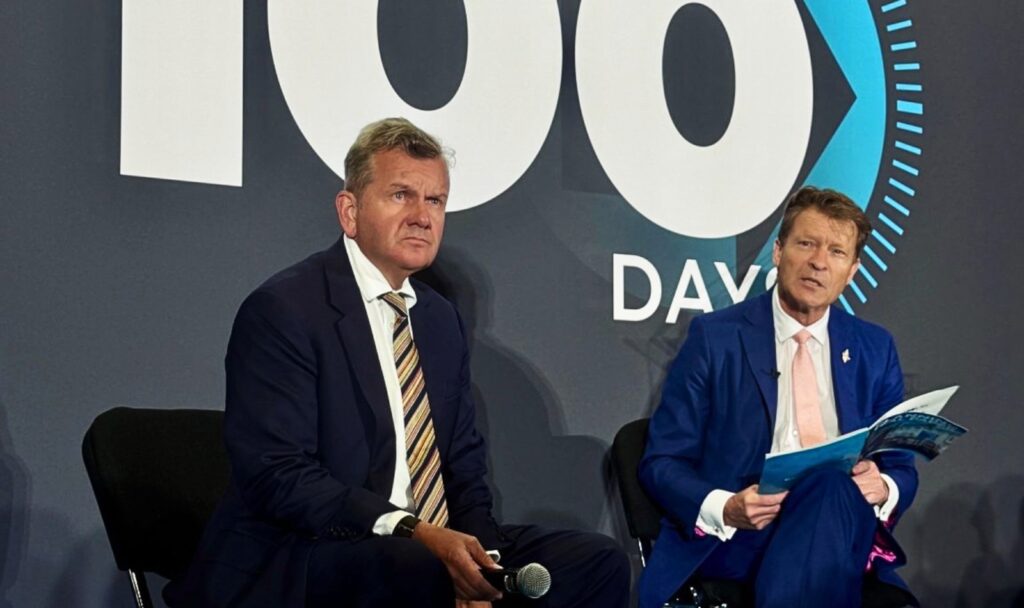
David Whitehouse is the chief executive of Offshore Energies UK (OEUK), formerly Oil and Gas UK, whose members include oil and gas majors BP, Chevron, Equinor, ExxonMobil, Shell, and TotalEnergies. Whitehouse was speaking on a panel at Labour Party conference in Liverpool on Tuesday about “reindustrialising Britain”.
Whitehouse, a former production engineer for Shell, argued that people should “stop dividing our workforce into clean jobs and dirty jobs”, and not “allow the energy debate to become really polarised, as if it is renewables versus oil and gas”.
He went on to back two contested fossil fuel projects – the Jackdaw gas field near Aberdeen and the Rosebank oil and gas field near the Shetland Islands – in the name of climate action.
Whitehouse said: “We should support projects like Jackdaw and Rosebank not because it goes against climate leadership, [but] because it is climate leadership that you support your own industries on that journey to net zero.”
His argument was based on the misleading claim that domestic gas production emits less carbon dioxide (CO2) than imported gas. In fact, North Sea Transition Authority data shows that UK gas production releases more than double the CO2 emissions of pipeline gas from Norway.
Rosebank alone would create an estimated 250 million tonnes of CO2 emissions over its 10-year lifetime, roughly 70 percent of the UK’s total annual emissions.
“A new oil field on the scale of Rosebank is fundamentally incompatible with safe climate limits and the UK’s international commitments,” said Robert Palmer, deputy director of the research and campaign group Uplift.
“The science is clear that the world already has far more oil and gas than can ever be safely burned if we are to limit global warming. Rosebank, which is overwhelmingly oil for export, would simply add hundreds of millions of barrels to an already unsustainable supply of fossil fuels.
“The industry’s claims would be laughable if they weren’t so serious.”
Andy Burnham’s Labour government is currently considering whether to approve the projects, which received licences under the Conservatives and so would escape Labour’s 2024 election pledge to ban new North Sea licences. However, any decision to approve the schemes would face fierce opposition from Labour MPs and climate advocates.
“The Prime Minister needs to listen to the warnings of scientists, keep in mind those who lost their homes to this summer’s wildfires, the UK farmers struggling to grow our food in the drought, and the lives lost in the floods in Nepal – and not the ridiculous spin from oil companies. He must reject Rosebank,” Palmer added.
Climate-Fuelled Weather
This year saw record-breaking heatwaves in the UK and around the world, leading to extreme weather and excess deaths.
When asked by DeSmog what impact heatwaves, wildfires, droughts and floods would have on jobs and industry, Whitehouse replied: “This summer I think people recognise that climate change is real, we need to deal with it. The end point for me is not negotiable. We must decarbonise, we must show leadership in the country.”
He continued: “I think it is right that we prioritise our own production. It comes with lower emissions, it’s better for the environment. But what it also brings with you is the social fabric. It means we have jobs.”
Whitehouse added: “I would argue we should back our own North Sea oil production, we should back it over imports.”
As DeSmog has reported, OEUK has lobbied the previous Conservative government to water down its windfall tax on oil and gas profits.
The panel was chaired by former Labour Cabinet minister Jim Murphy of Arden Strategies, a lobbying firm that has worked extensively for the oil and gas industry. The panel featured Olivia Powis from the Carbon Capture and Storage Association (CCSA), members of which include oil and gas corporations BP, Equinor, ExxonMobil, and Shell. As DeSmog reported, in 2023 the organisation’s board was dominated by oil and gas executives.