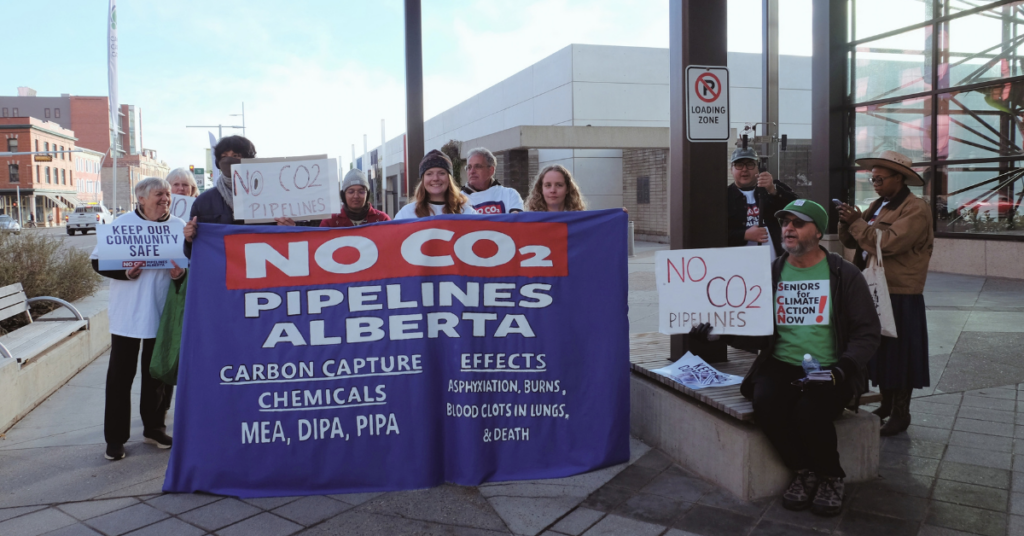

Prime Minister Mark Carney is betting big on a new bitumen pipeline to the west coast and with no lead private sector proponent, he might be betting with your tax dollars.
The last publicly purchased pipeline, the Trans Mountain expansion (TMX) cost taxpayers $34 billion and researchers at the International Institute of Sustainable Development estimate that the federal government would lose at least $8.9 billion if it was ever sold.
Why do we keep throwing public money at subsidizing fossil fuel infrastructure when all indications are that this new pipeline proposal is a risky bet?
DeSmog looked at the latest analysis detailing the shaky economics of a new pipeline and reached out to experts. The only winners might be financiers with short-term incentives in a position to profit even if the public is left holding the bag on another multibillion-dollar bitumen boondoggle.
“It’s important to remember that insiders often make their biggest paydays when the investment is made, not when the project is successful,” Clark Williams-Derry, an energy finance analyst at the energy think tank Institute for Energy Economics and Financial Analysis (IEEFA) explained to DeSmog. “This is certainly true for investment bankers who arrange financing. They earn their fees up front, when the debt or equity placement is made, not 10 years later when the project has a successful track record. Their incentive is to get a deal done, even if, in the end, it’s not a great project.”
The current agreement between Ottawa and Alberta has the public paying for 90 percent of the project with Pembina Pipeline Corporation potentially contributing the remainder of the money – if the company decides it is worth its while.
Pembina assured its shareholders “the proposed multi-stakeholder structure is intended to appropriately align risk and responsibility among participants and includes protection for Pembina related to matters such as cost overruns and returns.”
In other words, the taxpayer may again be at the back of the line should the project go south. TMX had massive cost overruns that will likely never be recovered by the Canadian government while the primary contractors who built the pipeline were of course paid in full.
Before the Trudeau government bought TMX, Texas-based Kinder Morgan was the original developer. Kinder Morgan investors were no doubt pleased when the pipeline company offloaded TMX onto Canadian taxpayers for a cool $4.5 billion in 2018. Kinder Morgan distributed $3.98 B from this sale to their shareholders in January 2019. Ottawa was saddled with more than $30 billion in cost overruns that will likely never be recovered due to inadequate pipeline tolls. Privatized profits and socialized losses are an all-too-common tradition with Canadian mega-projects, seemingly to be soon repeated.
Initial investors can also flip their stakes. “Private equity investors have a short time frame, usually 3-5 years, which means they have to get in and quickly find or generate a monetization event so that they can pull out their capital,” said Williams-Derry. “Sometimes they sell at a loss, but it’s still a way for the firm to find buyers even if the underlying investment is a bit of a dud. Their future investors turn into the bigger suckers to bail out today’s investors.”
“In short, there are lots of reasons why people put good money into weak projects. One thing that’s especially telling is that an entire sector’s under performance can persist for years but still attract investors who are willing to buy on the dips or take a bet that the sector will turn around. That’s been the story of the oil and gas industry for 15 years now.”
Are these sound reasons to again gamble with billions in public funds on another bitumen pipeline? Reasoned economic analysis and daily news developments all indicate that the energy transition is accelerating.
A new report from IEEFA details what the energy market might look like in the near future and why investing vast sums into yesterday’s infrastructure would likely be a money-loser. IEEFA considered projected oil prices, pipeline tolls, shipping costs to Asian markets, and of course the scenario that the government builds another 1,100 km pipeline to the Pacific, bankrolled by the beleaguered taxpayer.
IEEFA researchers found that only under the Canada Energy Regulator’s most optimistic oil demand scenario is a new pipeline even remotely profitable. A more plausible future energy market assumes an accelerating energy transition already being turbocharged by Iran-war price spikes will continue apace, destroying the business case for the planned pipeline. Expanding existing pipeline capacity would more than meet future production needs without the need of an additional mega-project or new bitumen mines.
Market dynamics are playing out in real time as soaring war-related fuel costs are causing entire national economies to retool their dependence on vulnerable deliveries of crude oil. Electrification of the transportation sector in China has already eliminated 36 million tonnes of global oil demand in the last six months, equivalent to the entire share consumed by the United Kingdom in the same time frame.
Carbon Brief just released another report showing that electric vehicles are nine times cheaper to operate than gas cars. No one needs a crystal ball to see where consumer demand is going as spiking fuel costs coincide with plunging prices for batteries that have declined 99 percent since 1991.
Another west coast pipeline would likely not become operational for six to eight years. Is this a wise financial investment as the energy transition accelerates? The oil patch doesn’t necessarily seem to think so, given that none of the major bitumen producers currently on track to rake in profits of $100 billion this year are prepared to pony up their own money for the project.
Making another massive fossil fuel investment based on short-term war-related price spikes or the self-interest of financial insiders is not a prudent financial path forward. Do better Prime Minister Carney.