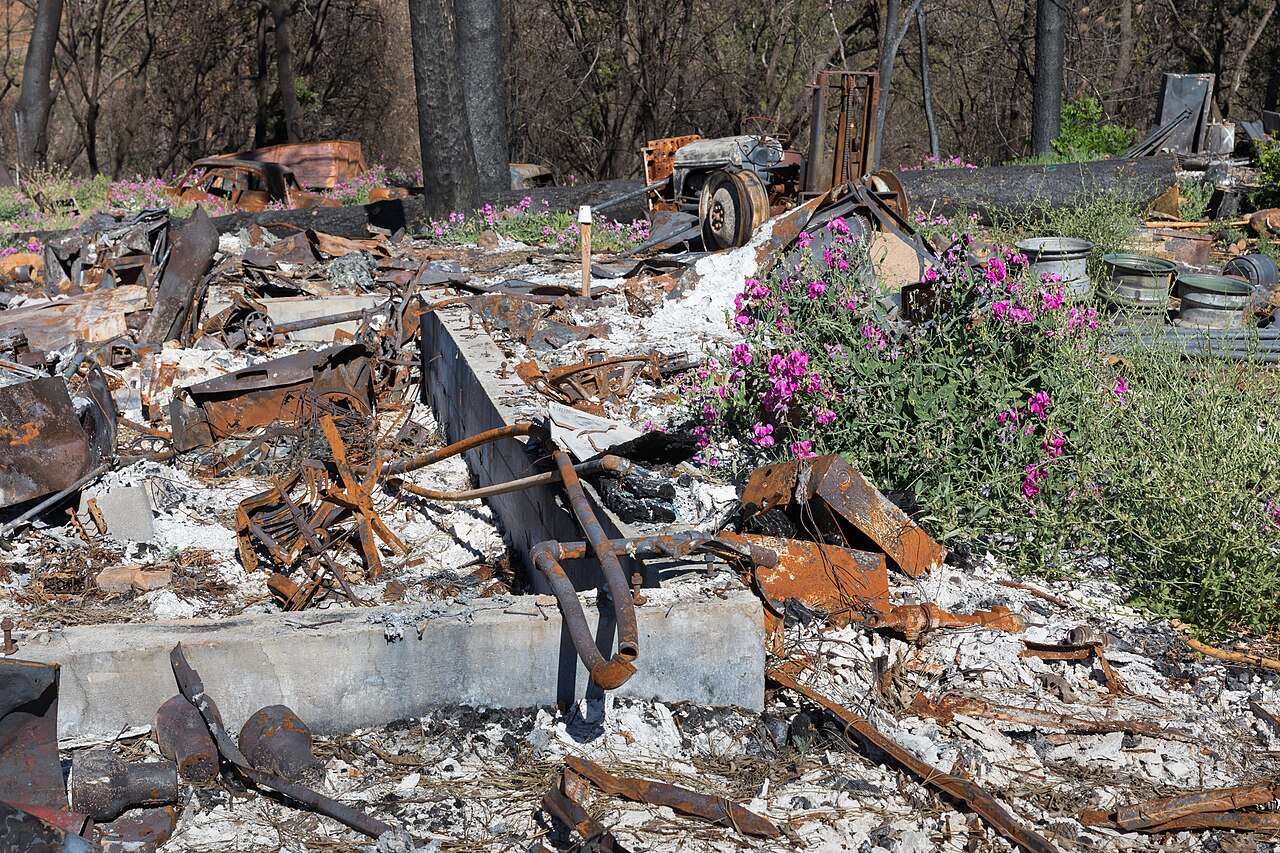
Just six months after Paradise, California was laid waste by the most deadly and destructive wildfire in the state’s history — November 2018’s Camp Fire — the town’s mayor received a generous-sounding offer from a Washington, D.C.-based lobbying firm.
“Our hearts were with you as we watched the fire unfold,” wrote Kristi Moore, managing partner of strategic development at The Ferguson Group, in a letter dated May 19, 2019. “We would like to offer our services to the Town of Paradise on a pro bono basis and become an official partner as you further develop and implement your recovery plans.”
Paradise soon took The Ferguson Group (TFG) up on its offer, according to a lobbying disclosure filed with Congress dated July 15, 2019, to provide “strategic advice” and assistance with obtaining federal funds to recover from the unprecedented disaster. During the same period, TFG was also working with the National Stripper Well Association, a fossil fuel industry trade group, according to research by two climate campaign groups.
The Ferguson Group is one of nearly 230 fossil fuel lobbyists identified in a recent report by the groups, F Minus and Make Polluters Pay, that also work for clients that support climate action or — like the local government of Paradise — are seeking federal aid to cope with climate-related impacts or disasters. They have dubbed such lobbyists “climate double agents” for representing fossil fuel interests while “simultaneously lobbying on almost every aspect of the climate crisis, from climate mitigation to disaster relief to wildlife conservation.”
The research, released in August, is also included in online database maintained by F Minus that also contains information on 1,500 state-level fossil fuel lobbyists representing more than 14,000 non-industry clients that publicly advocated action on climate change, including non-profit groups, schools, municipal governments, and hospitals.
“I think it would blow the majority of the public’s mind if they knew this was happening,” said Cassidy DiPaola, the communications director of Make Polluters Pay.
California is no stranger to wildfires, but the Camp Fire’s unprecedented scope of devastation — 85 dead, 50,000 displaced, and nearly 19,000 structures destroyed across 153,336 acres of land in 16 days — was in large part due 2018’s extremely hot and dry weather conditions in Northern California, which were intensified by climate change.
The National Stripper Well Association (NSWA) is a trade group representing over 1,000 producers, owners, and operators of crude oil and natural gas wells. Lobbying disclosure forms that TFG filed with Congress in July 2026 indicate that its work for the NSWA includes monitoring “congressional activities on methane related issues.”
The Trump administration is in the process of rolling back Biden-era mandates for oil and gas companies to cut their emissions of methane, a powerful heat-trapping gas, as Environmental Protection Agency chief Lee Zeldin confirmed to a convention of oil and gas producers in Santa Fe on October 7.
The Ferguson Group is the “most conflicted firm on wildfire and natural disaster relief issues,” said James Browning, founder and executive director of F Minus, and one of the report’s authors, told DeSmog. “They have an appalling map of activity funding the opposition on climate.”
However, “climate-ravaged cities and countries are locked into relationships” with such lobbying firms, he said, because “they certainly don’t want to bite the hand that feeds them.”
The Ferguson Group did not respond to DeSmog’s request for comment.
Of the 228 lobbyists named in the recent report, 47 were simultaneously working with fossil fuel interests and local governments seeking climate change-related relief.
In the first quarter of 2026, TFG was engaged with 50 local governments on climate-related work, according to the report — more than any other firm mentioned — while also working with five fossil fuel-related clients: the NSWA, the Permian Basin Petroleum Association, Texas Alliance for Energy Producers, Cat Creek Energy, and Southern California Public Power Authority.
The Ferguson Group focuses on lobbying Congress and the federal government, according to its website, with client services that include developing legislative and regulatory strategies, advocacy coordination, and pursuing grants on issues related to water, infrastructure, energy, natural resources, and the environment.
Throughout 2022 and 2023, according to disclosure forms filed with Congress, TFG lobbied for Paradise to receive federal support through the 2021 American Rescue Plan Act, which approved $2 trillion in economic recovery aid during the COVID-19 pandemic, as well as FEMA hazard mitigation grants under 2023’s Hazard Eligibility and Local Projects Act.
In February 2023, TFG also helped Paradise municipal officials draft the town’s updated “Federal Platform and Priorities,” which “documented recovery successes, immediate needs, as well as long term needs and policy considerations,” according to a Paradise Council Agenda Summary.
As recently as this summer, TFG represented Paradise’s “interests in Washington, DC [sic] with a specific focus on disaster recovery and response related to wildfires,” as well as “natural resources, clean air and water, and agriculture.”
Despite beginning its work with Paradise on a pro bono basis, Paradise has paid The Ferguson Group over $300,000 as of July 2026, according to the company’s disclosure firms filed with Congress. Paradise’s Office of Recovery and Economic Development did not respond to DeSmog’s questions on the extent of TFG’s work with the community, or the town’s awareness of its work with the fossil fuel industry.
The Ferguson Group’s relationship with the National Stripper Well Association goes back to 2017, according to disclosure forms filed with Congress. The NSWA describes itself as representing the interests of the nation’s “smallest and most economically-vulnerable oil and natural gas wells.”
TFG has lobbied on the group’s behalf for industry-favorable positions on “percentage depletion” and “pass-through deduction”— two separate tax provisions that allow eligible oil and gas operators to reduce taxable income and federal income tax burdens. The NSWA has framed these tax provisions as a way to help these smaller operators stay afloat. However, an Environmental Defense Fund analysis has shown that even though the industry likes to maintain that marginal wells are run by small businesses, nearly half of all marginal wells are owned by just 93 corporations, each of which controls more than 1,000 wells.
Shortly after The Ferguson Group began lobbying for Paradise, the firm also started working for the Permian Basin Petroleum Association (PBPA), the oldest and most active trade association representing oil and gas operators, midstream providers, and service companies across the largest oil-producing region in the United States.
Christopher Kearney, a principal and oil and gas lobbyist at TFG, was the author of strikingly parallel language used by two small oil and gas producers in their 2024 congressional testimonies against the Waste Emissions Charge, a Biden-era methane fee charged to polluters, as reported by E&E News. Kearney was the signatory on the company’s lobbying disclosure forms regarding for its work for the NSWA from 2021 to 2026, and for the PBPA from 2020 to 2024.
Although these forms do not list greenhouse gas regulatory-related activities as part of The Ferguson Group’s work with the PBPA, E&E News reported in January 2024 that Michael Oestman, an oil and gas operator and “longtime” member of the PBPA, originally got connected to Kearney “through the Permian Basin Petroleum Association, which reached out to see if [Oestman] would be willing to testify before Congress on the methane fee.”
Additionally, the Ferguson group’s 2024 disclosure of its work for PBPA, the most recent year available, included “monitor[ing] Congressional and Federal agency activities related to addressing COVID on the general economy and the oil and gas industry” as well as “activities regarding Endangered Species Act reform.”
The Permian Basin is home to three of the country’s most endangered species, according to the Center for Biological Diversity: the lesser prairie chicken, freshwater mussel, and dunes sagebrush lizard. The Trump administration delisted the lizard from the Endangered Species Act in June, settling a lawsuit filed by Texas Attorney General Ken Paxton contending that the rule could “undermine energy production” and threaten “private landowners’ ability to conduct business.”
In 2024, Texas produced about 28 percent of the nation’s total natural gas, and more than two fifths of the nation’s total crude oil production, according to the U.S. Energy Information Administration.
In addition to Paradise, Ferguson has also lobbied for Asheville, North Carolina after it was devastated by Hurricane Helene in 2024. The details of TFG’s work for Asheville included in its lobbying disclosure forms are limited, but each filing includes “work with the city in response to Hurricane Helene.” Asheville’s communications specialist declined to respond to DeSmog’s questions about the extent of TFG’s work with the community, the amount the city has paid to TFG, or its awareness of the firm’s work with fossil fuel clients.
“It almost becomes natural disaster tourism, right?” said Browning of F Minus. “They see a natural disaster and they swoop in. And now they’re making money by lobbying off it.”
A separate report from Brown University’s Climate Development Lab (CDL), published in tandem with the F Minus and Make Polluters Pay analysis, documented systemic and coordinated opposition to state-level climate superfund bills by fossil fuel and energy-intensive industries. This type of legislation, which is growing in popularity around the country, would require large fossil fuel producers and refiners to pay for state-level climate damages as well as adapting infrastruture to the new climate normal
“To me, it’s an issue of kindergarten ethics,” said Timmons Roberts, a professor of environmental studies at Brown who a co-authored the report. “If you know you made a mess, you clean it up.”
The Brown researchers found that while support for climate superfund bills has “dominated” pubic hearings, groups lobbying in opposition to them have made more submissions during public comment periods, sometimes swaying state leaders against the legislation. The Ferguson Group was not named in the report.