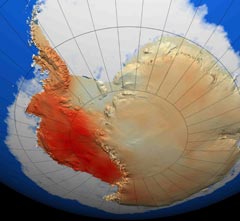
A paper published this week in the prestigious journal Nature shows that in fact Antarctica is getting warmer, consistent with an overall trend of global temperature rise.
For years, industry-funded “skeptics” have been harping on in the mainstream media that Antarctica was getting colder instead of warmer. This apparently was evidence that global warming was all a big mistake.
Stating the obvious, the authors of this latest study said that warming temperatures in Antarctica are “difficult to explain” without linking them to carbon emissions from the burning of fossil fuels.
Misinformation about Antarctic cooling has been frustrating for researchers trying to communicate the seriousness of climate change to the public.
“The thing you hear all the time is that Antarctica is cooling and that’s not the case,” said Eric Steig of the University of Washington in Seattle, lead author of the study in Thursday’s edition of the journal Nature.
“This has put the last pieces of the jigsaw in place,” said Gareth Marshall, a British Antarctic Survey climatologist in Cambridge “If you consider Antarctica as a whole, it shows a significant warming of similar levels to the rest of the Southern Hemisphere.”
While this new research is good news for our understanding about climate change, the implications for coastal areas of the world are hair-raising.
West Antarctica “will eventually melt if warming like this continues,” said Drew Shindell, of the NASA Goddard Institute for Space Studies, who was one of the authors. A 3 Celsius (5.4 F) rise could trigger a wide melt of West Antarctica, he said. Greenland is also vulnerable. Together, Greenland and West Antarctica hold enough ice to raise sea levels by 14 meters.
“Even losing a fraction of both would cause a few meters this century, with disastrous consequences,” said Barry Brook, director of climate change research at the University of Adelaide in Australia.
As if on queue, reports emerged last week showing that the massive Wilkins ice shelf is on the verge of breaking off into the ocean.
Scientists do not expect this 15,000 square kilometer chunk of ice to immediately raise sea levels since it is already floating. However, it is yet another dramatic example of the pace of climate-related change around the world.
The collapse of the ice shelf could also lead to future sea level changes from increased flow of land-based ice sheets into the warming Southern Ocean.
The myth of Antarctic cooling was largely popularized by the hilariously inaccurate novel, “State of Fear” by Michael Crichton. The premise of this potboiler was that an all-powerful and hyper-violent group of environmentalists were staging a series of fake climate catastrophes as a way of raising money.
I’m not kidding.
Proving that all politics really is theatre, the science fiction author was invited to testify as a “climate expert” at a US government hearing on climate change by the famously ignorant Senator Inhofe.
Strangely, Inhofe has also received over $1.1 million in campaign contributions from the oil and gas sector.
With the Antarctic warming myth dead and gone, climate skeptics will now have to rely on other red herrings to confuse the public in the popular press.
Check out Real Climate’s take on the Nature study: State of Antarctica: red or blue?
This month we’re giving away FREE copies Coming Clean: Breaking America’s Addiction to Oil and Coal.
Go here to find out more details about DeSmogBlog’s monthly book give-away.