
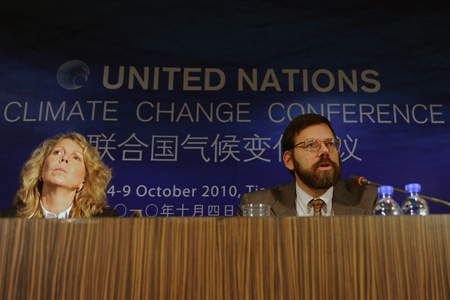
It has not taken long for the United States’ diplomatic team to establish the country’s hard-nosed negotiating position at the United Nations climate conference in Cancun, Mexico (COP16). The nation’s stance is so firm, it might lead the delegation to abandon the proceedings early.
In the first day of the negotiations, the United States made it clear that it would only sign on to a “balanced package” that requires certain criteria being satisfied.
According the UK’s The Guardian newspaper this criteria includes: developing nations committing to emissions cuts and the establishment of a verifiable system of accounting for these cuts. If these features were included in a treaty, the United States would agree to the provisions that are important to emerging economies such as climate finance, technology sharing, and deforestation.
In a briefing with journalists, Todd Stern, the U.S.’s chief climate envoy, said, “We’re either going to see progress across the range of issues or we’re not going to see much progress. We’re not going to race forward on three issues and a take a first step on other important ones. We’re going to have to get them all moving at a similar pace.”
The Chinese, however, have no desire to either establish a cap on emissions or an accounting system to monitor these emissions. The Chinese feel this will hinder their economic development, and is unfair on several levels.
China says nations like the United States have became economic juggernauts as result of the use of cheap fossil fuels; additionally, these economies have consumed high-emitting energy sources for years, and have, therefore, contributed the most to anthropogenic global warming.
These two powerhouse nations clashed over this issue last year at Copenhagen. It took a last ditch effort of diplomacy from U.S. President Barack Obama to establish the limited Copenhagen Accord. However, the United States and the Obama administration have lost a large amount of international clout with the failure to pass new energy policy. And, many wonder if the current policies will allow the U.S. to meet the modest target it agreed to in Copenhagen of cutting its emissions 17% below 2005 levels.
Michael Levi, an energy and environment fellow at the Council on Foreign Relations says he would not be surprised if America’s demands are not met: “There are decent odds the United States will be presented with a final package that takes action on all sorts of things that developing countries want but doesn’t have any clear wins for Washington. I wouldn’t be surprised to see the US reject such an outcome, even if it means walking away with nothing and being attacked for that.”
There are still roughly two weeks of negotiations left but the already deflated Cancun talks appear headed down a familiar path – either replicating last year’s negotiations, or establishing an accord that does not have the support of the world’s largest power.