
The Met Office asked and the public has answered: name our storms after climate deniers.
This week, the Met Office issued a call for people to help create a list of names for storms expected to affect the UK and Ireland this winter. Names can be suggested by tweeting directly to @metoffice using the twitter hashtag ‘#nameourstorms’ or on its Facebook page and via email.
And it turns out that quite a few people are calling for the names of UK climate deniers such as Lord Lawson, Lord Monckton and Matt Ridley to be used.
Threatening Weather
“Putting names on severe storms helps the public to immediately relate to threatening weather systems,” explains the MET office. As climate change continues to create more extreme weather, it seems fitting to name severe storms after those who deny manmade climate change in order to create awareness of this “threatening weather”.
We get to names storms – tweet @metoffice #nameourstorms Let’s name after people opposing action on climate change http://t.co/d9QlUYWLIJ
— Joe Jenkins (@MrJoeJenkins) September 9, 2015
Here’s what some prominent UK climate deniers have to say about climate change:
Lord Lawson: “It is far from clear that the inhabitants of the planet as a whole would suffer a significant net cost, or indeed any cost at all.”
Matt Ridley: “A cumulative change of less than 2°C by the end of this century will do no net harm. It will actually do net good […] rainfall will increase slightly, growing seasons will lengthen, Greenland’s ice cap will melt only very slowly, and so on.”
Lord Monckton: “The right response to the non-problem of global warming is to have the courage to do nothing.”
Peter Lilley: “The tendency of those committed to the theory of catastrophic man-made global warming to unquestioningly adopt the assumptions, at every stage, that maximise the expectation of calamity should alert us that groupthink is driving the movement.”
James Delingpole: “It is not my job to sit down and read peer-reviewed papers because I simply haven’t got the time … I am an interpreter of interpretations.”
Other suggestions on Twitter include greenhouse gas emitters such as BP and Shell. And, after this summer’s cuts to renewable subsidies, “Storm Amber” and “Storm Osborne” were also suggested.
Popular Names
The Met office will compile a list of the public’s suggestions along with names proposed by Met Éireann. Storm names will then be taken from this list in alphabetical order, alternating between male and female names. (Although, sticking strictly to British climate deniers may result in a lack of female storm names.)
“Popularity will play a large role in the final list. We have had thousands of suggestions and we are currently collating these. We will be communicating further on the progress of the list by the end of this week or the beginning of next week. We expect to have a final list by the end of the month,” a Met Office press officer told DeSmog UK.
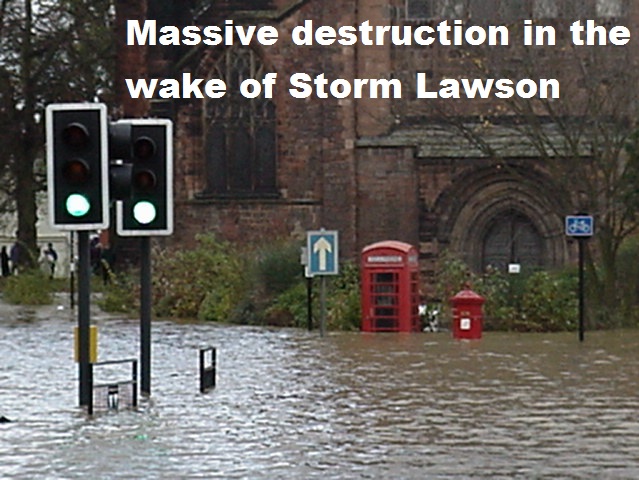
Just imagine turning on the television or radio to hear “brace for violent thunderstorms as Storm Monckton gathers speed” or “torrential downpours sweep in from the North as Storm Ridley approaches.”
Photo: John Kerstholt via Wikimedia Commons