

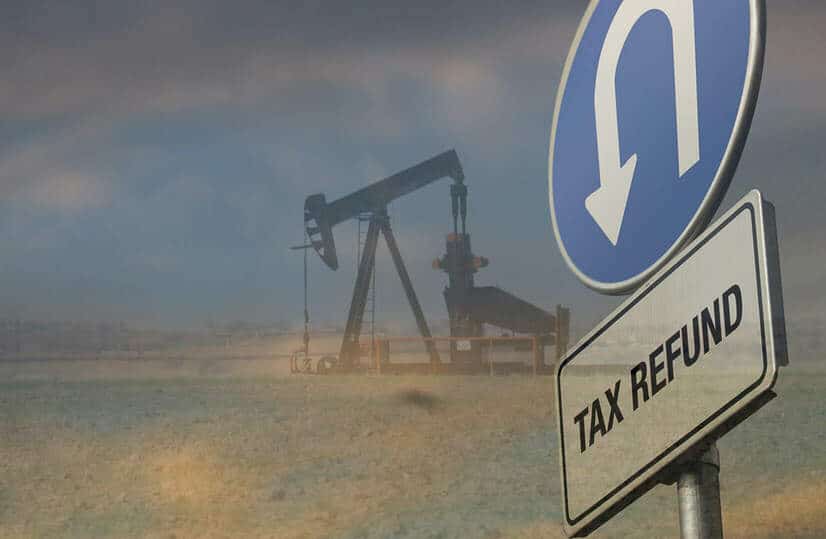
The fossil fuel industry and its investors have financially benefited from tax policies and subsidies designed to reduce the emissions from oil, gas, and coal — sometimes without taking the action required to tackle climate change.
Recently, claims have been surfacing of companies taking the taxpayer money offered to incentivize these actions but not following through on reducing their emissions. In March, for example, Reuters reported that Congress has opened an investigation into problems with the government’s “clean coal” tax credit. This is after Reuters revealed that financial institutions, including Goldman Sachs, were making huge profits off the program, despite it not effectively reducing emissions.
Now, companies such as ExxonMobil are lobbying against transparency efforts when it comes to reporting their emissions for an existing carbon capture tax credit.
And the industry is also increasingly calling for a national carbon tax to be introduced. In March, the American Petroleum Institute (API) said it supports efforts to put a price on carbon — this is a reversal from its position a decade ago when it was opposed to a bill that would have introduced a cap and trade program to limit carbon emissions.
Introducing a carbon tax would allow polluters to continue to produce carbon, they would just have to pay a price to do so.
These market-based approaches to limiting climate emissions, however, raise concerns about their overall effectiveness. They provide an opportunity for companies to reap the financial benefits of climate action without actually delivering the emission reductions. This makes them incredibly popular with the fossil fuel industry.
“It’s naive of us to think that all of a sudden the oil and gas industry is going to put forward policies that are going to keep fossil fuels in the ground,” Jim Walsh, senior energy policy analyst for environmental NGO Food and Water Watch, told DeSmog.
Politicians, meanwhile, are pushing to further expand the carbon capture tax credit program (known as 45Q). And the clean coal tax credit is up for renewal at the end of 2021. This is despite both programs having failed to achieve their climate goals while delivering large financial returns to large banks and insurance firms and fossil fuel companies.
NEW: @MittRomney leans in on carbon tax to spur clean energy technology breakthroughs. I interviewed Romney about his interest in a carbon tax, which is very real, and why he thinks it can be a second "pillar" of the Republican innovation agenda https://t.co/44sdn55LOA
— Joshua Siegel (@SiegelScribe) March 19, 2021
For these tax credit initiatives to be successful, there needs to be better government oversight and the industry needs to take more serious action to tackle its emissions.
At the moment, in order to obtain these tax credits companies rely on the use of carbon capture and storage technology as a way of reducing emissions. But for these types of solutions to be truly successful, the right technology needs to exist on a scale large enough to be widely used.
Currently, carbon capture and storage, which aims to scrub carbon dioxide out of smokestacks and permanently lock it underground, is not commercially viable. In September 2020, energy consulting group Rystad predicted that the 10 commercial scale carbon capture projects planned for Europe have good odds of being operational by 2035.
At the same time, Rystad noted that carbon capture technology is facing economic competition from an existing proven method to eliminate carbon emissions from power production: renewable energy.
In December, Bloomberg reported that ExxonMobil had halted plans for its carbon capture project in Wyoming due to the financial “fallout from Covid-19.” This is despite the company noting that “a recent change to the U.S. tax code would help overcome that hurdle [how to make money on carbon capture] with lucrative credits for safe storage,” Bloomberg wrote.
Even despite carbon capture being unproven and Exxon abandoning its project in Wyoming, North Dakota Senator Kevin Cramer (R) expressed his strong support of the expanded carbon capture tax credit program in a January press release: “Carbon capture is the future of reliable, low emissions energy, and North Dakota is a national leader in the development and use of this technology. With the administration’s long-awaited guidance finalized, investors can now take advantage of the carbon capture tax credit with confidence and clarity.”
Past Failures
Market-based solutions to reduce emissions are not new. California has a carbon cap and trade program that began in 2013. And in 2009 a coalition of Eastern states created the Regional Greenhouse Gas Initiative (RGGI) to cap carbon emissions with companies being able to purchase emissions allowances.
The results of these market-based approaches, however, are not encouraging and indicate a willingness of the industry to take the tax credits but not bother with reducing emissions. A 2019 ProPublica investigation of California’s cap and trade program found that the biggest oil and gas companies in the state were actually polluting more under the cap and trade program than they were before they joined the program. This result makes it clear why the oil industry is so supportive of a national market-based approaches, like a cap and trade program.
API Pres. & CEO @mj_sommers: "As our industry accelerates efforts to advance groundbreaking technologies, reduce emissions and drive transparent and consistent climate reporting, we urge lawmakers to support market-based policies that foster innovation.” https://t.co/HrKwsHK0Bm
— American Petroleum Institute (@APIenergy) March 30, 2021
And while the RGGI program has coincided with a reduction of emissions for the states involved, the New York Times reported in April 2019 that it was “unclear” if this was due to the program or to other factors, such as the lower cost of renewable energy, new technologies, and natural gas replacing coal power.
Given the oil and gas industry’s history of weak financial oversight, past challenges with tax incentives, and the industry’s efforts to mislead the public on the existence and importance of tackling climate change, moving to a new system of carbon taxes or cap and trade to limit carbon emissions — which, in a 180-change, the industry now strongly supports — appears to be poised for failure.
The American Petroleum Institute is considering backing a carbon tax — but only to prevent ambitious regulation of greenhouse emissions. We need to keep fossils fuels in the ground. https://t.co/KvrL2ssqJq
— Center for Bio Div (@CenterForBioDiv) March 4, 2021
The Questionable Benefits of 45Q
In 2008, a new program known as the 45Q tax credit started providing financial incentives for carbon capture and sequestration. The program gave companies $20 a metric ton for capturing carbon dioxide (CO2) and injecting it into underground rock formations that would theoretically store the CO2 forever.
In 2018, the program was renewed and companies now get more money per ton of CO2 stored; this will increase to $50 a metric ton by 2026. The program also offers tax credits for companies that inject CO2 into oil reservoirs in a process called enhanced oil recovery (EOR).
In April 2020, however, Senator Bob Menendez (D-NJ) expressed his concern about the failure of the program offering tax credits for carbon capture in a letter to the Internal Revenue Service (IRS) urging the agency to take action against companies gaming the system with respect to the 45Q tax credit.
In a press release Sen. Menendez said that the industry was taking over $1 billion in tax credits without providing evidence of actually complying with the program in an “apparent failure of the fossil fuel industry to act in good faith.”
Menendez’s assertions are based on evidence provided in an April 2020 memo by the Inspector General for the Tax Administration about the 45Q program.
According to that memo, ten companies accounted for 99.9 percent of the just over $1 billion total handed out in tax credits, with the remainder claimed by 662 other companies.
@SenJohnBarrasso offered no comment last month after a IRS Inspector General investigation revealed a massive $900M tax scam at the heart of #45Q. Put that in that in your articles. https://t.co/rACMywT9mZ
— John Noël (@noel_johnny) May 29, 2020
The review found that of these ten companies, 87 percent of the claims occurred when the companies “were not in compliance with the EPA.”
The U.S. Environmental Protection Agency (EPA) requires companies claiming the 45Q tax credit to quantify the amount of carbon their projects have captured and stored. While small errors are expected in tax filings, having the majority of the credits given to out-of-compliance companies signifies an almost complete failure for the program.
Seven of the top ten program participants did not even “submit a monitoring, reporting and verification (MRV) plan.” This part of the 45Q program is intended to verify whether carbon dioxide is actually captured and stored, delivering the promised climate benefit.
The names of the companies are not listed in the memo; regulations specify that this information is not available to the public.
DeSmog reached out to Sen. Menendez’s office, the IRS inspector general’s office, and the Department of Energy for information about the identity of the ten companies highlighted in the report. The DOE directed DeSmog to the IRS. DeSmog spoke with IRS counsel Maggie Stehn who could not comment but said the IRS communications department had been notified about the request. The IRS inspector general’s office and Sen. Menendez’s office did not reply by time of publication.
The new 45Q regulations were finalized in January and state that while commenters requested the documents detailing a company’s compliance — known as lifecycle greenhouse gas emissions (LCA) reports — be made public to increase transparency, the IRS chose to allow companies to keep the reports secret.
Proper oversight and enforcement is key to the success of these solutions. But so far oil, gas, and coal companies have taken taxpayer money without documenting that they have effectively captured and stored carbon and continue to work to stop efforts at transparency in reporting.
Clean Coal Tax Program Problems
The coal industry also has enjoyed tax incentives to reduce emissions of nitrogen oxides (NOx), which are produced when burning fossil fuels and are harmful to human health. If companies burn a specific type of low-emission coal and reduce their NOx emissions, they receive a tax benefit: $7.30 for each ton of coal burned.
As Sen. Cramer told Reuters in 2018: “The tax credit program is bridging the divide to make coal clean and beautiful.”
While this program is designed to decrease harmful emissions, it still results in coal being burned which increases carbon dioxide emissions. A study by the group Resources for the Future estimated that carbon emissions increased as a result of this program.
And a 2018 Reuters investigation found that while the refined coal production tax credit program was used by companies to claim tax credits, the program failed to reduce emissions. According to Reuters, this was due to two main failures: relying on the industry to fulfill the requirement to reduce emissions and lack of enforcement.
Coal producers sprayed a bunch of chemicals on their coal to make it “cleaner.” It didn’t reduce pollution but it did allow coal companies to write off billions on their taxes. @Reuters https://t.co/8BwLPzEZxi
— Caleb Heeringa (@CalebHeeringa) March 16, 2021
One huge flaw in the refined coal production tax credit, according to Reuters, was that instead of tracking actual emissions produced by burning the specially designated coal, the companies were allowed to show in laboratory settings that burning the coal reduced NOx emissions in the lab.
Unfortunately, in the real world, the investigation found that in many cases burning that same “clean” coal did not reduce NOx; instead, the companies burning the coal often increased these emissions. Still, the companies treating the coal — often backed by large financial institutions — got “a tax credit of $7.30 for each ton burned.” According to Reuters, the tax benefits were claimed by major financial institutions including Fidelity Investments, Goldman Sachs, and JPMorgan Chase.
A.J. Gallagher, for instance, touted the huge profits it was making on clean coal tax credits on a March 2018 investor relations call. “Our return on investment is staggering,” the company’s CFO Douglas Howell told analysts in the March 14 call. “Oh, 200 percent, 300 percent, 400 percent, 500 percent.”
Financial institutions are able to claim these credits, in addition to coal companies, a January 2021 article by S&P Global explains, because these companies invest in the infrastructure to chemically treat the coal to make it qualify for the tax credit. They then buy coal from coal producers, treat it and often sell it to coal power producers for less than they paid for it because the profit is made in the tax credit.
This refined coal tax credit program expires at the end of 2021 but its beneficiaries are lobbying for it to be continued. Lobbyists for Gallagher are working to get the tax credit extension, as S&P reported.
As Reuters reported in March, Congress has now begun an investigation into the refined coal tax credit program.
The Risk of Market-Based Solutions
Oil and coal companies along with major financial institutions strongly support the continuation of the 45Q and refined coal tax credit programs. Lobbying has continued with efforts to expand the 45Q program and to renew the refined coal tax credit — and to weaken oversight.
In September 2020, InsideClimate News reported on ExxonMobil’s efforts to limit oversight of the 45Q program, noting that Exxon’s team of lobbyists “has fought relentlessly to do away with a requirement that companies claiming the credit submit monitoring plans to the Environmental Protection Agency.”
With the poor track record of market-based programs to reduce emissions while enriching program participants, it is understandable that the fossil fuel industry is now supporting national market-based policies to address carbon emissions. But not everyone agrees that market-based solutions are the way to reduce emissions.
Mark Jacobson, professor of civil and environmental engineering at Stanford University, told DeSmog that eliminating the use of fossil fuels is a more effective way to reduce carbon emissions than using market-based solutions.
“Carbon taxes being pushed by the oil and gas industry, just like their push for carbon capture — it’s just useless scams,” Jacobson told DeSmog. “They are just not anything that will actually help solve the problems.”
Jacobson pointed to renewable portfolio standards as a more effective program; these incentivize increased renewable energy production — thus replacing carbon intensive power production with renewable — resulting in large emissions reductions.
Another advantage of renewable portfolio standards is it helps eliminate the chance for companies to manipulate the systems because that instead of offering financial incentives to fossil fuel consumers to reduce emissions, it drives investing in clean renewable energy projects that do not produce carbon emissions.
The past failures of market-based climate approaches in the U.S. serve as a stark warning of what to expect if fossil fuel industry lobbyists get their latest wish and convince politicians to allow them to keep doing business as usual — while working to move to a national carbon pricing system.
As Jacobson noted, policies like this, including putting a price on carbon “allow polluters to keep polluting and pay the tax.”
.@exxonmobil told its shareholders carbon capture would be huge; now it tanks its own. Something is not adding up. From @climate. pic.twitter.com/zkpvMqHXQ2
— Sheldon Whitehouse (@SenWhitehouse) December 9, 2020