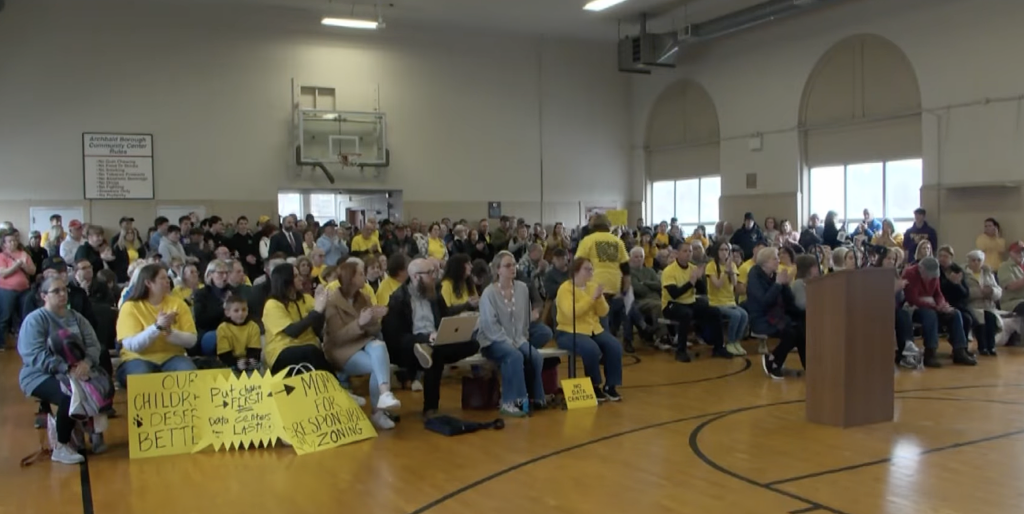


On a chilly Monday just before Thanksgiving, residents of Archbald, Pennsylvania hurried from work in the fading autumn light to snag seats in the old brick Borough Building for a 5 p.m. council meeting. After the roughly 50 seats quickly filled, people continued to pack the room, standing along the walls or wedging themselves into the remaining floor space. Police officers manned the doors. Outside, latecomers huddled around a laptop in the 40-degree cold to watch proceedings on a hastily rigged livestream. On the sidewalk, someone waved a handmade sign saying “Boycott AI.”
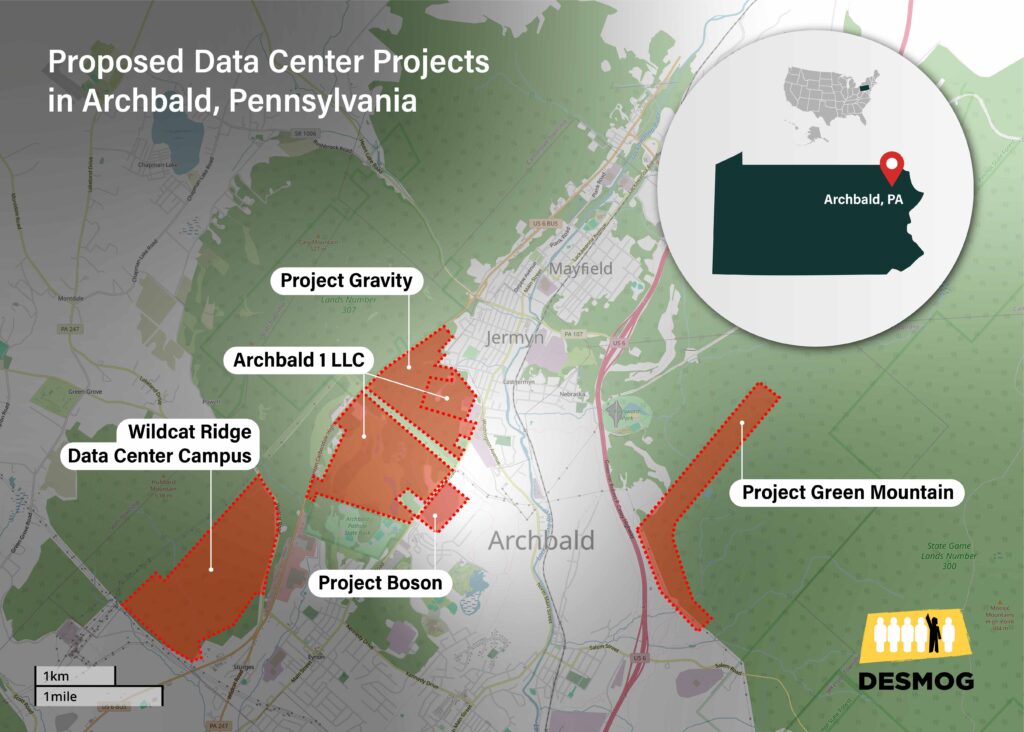
Since the launch of ChatGPT in November 2022 — an inflection point in the race to develop ever more powerful forms of artificial intelligence — developers have been scouring the United States for places to build the giant computing clusters needed to scale up the technology. Located nine miles northeast of the city of Scranton, and home to about 7,500 people, Archbald is facing plans to build five data center complexes across six sites, making it one of the most intensely contested areas for such projects in the country, if not the world.
Backed by five real estate companies, along with the lawyers and lobbyists working on their behalf, the plans include a total of 51 data center buildings with a combined floor space of 13.4 million square feet — an area nine times the size of the U.S. Capitol. Worried residents fear the sheer scale of these mega-projects will turn their wooded Lackawanna River valley into an industrial maze buzzing with the sound of dump trucks, diesel generators, and huge cooling machines.
“You are destroying our lives if you allow these data centers to come in. You are disrupting this entire community,” resident Carolyn Mizanty told Archbald’s seven council members, seated at a long wooden desk at the November 24 meeting. In about an hour, the council was due to vote on whether to adopt proposed new zoning rules that would clear the way for several major projects.
Opponents of the plans say that a combination of behind-the-scenes lobbying, the prospect of enormous investments in the borough, and the promise of future tax dollars have turned elected officials against the people they represent.
“Here in Archbald, we are fighting against our local government,” said resident Tamara Misewicz-Healey from the podium. “Honestly, it’s broken my heart.”
It’s a scene playing out in town halls and county chambers across the country.
Because local zoning regulations often rule out projects as big as data centers, municipal governments more accustomed to dealing with applications to build housing developments and warehouses are now responsible for deciding the fate of the multi-billion-dollar facilities at the heart of a global quest for AI supremacy.
The potential impacts on local communities, landscapes, and electricity bills — which can surge due to the projects’ insatiable power demand — have been catalyzing local opposition movements that transcend traditional Democratic and Republican divides. The frenzied pace of development is also threatening to increase emissions of climate-heating carbon pollution, by driving demand for new natural gas-fired power plants, as well as extending the life of coal-fired power plants in some states. Data centers could consume more than a tenth of the nation’s electricity by 2028, up from four percent in 2023, the U.S. Department of Energy projects.
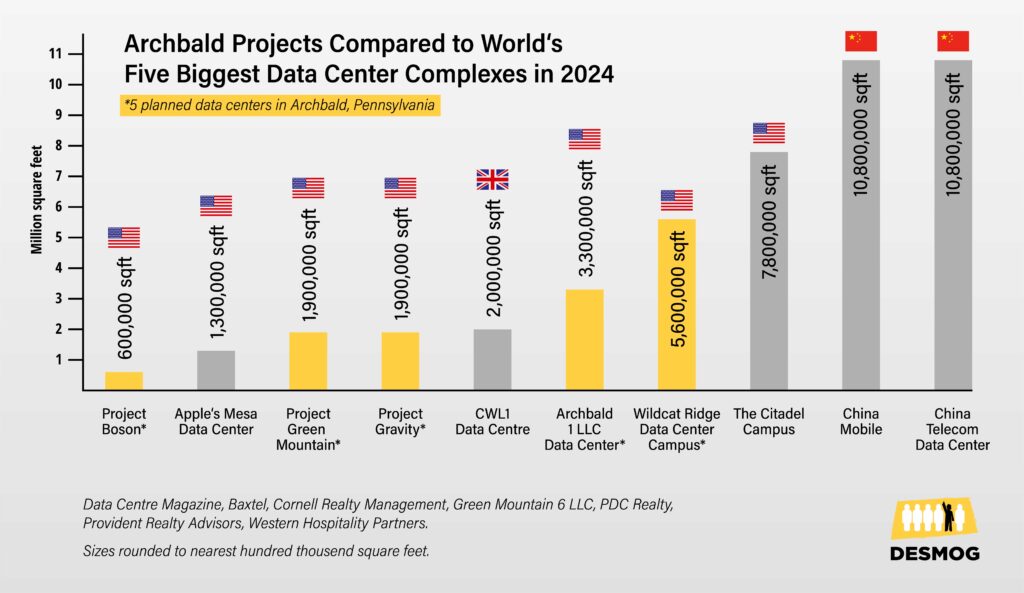
Over four months of attending council meetings, filing public records requests, speaking with residents, and interviewing borough officials, DeSmog built up a picture of the struggle playing out in Archbald between grassroots opponents, developers, and elected officials, which is emblematic of similar fights taking place nationwide.
The account that emerged showed how data center developers successfully leveraged access to borough officials to get key clauses inserted into the amended version of the zoning code put to a vote at the November 24 hearing. Meanwhile, residents struggled to secure amendments to the new rules — or even to establish who is behind the plans.


Four of the five developers active in Archbald — Western Hospitality Partners; PDC Realty; Cornell Realty Management; and Green Mountain 6, LLC — have no record of completing or operating data centers before, according to a DeSmog review of industry databases. The remaining developer — Provident Realty Advisors — has partnered with another company to start building its first multi-building data center complex in Texas.
None of these companies responded to requests for more information about their data center plans in Archbald, even as residents said they urgently need answers.
Antoinette Merrifield has lived in the Valley View Estates trailer park, a quiet, tree-lined property on the Archbald Borough line with neighboring Jermyn, for almost 30 years. Merrifield, who shares the trailer with her father George, had not planned on leaving — until Western Hospitality Partners signed an agreement in October 2024 to buy the land for its Project Gravity data center project, according to the Lackawanna County Recorder of Deeds.
Merrifield first heard about the sale from a news report. She said the current landlord gave the park’s roughly dozen households a tentative move-out date of this April, when the property will officially change ownership, but they have since received no further information.
“I need to know ahead of time,” said Merrified, neatly crossed-out days on a wall calendar marking the passing time.
“It’s all messed up, isn’t it?” said George Merrifield, who is fighting cancer. “It’s greedy, you know.”
Tina Goble, a former Valley View Estates resident, said that current tenants, many living on low incomes and disability assistance, face an uncertain future. Her own recent inquiries about public housing led her to a five-year waiting list.
“What are these people supposed to do? To live in the streets for five years?” said Goble. ”You can’t just worry about the money, what about the people?… I guarantee they don’t have them built in their backyard or in their neighborhood… That’s disgusting to me that they would actually put people out like that.”
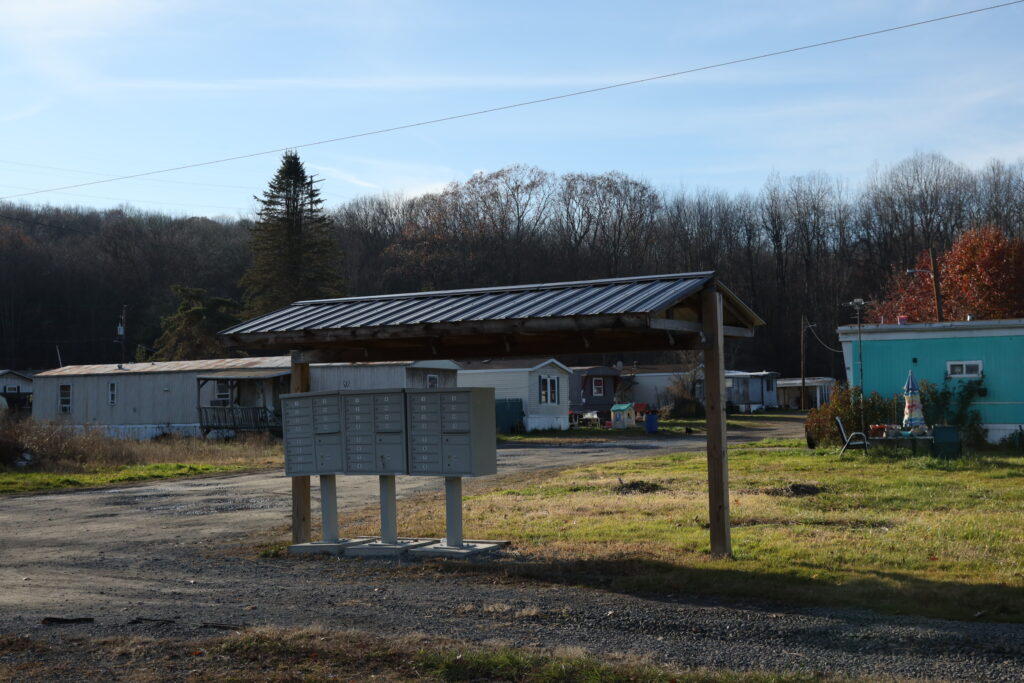
The Valley View Estates trailer park on November 20, 2025. (Credit: Edward Donnelly/DeSmog)
From Coal to ‘Compute’
In 1884, a coal miner named Patrick Mahon working for the Jones & Simpson Company was detonating explosives underground to extend Archbald’s warren of mine shafts at the heart of the world’s biggest anthracite coal belt. An avalanche of stones and water came cascading down through the breach to reveal a remarkable natural feature: the world’s largest known glacial pothole, 38 feet deep and 42 feet in diameter at its widest point, chiseled out by a mammoth ice sheet during the last Ice Age.
The “Archbald Pothole” was fenced off, and mine boss Edward Jones went on to lead tours of the geological oddity. Other natural features in the area received less reverential treatment.
As Archbald’s coal mines fed the awakening industrial giant of the U.S. at the end of the 19th century, acid leached into the Lackawanna River. Surrounding slopes were clear-cut in service of King Coal. Next to the mines, immigrant laborers and their families built neighborhoods with names like “Tipperary,” “Frog Town,” “Stump Field,” and “Dark Valley.” Mining companies left behind a scarred landscape that took generations to clean up and revitalize. (Archbald’s last coal mine, the Gravity Slope Colliery, closed in 1955).


“Two of my great grandfathers were killed in the mines, many others were injured, and most suffered and died from illnesses related to their work,” Madonna Munley, an Archbald resident and retired school teacher, told a November 5, 2025 Archbald Planning Commission meeting.
“When the mines ceased to be profitable,” she said, “the owners packed up and moved out. They never cared about the people or the town.”
Munley is one of the dozens of local residents who consistently showed up at weekly public meetings last fall, asking borough officials to implement zoning provisions that would protect Archbald from being engulfed by the growing infrastructure and resource demands of the AI boom.
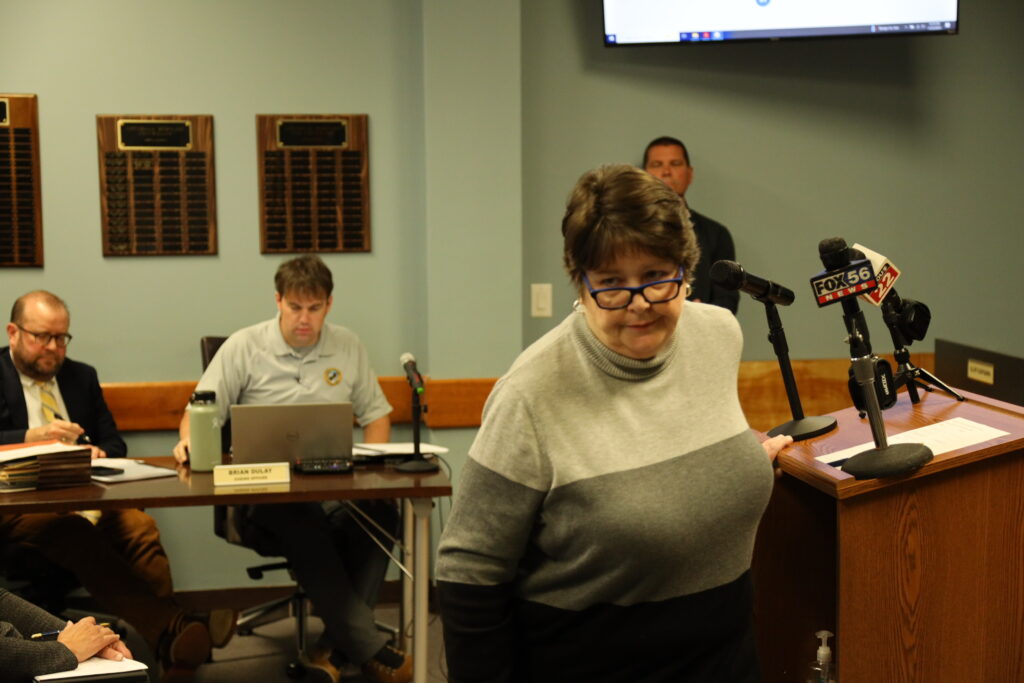
Madonna Munley at an Archbald Planning Commission meeting on November 5, 2025. (Credit: Edward Donnelly/DeSmog)
To scale up their “compute” capabilities, tech companies need land for building sprawling multi-building “hyperscale” data centers that house tens to hundreds of thousands of specialized computing units, in locations with access to the vast amounts of electricity needed to power them.
With its extensive natural gas and nuclear power resources, along with tax incentives, Pennsylvania is drawing an increasing number of AI investors. In Lackawanna County alone, new plans for large-scale data centers have been announced since 2024 in the communities of Blakely, Dickson City, Jessup, Olyphant, Clifton Township, Covington Township, and Ransom Township, in addition to Archbald.
At a conference organized by Pennsylvania Senator Dave McCormick (R) in Pittsburgh last July, a group of energy, financial, real estate, and tech companies announced $90 billion in statewide energy and AI investments. President Donald Trump — who signed executive orders in January and December 2025 to fast-track AI infrastructure investments nationwide — attended the event alongside representatives from AI and tech companies including Anthropic, Google, and Meta, private equity giant Blackstone, power utility PPL, natural gas company EQT, and Equinor, Norway’s state-owned energy company.
“Mr. President, this is the beginning of an economic renaissance for Pennsylvania and a huge step forward,” McCormick, seated next to Trump, told the conference.
But for all the big names on the stage in Pittsburgh, Archbald residents are still wondering which tech companies would be the ones operating the massive AI computing complexes near their homes — and who is writing the regulations that will decide whether those plans go ahead.
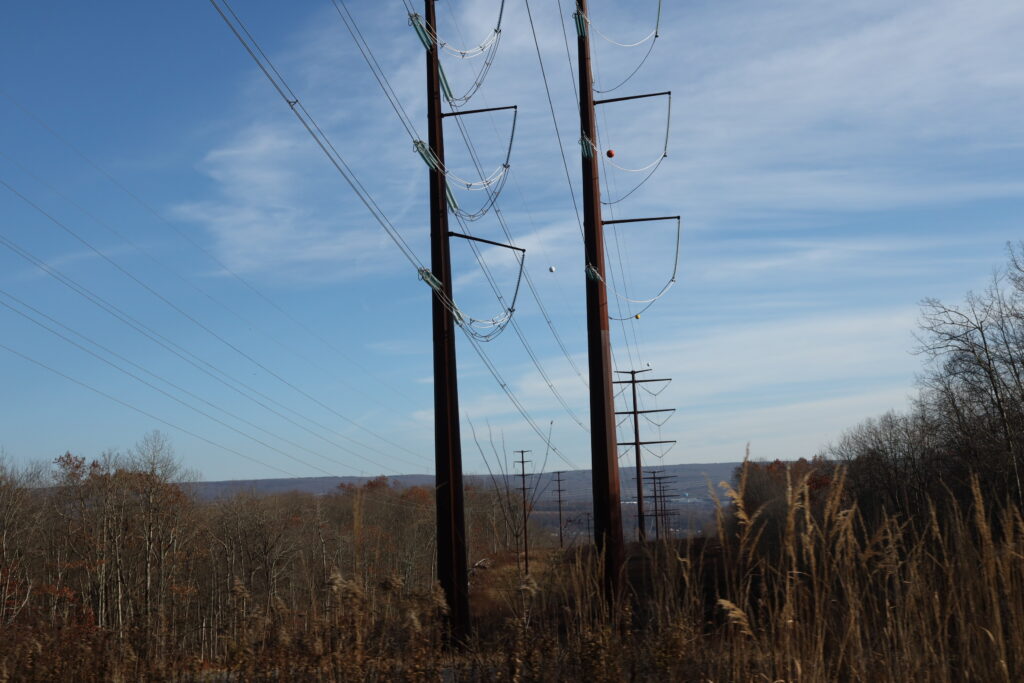
High-voltage power lines in Archbald. (Credit: Edward Donnelly/DeSmog)
Changing the Rules
Isaac Hager has been called “Brooklyn’s most mysterious dealmaker” by The Real Deal, a real estate trade publication, for his combination of a low public profile and high stakes investments in hotels and condos in New York City. His company, Cornell Realty Management, is also at the heart of the biggest mystery in Archbald: How and why, exactly, did the borough come up with the zoning amendments easing the way for the planned data center buildout?
In December 2024, Cornell Realty Management approached Archbald Borough with its plans to build the Wildcat Ridge Data Center Campus on a roughly one-square-mile wooded tract then zoned for residential and conservation uses, according to public records. The project would need 1.6 gigawatts of electricity, according to its zoning application. This happens to be nearly equivalent to the generating capacity of Martins Creek Power Plant, which at 1.7 gigawatts is Pennsylvania’s largest natural gas-fired power plant, powering the equivalent of about 1.4 million homes.
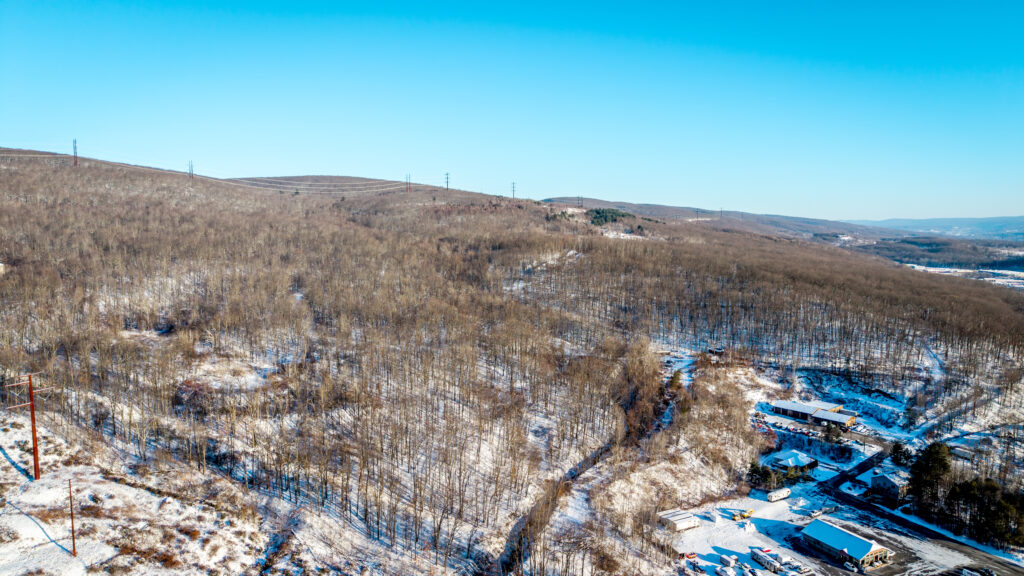
Aerial view looking towards the proposed site of the Wildcat Ridge Data Center Campus, January 2026. (Credit: NEPA Drone)
Unusually for data centers, the 574-acre Wildcat Ridge project also features plans to add a retail shopping area, an office building, and a grocery store, which Cornell Realty Management estimates will ultimately provide 593 permanent full-time jobs, out of a total of a projected 1,280 jobs for the development as a whole.
In February 2025, not long after Cornell Realty Management had presented its Wildcat Ridge project to a January 8 council meeting, engineering firm LaBella Associates wrote to Archbald Borough on the company’s behalf. LaBella Associates was seeking clarification over the definition of “data centers” in the local zoning code, which had been added in 2023, when the council had opted to allow the facilities in areas already dedicated for commercial or industrial use.
Even if Cornell Realty Management could get the borough to flip the proposed Wildcat Ridge sites from their current residential or conservation status to commercial or industrial zoning, the borough’s data center rules would need to be rewritten to accommodate the huge project, due to size limits in the existing code. Specifically, the company wanted to build structures up to 120 feet tall — more than double the 55-foot height normally permitted in industrial zones.
Although zoning authority in Archbald rests with the council, the company’s hand was strengthened by a provision in Pennsylvania state law that allows developers to seek legal redress against municipalities if local codes block a proposed project. Known as a “curative amendment,” this mechanism means that towns whose budgets might only stretch to a single lawyer can find themselves embroiled in zoning disputes with developers fielding top-tier legal teams.
Archbald officials chose to work with Cornell Realty Management’s request. Borough manager Dan Markey told DeSmog that he asked the developer to cut a $30,000 check to Archbald Borough to cover costs related to its project application and amending the zoning code. Markey said the move spared taxpayers the fees, and allowed the borough to select Pennoni Inc., a Philadelphia-based engineering consultancy, to review the existing zoning rules, at a cost of $14,000.
“I said, I’m making you no promises and no guarantees because I don’t have a vote, the council votes,” Markey told Cornell Realty Management about its rezoning request, according to an account of the interaction Markey provided to DeSmog.
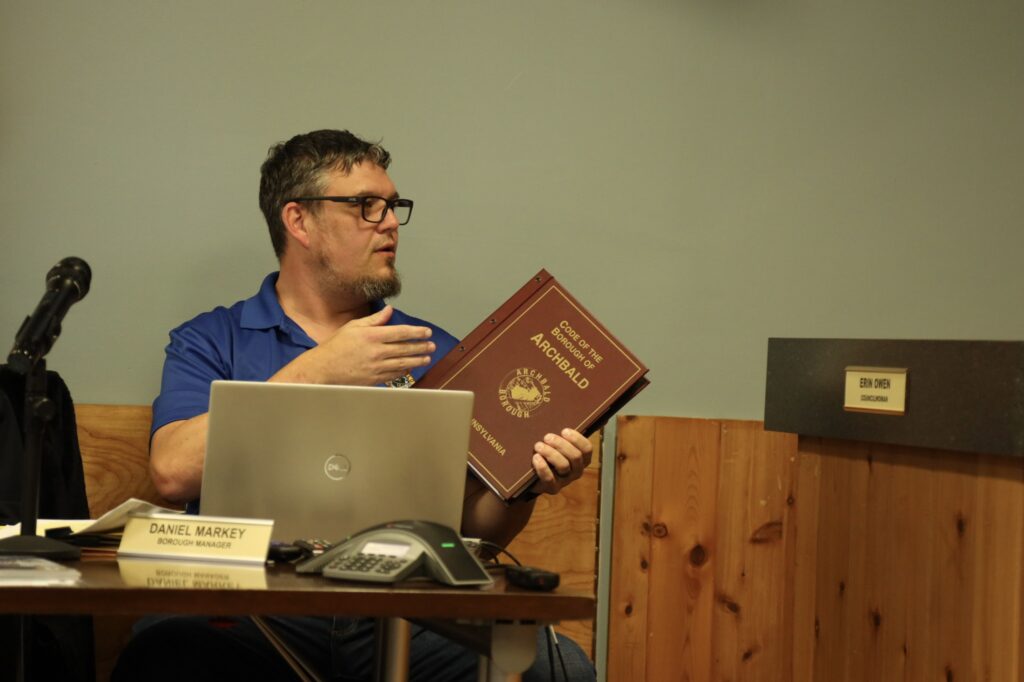
Archbald Borough Manager Dan Markey at a November 19, 2025 council meeting. (Credit: Edward Donnelly/DeSmog)
Unbeknownst to most Archbald residents, other companies were also starting to seek approvals. On February 25, 2025, zoning officer Brian Dulay emailed Pennoni a summary indicating that eight potential data center developers were interested in building in Archbald, including Cornell Realty Management, according to the records.
At least three of those developers — PDC Realty (Project Boson), Western Hospitality Partners (Project Gravity), and Provident Realty Advisors (Archbald 1 LLC) — were eligible to obtain initial zoning approvals under the existing 2023 rules. Still, the regulations’ limits on building heights, noise, and setbacks from homes put caps on their plans. As the year wore on, several developers wrote to borough officials to attempt to loosen those restrictions.
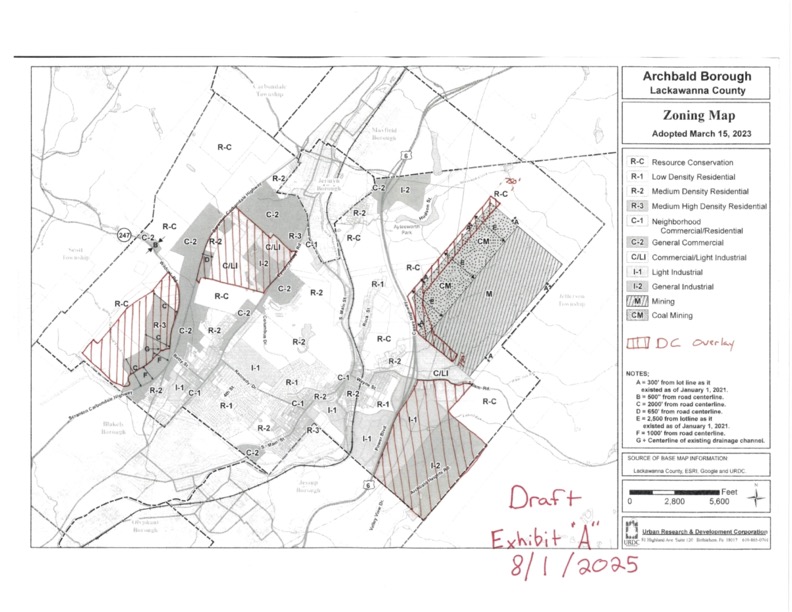
By March, the borough had decided to pass two separate zoning measures: an overall revision of the code related to data centers; and a separate “data center overlay” map showing where data centers would be allowed, according to emails obtained via records requests. Proposed developments would still have to go before a special council vote to win final approval, giving it more say in zoning decisions, a process known as “conditional use.”
In mid-March 2025, Markey coordinated a meeting between Pennoni, borough staff, Cornell Realty Management, and council president Dave Moran to discuss the zoning rules, the emails showed. A little over two weeks later — on March 27 — Archbald staff met with representatives of developer Western Hospitality Partners, civil engineering firm Kimley-Horn, and local construction contractor Jim Marzolino at the Archbald office of Marzolino’s Kriger Construction, according to the emails. The next day, a Kimley-Horn engineer, Justin Moceri, emailed Archbald officials offering to let them “pick my brain on insight into the data center overlay district text language given my experience.”
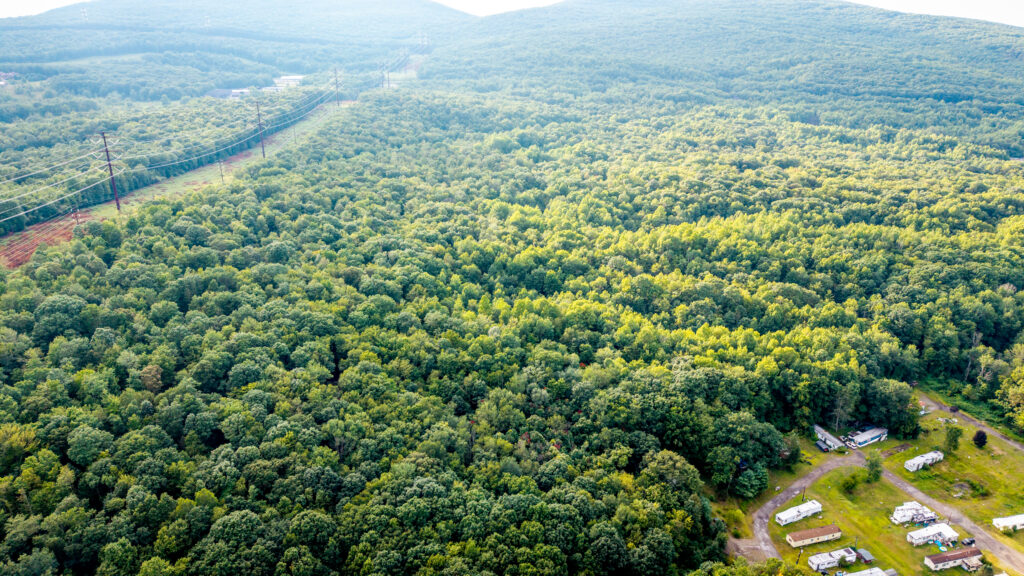
View of the proposed Project Gravity data center site and edge of Valley View Estates trailer park, August 2025. (Credit: NEPA Drone)
Two weeks later — on April 10 — borough staff and Pennoni were sharing a draft zoning ordinance. A section about proposed data center size requirements included a typed comment that seemed to favor developers by seeking to “verify these dimensions can still accommodate the application.”
By June 10, three developers — Cornell Realty Management, Dallas-based Provident Realty Advisors, and a developer identified only as “Wolf” in an email — had submitted suggestions for the new data center zoning amendment, according to the records. Borough solicitor Jay O’Connor wrote Pennoni asking the consultancy to combine the proposed new data center rules and “overlay district” into a single zoning amendment. O’Connor further instructed Pennoni to integrate requests from the data center developers by using “classifications… addressing the proposals… from the potential applicants who have contacted the Borough.”
Meanwhile, council president Dave Moran asked borough officials to increase residential setbacks from 400 feet to 1,000 feet, but this request failed to get integrated into any draft ordinance found in the records, according to the emails. Instead, one developer worked to reduce that distance.
On July 18, Provident Realty Advisors, which had not yet publicly announced plans to build in Archbald, submitted additional recommendations for the data center zoning ordinance, including 200-foot setbacks from homes and looser noise restrictions, according to the records. Two weeks later, on July 30, borough manager Markey wrote to Pennoni asking for a revision in the proposed ordinance, shortening residential setbacks from data centers from 400 feet to 300 feet — a measure intended to satisfy developers.
“After speaking with some potential developers, this is the number that can potentially be agreed upon,” Markey wrote in the email. The request made it into the next draft of the ordinance.
Markey defended the borough’s oversight process to DeSmog, saying that officials had not simply accepted blanket provisions sought by developers, but had worked to find compromises. For example, Markey said, the 90-foot height limit included in the zoning amendment is lower than the 120 feet originally sought by developers. (A clause in the ordinance still allows developers to build higher than 90 feet if they get special permission).
Archbald officials presented a map of the proposed data center “overlay,” where the new zoning regulations would apply, to a public meeting on August 1. Various smaller and medium-scale sites that had previously been opened up to data centers under the 2023 rules had been removed. But in four significant areas, the map favored the developers. The areas shaded over for data centers corresponded exactly to Cornell Realty Management’s proposed Wildcat Ridge Data Center Campus, Project Gravity, and the yet-to-be-announced Archbald 1 LLC and Project Green Mountain complexes.
On September 9, Khaled Hassan, a Pennoni vice-president who worked on the Archbald zoning amendment, wrote Markey asking him to “share with us how you established the marked boundaries?” in the data center overlay. Markey responded: “Besides the I-1, I-2 [industrial] zones on the bottom of the map…the rest of the lines drawn were property lines of property owners looking to develop or sell to developers. They were all pretty much specific requests.”
All five Archbald data center developers have yet to publicly announce who the end users for their proposed data center complexes will be. Very few companies worldwide operate “hyperscale” AI data centers on the scale planned in Archbald, among them: Amazon, Google, Meta, Microsoft, and Oracle.
“They’ve thrown around hints, like ‘you know this company, you probably use them every day’, and ‘you might have their app on your phone’,” Markey said, of the developers. “If they do them right and they are committed to be good community partners, then it [the identity of the end user] might be inconsequential.”
“Financially, this could be a complete game changer for Archbald. For Lackawanna County, not just Archbald,” Markey added. He estimated that one of the data center complexes would generate $4.3 million a year in local property taxes at current rates, which would amount to more than 60 percent of Archbald’s annual budget. “And that would be just one project.”
Final Decision
Throughout the months of consultations between Archbald Borough and the developers, word of the enormous scale of the changes portended by the projects had been slow to filter out. But by fall, a nucleus of opposition had formed, with residents sharing their concerns on Facebook groups and at increasingly vocal public meetings.
When Archbald Borough Council convened to vote on the proposed new zoning measures in the basement of St. Thomas Aquinas Church in early October, about a hundred people flooded the venue to demand more time for consultations, forcing the decision to be postponed, according to meeting minutes and reporting by the Scranton Times-Tribune.
By mid-month, the Archbald Neighborhood Association, a group leading local opposition to the data centers, had submitted a draft amendment to restrict the projects to a single industrial-zoned site.


During this time, Provident Realty Advisors submitted a zoning application for its data center plans under the name of “Archbald 1 LLC.” Moran, the council president, told the Scranton Times-Tribune at the time that the proposed new rules would protect Archbald from an even bigger influx of data centers by taking certain sites off the table.
By mid-November, Moran was appealing to residents to stop making so many Right-to-Know requests (Pennsylvania’s version of a Freedom of Information request) because, he said, they were overwhelming the borough’s capacity to respond.
At a November 19 council meeting, Larry Moran, solicitor for the local Valley View School District, urged residents to support the proposed zoning amendment.
Citing his experience representing trade unions building data centers, as well as a property owner selling land for a project in nearby Covington Township, Moran said developers had told him that a single data center building could generate about $5 million in local yearly tax revenue.
This money could be used to repair leaking school roofs, eliminate shortfalls in special education for disabled children, and restore canceled programs. “It’s desperately needed money,” Moran said.
A shouting match then erupted between Moran and council member Owen, the council’s leading opponent of the data centers, who questioned Moran’s claims that data centers could be built safely in the community. Onlookers joined Owen’s side as council president Dave Moran repeatedly banged his gavel.
“They’re coming for our jobs!” a member of the crowd yelled in the direction of the school solicitor. “Get out!”
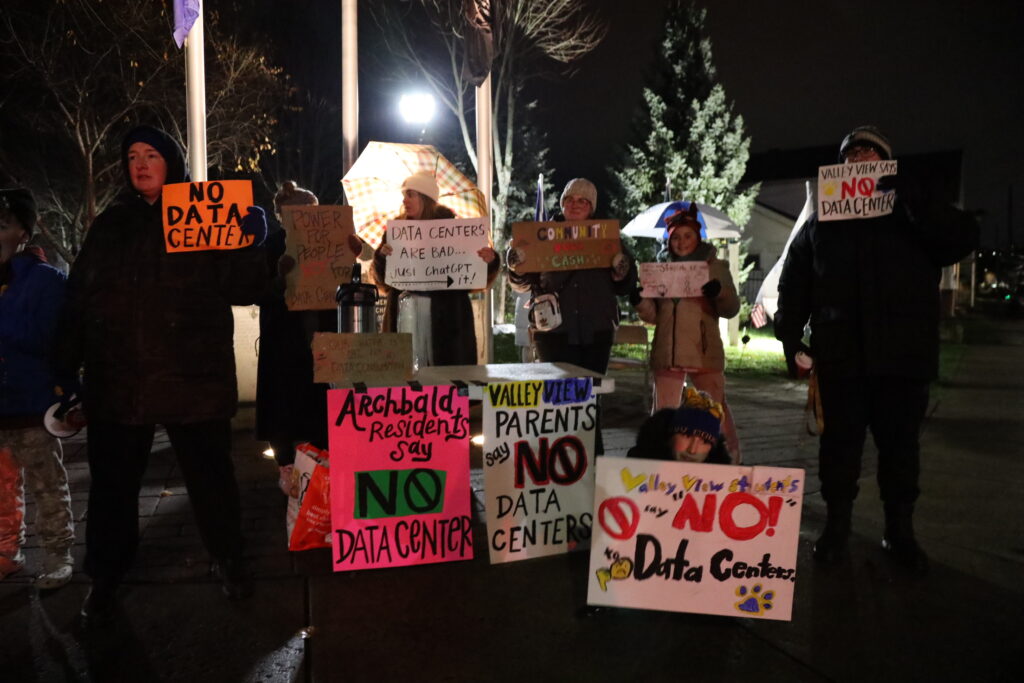
Protest against data centers before a November 12, 2025 Archbald public meeting. (Credit Edward Donnelly/DeSmog)
‘Sold Your Souls’
The crowd that swamped the borough chambers on November 24 was focused on one agenda item: a council ballot on the hotly contested zoning amendment. If approved by a simple majority of four or more votes, the new code would open up two new swaths of land to data centers, and allow developers of two already-permitted areas to apply to build taller.
Many locals speculated that the council’s decision had already been made — and murmured that the overflow conditions and inconvenient 5 p.m. start time were a ploy to suppress public participation. Some said that the borough had ignored their written request to hold the meeting in a more spacious venue. After the recitation of the Pledge of Allegiance, Owen called the conditions “unacceptable” and a “safety hazard,” and asked for the meeting to be rescheduled to accommodate all residents.
Moran, the council president, denied her request. Owen stood in protest as public comments began.
Residents took turns at the podium to read off a litany of reasons for why they opposed building data centers in the borough, such as harmful air, light, and noise pollution, strains on the power grid, higher utility bills, lowered property values, destruction of wildlife habitat, depletion of water resources, and climate-heating carbon pollution. In total, 18 Archbald residents spoke against the zoning amendment during the time allotted. None spoke in favor.
“I can understand how you are being cajoled and enticed by developers with deep pockets!” exclaimed Michael Pilch, to resounding cheers.
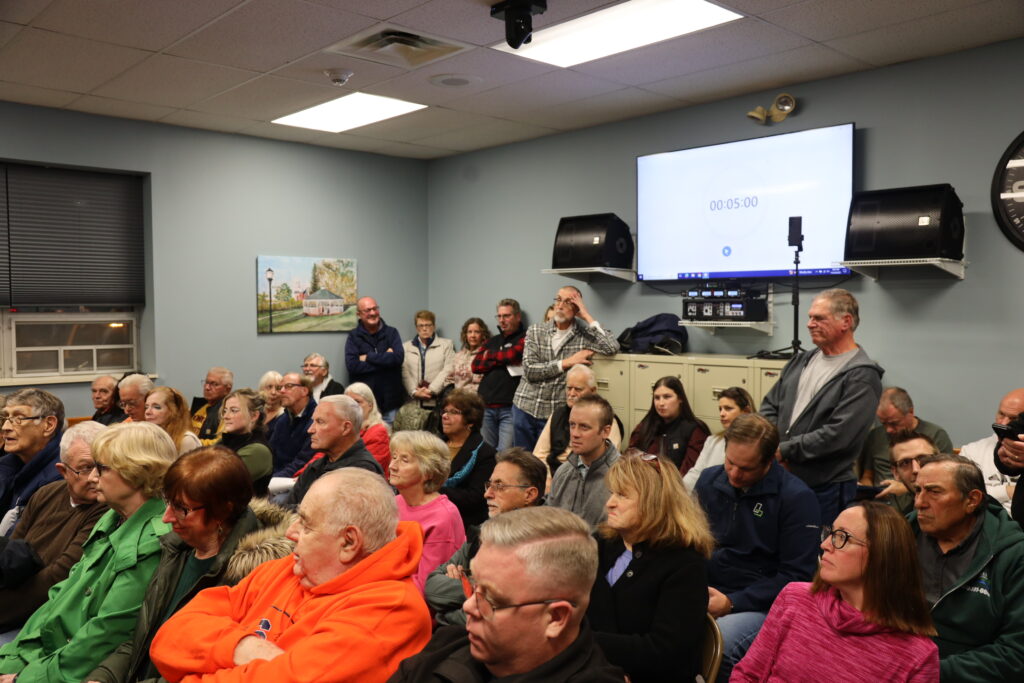
The November 24, 2025 special council meeting in Archbald. (Credit: Edward Donnelly/DeSmog)
“I wish that the council had the decency to schedule a special hearing to hear questions about these data centers, address concerns, and work on the amendment together that actually protects the residents and natural resources of Archbald,” said Kaileigh Cornell, a member of the Archbald Neighborhood Association.
“Who put the wording in the zoning in 2023 that passed with the words ‘data center’?” asked resident Anita Mancuso. “Because it’s caused such a huge mess.”
Once public comments concluded, council member Marie Andreoli proposed a motion to vote on the data center amendment. Two council members voted against it, Owen and Laura Lewis, to almost unanimous cheers, and another, John Shnipes III, abstained. Four council members voted in favor: Andreoli, Moran, Richard Guman, and Francis Burke.
Groans and shouts erupted from the crowd. “You should be ashamed of yourselves.” “Disgusting.” “Sold your souls!”
None of the four Archbald council members who voted in favor of the zoning amendment explained their reasons for adopting it during the meeting.
Asked afterwards by DeSmog why he’d backed the measure, Moran cited the moves to restrict data centers to specific areas and increased clarity in the rules relative to the 2023 ordinance.
When asked why the council approved raising the allowed building height for data centers from 55 feet to 90 feet, Moran said that a committee of borough staff made the recommendation.
“No comment,” council member Guman said as he made his way out of the meeting, when asked why he voted for the zoning changes. “No comment,” said council member Burke, who also voted in favor.


Political Flashpoint
In his February 3, 2026 annual budget address, Pennsylvania Governor Josh Shapiro (D), widely tipped as a 2028 presidential hopeful, said, “the United States is locked in a battle for AI supremacy against China… We are delivering the speed and certainty in our permitting process these massive projects require.”
Shapiro added, however, that “too many of these projects have been shrouded in secrecy, with local communities left in the dark about who is coming in and what they’re building.”
As Shapiro joins other Democratic and Republican leaders nationwide in promoting AI data centers, some local officials are siding with concerned residents. Lackawanna County Commissioner Bill Gaughan (D) is a sharp critic of the boom, calling it “one of the biggest environment and social threats of our generation.”
“Hundreds and hundreds and hundreds of people showed up on a weeknight in the middle of winter because they’re scared and they’re angry that it seems as if every available acre of land in our community will eventually be turned into a windowless box that hums 24-7 and sends most of its profits someplace else,” Gaughan told a Lackawanna County Commission meeting in February, referring to the groundswell of opposition to data centers in Archbald.
On February 18, Gaughan joined Pennsylvania state lawmakers in calling for a three-year moratorium on data center development in the state, a bipartisan measure that state senators Katie Muth (D) and Rosemary Brown (R) have co-sponsored in Harrisburg, the state capital.
Despite growing support for slowing the buildout, many fear the projects are picking up pace. In early March, Misewicz-Healey, the Archbald resident who had pleaded with the council to put tougher restrictions on data centers, posted an excerpt from an email on social media that appeared to be from Pennsylvania’s Office of Transformation & Opportunity, stating that Western Hospitality Partners’ Project Gravity was benefiting from accelerated permitting reviews under the PA Permit Fast Track Program, which seeks to streamline approvals in the state. The project does not appear on a list posted on the agency’s website of fast-tracked developments. The Office of Transformation & Opportunity did not respond to a request for comment.
Western Hospitality Partners has established a presence in Harrisburg through its subsidiary Archbald 25 Developer LLC, which paid $67,500 to lobbyists last year, according to state transparency records, with the subject listed as “real estate.”
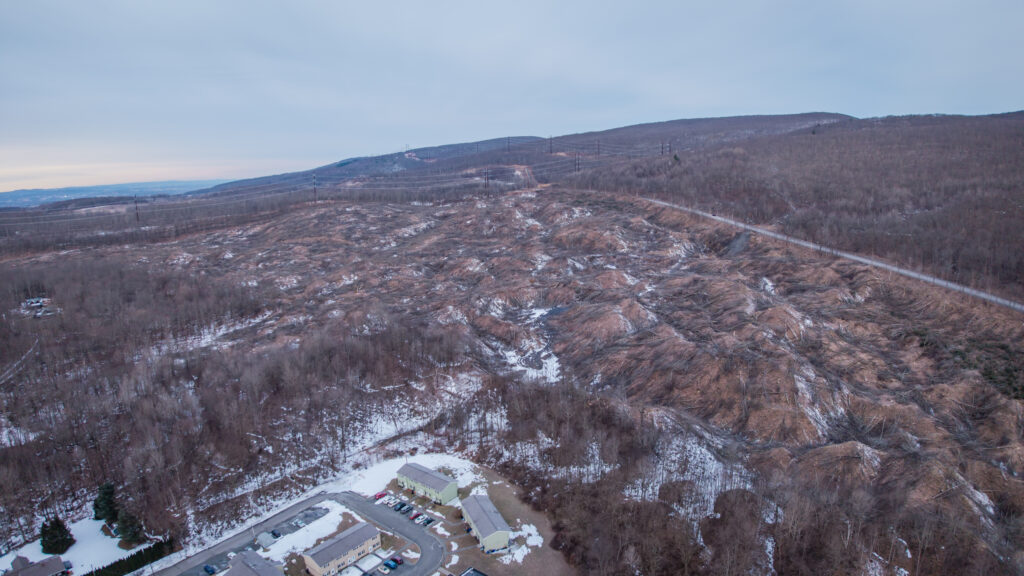
View of the tree clearing at the Project Gravity site, February 2026. (Credit: NEPA Drone)
With companies such as Amazon and Microsoft spending a combined total of hundreds of thousands of dollars per year on lobbying in Harrisburg, residents opposing the data center plans believe they have the best chance of blocking the projects at the local level. A re-composed Archbald Borough Council welcomed three new members in January, replacing Burke (who lost re-election), Lewis (who retired), and Shnipes (who resigned).
The council will vote on three final “conditional use” permits for data center projects in the coming months: the Wildcat Ridge Data Center Campus, Archbald 1 LLC, and Project Green Mountain. Residents have packed the Valley View High School auditorium for several hearings held on the proposals since January.
Meanwhile, eight Archbald residents, using crowdsourced funds, have filed an appeal against the borough’s zoning amendment in the Lackawanna Court of Common Pleas. They allege that the borough council did not transparently advertise all zoning changes to residents prior to the November 24 hearing, as required by law, and failed to make the meeting accessible to all residents by choosing a too-small venue, among other complaints.
Archbald Borough has denied the allegations, calling the lawsuit “frivolous” in a written response to the court, and requesting that the plaintiffs be made to post a bond for the proceedings to continue. The developers behind the three conditional use applications — Cornell Realty Management, Provident Realty Advisors, and Green Mountain 6 LLC — have petitioned the court to reject the case. A final ruling is pending.
Sounds of chainsaws at Western Hospitality Partners’ Project Gravity site have heightened local alarm. Images from a March 2 flyover by aerial photographer NEPA Drone show widespread land clearing and hundreds of recently felled trees, including near the border with the Valley View Estates trailer park. For worried residents, the AI boom has never felt nearer.
“We’re not giving up,” said Madonna Munley, who warned against bringing back polluting industries to Archbald. “Do or die, we’re not going down without a fight.”
The reporting for this story was supported by the Fund for Investigative Journalism.