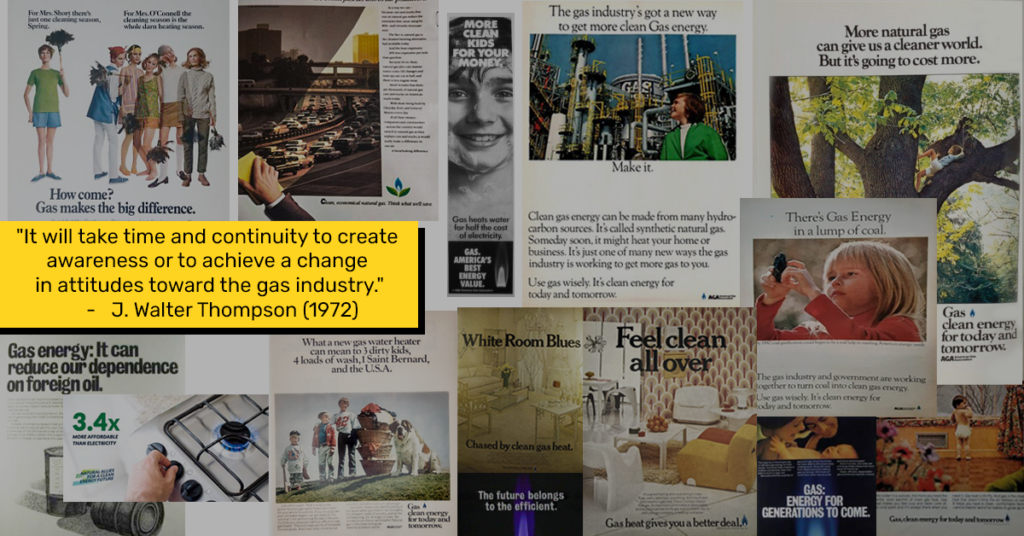

Four of the world’s biggest oil and gas companies have spent the last four years systematically shifting away from climate-friendly advertising to push a new message: fossil fuels are here to stay, a report has found.
Campaign group Clean Creatives analysed 1,859 communications from BP, Shell, ExxonMobil, and Chevron published between 2020 and 2024, spanning paid advertisements on Facebook, YouTube, LinkedIn, TikTok, Instagram and television, alongside press releases, investor communications and executive speeches.
The report found a “consistent and coordinated narrative shift” from attempts to portray the companies as climate leaders to embracing what Clean Creatives calls “fossil fuel permanence” — the idea that the world can’t function without oil and gas, which account for at least half of the carbon dioxide emissions fuelling the climate crisis.
“Despite differences in tone, BP, Shell, ExxonMobil and Chevron followed strikingly similar narrative shifts, moving from ‘part of the solution’ to ‘you can’t live without us’ messaging,” Clean Creatives said.
This evolution marks a new era of climate messaging that is more sophisticated than traditional forms of greenwashing based on making false environmental claims and harder to challenge, the report argues. Companies are now promoting speculative technologies for reducing emissions — such as carbon capture and storage (CCS) and blue hydrogen — as justifications for expanding oil and gas production.
Clean Creatives calls this “climate gaslighting”, as the oil industry attempts to persuade the public that the climate crisis is under control, while investing in projects that will lock in fossil fuel dependence for decades to come.
“Greenwashing has taken on a new form. Instead of making false claims, oil majors are promoting false solutions like CCS and natural gas, even though they are derived from and create long-term dependence on fossil fuels.” said Nayantara Dutta, head of research at Clean Creatives and lead author of the report. “While the world is phasing out fossil fuels, oil companies are crafting a narrative which keeps them profitable and in power.”
Shell declined to comment. BP, Chevron and ExxonMobil did not immediately respond.
‘Manipulation of the Public’
Following a surge in climate protests in Europe, North America and other areas in 2019, some of the world’s biggest polluters made “net zero” pledges to slash their emissions. In 2020, BP and Shell made a similar commitment. Meanwhile, both ExxonMobil and Chevron pledged to lower their carbon emissions.
By 2023, the report found that all four companies had settled on what it calls a “both, and” approach — acknowledging the need for emissions reductions while insisting fossil fuel expansion could happen at the same time. By 2024, any pretence of a transition had largely disappeared. Oil industry advertising campaigns increasingly cast oil and gas as permanent economic necessities with carbon capture, hydrogen and biofuels serving not as pathways away from fossil fuels, but as excuses to keep drilling.
BP’s own targets shifted substantially over the period. In 2020, the company pledged to reduce oil and gas production by 40 percent by 2030, a figure that fell to 30 percent in 2023 and 25 percent in 2024. Shell’s annual Energy Transition Strategy report mentioned liquefied natural gas (LNG) eight times in 2021. By 2024, that figure had risen to 90, according to Clean Creatives’ research.
“The transition from greenwashing to advocacy of fossil fuel energy dominance is the latest rhetorical twist in the manipulation of the public to accept greenhouse gas emissions as just part of doing business,” said Robert Brulle, an environmental sociologist at Brown University.
Clean Creatives’ annual F-List — which tracks relationships between advertising and public relations agencies and fossil fuel companies — documented 1,217 active or recent fossil fuel advertising contracts globally in 2025. The largest five advertising holding companies — WPP, Omnicom, Dentsu, Havas and Publicis, which have hundreds of subsidiaries and dominate the global advertising industry — have shown few signs of dropping oil and gas clients.
“Selling delay in the middle of a climate emergency isn’t neutral — it puts people directly in harm’s way and costs lives,” said Dana Schran, general coordinator of the Climate Action Against Disinformation coalition.
The report landed at a moment of renewed geopolitical pressure on energy markets, with the U.S.-Israeli attacks on Iran pushing oil prices higher. Campaigners argue this context could make the industry’s “energy security” messaging more potent — but also more misleading, since expanding domestic renewable energy would reduce exposure to volatile oil and gas prices. More than 1,500 independent advertising agencies and 4,000 individual creatives have signed Clean Creatives’ pledge to refuse future fossil fuel contracts.
Subscribe to our newsletter
Stay up to date with DeSmog news and alerts