
Over a decade ago, Shell announced it would build a major petrochemical complex on the Ohio River in Beaver County, Pennsylvania, lured to the state by historic public incentives amid what was hailed as the coming of a new petrochemical corridor outside the Gulf Coast. At the time, local and state leaders hoped the massive facility, drawing on cheap shale gas drilled nearby to produce the feedstock for plastics, would bring economic growth and thousands of jobs to the Ohio River region in western Pennsylvania.
The corridor never materialized. Instead, Beaver County’s economy continues to fall behind, according to a new report from the Ohio River Valley Institute (ORVI) published Wednesday and a June report from the Institute for Energy Economics and Financial Analysis (IEEFA).
The failed economic legacy of the Shell Polymers Monaca plant is now influencing debate over Beaver County’s next wave of industrial development. Residents considering data center proposals are questioning whether new promises of jobs and investment are worth the potential health and environmental costs after seeing years of pollution and limited economic gains from the pledged flagship petrochemical project.
Beaver County is important because it “provides us with a clear before-and-after picture” of what happens to a place when a large petrochemical facility is built, said Eric de Place, an ORVI report co-author and Institute research fellow.
Since 2012, Beaver County’s population and the number of businesses have decreased, the ORVI report showed, while Pennsylvania and the U.S. had increases for both metrics. Similarly, the county’s gross domestic product (GDP) fell by 16.3 percent between 2012–2024, while Pennsylvania and U.S. GDPs rose by 16.6 and 33.9 percent, respectively. Seven out of 10 surrounding counties also saw increased GDPs, the report found, and just one — Indiana County — had a bigger slump than Beaver County.
The ORVI report “puts into stark relief the reality of the Shell ethane cracker — it has not engendered an economic renaissance in the Ohio River Valley,” Jennifer Baka, an energy geographer at Pennsylvania State University, said in an email. “Instead, it repeats patterns that are often associated with the extractive sector — limited improvements to the local economy and increased pollution burdens.”
The June report from IEEFA, a nonpartisan think tank focused on a sustainable energy transition, reached similar conclusions. The IEEFA report examined the “limited role” of the petrochemical industry in Pennsylvania’s economic and job growth, and found that the chemical manufacturing sector’s contribution to the state’s GDP decreased between 2000–2024, and jobs in the petrochemical and plastics manufacturing sector fell by nearly half during the same period.
“This has not been a positive thing,” said report co-author Suzanne Mattei, an attorney and energy policy analyst for IEEFA, “and the government sunk a lot of money into it.”
Despite Shell receiving a record-breaking $1.65 billion estimated tax break from the state, the IEEFA report found that the Shell Polymers Monaca plant hasn’t spurred additional industry expansion, or even stalled a broader decline in petrochemical industry employment. However, the facility has contributed to the region’s ongoing air quality problems, the report notes, racking up 53 environmental violations since 2017.
“The Shapiro administration has held Shell accountable for environmental violations, securing a nearly $5 million penalty and a $5 million community fund,” said a statement provided by Pennsylvania Department of Environmental Protection (DEP) spokesperson Neil Shader. “DEP continues to investigate more recent violations and does not comment on possible future enforcement actions.”
The Petrochemical Corridor That Never Was
“They promised jobs for 100 years in this area. That was on billboards,” said Hilary Starcher-O’Toole, executive director of the Beaver County Marcellus Awareness Community, a regional pollution activist group. She is “not surprised in the slightest” by the economic decline, she added.
“It was their common thread, messaging that they were going to bring something new to the area, and we were going to have a booming economy.” Instead, she said, Beaver County is experiencing job, population, and economic losses.
Shell commissioned economic impact studies from Robert Morris University in 2014 and 2021, the latter of which said the complex would create 600 jobs on-site and more than 11,000 in total, including indirect jobs; ORVI claimed in a 2023 report that those studies were “deeply flawed, projecting unrealistic job-creation estimates and inflated economic benefits.”
The university studies’ co-author Marcel C. Minutolo, a management professor, did not respond to a request for comment.
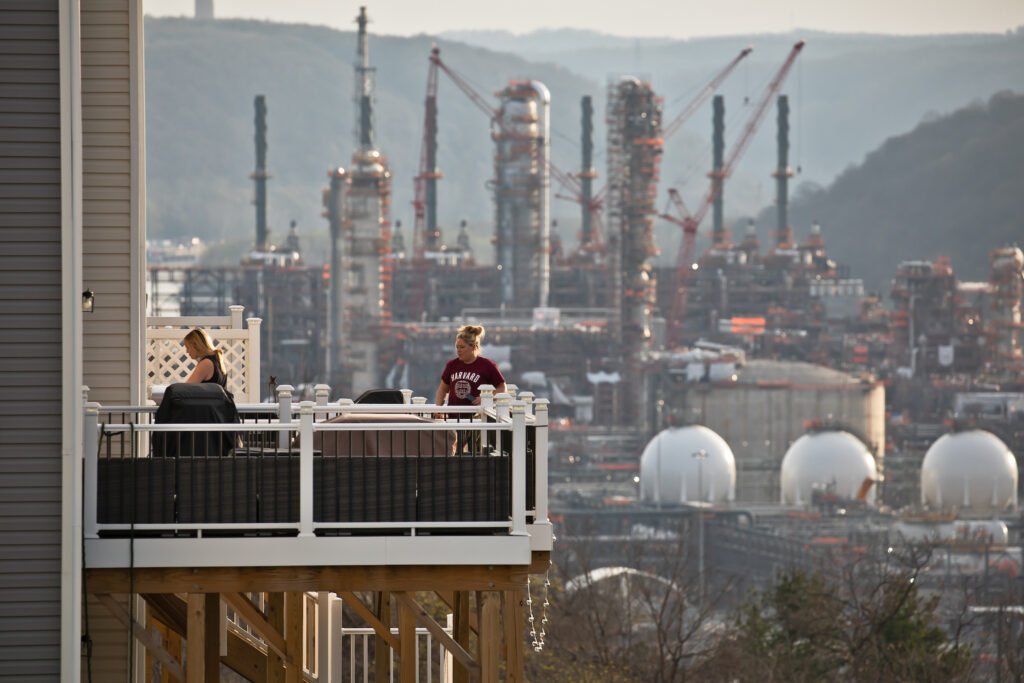
Monaca residents on their home’s deck in a neighborhood overlooking the Shell complex in Beaver County, PA, April 2022. The plant has increased pollution burdens for residents, new reports show. Credit: Julie Dermansky
Since 2000, jobs in Pennsylvania’s refining and petrochemical-related industrial sector dropped by half, IEEFA’s report said, to just 5,651 in 2024.
Shell spokesperson Natalie Gunnell confirmed by email that “approximately 600 people are on site,” at the Monaca plant, including employees and contractors, but declined to comment on the IEEFA report, as did the Beaver County Chamber of Commerce.
Pennsylvania should “reform its approach to economic development incentives,” and more rigorously review plans for development projects before committing public funds or tax incentives, the IEEFA report’s authors wrote. Had the state’s government conducted its own, independent market analysis, it would have reached the same conclusion as IEEFA, Mattei noted.
Yet, “Pennsylvania continues to align petrochemical production from natural gas with the state’s budgetary and energy goals,” betting that as gas production rises, chemical and plastic production will follow, the IEEFA report said.
Tax Credits Totaling $1.65 billion
When Shell announced in 2011 that it would build a “world-scale” ethylene cracker plant in Appalachia, Pennsylvania’s government went to great lengths to convince the company to build there rather than in neighboring states.
Through a tax incentive created in 2012, the state awarded Shell over $89 million between 2023–2025, the IEEFA report said; the oil giant will continue receiving an annual tax credit until 2042, which the Pennsylvania Budget and Policy Center has said could amount to a $1.65 billion tax break. The state legislature also granted Shell benefits through a specially amended state tax program, which exempted the multinational corporation from all state income and property taxes and limited sales taxes for 15 years.
Shell’s Monaca plant was hyped as leading a regional expansion for the petrochemical industry. But years later, the Shell complex alone “still accounts for the vast majority of polyethylene and related output in the state,” the IEEFA report said. The plant annually produces an estimated 3.5 billion pounds of polyethylene pellets, a plastics material widely used in products such as packaging, piping, and bottles.
Five other plants were planned for the region, but a glut of new petrochemical plants sprang up in the U.S. and especially China, “and the market changed drastically, according to IEEFA’s Mattei. An excess of plastics products began to outstrip demand.
Even with current oil and petrochemical supply chains scrambled by the U.S.-Israel war with Iran, supply chain practice experts like Syracuse University’s Patrick Penfield don’t foresee a reversal of this longer-term trend even after geopolitical relations — and markets — stabilize. “Before the war, the market was already grappling with a plastics oversupply, and several planned U.S. capacity expansions had been canceled as a result,” Penfield told Oil and Gas Watch last month.
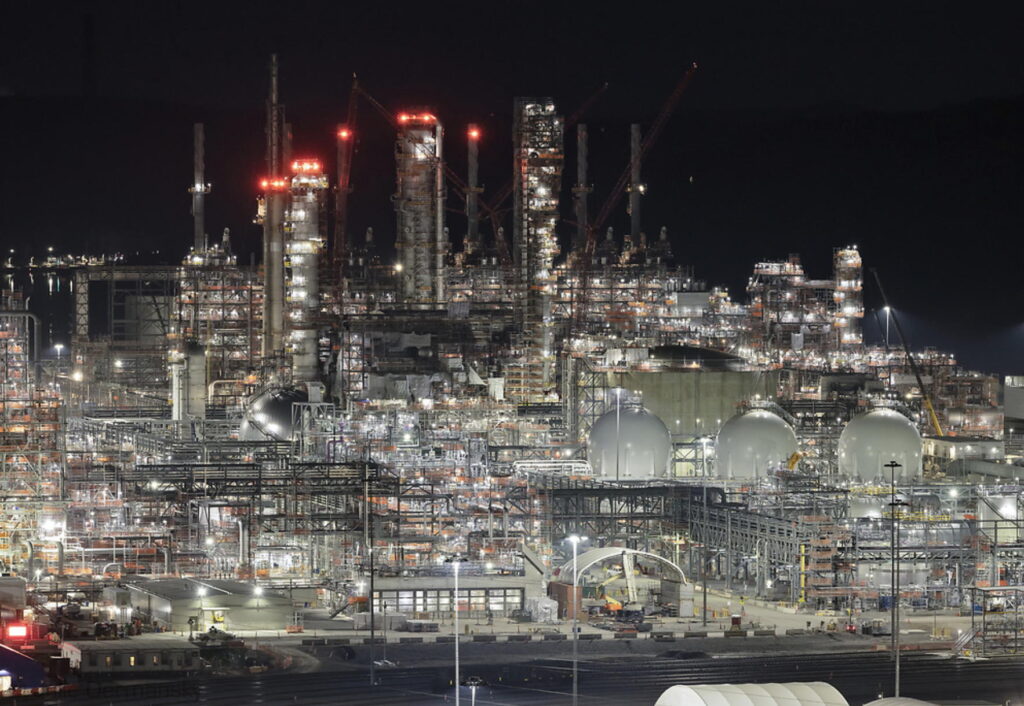
Meanwhile, the Shell plant’s monthly emission reports “indicate repeated problems with control of nitrogen oxides emissions,” the IEEFA report said, which can aggravate respiratory diseases. In the long term those emissions “may contribute to the development of asthma and potentially increase susceptibility to respiratory infections,” the report stated.
The metropolitan area that includes Beaver County, covering industrial areas in Pittsburgh, West Virginia and Ohio, is high on the American Lung Association’s lists of places with the worst short-term and year-round particle pollution, ranking 11th and 16th, respectively. But the region’s air quality issues far predated the petrochemical complex.
“Extracting fossil fuels out of the ground and burning them is not healthy for people who live nearby, who work in the industry,” said Dr. Ned Ketyer, a retired pediatrician and president of Physicians for Social Responsibility Pennsylvania. “These are people that are going to get sick early in their lives, and they’re going to die prematurely. That’s not universal, but that’s the trend that that we see.”
Ketyer said companies operating in the region “try very hard to operate as safely as they can,” but “there are inherent risks, inherent pollution that comes from this that really can’t be avoided.”
When cracking — the process used to separate ethane from natural gas to get ethylene, a building block for many plastics — chemicals are released into the air, he said, “and so you start getting a community that starts complaining of health symptoms. Now, some of the health symptoms, people aren’t going to feel for years, and that’s just the way low-level exposure to these chemicals work.” And just because something is permitted doesn’t mean it’s safe, he added.
“The problem is that our emphasis in this country, I think, has always been on financial reward, and not on public health and safety.”
Shell is now in the process of getting a new air quality permit approved, which the Pennsylvania Department of Environmental Protection (DEP) held a public hearing for on April 7. The plant still lacks the Title V air quality permit that is required under the Clean Air Act, the IEEFA report notes, and instead continues to operate under a temporary air quality plan that the state DEP has extended seven times, with the latest expiring on Oct. 28.
Data Centers Bring New Promises
Like other small communities across Pennsylvania and the nation, Beaver County is experiencing the kind of community engagement over data center impacts that advocates wish they had seen for industrial fossil fuel projects like the Monaca plant.
Multiple data centers have been proposed for Beaver County. Starcher-O’Toole said she arrived five minutes before a recent town hall meeting for one of them to find it completely full.
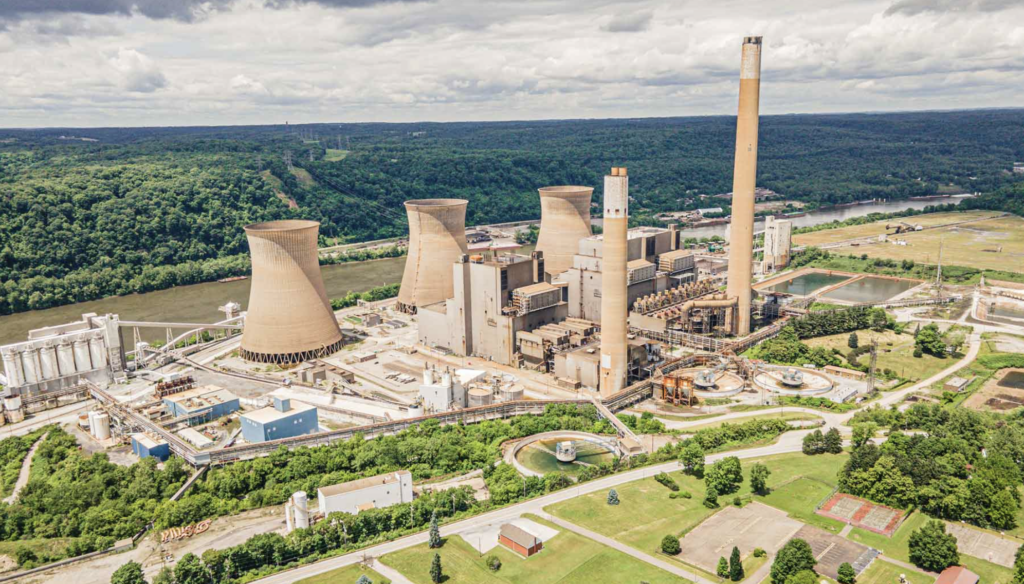
A rendering of the Shippingport Power Station proposed for Beaver County to replace the former Bruce Mansfeld Power Plant located near the Shell Polymer Monaca plant. Credit: The Frontier Group of Companies
She, and others, mentioned concerns about the data centers’ water and power demands, the latter of which encourages more fracking, and the resulting pollution. “I think people are starting to understand, like, ‘this is what it’s going to do,’ and there is a lot of concern around the diesel generators that are attached to them,” she said, “but, in my mind, I’m trying to think — what have I done wrong, and what have we done wrong, to where the same amount of pushback wasn’t there for Shell?”
Among the data centers proposed for Beaver County is the Shippingport Power Station, a 382-acre campus that would include a gas-fired power plant and adjacent data center, built at the former Bruce Mansfield Power Plant, which sits on the Ohio River not far from the Shell Polymer Monaca Plant.
Shell is now considering selling its chemical facilities, including the Beaver County plant, according to The Wall Street Journal and other outlets. Shell CEO Wael Sawan reiterated that the company is “leaning into” the possible sale at the quarterly earnings call in May. Spokesperson Stephen Doolan said Shell had no further information to add.
“What legacy will Shell leave behind when it leaves Beaver County?” the ORVI report authors write. In the face of new power plant and data center proposals, “the facts from Shell’s legacy should encourage state and local officials to pause before extending further tax subsidies,” and instead prioritize long-term development strategies that center communities.
Starcher-O’Toole reminisced about her parents taking her to Monaca Riverfront Park, where she now brings her kids. “It’s just not the same,” she said, knowing the plant is right around the river bend and seeing its smoke rise.
“It’s really hard to see. I mean, there’s no nighttime down there anymore. The whole thing glows.”