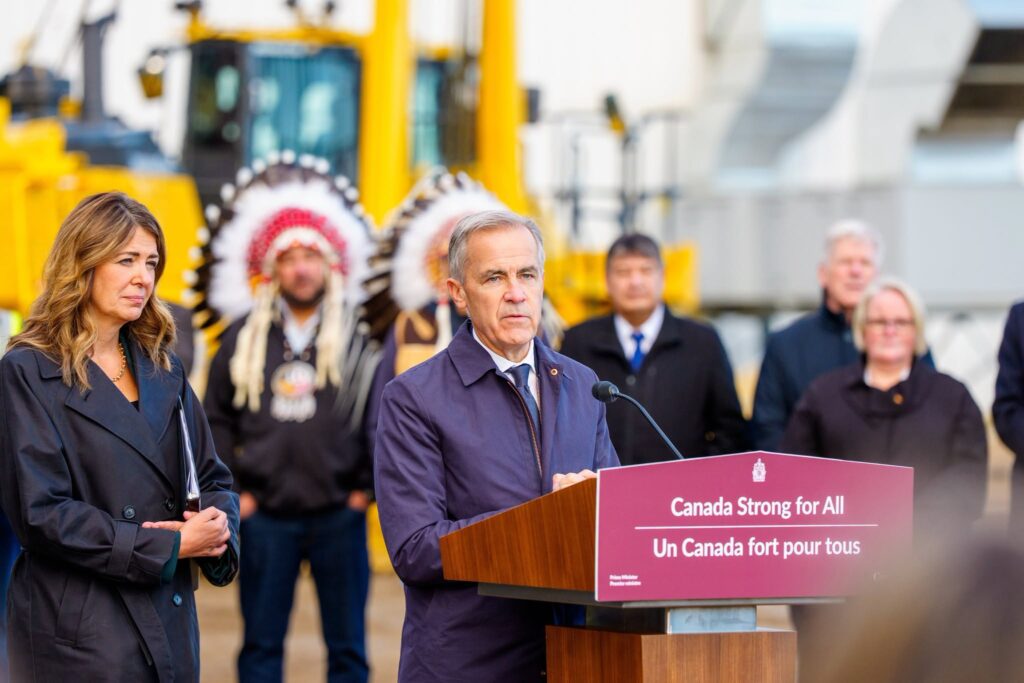

Last May, Prime Minister Mark Carney announced a national electricity strategy aimed at building Canadian energy independence, lowering costs to consumers, and reducing climate destabilizing emissions. “Canada’s electricity system is currently fragmented across provincial and territorial grids, costing us billions of dollars in outages, duplicative infrastructure, and wasted power,” Carney’s government explained at the time.
Building a more interconnected electrical system to bolster Canada’s energy sovereignty is long overdue. But has Carney undermined his own efforts by unleashing a gas-fired data centre boom in Alberta? It sure looks that way.
Consultations with provinces are only beginning and Ottawa has already emphasized a role for fossil fuels and upcoming cuts to clean energy regulations. In an apparent sop to Alberta, Carney conceded that implementing the strategy will, “require a willingness to use a wide range of energy – including natural gas. That’s why we intend to adjust clean electricity regulations to provide the flexibility needed to keep energy costs for all Canadian families reliable and affordable, while reducing emissions and building the clean energy system of the future.”
Alberta and BC are the two provinces that might benefit most from improved power sharing. BC’s abundant hydro resources could act as a baseload battery when paired with Canada’s best wind and solar sites in Alberta, reducing the eye-watering prices paid by Alberta households while also reducing emissions.
Building grid connections is not a new idea. Way back in 1986, the only existing transmission intertie between Alberta and BC was completed near Cranbrook, engineered to deliver 1.2 gigawatts of capacity. However, lack of investment by Alberta grid operators means that allowed energy imports from BC are currently restricted to a mere quarter of that amount. The Alberta Chambers of Commerce estimates these restrictions cost Alberta ratepayers $300 to $500 million a year in higher bills.
“It’s crazy,” Madeleine McPherson, a civil engineer at the University of Victoria told Business in Vancouver regarding the underutilized BC-Alberta connection. “You would think that the hard part is done, and yet here it is and it’s not being used… The fact they haven’t, that’s political. That’s insane.”
Under the Canadian constitution, electricity generation and distribution is a provincial responsibility. Ottawa can offer incentives but cannot intrude into this jurisdictional sandbox unless invited. Carney is instead offering incentives for more polluting forms of energy.
By caving on federal clean energy regulations in his memorandum of understanding (MOU) with Alberta, Carney created favourable conditions for a massive gas-fired data-centre boom with the enthusiastic support of Smith. Will powerful natural gas incumbents now gorging on government-driven AI demand resist the very national grid he is promoting?
Alberta is now considering 21 GW of data centres which could be powered by gas– an amount described by one expert as “absurdly high” – and is inviting developers to “bring their own power” as long as that power involves burning natural gas. Alberta’s Minister of Technology and Innovation, Nate Glubish, recently stated that he sees “data centers as digital pipelines and digital refineries for us to help get the value from our natural gas to global markets.”
Nearly a hundred data-centre projects are in the works across Canada, and roughly nine in ten are slated for Alberta. The AI build-out is essentially a machine for manufacturing new long-term demand for natural gas.
Simultaneously, Smith has repeatedly acted to limit competition from cheaper and cleaner electricity sources, such as her surprise moratorium on renewable energy approvals or onerous restrictions on wind and solar siting and reclamation. Such ham-handed interventions to limit electricity competition are likely about to get worse with Alberta households paying the price.
Every new gas plant built to fuel Alberta’s data centre feeding frenzy contributes to a infrastructure-driven carbon lock-in that incentivizes incumbent producers to keep cheaper and cleaner power out. Gas fired generation facilities have a lifespan of about 30 years. Operators making such long-term investments based on Alberta’s current pro-gas policies may strongly resist any efforts to change them, undermining Carney’s energy strategy.
Current incumbents are already pushing back against cleaner cheaper competition. Oil sands giant Suncor is one of Alberta’s largest electricity generators with 2.2 megawatts of cogeneration capacity connected to the grid and is already resisting electricity interties. In 2024, Suncor filed a complaint with the Alberta Utilities Commission asking the regulator to impose a new charge on electricity imports based on an audacious “public interest” argument, citing fairness and supply adequacy. In response, the Alberta Energy System Operator filed expert evidence concluding such charges would instead worsen reliability by suppressing electricity imports when Alberta needs them most.
Even the right-leaning MacDonald Laurier Institute (MLI) acknowledges that Alberta’s grid is isolated by design, resulting in frequent price spikes and some of the highest electricity rates in the country. MLI just released a report on Carney’s national energy strategy that states, “Alberta is the largest example of a policy-induced near-isolated grid in Canada…Before restructuring in 2000, prices for electricity in Alberta were modest and relatively stable. Afterward, they have been relatively high and more volatile, reflecting the dynamics of an isolated and liberalized wholesale market.”
Despite this, MLI still writes that “The federal government must resist the temptation to impose its will – for which it has uncertain authority anyway.” This is unsurprising as MLI is a member of the Atlas Network, described by SourceWatch as “The Johnny Appleseed of antiregulation groups.”
That is the contradiction Carney needs to confront. The whole point of an east-west electricity grid is to increase competition and interconnection. His MOU with Alberta is fuelling an AI gas build-out whose beneficiaries have a strong incentive to resist this laudable effort. If Ottawa is serious about east–west power, it will have to treat intertie access — not just intertie construction — as a national-interest question and be willing to take on provincial and corporate gatekeepers who profit from keeping existing walls up.
The stakes are high. We may soon see if our nation is run by our elected leaders, or if the real power resides with polluting giants like Suncor. As the old joke goes, is Canada a country or just three oil companies in a trench coat?